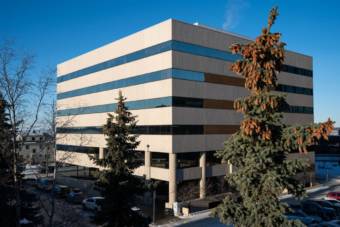
Gladys Jung Elementary School, where a principal charged with sexual abuse was arrested in 2019. (Katie Basile/KYUK)
Following the arrest of one of its elementary school principals, the Lower Kuskokwim School District is changing its policies on how sexually inappropriate behavior is reported and investigated. In meetings about the new policies, school board members asked whether the district’s administration was capable of investigating its own employees without bias.
In December 2019, Bethel elementary school principal Chris Carmichael was arrested and later charged with two counts of sexual abuse of a minor. An investigation by KYUK, the Anchorage Daily News, and ProPublica showed that the school district had received multiple complaints about Carmichael’s inappropriate conduct with students before his arrest.
“Unfortunately, we find ourselves in the situation where there’s credible allegations,” said Lower Kuskokwim school board member Michael Husa. “It’s been turned over to the court system, and it’s working its way through. What we want to do is set up policies that should something similar ever happen, we catch it much sooner or, preferably, before it ever develops.”
Several months after Carmichael’s arrest, district staff introduced new policies, which are making their way through the school board’s approval process. The policies identify specific examples of “sexual grooming” behavior and spell out how the district should respond to reports of such behavior.
State laws require schools to report inappropriate behavior between staff and a student to law enforcement and the Office of Children’s Services. But the district can also conduct its own investigation, and this internal investigative process is mainly what the district’s new policy seeks to change.
In board meetings, Husa has advocated for more oversight of the superintendent when the district investigates an employee. He said this was nothing against the current superintendent, Kimberly Hankins, but just another precaution to take.
“Ms. Hankins has been in the district for a number of years,” Husa said. “She has relationships with employees already. She will continue to develop those, and I want more than one person’s eyes on it. So that we don’t have the potential bias.”
At Husa’s suggestion, the board decided that any complaint of inappropriate behavior must be investigated by a three-person committee. That will include the superintendent, the director of human resources and the district’s safety coordinator.
Husa went further. He suggested that the district should bring in outside help so that the administration does not investigate employees they may have relationships with.
“It needs to be examined through an independent set of eyes,” Husa said.
The school board passed another change that will require the district to bring in professional investigators in certain cases. The policy is unclear as to what circumstances would trigger the involvement of an independent agency.
Superintendent Hankins wrote in an email that “whether and how an independent agency becomes involved will depend on the circumstances, what is reported, to whom, and what is discovered during the District’s initial review, along with what is discovered in any investigation by local law enforcement.”
Husa had issues with another part of the district’s new policy — the part that defines what kind of sexual grooming behavior needs to be reported and investigated. The first draft included giving gifts to students and visiting them at home as behaviors that should be investigated. Husa argued that those behaviors could be normal when you’re part of a small community.
“Being involved in the community shows students that teachers aren’t there just to be at the school, they’re there as part of the community,” Husa said. “Part of the reason I was successful as a teacher out here was I had those relationships with the community.”
Court records and interviews with parents showed that former principal Chris Carmichael had a history of giving gifts to students. However, the school board agreed with Husa and removed gift giving from the list of behaviors that warrant investigations into school staff. And board members decided that staff visiting students at home is allowed if a parent or guardian is present. Other inappropriate behaviors on the list include, but are not limited to, texting or messaging particular students frequently, being overly touchy with a student and being alone with a student behind closed doors at school.
The school board will take another look at the new policy before adopting it. The next board meeting is on Sept. 24.
Mandy Cole, executive director of AWARE, worries people might have to choose between staying in an abusive home or living in close quarters at the shelter during the pandemic. (Photo by Quinton Chandler/KTOO)
When COVID-19 shut much of the country down in mid-March, domestic violence shelters saw fewer seeking sanctuary as people faced hard choices between living with strangers during a pandemic or staying in an abusive home.
The trend holds true for some Southeast Alaska communities as well. Recently, fewer people than usual are spending the night at Women in Safe Homes shelter in Ketchikan.
“Where, where is everybody?” asked Shelter Manager Rebecca Yunker. “Because we know it’s still out there.”
Yunker said that in Ketchikan, they usually have around 20 people at a time at the shelter. Recently, there have been less than half that. She said the number of people calling for assistance has also dropped off drastically in Ketchikan and Wrangell.
Ketchikan Police Department Deputy Chief Eric Mattson says the department has received fewer calls related to domestic violence this year than last year.
“The trend it looks like is, one, we’ve had fewer domestic violence related phone calls, and certainly fewer domestic violence related arrests,” he said.
So far this year, Ketchikan police reportedly responded to 252 domestic violence calls. That’s 8% less than last year. Domestic violence arrests are down by over 35 percent.
In Sitka, the situation looks a little different.
Sitkans Against Family Violence, a nonprofit that runs a shelter in Sitka, also saw fewer people in their shelter this summer. But unlike Ketchikan and Wrangell, Executive Director Natalie Wojcik said crisis calls in Sitka tripled during the shutdown.
“My guess is that it had to do with, with having to be quarantined with someone who’s abusive and all the stressors that were caused from the pandemic, but I can’t say for sure,” she said.
When the state started to allow businesses to reopen in this spring, she says her shelter saw an influx in particularly violent calls. She calls this an increase in lethality, when abusers become progressively more dangerous.
“I guess what was strange for us is Sitka’s a pretty small town, and we definitely see lethality here but we don’t often see a ton of it at once. Most of the time for us at SAFV it kind of spread out over time, and we had like a week where it was constant.”
Since then, Wojcik says call numbers have dropped off and remain lower than normal. But she says she’s concerned for Sitka’s homeless population. Her shelter only houses women and children, so men without homes are left without options.
Meanwhile in Juneau, AWARE shelter executive director Mandy Cole says she’s seeing about as many people at the shelter as she usually does — a rebound from the lows of the lockdown. Still, she’s worried people might have to make a dangerous choice: to stay in an abusive home, or take the risk of living in close quarters at AWARE’s shelter during the pandemic.
“My greatest fear of course is that people are so worried about the virus that they, that they don’t reach out for help when they really need it,” Cole said.
All three shelters have taken extra precautions against the spread of COVID-19. They say they have sufficient access to sanitation, protective equipment and testing.
Back in Ketchikan, Yunker says she’s worried that pandemic fears are the reason fewer people are seeking help.
“It sounds weird but I hope our numbers go back up because we know it’s there, and we hope that they start coming back in and receiving our services.”
She said she’s not even sure people know that the shelter is still open. For now, they’re trying to get the word out and figure out how to reach those in need.
Across the state this week, in cities and small towns, Alaskans peacefully protested the death of George Floyd, a black man who died in Minneapolis on Memorial Day after a white police officer pinned him to the ground with his knee on Floyd’s neck. In a widely-shared video, Floyd can be heard saying “I can’t breathe.”
Four Minnesota Police officers were initially fired one day after Floyd’s death. One officer, Derek Chauvin, was arrested and charged with murder. Since then, nightly demonstrations, some of which have turned violent, filled streets in cities across the country. The other three officers involved have since been arrested and charged. Activists across the globe continue to protest.
Since last Saturday, Alaskans from Kotzebue to Ketchikan joined other communities in the call for an end to police brutality. Many also had signs calling out acts of institutional and systemic racism. Here’s a look at how protests took shape across the state:
Anchorage
Nykia Johnson, JD Conley, and Zakia Thornton attend the “I Can’t Breathe Rally” in Anchorage on May 29, 2020 (Mayowa Aina/Alaska Public Media)
“I’m fed up. I’m fighting against the police brutality. We got to stand together. If we don’t come together who’s gonna stop it?,” said Zakia Thornton at the “I Can’t Breathe” rally in Anchorage.
Juneau
People held signs decrying violence against black people and calling out institutional racism, many supporting the Black Lives Matter movement on Saturday, May 30, 2020 in Juneau, Alaska. (Photo by Rashah McChesney/KTOO)
In Juneau, chants of “Silence is violence,” and “If you see something say something,” urged white protestors and allies of the Black Lives Matter movement to take tangible steps toward preventing violence against black people.
Kotzebue
Organizers of the protest come together after marching through Kotzebue on June 2, 2020 (Photo by Berett Wilber/KOTZ)
“I was surprised. I even told Camille, because it was so last minute, I even told Camille if it’s just you and I, we’re going to walk,” said Stepheena Smith who helped organize the event in Kotzebue.
Sitka
Louise Brady and Dionne Brady-Howard led a group in singing two Tlingit songs- Aakwtaatseen, followed by Xwaal’, the Peace Hat Song on June 1, 2020 (Katherine Rose/KCAW)
“These are really heartbreaking times that we’re living in right now, and I really would like to thank the organizers for putting this together because I think sometimes it’s really difficult if we don’t have an outlet for all this pain. I think with the turnout and all the people here we can see that there’s a lot of people who care,” Louise Brady said at the event in Sitka.
Bethel
Community members marched from the Yupiit Piciryarait Cultural Center to Watson’s Corner and back in solidarity with the Black Lives Matter movement in the wake of the murder of George Floyd in Bethel, Alaska on June 2, 2020. (Katie Basile/KYUK)
“I mean, it’s great that everyone’s coming together to try to make a change, but I’ve seen this a lot,” said Garry Howard at the event in Bethel. “Hoping for a change, but we’ll see.”
Ketchikan
From left to right, Audrey Daniels, Isabel Morris and Rosie Daniels were among a handful of protesters demonstrating at the corner of Tongass Avenue and Jefferson Street June 3, 2020 (Eric Stone/KRBD)
“It just makes me feel uncomfortable to live in this town, because this is a Native town and we have racist people like that here and it just doesn’t make sense,” said teenager Rosie Daniels of motorists who flipped her off or displayed a thumbs down at the event in Ketchikan.
Kodiak
Ron Jackson holds a sign in support of the Black Lives Matter movement in downtown Kodiak. (Photo by Kavitha George/KMXT)
“I think that a lot of the issues that we’re facing now are not issues that we see here. So maybe Kodiak doesn’t know how to respond to those types of movements. Kodiak can respond to climate change because it directly affects us. Kodiak can respond to Pebble Mine because it directly affects us. And so I think that what doesn’t affect us, we’re not quite so sure how to respond to,” said Tyler Barnes at the event in Kodiak.
Haines
Haines residents gather at the Fort Seward parade grounds for a vigil in memory of George Floyd on June 1, 2020 (Photo by Henry Leasia)
“Half of me feels safe up here in a weird way like we’re very sheltered from what’s going on in the Lower 48, just as far as the violence and the intense police state, but I also feel very guilty for not being there,” said Megan Mcgrail, one of the events organizers in Haines.
There have been more demonstrations too. On social media, Alaskans have posted about marches and rallies in communities including Unalakleet and Soldotna.
While Alaska’s rallies and protests have remained peaceful some Alaskans have reported instances of intimidation, backlash, or resistance. More demonstrations are planned for this weekend.
Send photos of the demonstrations in your Alaska communities to news@alaskapublic.org.
The Nora Guinn Justice Center in Bethel. (Photo by Dean Swope/KYUK)
There are now at least four girls alleging in court that former Bethel Elementary School Principal Chris Carmichael abused them.
In December 2019, Carmichael was arrested, and later charged with sexual abuse of a minor. Since then, attorneys for four of Carmichael’s former students have filed a lawsuit against the Lower Kuskokwim School District, where Carmichael worked, saying that the district failed to protect them.
In federal court, Carmichael faces charges of attempted coercion and enticement of a minor, possession of child pornography, and attempted transfer of obscene material to a minor. He has also been charged by the state with two counts of sexual abuse of a minor. Carmichael has pleaded not guilty.
An investigation by KYUK, Anchorage Daily News, and ProPublica found that the Lower Kuskokwim School District was aware law enforcement had twice investigated Carmichael, years before his arrest. In 2016, Alaska State Troopers found messages that he sent to a former student that may have violated Alaska ethics laws that forbid any kind of sexual conduct between teachers and students.
A lawsuit against LKSD is claiming that the school district failed to “appropriately and reasonably act and follow up on prior complaints.” That lawsuit was filed on behalf of one of Carmichael’s former students the same month he was arrested. The next month, another girl was added to that suit. Attorneys for the two girls in Bethel claim that Carmichael sexually assaulted them between 2015 and 2018, and that the school district “should have protected students from Principal Carmichael’s proclivity to sexually assault children.”
The district responded to the civil claims, denying that sexual abuse occurred in those cases. It is unclear if the girls represented in the lawsuit are the same victims cited in Carmichael’s criminal charges.
Two more girls came forward in another lawsuit filed May 7. The attorney representing them, Reilly Cosgrove, says that his clients are separate victims from those represented in the first lawsuit, bringing the number of former students alleging that Carmichael abused them to at least four. The suit claims that Carmichael molested them, but does not say when or where. In order to protect his clients’ identities, Cosgrove said that he could not answer if his clients were the victims cited in the criminal charges.
“My clients have asked for as much privacy as possible, so I won’t comment on who they are or what has happened to them,” Cosgrove said. “But our lawsuit will prove that the district is directly responsible for the abuse suffered by my clients and Mr. Carmichael’s many other victims.”
The Lower Kuskokwim School District did not respond to KYUK’s request for a response to the second lawsuit’s claims.
Western Alaska, a region with a sexual assault rate six times the national average, accounts for just 10 percent of the state population, but 40 percent of educators sanctioned for sexual misconduct with students over the past decade, according to analysis by KYUK, the Anchorage Daily News, and ProPublica. The state public safety department says that the most common victim of sexual abuse in the region is a 15-year-old girl, and she is almost always preyed upon by someone she knows.
In 2014, the Yupiit School District, along the middle Kuskokwim River, agreed to pay $2 million to the families of nine girls who said that they were sexually abused by their teacher. Martin Bowman, a 59-year-old former shop teacher in Tuluksak, surrendered his teaching certificate, writing, “I understand that exposing one’s self and inappropriately touching female students while in one’s residence is a violation of the code of ethics.”
In 2018, Alaska State Troopers found 2,000 images of child pornography on the work laptop of another Tuluksak teacher, John Paul Douglas. He pleaded guilty to a felony and lost his teaching license.
About 150 miles down the Kuskokwim River in Kwigillingok, Michael Wier, a then 31-year-old history and language arts teacher, was charged with sexual abuse of a 15-year-old female student in 2015. He pled guilty to a lesser charge of harassment and gave up his teaching certificate in Alaska. Court records show another civil suit against LKSD was filed in 2019 related to the case.
Cases of sexual abuse can be expensive for school districts, especially if a plaintiff can prove that the district should have done more to protect students. Norm Wooten, Executive Director for the Association of Alaska School Boards, also sits on the board for Alaska Public Entity Insurance, the insurance company that covers LKSD. In school sex abuse cases, Wooten says that the biggest cost is to the abused children, and then the community. But if there’s a lawsuit, he says that there is a financial cost that’s shared by the whole state.
“If there is a sexual abuse case in one school, it affects every school in the state because insurance costs are spread out among school districts across the state,” Wooten said.
Jim Valcarce is an attorney representing two of Carmichael’s former students in Bethel. Last year, Valcarce represented 13 girls from the village of Wales who were abused by a teacher, Amos Oxereok. In the settlement for that lawsuit, the Bering Strait School District agreed to pay $12.6 million to the victims.
According to the Nome Nugget newspaper, children and parents in that case also said that school officials failed to take action following reports that a teacher was molesting the girls.
The playground at the Gladys Jung Elementary School on March 16. The school’s principal was charged with possession of child pornography, attempted coercion of a child and sexual abuse of a minor. (Katie Basile/KYUK)
For some parents, it was the gifts from the principal to young girls and their families that gave them pause. A few too many presents that cost a little too much money. Then began the late-night Facebook messages.
Through most of it, the principal of one of the largest elementary schools in rural Alaska remained on the job and in close contact with students. Then, in December, Gladys Jung Elementary Principal Christopher Carmichael was arrested by the FBI’s Child Exploitation Task Force and later charged with possession of child pornography, attempted coercion of a child and sexual abuse of a minor.
In a state with a history of failing to protect children, and in a region with a sexual assault rate more than six times the national average, parents of girls are asking the same question: How was this allowed to happen?
An investigation by the Anchorage Daily News, KYUK public radio and ProPublica found that at least twice over the previous four years, parents had complained to police about Carmichael. In 2016, Carmichael admitted behavior to his supervisors that, under Alaska ethics laws for educators, could have cost him his teaching certificate.
After those earlier investigations, which ended without charges, Carmichael’s employer, the Lower Kuskokwim School District, allowed him to remain at school. The district fired Carmichael after his arrest.
Gladys Jung Elementary School Chris Carmichael was arrested in Bethel and released into federal custody on Dec. 11, 2019. (Photo by Petra Harpak/KYUK)
According to the FBI, the principal sent a series of explicit texts to a phone number that he believed belonged to a 13-year-old girl, asking the girl to masturbate, send him photos and call him “daddy.” At the time of his arrest he’d been planning to meet a child for sex in Bethel, the federal charges say.
“The relationship between a teacher and child or a principal and a child should be one above reproach,” said Susan Murphy, who served as school board president in 2016 when state troopers first investigated Carmichael.
Murphy said the board was not informed about the complaint or the investigation.
“I’d like to know why the hell he wasn’t fired,” she said.
The case of the charismatic Bethel school principal is the latest in a string of rural Alaska educators accused of sexually abusing students. Prior generations of children in the region suffered abuse at the hands of visiting Catholic priests, many of whom worked in village and regional schoolhouses. Separately, Alaska Native students from the region were plucked from their homes and shipped to boarding schools, where some were abused and many punished for speaking their indigenous language.
Western Alaska accounts for just 10% of the state population but 40% of all educators sanctioned for sexual misconduct with students over the past decade, an analysis by the Daily News, ProPublica and KYUK has found.
Other offenders go undetected or, like Carmichael, are given chance after chance despite Alaska laws and ethics codes that allow a state regulatory board to suspend or remove any teacher who shows signs of viewing students as sexual targets.
Carmichael on Dec. 20 pleaded not guilty to federal charges of attempted coercion and enticement of a minor, possession of child pornography and attempted transfer of obscene material to a minor. In April, he pleaded not guilty to separate state charges of sexual abuse of a minor. Carmichael’s defense attorney said he had no comment for this story.
The parents of two girls who allege the principal molested them have filed suit against the district in state court in Bethel. In a legal response to the suit, the school district wrote that no sexual abuse of the girls by Carmichael occurred.
Back in December, hours after the FBI handcuffed Carmichael, Lower Kuskokwim School District Superintendent Dan Walker told a reporter he had no knowledge of any concerns about the principal.
Asked how he could have said that given the prior accusations against Carmichael, Walker said in a statement last week: “Twice LKSD reviewed the facts and saw nothing that put a child at risk. Not only did I not see it coming, I do not believe that the people who worked directly with Carmichael saw it coming either.”
“An Incredibly Popular Principal”
Now 55, Carmichael arrived in Bethel in 2014 after working for about 15 years in two tiny, nearby coastal villages at the edge of the Bering Sea.
Parents say he was a big, gregarious man. Energetic, loud and outgoing.
“Please be aware that Carmichael had been an incredibly popular principal with students, staff and parents and had a solid reputation as a principal,” Walker wrote in a statement for this story. “He was the kind of person who had the reputation of bending over backwards to help people. Carmichael was well-respected by students, staff and parents.”
In Bethel, villagers from dozens of surrounding communities arrive year-round by small plane, boat or, in the winter, drive the frozen river to shop for groceries. Carmichael oversaw students and staff at Gladys Jung Elementary, with an enrollment of 330 children from third to sixth grade. That’s about as many students as the entire population of the village where he worked before changing jobs.
But he kept an eye on at least one of his former village students after the move, state criminal charges say. When the girl, then 14, posted a selfie to Facebook in January 2016, Carmichael saw the picture and messaged her on the platform.
“Love those luscious red lips on your profile pic :-)” he wrote from Bethel. The two began to chat.
Carmichael called the girl by pet names. “Sweetness,” “loveliness,” “baby,” “sweetie,” “sweet girl,” “pretty girl,” “beautiful” and “sweetheart.”
He teased her about being up late at night.
“I know you and your naughty ways to (sic) well :-),” he wrote, according to charging documents. “You can’t escape my all seeing eye! :-)”
“Bend you over my knee and whackkk! :),” the principal wrote.
The girl’s mother saw the exchange a few weeks later and phoned state troopers. Why, she asked, was her child receiving messages from a school administrator talking about her daughter’s lips, her naughty ways and spanking?
A criminal complaint filed in state court describes what happened next.
Within a few weeks of the Facebook exchange, state troopers and employees for a child advocacy center flew from Bethel to the village to investigate.
On March 15, 2016, troopers met with the assistant superintendent for the Lower Kuskokwim School District, Carlton Kuhns, and told him about the criminal investigation into the Bethel elementary school principal. During this period, the district placed Carmichael on paid administrative leave because of the investigation, a district attorney later told KYUK.
(In response to questions, the superintendent would not say how long Carmichael was placed on leave during the 2016 trooper investigation, citing the ongoing lawsuit.)
But the criminal charges recently filed by state prosecutors have helped fill in some details about what was alleged. Troopers confronted Carmichael at his office at Gladys Jung Elementary. The principal said he “regretted the wording that he used” and told troopers he’d been medicated when he messaged the girl. He hadn’t meant any harm but learned his lesson and would stop “Facebooking” with students, he promised.
Walker, the superintendent, said Carmichael had been on approved sick leave in Anchorage when he began chatting online with the girl.
“While we were quite disturbed when we saw the texts, we did not have information that the girl was in any danger,” he said. Walker said he called Carmichael into his office at the time, and Carmichael admitted to sending the messages but claimed his judgment had been impaired by medication.
Still, the LKSD assistant superintendent was concerned enough to request that troopers seize Carmichael’s work laptop and iPad and search them for possible child pornography. Detectives found no illegal pictures but confirmed Carmichael had sent the messages, calling them “clearly inappropriate and concerning.”
The principal was not charged with a crime because, according to a statement by the school district, troopers at the time did not find evidence that he explicitly solicited the child for sex.
It’s unclear, though, why the investigation didn’t trigger action against his license. Any sexually charged behavior toward a student or recent student can cost an educator his or her job.
“The threshold is much, much lower for protecting students in the classroom than in a criminal court,” said Melody Mann, executive director for the teaching standards commission.
A High Rate of Sexual Misconduct
Linguists have said the vast Yukon-Kuskokwim Delta where Carmichael worked is one of the only places in the state where Alaska Native children still grow up speaking Native languages. Village and tribal leaders here have led the fight for fishing rights, equal school funding and public safety.
Gladys Jung Elementary School, whose former principal has been accused of sexual abuse of a minor and other crimes involving children. (Katie Basile/KYUK)
When the Alaska Department of Public Safety compares sexual assault rates across the state, it includes the riverfed villages of the delta, the icy Arctic villages of the northwest and the seafaring Aleutian Island communities as a single region labeled Western Alaska. More teachers have been charged with sexual misconduct here, per capita, than any other region.
The most common victim of sexual abuse is a 15-year-old girl, the public safety department says, and she is almost always preyed upon by someone she knows.
In Tuluksak, 35 miles upriver from Bethel, the tiny local school district agreed to pay $2 million in 2014 to the families of nine girls who said they were sexually abused by a shop teacher. To the frustration of many in the Yup’ik village of 361, the teacher, Martin A. Bowman, was never charged with a crime but surrendered his teaching certificate in 2015, writing, “I understand that exposing one’s self and inappropriately touching female students while in one’s residence is a violation of the code of ethics of the education profession and grounds for revocation.”
Two years after that, Alaska State Troopers found 2,000 images of child pornography on the work laptop of another Tuluksak teacher, John Paul Douglas. He pleaded guilty to a felony and lost his teaching license in 2018.
About 150 miles downriver from Tuluksak, where the wide and slow Kuskokwim yawns open into Kuskokwim Bay, is the village of Kwigillingok, population 374. There, Bethel prosecutors charged a history and language arts teacher with sexual abuse of a 15-year-old student in 2015.
The teacher, Michael Wier, then 31, denied wrongdoing but pleaded guilty to a lesser charge of harassment. He worked for the same school superintendent, Walker, as Carmichael did. (Wier surrendered his teaching license.)
District staff members and teachers are trained to report concerns, Walker told the Anchorage Daily News at the time.
“We put him on administrative leave immediately,” Walker said of the Kwigillingok teacher. “Obviously we take that very seriously.”
In Alaska and elsewhere, teachers and principals answer to two authorities. Police investigate reports of sexual abuse and, if prosecutors believe there is enough evidence to win at trial, criminal charges are filed in state court.
But educators must also hold a valid teaching or school administrator certificate to work in the state, and that license can be taken away for behavior that might not be criminal but is unethical for a person who has power over and access to children.
Under Alaska law, forbidden “sexual conduct” between teachers and students is broadly defined and includes much more than physical sexual abuse. Ethics rules state teachers cannot tell children explicit jokes and stories, write flirtatious messages, engage in “sexual kidding or teasing” or even make “sexual innuendos or comments with double entendre.”
Educators who become aware that another teacher or administrator has broken those rules must report the violation to the Professional Teaching Practices Commission. The regulatory board can vote to suspend or revoke the educator’s work license — even if no criminal case is ever filed.
In the case of Carmichael, a second complaint surfaced just two years after troopers investigated his messages to a 14-year-old girl. This time, the victim was younger. And this time, the girl said, he had begun to touch.
A Second Allegation Against Carmichael
In early 2018, an 11-year-old child told her mother that Carmichael “looked down at her breasts and then touched her breasts with his hand.”
The student said the principal then smiled and walked into the same office where two years earlier he promised his boss and state troopers that he would not send inappropriate messages to students.
Bethel police learned of the encounter on Feb. 12 and obtained a warrant that allowed investigators to record a phone call between the second girl’s mother and Carmichael.
In the call, the mother confronted Carmichal about the groping. The principal said he “was probably joking around and wrestling the kids.” Any touching must have been an accident.
Two weeks later, a Lower Kuskokwim School District administrator met with law enforcement about accusations against Carmichael for the second time in two years. This time, instead of state troopers, it was the Bethel chief of police. Instead of the assistant superintendent, police met directly with Walker, the superintendent, to talk about the investigation into Carmichael allegedly touching a student’s breast.
Carmichael was once again placed on paid leave. The principal once again he said the allegations were all a misunderstanding. Current school board member Wassillie Pleasant said the school district didn’t inform the board of this investigation either.
Walker said that the district investigated the complaint and chalked it up to a mistake. An “interscholastic sporting event” had been underway at the school at the time, and visiting athletes were moving their bags into Carmichael’s office.
As part of the district investigation, the girl was asked to reenact what happened, and she demonstrated how Carmichael had been swinging his arms and the back of his hand brushed against her, “sweeping up from her stomach to her chest as he walked through the door,” Walker wrote.
Bethel police say they referred the case for prosecution but, at the time, it was not considered a very provable case, said acting Police Chief Amy Davis. Charges were not filed. Carmichael returned to work within three weeks.
Bethel police didn’t believe they had enough evidence to file charges against the principal at the time, acting Police Chief Amy Davis later told KYUK. Carmichael returned to work within three weeks.
It’s unclear, and the school district on April 23 refused to say, whether the school district reported the 2016 and 2018 allegations of sexual misconduct to the state regulatory board. Most Bethel parents knew nothing of either accusation.
A Region With a History of Abuse
When a school district fails to protect students from predatory employees, it can cost millions.
One of the Bethel-based attorneys who filed the Carmichael lawsuit recently won a $12.6 million settlement and an apology from another Western Alaska school district.
In that case, nine girls — 6% of the local population — said they had been sexually abused by a teacher in the tiny community of Wales. Like the villages where Carmichael worked early in his Alaska career, Wales rests on the icy shores of the Bering Sea coast. The village of 150 people is closer to Russia than to any major Alaska town.
In this era of mandatory hand-washing, the village is on a long list of Alaska communities that are still waiting for indoor plumbing and most buildings have no running water. The school is one exception.
As in many Alaska villages that can only be reached by plane, the schoolhouse doubles as a community center, a source of reliable Wi-Fi and regular breakfast and lunch service. (More than a third of the population is below the poverty line.) There, longtime teacher’s aide and district technology specialist Amos Oxereok admitted to two counts of sexual abuse of a minor.
“He molested a whole generation in the village. Whatever the sentence, let Amos not ever come into contact with any young kids,” one Wales resident testified at his 2018 sentencing, according to the Nome Nugget.
The civil case came later. Parents and victims testified the Nome-based Bering Strait School District knew Oxerok had targeted students for years. One family said three of their daughters had been among the victims.
“It made me feel like I was different and I wasn’t safe,” a victim testified at a February 2019 hearing in Nome, the newspaper there reported at the time. “I was scared when he touched me.”
As part of the settlement, the Bering Strait School District agreed to train employees to spot warning signs that a fellow educator might be grooming a child for abuse.
In Alaska, the failure by some school districts to protect students comes in the same regions where Jesuits sexually abused children with impunity in the 1950s, ’60s and ’70s. Some of the priests worked in village schools or regional boarding schools. A wave of lawsuits beginning in the 2000s bankrupted the Diocese of Fairbanks. One lawsuit brought by 110 Western Alaska victims settled for $50 million in 2007.
School attorneys who research sexual misconduct say districts have much to learn from how churches mishandled early abuse cases. For churches, the recipe for failure was neglecting to train employees about predatory behaviors, instinctively trying to cover up abuses when revealed and “misguided trust in individuals who should not have been trusted with second chances,” according to research presented at the 2016 School Law Practice Seminar in Portland, Oregon.
The training program for the Bering Strait School District says there are telltale signs that sometimes precede the abuse of students: An adult befriends a child and makes the child think he or she has a special connection to the adult. The predator’s aim is to lower the child’s natural inhibitions and set the stage for physical abuse.
The Bethel-based school district where Carmichael works is also training employees to watch for potential signs of abuse, the superintendent said Monday.
“The training is brand new to Alaska and new to most other states in the nation,” Walker wrote.
“He Was Very Skilled at Grooming People”
When a third victim complained about Chris Carmichael, the behavior she described was textbook “grooming,” according to the training manual.
Described in criminal charges as “Victim C,” she was a seventh grader who had recently graduated from Carmichael’s elementary school. She revealed that during the same school year Carmichael was accused of touching an 11-year-old’s breast, he had also been groping her breasts in school closets and in his office.
He told her he liked to choose areas where he would not be seen by security cameras, she said.
Bethel police learned of the new victim in June 2019, around the same time the state department of education renewed Carmichael’s certificate to work as a school principal for another five years.
This time, investigators did not take their information to the school district, which had kept Carmichael on the job after each of the prior investigations. Instead, Bethel police quietly partnered with FBI agents based in Anchorage to launch an undercover sting.
The girl told the investigators that Carmichael had befriended her as his student between third and sixth grade and stayed in touch after she graduated elementary school. She was in seventh grade when he began squeezing her breasts and rubbing her upper thigh, she said.
“This touching usually occurred later in the afternoon after the teachers and staff had gone home,” the state felony charges against Carmichael say. The principal gave the girl his cellphone number. He asked her to call him “daddy” and to keep their relationship secret.
The girl’s mother told police Carmichael had made a habit of giving the girl and her family gifts, including a king-sized bed and paint.
Bethel parent Mary Peltola, a former state lawmaker whose children are not involved in the case, said Carmichael once bought presents for her own fifth grade daughter. Peltola felt uncomfortable about the presents, she said.
“I think that he was very skilled at grooming people,” Peltola said. “Little gifts like that I think were paving the way.”
In order to determine if Carmichael paid for gifts using his school district credit card, or if he ever traveled on school-paid trips out of town with students, the Daily News and KYUK have requested Carmichael’s spending records beginning Jan. 1, 2014. In response, the district said it would only provide the information if the newsrooms paid $1,700 in research fees. (The newsrooms have declined to do so and are appealing the fee.)
The same day the newsrooms made that request to the district, current Gladys Jung Elementary Principal Joshua Gill, who was the director of personnel when Carmichael was still principal, sent an email to advisory school board members telling them to keep quiet.
“The best answer is ‘No Comment,’” Gill wrote. “Please let me know if you have any questions.”
Rather than comply with the district’s instructions, one of the board members, Dalarie Peters resigned.
“Transparency’s something that’s really important to me and with that major barrier there, I just don’t feel like I can serve the people that voted for me,” Peters said.
Peters says the email is just the latest example of the school district’s effort to end public discussion about Carmichael’s alleged misdeeds.
“They keep everything so hush-hush,” Peters said.
An Undercover Sting and an Arrest
By the fall of 2019, the third and final investigation into Carmichael was about to spill into view. Bethel police had obtained another search warrant and, posing as one of Carmichael’s former students, began to chat online with the school principal.
“IWU,” “IMU, “ILU,” Carmichael wrote during the chats, believing he was talking to the girl who said he groped her repeatedly at the Bethel elementary school closets. I want you, miss you, love you.
Later, believing he was texting the 13-year-old cousin of the former student, Carmichael asked what the girl had done sexually with boys and asked her if she had masturbated. He’d masturbated thinking about her, he said.
Delete these messages, the principal would warn.
On Dec. 2, 2019, an FBI agent, posing as the 13-year-old, phoned Carmichael in a recorded call. The principal knew his messages could trap him and told her he would have to pretend he thought she was 18.
“We all have our naughty little things we like doing,” Carmichael said in one recorded call. He believed that the 13-year-old’s father wasn’t living at home. When he’d heard her dad wasn’t around, it made him want to adopt her, he said.
“I love you exactly how you are and exactly how old you are,” he said in a Dec. 8 call recorded by investigators. “You are perfect for me.”
He’d be traveling to Anchorage soon, he said. Maybe they could meet.
They could go to the mall together, Carmichael proposed, and she could pretend to be his daughter. They could shop at Victoria’s Secret and then go back to his downtown Anchorage hotel where he would shower with her.
In explicit detail Carmichael told the agent, still believing she was a 13-year-old, the ways in which he planned to sexually abuse her. In the following days the FBI arranged for Carmichael’s third victim, the girl he is charged with abusing in a closet at the elementary school, to make a recorded call of her own to the principal.
As the girl held a stuffed animal and the FBI listened in, Carmichael told her he planned to visit her at a hotel in Bethel. He had to be careful because he was being watched, he said. Someone from the police department had visited him earlier in the day, and he believed his messages were being read.
In fact, he said, maybe the girl could send him a message claiming he had touched her breasts by accident to help keep him out of trouble. Carmichael didn’t want to go to jail and “put her through that public humiliation,” he said.
When the call ended, authorities confronted Carmichael at his Bethel home and read him his rights. He was arrested at about 1 a.m. Dec. 11. In an interview with law enforcement he admitted to having a sexual attraction to children.
Hours later, after Bethel woke to news the well-liked principal had been arrested, a reporter for Bethel public radio station KYUK interviewed district superintendent Walker about the case.
“We were blindsided by it,” Walker said.”We did not have any prior knowledge that they were conducting an investigation.”
The FBI had indeed kept the undercover sting from the school district. But Walker had met with Bethel police two years earlier when the 11-year-old said the principal groped her. He had been working at the school district when Alaska State Troopers investigated Carmichael in 2016, meeting with district officials about their findings and searching his computer at the district’s request.
“You hadn’t heard anything, not from police but from members of the community or staff or anything like that?” the reporter asked. “You haven’t heard anything about Chris Carmichael before this incident?”
“We did not know anything prior to that,” Walker replied.
The superintendent said he couldn’t answer certain questions about Carmichael, however, because of a pending lawsuit. Two of Carmichael’s former students sued in December, saying the district allowed the Gladys Jung Elementary principal to abuse them despite repeated warnings about his behavior.
The parents argue that the Lower Kuskokwim School District “had a duty to exercise reasonable care in the hiring, retention and supervision of its employees.”
The district is contesting the suit, contending that no abuse occurred.
Awaiting trial for on sexual abuse of a minor charges, Carmichael’s next hearing is scheduled for June in Bethel.
———————————————————————————————–
If you or someone you know needs help, here are a few resources:
-Call STAR Alaska’s 24-hour crisis line at 907-276-7273 or its toll-free crisis line at 800-478-8999
ProPublica and the Anchorage Daily News are continuing their work to report on sexual violence in Alaska. We’ve learned that in addition to seeking justice from law enforcement and the courts, many victims want their voices heard. If you’re a survivor of sexual abuse by school personnel in Alaska and would like to share your story, you can do so here. You can also email alaska@propublica.org. We understand that your privacy is important. We won’t voluntarily publish any personal information you share without your explicit permission.
Correction: An earlier version of this story said Bethel police did not believe they had enough evidence to charge Carmichael with a crime in 2018. Acting Police Chief Amy Davis says that while the case was not very provable based on available evidence, police did refer it for prosecution.
A 12-foot-tall kuspuk featuring portraits of 250 missing or murdered Indigenous women is presented on stage at the Alaska Federation of Natives convention in Fairbanks, Oct. 17, 2019. (Photo by Casey Grove/Alaska Public Media)
May 5 is National Day of Awareness for Missing and Murdered Native Women and Girls.
The missing and murdered Native women epidemic is an issue affecting Indigenous people in the United States, Canada and around the world.
In the U.S., there is no official federal database on the issue, and many members of the movement argue that law enforcement has not done enough to investigate the women who’ve gone missing.
The little available data is grim: According to the U.S. Department of Justice, nearly half of all Native American women have experienced intimate partner violence, and on some reservations women are murdered at a rate 10 times higher than the national average.
Indigenous activists and other nonprofits have created a movement in the U.S., working to raise awareness of the issue through organized marches, community meetings, the building of databases and domestic violence trainings for police.
While in-person events weren’t happening Tuesday because of the coronavirus pandemic, many will wear red to remember the women and girls affected by the epidemic. The goal is to honor those who have been lost, and hold people in power accountable for investigating those losses.