Sexual Abuse & Domestic Violence

As the Juneau School District responds to online monitoring concerns, student questions remain

The Juneau School District posted information about Bark for Schools on its homepage, as it appears here on Oct. 31, 2019, including FAQs and an informational video produced by Bark.
The Juneau School District posted information about Bark for Schools on its homepage, as it appears here on Oct. 31, 2019, including FAQs and an informational video produced by Bark. (KTOO screenshot)

This fall, the Juneau School District began using a third-party service to monitor emails and messages sent on school accounts, hoping to increase student safety.

Students and parents have raised concerns about privacy and data control. The district has made adjustments, but there’s still plenty of confusion.

The first time Toby Minick heard about it, he was at school. He’s a senior at Juneau-Douglas High School: Yadaa.at Kalé.

“I think it was probably in calculus class, which is my first class of the day. And a lot of people were kind of, like, murmuring and talking about it.”

Minick’s classmates were talking about Bark for Schools. Provided by a tech monitoring company called Bark, it’s a service the Juneau School District started using this fall to monitor what passes through student accounts. It screens for mentions of violence, self-harm, drug use, sexual content and cyberbullying — flagging messages for school administrators to review.

Parents can sign up to receive those alerts, but they’ll only get them right away if a message is flagged outside of school hours. Otherwise, they’ll receive them in weekly updates on their students’ accounts.

The district’s goal in using Bark for Schools is student safety, but many were unhappy to learn about the service. A handful of students, parents and teachers — and one outgoing member of the Juneau School District Board of Education, Steve Whitney — shared their concerns at the Oct. 8 school board meeting. Most pointed to a lack of communication about exactly what Bark for Schools is and what it does.

Since then, the district has shared more information on its website and directly with families. But weeks later, students like Minick still have questions.

“Until we get answers, I’m super against it. And probably when we get answers, I’ll still be super against it. It just seems like an invasion of privacy,” said Minick.

The school district sees things a little differently.

Bridget Weiss smiles as she's congratulated on her appointment to interim superintendent of the Juneau School District at a meeting of the Juneau School Board on Aug. 6, 2018. (Photo by Jeremy Hsieh/KTOO)
Juneau School District Superintendent Bridget Weiss on Aug. 6, 2018. (Photo by Jeremy Hsieh/KTOO)

“We have no desire to monitor anything private. We are monitoring an academic environment that we are providing,” said Juneau schools Superintendent Bridget Weiss.

Many students and parents still aren’t sure about Bark’s reach.

According to the company and the Juneau School District, Bark only monitors messages sent from — or to — school-issued email addresses and Gmail chat, as well as anything stored in student Google Drive folders or posted in Google Classroom.

Bark does monitor those accounts when a student uses them on a personal phone or computer, but it does not monitor anything else on the device. It doesn’t track internet searches, and it has nothing to do with school Wi-Fi networks.

Weiss said if a student talks about an unsafe situation on a school platform, administrators should be able to respond. She said they treat the alerts just as they would if a teacher or parent overheard something concerning and reported it.

The district has always had the ability — and a legal responsibility under the Children’s Internet Protection Act — to monitor school platforms. But with 2,500 students, Weiss said the district didn’t have an effective way to do it.

“What this is allowing us to do is to have a shield of protection for students that we didn’t have the manpower — would never have. It would be impossible to do a literal monitoring by a human being in the same way,” said Weiss.

For some parents and students, that is their biggest concern: that the monitoring is being done by a third-party company.

Minick shares that reservation.

“It is weird that our schools are monitoring us, but I feel like that’s more acceptable to me than if a company is taking our data or scanning our data and that kind of stuff,” Minick said. “I trust my school more than I trust this ethereal other company, Bark, that I don’t know anything about.”

Bark doesn’t make any money off Bark for Schools, at least not directly. It provides the free service to over 1,500 school districts in the country. According to the company’s website, its motivation was the Parkland school shooting. Through that partnership, Bark hopes to build trust and interest in its main product: a service that parents — not schools — can buy to monitor their kids’ personal messages and social media accounts.

Another complaint raised by parents at the October school board meeting was the influx of advertising for Bark’s parent product sent to parent email addresses since the service’s implementation. In response, the school district has requested Bark to stop sending solicitations, unless a parent has signed up to receive Bark notifications.

Students at the school board meeting also questioned how Bark might use the data it collects. In a phone interview with KTOO, Bark’s Chief Parent Officer Titania Jordan said data is never shared with other companies.

“We are not looking to monetize or sell your children’s personal data,” Jordan said. “Our goal as a company is to protect your family and empower you with the knowledge to protect your family.”

Jordan encouraged anyone with questions or concerns about Bark to contact the company directly at help@bark.us.

Normally, Bark deletes all data 30 days after it’s collected. The Juneau School District requested that period be reduced to 15 days.

Jordan said Bark tries to provide tools to keep kids safe at a time when technology is changing rapidly

“This is a whole new landscape, right? Kids have never had this sort of access before in human history. And schools and parents have never had to school or parent kids in this sort of environment ever,” said Jordan.

Minick, 17, said growing up in that environment doesn’t mean his peers take any of it for granted.

“I don’t think a lot of people have that opinion that, like, our privacy in a new, digitalized age is something that we should assume is already, you know, forfeit or whatever,” Minick said. “We should know where our information is going, who has it, what they’re doing with it.”

In response to concerns from students and parents, Weiss said the district is providing options.

Families have three choices. One is to stick with the status quo and use all school-provided platforms, monitored by Bark. Another is to completely opt out of school platforms — but a lot of classes rely on online tools, and it’s not clear how students and teachers will have to adjust. The third option is restricted access: Students will be able to use Google Classroom and Google Docs, but they won’t have a school-issued email address or Gmail chat. However, any messages sent to school accounts will still be monitored by Bark.

Families interested in restricted access or opting out should contact their principal.

District administrators hope they can answer remaining questions about Bark and move forward with the school year. But district chief of staff Kristin Bartlett said she’s pleased to see students engaged and thinking critically.

“All of the questions that the students have been asking are the questions that we have taught them to ask — about their privacy, and their footprint and how their information is being used. So the fact that they’re asking these questions is exactly what we would want them to do,” said Bartlett.

Bark won’t officially be on the agenda of the next school board meeting — it’s not an action item the board can vote on — but Weiss will give an update.

Members of the public can speak about Bark or any other topic during the public comment period. The board meets on Tuesday, Nov. 12, at 6 p.m. in the library of Juneau-Douglas High School: Yadaa.at Kalé.

Pushed by young people, AFN declares a climate emergency

Dylan Lee speaks at a rally organized by Defend The Sacred outside the Carlson Center during the 2019 Alaska Federation of Natives convention. (Photo by Zachariah Hughes/Alaska Public Media)

The 53rd Alaska Federation of Natives convention wrapped up in Fairbanks late Saturday afternoon.

Conference attendees heard remarks by both of Alaska’s U.S. senators and voted on a number or resolutions, which included a contentious debate on climate change — a topic that came up repeatedly.

‘We’re crying up here’

AFN delegates approved a measure declaring a state of emergency over climate change. The resolution was authored by young participants in the Elders and Youth Conference and also called for the creation of a leadership task force focused on climate action.

During more than an hour of debate, the resolution received strong push back, particularly from members of the North Slope delegation.

Crawford Patkotak chairs the Arctic Slope Regional Corp. board. He said the measure leaves open the possibility that outside interests like environmental and animal rights groups could set the terms for resource development on Indigenous lands.

“These are the same organizations that come into our communities and try to split us all apart, split all the corporations, the tribes, the governments. Because they have an agenda. And if they had their agenda, we wouldn’t be able to hunt today,” Patkotak said as applause broke out. “If they had their agenda, we wouldn’t be able to develop the oil we have in the ground. That would cripple us economically.”

Opponents pushed an amendment that would have included language sympathetic to fossil fuel extraction, something the youth delegates opposed categorically, saying it defeated the resolution’s intent.

Two of the measure’s authors were on hand and fought back attempts to soften it.

“I am not an environmentalist. I am an Indigenous youth,” said Quannah Potts. “We are not here to fight with our own people. We are here to stand together. This is a serious issue. I’m worried about our future generations. We’re crying up here. We should not have to cry to you guys. We should not have to come to you worrying about our future generations, our future children and grandchildren. We should be able to live our ways of life, to hunt.”

Several elders and leaders agreed with the youth delegates. Chief Victor Joseph, chairman of Tanana Chiefs Conference, defended the measure, saying the discussion had veered away from the scope and scale the resolution calls for.

“Let’s honor these young people who stood up. They need it. And they did it eloquently and in a good way. Let’s stop the debate and give them what they want,” Joseph said.

Ultimately the measure passed and was adopted by AFN.

U.S. Sen. Lisa Murkowski, R-Alaska, speaking at the Alaska Federation of Natives convention at the Carlson Center in Fairbanks, Oct. 19, 2019. (Photo by Zachariah Hughes/Alaska Public Media)

‘Why did it take an outsider to see?’

In her remarks, Sen. Lisa Murkowski also mentioned the accelerating impacts of climate change on Alaska, including pallets of fans being shipped to Kotzebue this summer, shriveled blueberries from the drought in Southeast Alaska, and choking smoke from wildfires.

Reflecting on the convention’s theme of “Good Government, Alaskan Driven,” Murkowski said she sees hope in the persistence and adaptability of communities like Newtok.

“There’s been challenges, plenty of challenges. They’ve seen setbacks, they’ve had their disagreements. These are the bumps in the road that come with change and with life anywhere,” Murkowski said. “But the community stuck with it. And then just last week, 10 kids had their first day of school at Mertarvik. It is really, really good.”

Murkowski spoke extensively about the dismal state of public safety in Alaska, particularly for Indigenous women and children. She highlighted her legislative efforts to strengthen laws and channel funds to protect women.

A visit this summer from U.S. Attorney General William Barr has been advantageous for steering federal resources into the state, Murkowski said, but she is unsettled that it took a Department of Justice visit to rural Alaska for an official state of emergency to be declared.

“Why did it take an outsider to see? That’s something that continues to trouble me,” Murkoski said during an interview with reporters after her speech. “But I recognize that with every person that we bring up from the outside, we make just a little bit more headway.”

U.S. Sen. Dan Sullivan, R-Alaska, speaking at the Alaska Federation of Natives convention at the Carlson Center in Fairbanks, Oct. 19, 2019. (Photo by Zachariah Hughes/Alaska Public Media)

Public safety was a topic that Sen. Dan Sullivan spoke of at length, too, during his remarks to the convention.

He also pointed to successful passage of an act to secure land claims for Alaska Native veterans who served during the Vietnam War, when the original selection process took place. But he acknowledged there will be more challenges ahead with implementing the bill.

AFN co-chair Ana Hoffman was reelected to another term, though her challenger, Greg Razo, received substantial support for his bid.

Next year’s AFN convention will be held in Anchorage.

Judge: Alaska’s justice system is failing in the case of slain Mountain Village woman

The Yukon River community of Mountain Village is seen on June 27, 2019. (Photo by Loren Holmes/Anchorage Daily News)

In an unusual order, an Alaska judge has declared a crisis in the state’s courts, saying that turnover among public defenders is delaying criminal trials and denying justice for victims and defendants alike.

“The state of Alaska’s criminal justice system is operating on the fringes, barely able to protect against the deprivation of fundamental rights, barely able to respond in a professionally responsible manner to Alaska(‘s) rising violent crime rates,” Fairbanks Superior Court Judge Michael A. MacDonald wrote in a blistering Aug. 30 decision, which has previously not been reported.

The remarks by the veteran judge came in a 37-page order to delay the murder trial of Alexie Walters, a man accused of beating his girlfriend, Gertrude Queenie, to death in 2017 in Mountain Village, on the Yukon River in Southwest Alaska. The public defender representing Walters was juggling 200 cases and resigned due to “mental exhaustion” a week before the trial was to begin in July, according to the order.

MacDonald, who was appointed by then-Gov. Sarah Palin in 2007, admonished public defenders for “specific professional failures” in their handling of Walters’ case.

But he added that those specific failures were symptoms of broader dysfunction, like public defender and prosecutor jobs going unfilled because of obstacles to recruitment and retention, as well as travel restrictions. And he blamed the dysfunction not on managers but on spending plans and policy decisions made by Alaska governors and lawmakers over the years, and continuing to this day.

“The record in this case should reflect that, as a result of the policy and budget choices made by the legislative and executive branches the people of Alaska must tolerate long delays in the prosecution of the type of crimes charged in this case — crimes against women, crimes fueled by substance abuse, crimes against law enforcement officers, crimes against rural Alaskans,” the judge wrote.

Rising caseloads, tight budgets

MacDonald’s ruling addresses some of the most urgent problems facing Alaska’s criminal justice system, where policymakers and the public have increasingly turned their focus in recent years. In 2017, the year Queenie was killed, the rate of women killed by men in Alaska was three times the national average and the highest in the United States, according to the Violence Policy Center.

An ongoing Daily News and ProPublica investigation has found that one in three Alaska communities has no local law enforcement of any kind. In some villages, city and tribal leaders say they have no choice but to hire convicted criminals as cops. In June, U.S. Attorney General William P. Barr declared a public safety emergency in the state, announcing $10.5 million in funding for village police, equipment and public safety buildings.

The judge’s order describes a disparity in the next phase of the criminal justice system — the one that begins after a suspect is arrested and the clock starts ticking toward a timely resolution for defendant and victim.

Alaska’s public defenders have argued for the past two years that rising caseloads and tight budgets are straining their ability to fulfill their constitutional obligation to represent their clients. Judges appoint public defenders for defendants who can’t afford to hire their own lawyers.

The Alaska Public Defender Agency’s longtime director, Quinlan Steiner, announced his resignation in April. Gov. Mike Dunleavy named Steiner’s replacement Tuesday: Samantha Cherot of Anchorage, who has worked both as a public defender and a private criminal defense and family attorney.

Doug Moody, a supervisor at the Public Defender Agency, said in a phone interview Tuesday that Cherot will be reviewing MacDonald’s critique.

“Without a doubt, the new director will get this order for a variety of reasons, and will be thinking about how we can do things more efficiently,” Moody said.

MacDonald declined to be interviewed, saying that Walter’s case is still open.

‘I killed her’

MacDonald’s order and decision are part of the ongoing effort to hold a criminal trial in Fairbanks for Walters, who was 34 when troopers arrested him Oct. 5, 2017, in Mountain Village on charges of murder, assault and evidence tampering.

According to the charges, his mother called to report the attack and Walters fired a shotgun when two Village Police Officers attempted to approach him. Troopers arrived hours later and interviewed Walters, who admitted to beating Queenie, his 22-year-old girlfriend, with his fists and a broom handle.

“I was the only one there, I did that, I killed her,” he told investigators, according to the charges.

The trial has been delayed at least 15 times at the request of the defense, according to MacDonald’s order. At one June hearing, shortly before she resigned, the public defender noted she was working a double case load. She had “hit the wall,” an acting supervisor later told the judge.

Anna Bill, a former Mountain Village police officer honored by the Alaska Federation of Natives for her advocacy on behalf of Alaska Native women and children, said the homicide was devastating for the victim’s family.

Former Mountain Village police officer Anna Bill holds a Shirley Demientieff Award presented to her during the Alaska Federation of Natives Convention in the Dena'ina Center on Thursday, Oct. 18, 2018. Lt. Gov. Valerie Davidson is at left.
Former Mountain Village police officer Anna Bill holds a Shirley Demientieff Award presented to her during the Alaska Federation of Natives Convention in the Dena’ina Center on Thursday, Oct. 18, 2018. Lt. Gov. Valerie Davidson is at left. (Photo by Bill Roth/Anchorage Daily News)

Bill said that in her experience with the criminal justice system, cases involving white defendants and victims appear to be resolved more quickly than cases involving Alaska Natives. “All the white people are getting done first while the Natives get pushed to the back burner,” Bill wrote in a Facebook message when asked about the case. She said she was not a police officer in the village at the time of the killing.

An employee at the city of Mountain Village said the city currently has no police officer and that no officials were available to comment on the case.

MacDonald serves as the presiding judge for the Fairbanks-based Fourth Judicial District. The district covers an enormous and geographically diverse swath of Alaska, from the woodsy Alaska-Canada border in the Interior to the Bering Sea coast.

‘Delay is always the friend of the defense …’

In addition to the Mountain Village case, the judge wrote, he’s overseeing two other homicide trials and a sexual assault case that have all been significantly delayed due to a public defender withdrawing “late into the case.”

Such delays typically benefit defendants and make it harder for prosecutors to secure convictions, said Alaska Deputy Attorney General John Skidmore.

“Witness memories fade,” Skidmore said. “Delay is always the friend of the defense because it makes it harder for prosecutors to put on their case.”

Skidmore said the number of prosecutors is rebounding following a reduction years earlier and now includes more than 120 attorneys. A district attorney has been selected to oversee the Bethel office and Skidmore said he is in talks with the North Slope Borough in hopes of funding the first Utqiagvik-based district attorney in several years.

The Public Defender Agency’s budget, meanwhile, has grown by 9% in the past two years. But its workload is growing more quickly — just between the 2017 and 2018 fiscal years, it saw a 16% increase in felony cases statewide, according to data the agency has presented to the Legislature. While the agency’s inflation-adjusted spending has doubled in the past 30 years, its felony caseload has tripled, it says.

Last year, Steiner, who was then the agency’s director, warned that his attorneys were at their limit and would have to start refusing to handle new cases without a $1 million boost to their $26 million budget. Even after that request was granted, Steiner said at a legislative budget hearing in March that he needed at least nine more lawyers, on top of an existing staff of roughly 75 criminal attorneys, to fulfill the agency’s constitutional obligations.

The need for nine more lawyers was based on a 45-year-old standard set by the American Bar Association that public defenders’ annual caseloads should not exceed 150 felonies. A separate 1998 audit done for the Alaska Legislature said the state’s public defenders can “ethically” handle no more than 59 cases in a 60-hour workweek; by that standard, Steiner said at the March hearing, his agency needed 66 more lawyers to fulfill its constitutional obligations.

Moody, the Alaska Public Defender Agency supervisor, said there are currently 11 vacant attorney positions out of 98 statewide. (In addition to the 75 criminal attorneys, about 25 more work on appeals and children’s cases.) At one point, the agency’s seven-attorney Bethel office was down to three, he said.

State lawmakers this year held the public defenders’ base budget effectively flat, though they included some $1.3 million, or a roughly 5% boost, in separate criminal justice legislation that was expected to generate more prosecutions.

In arguments included with MacDonald’s order, public defenders described an agency at its breaking point, struggling to retain experienced attorneys and unable to compete for recruits against cities with a lower cost of living and comparable pay.

“Our salaries up here used to be the draw,” an attorney for the agency said. “But there are plenty of public defender offices in the Lower 48 who are offering those exact salaries right now with lower cost of living and more stability in their government and their budget.”

The public defender agency asked that MacDonald be disqualified from the Mountain Village case because of his bias against the agency and Walters, the defendant. The motion filed by Walters’ new public defender, Julia Metzger, cited MacDonald’s comments in hearings over the summer, including remarks about the public defender agency neglecting clients and accusing its attorneys of “complete abandonment and total disregard of professional responsibilities.”

Metzger said MacDonald launched into a “17-minute diatribe” at a July 18 hearing, during which he predicted the public defender agency might continue to delay the Mountain Village homicide trial until 2020. He warned Metzger against “scurrying around in district court,” spending time on lesser felony cases instead of the homicide case, according to her motion. (The motion argued that the judge misunderstood the limits on public defenders, who do not choose which charges are filed.)

MacDonald denied the request, saying his findings “are not an indictment” of the Alaska Public Defender Agency nor its attorneys.

“On the whole they are to be commended for all they do in the face of serious institutional limits,” he wrote.

According to online court records, no new trial date has been set in the killing of Gertrude Queenie.

This story was produced as part of a collaboration between Alaska Public Media and the Anchorage Daily News. It was republished with permission.

Diocese of Juneau finds ‘credible evidence’ of sexual misconduct by Southeast Alaska priests

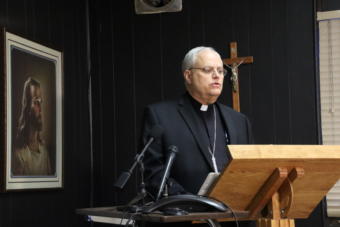
Bishop Andrew Bellisario addresses reporters at St. Ann's Parish Hall on August 21, 2019. (Photo by Adelyn Baxter/KTOO)
Bishop Andrew Bellisario addresses reporters at St. Ann’s Parish Hall on Aug. 21, 2019. (Photo by Adelyn Baxter/KTOO)

The Diocese of Juneau announced Wednesday that there is enough evidence to conclude that at least seven people who served the Roman Catholic Church in Southeast Alaska since 1951 engaged in sexual misconduct involving minors or vulnerable adults.

The individuals named in the report are priests Francis Cowgill, Javier Gutierrez, Patrick Hurley, Michael Nash, Edmund Penisten and Henry Leo Sweeney, and brother Frederick Raehsler.

Each of them served in several churches throughout Southeast Alaska. One of them also served in Kodiak and Anchorage.

Bishop Andrew Bellisario commissioned the independent investigation last December.

During a press conference Wednesday, Bellisario expressed his remorse at the findings.

“I want to offer a very sincere apology. It brings a lot of shame and a lot of regret, a lot of sorrow to me personally as the bishop of this diocese,” Bellisario said. “But it is something that needs to be expressed to those who have been harmed.”

The most recent allegation involves Edmund Penisten, who recently served in Klawock at St. John by the Sea Parish before being placed on administrative leave earlier this year.

Penisten was also removed from his post in Sitka in 2010 after being accused of accessing child pornography from a parish computer. An investigation at the time concluded that he could return to ministry. He then lived in Juneau from 2011-2014 before moving to Klawock in 2015.

Bellisario said the decision to remove Penisten again resulted directly from a review of the 2010 case by the commission. His case is still being reviewed by the diocese.

Another former priest named in the report, Michael Nash, died in a plane crash near Ketchikan in July.

Nash was dismissed from the clergy after allegations surfaced that he had sexually abused young boys while serving at churches in Juneau and elsewhere in Southeast. He was living in Wrangell at the time of his death.

The investigation relied on personnel records going back to 1951, when the diocese was founded. The independent commission tasked with conducting it was made up of retired Juneau Police Department Lt. Kris Sell and retired judges Keith Levy and Thomas Nave.

Levy and Nave replaced retired judges Patricia Collins and Thomas Schulz, who were both unable to continue for personal reasons and left early in the investigation, according to the diocese. 

Bellisario acknowledged that there may be more victims and perpetrators than the investigation was able to reveal.

“What we’re hoping for, of course, is if somebody, whether they were a past victim and sees this, or a new victim, that they will be willing to come forward and share with us,” he said.

The diocese will update the list of offenders if new information becomes available.

Alaska Native men gather to explore culture, identity, domestic violence and building healthy communities

Lyle James scans the waters of Lynn Canal for harbor seals during a hunt early on the morning of June 30, 2019.
Lyle James scans the waters of Lynn Canal for harbor seals during a hunt early on the morning of June 30, 2019. (Photo by Jeremy Hsieh/KTOO)

Early Sunday morning aboard an aluminum skiff in Lynn Canal, Johon Echohawk Atkinson of Metlakatla had his eyes trained on his cousin’s husband, who had hopped onto some kelpy, mussel-encrusted rocks with a .22-caliber rifle slung over his shoulder.

“Lyle in his natural elements,” Atkinson said.

Lyle as in Lyle James, a cultural educator and a leader of the Indigenous dance group Woosh.Ji.Een in Juneau. James is Tlingit, Filipino and Hawaiian. He led this seal hunt.

A Men’s Gathering

Atkinson and James are two out of dozens of men from around the state who want to end violence and build healthier communities that converged in Juneau this past weekend.

The organizers — the Alaska Network on Domestic Violence and Sexual Assault, AWARE, Sealaska, and Goldbelt Heritage Foundation — called it a “Men’s Gathering.”

There were panels and discussions about masculinity, colonization, trauma, relationships and healing. As at many conferences, there was a hands-on team building activity the last day. But they didn’t practice trust falls or traverse a ropes course: They picked up filet knives and processed four freshly harvested harbor seals.

But first, James had to do the harvesting.

Seal hunting

Atkinson is from Metlakatla, with Tsimshian and Pawnee roots. Hunting seal was new to him, and he was eager to learn and bring the know-how back to his community. In a lot of Alaska Native communities, he said a loss of culture and identity has caused problems, including domestic violence.

“We also lost our values, you know?” Atkinson said. “Our way of living that has always kept us strong and healthy since time immemorial. So now, with us bringing back our language, with our culture, we’re also bringing back our traditional values, us as men, to be providers and protectors.”

Small waves lapped up against the idling skiff. As Atkinson waited for the hunter to pick his shot, a question from a panel discussion the day before swirled in his head.

“Honestly, that was probably the hardest question that the men answered,” Atkinson said. Because it’s not something men usually talk about.

“And I think that’s part of the problem. … Our mindset was, the way society is, to not talk about love, you know? To not talk about your emotions, to not cry, you know, to not do anything pertaining — that has any feeling. So when those three men were asked, ‘What is love?’ … I’ve never been asked that before, and I’m 38 years old, you know? So it was great, you know, hearing men twice my age, being able to talk about love and become vulnerable in front of an audience of men from all over Alaska.”

After the fourth and final harbor seal of the morning hunt was shot, Lyle James pointed the boat toward a shallow cove and Atkinson grabbed a gaff hook and pulled in the seal.

Lyle James hopped back into the boat. Motoring back to Amalga Harbor, he explained the philosophy that he takes into hunting.

“I never go out and assume that I’m going to get something. I’m just — if a seal’s willing to give itself to us, then I definitely appreciate it,” he said.

They took the seals to Auke Rec. The conference attendees arrived in a caravan. Soon, about a dozen men were wrist deep in seal guts.

Men work together to process a harbor seal at the Auke Village Recreation Area in Juneau on June 30, 2019. Seal harvests are common across many Alaska Native groups.
Men work together to process a harbor seal at the Auke Village Recreation Area in Juneau on June 30, 2019. Seal harvests are common across many Alaska Native groups. (Photo by Jeremy Hsieh/KTOO)

Damen Bell-Holter was one of them. He’s multiracial and grew up in Hydaburg, played professional basketball for a few years in the U.S. and Europe, but identified strongly with his village roots, his Haida side especially. Now he works for Sealaska in youth programs. As he sharpened a knife to strip fat off a seal hide, he recalled some lessons from his youth.

“As little kids we were taught, like, every time you go out, deer, everything, deer, seal, fish — we always use every single part of it and you say thanks, we always say thanks every time,” Bell-Holter said. “We make sure that we always use everything. Every piece of the seal, every piece of the deer.”

Leaders from across Alaska

A lot of these guys have leadership roles in their communities running support groups, coaching kids’ basketball, or working directly in social service jobs.

Ethan Candyfire was awed by the experience. He’s Kiowa Apache, Cheyenne and Arapaho, but lives on St. Paul Island in the Bering Sea. He used to work in law enforcement there.

“It’s so reactive, you know?” he said. “A lot of the work that I did was completely after the fact, it’s way after the toxicities and all that all those things happen. So what I realized is, you know, it’s our young people, you know? You kind of have to build them up, you know, you have to put good things — you have to teach them to ask themselves good questions.”

Now he teaches math and coding, and coaches junior high basketball.

“It’s hard in small communities, when people, like, know about some negativity in your life, they know your problems in your situations,” Candyfire said. “But just teaching our youth like, it’s all right, to make, you know, boneheaded mistakes.  And that no matter what, don’t feel like you have to stay home, you know, stay away from people. Like, come to these circles, come talk, you know? When you’re uncomfortable, you need to just go ahead and walk in those.”

The seal meat stacked up in one-gallon Ziploc bags. The seal fat went into a big pot to render. It all gets distributed to Elders and conference attendees.

The seal harvest and the men’s gathering aren’t silver bullets. There are many factors that lead to domestic violence and unhealthy relationships. It’s complex.

But Johon Echohawk Atkinson says confronting the issue with other men and creating a space where they can be vulnerable with each other is a huge step.

Alaska state budget vetoes reduce funding for homeless shelters and services

The Brother Francis Shelter in Anchorage in 2015. (Video still by Mikko Wilson/360 North)

Anchorage homeless shelters and services are bracing for cutbacks and closures after Gov. Mike Dunleavy announced about $400 million in line-item state budget vetoes Friday.

The Brother Francis Shelter, an emergency shelter for adult men and women, will have to reduce its capacity from 240 to approximately 100 people, according to Catholic Social Services. The Clare House, Catholic Social Services’ emergency shelter for women with children and expectant mothers, may have to close during the day. Safe Harbor Muldoon, a transitional housing facility sheltering dozens of families facing homelessness, faces closure.

So does Sitka Place, a supportive housing facility serving homeless people with serious mental illnesses, according to Patrick Anderson, CEO of Rural Alaska Community Action Program, the statewide nonprofit operating both Sitka Place and Safe Harbor Muldoon.

“That’s devastating,” Anderson said of the budget cuts.

As of Friday evening, Anderson said his organization was still assessing the full impact of the governor’s vetoes. So were other shelters and social service organizations around Anchorage. Lisa Aquino, executive director of Catholic Social Services, said the nonprofit had relied on more than $1.3 million in vetoed state funding. She said its board of directors plans to hold an emergency meeting this week to determine the next steps. One thing was immediately clear, she said.

“It’ll be devastating,” Aquino said. “And it will have big financial implications for so many in the community.”

Statewide, homeless shelters and housing services received funding through four grant programs: the Homeless Assistance Program, the Special Needs Housing Grant, the Human Services Community Matching Grant and the Community Initiative Matching Grant. The governor’s recent vetoes sharply reduced the first two programs and zeroed out the latter two.

“The State’s fiscal reality dictates a reduction in expenditures across all agencies,” read the fiscal note for the cuts.

Jasmine Khan, executive director of the Anchorage Coalition to End Homelessness, said overall state funding for homelessness services fell from approximately $13.7 million to about $2.6 million. The money funded 50 programs around the state and at least five shelters in Anchorage, Khan said. Ending the programs would have an immediate negative effect on homelessness in Anchorage, she said. The extent has yet to be realized.

“If anything shuts down, we will see more people on the streets,” Khan said.

Site notifications
Update notification options
Subscribe to notifications