Sexual Abuse & Domestic Violence

Former legislative staffer alleges harassment by Rep. Westlake

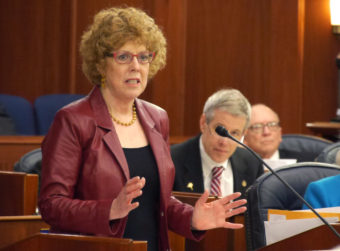
Rep. Dean Westlake, D-Kotzebue, speaks in support of House Bill 78, during a House Floor Session on Feb 3, 2017. (Photo by Skip Gray/360 North)
Rep. Dean Westlake, D-Kotzebue, speaks during a House floor session in February. He faces sexual harassment allegations by a former legislative staff member. (Photo by Skip Gray/360 North)

A former Alaska House staff member has alleged two incidents of sexual harassment by Rep. Dean Westlake, a Kotzebue Democrat. A report on the allegations today prompted House Speaker Bryce Edgmon to encourage victims of harassment to come forward.

Olivia Garrett worked for Fairbanks Democratic Rep. Scott Kawasaki during the legislative session this spring. She said Westlake harassed her on two occasions.

Garrett said she addressed a letter to Edgmon and House Majority Leader Chris Tuck, an Anchorage Democrat. In it, she wrote that Westlake grabbed her and told her that her hair “turned him on.”

On the second occasion, she said he grabbed her buttocks as she passed by.

Garrett said she wrote the letter at Tuck’s direction, including his instruction to include the phrase, “I hope we can both move forward in a professional manner so no one is embarrassed or damaged.” She said she never heard anything more about it from Tuck. She said she believes Tuck never showed Edgmon the letter or spoke with Westlake.

Tuck gave limited comment.

“She is free to say that, but at this time we are not free to respond, because of the nature of the allegations, as well as preserving the privacy rights for future complainants coming forward,” he said.

He added that any response he made could be construed as a form of retaliation.

The blog Must Read Alaska reported on the allegations Wednesday morning. Soon after the report, Edgmon responded.

The Dilligham Democrat said he welcomes those who’ve experienced harassment to bring their concerns to his office.

“We don’t condone this kind of activity and we’re committed to making changes in the Legislature so it doesn’t happen in the future,” Edgmon said.

An aide to Westlake said the representative is recovering from heart surgery he recently had and wouldn’t have a comment at this time.

A subcommittee is meeting Thursday with a goal of making recommendations to revise the Legislature’s sexual harassment policies. They were last updated in 2000.

Edgmon explained the subcommittee’s task.

“It’s our intent to go back and revisit those policies and to look at the formal complaint process and certainly the informal complaint process and to see how we can strengthen and modernize, if you will, how that occurs,” he said.

Garrett wasn’t available for a phone call on Wednesday, but answered questions by email. She made her concerns about Westlake public at an Alaska Democratic Party meeting last week. She also raised concerns about how the party handled a separate complaint she made last year.

The party then announced that it would require all candidates participating in the party’s coordinated campaign next year to complete an online sexual harassment awareness course.

Garrett said mandatory training is a positive step but isn’t enough. She said: “I hope there are consequences for offending staff and legislators and that they’re enforced.”

Garrett also called on Westlake to resign. She said the House majority should remove Westlake from committees and take away his staff.

Alaska Democratic Party Executive Director Jay Parmley said the Legislature should investigate Garrett’s allegations.

“If all of these accusations are true, there’s no doubt that Rep. Westlake should step aside and should resign, because there’s just no place for this in the Legislature,” he said.

Edgmon said the national attention on harassment could prove to be a watershed moment in reducing harassment.

“I think we ought to seize the moment and do whatever we can to make sure we can change the culture going forward,” he said.

The sexual harassment policy subcommittee is expected to submit recommendations before the next legislative session starts.

Sitka Tribe of Alaska receives $2M grant to help domestic violence victims

Sitka Tribe of Alaska’s Sheet’ka Kwaan Naa Kahidi building (Photo by KCAW)

The Sitka Tribe of Alaska has landed more than $2 million in federal grant money to aid victims of domestic violence.

The money is being awarded in three separate grants and will create five new positions to support women and children in Sitka.

The first grant puts $600,000 towards facility improvements at Sitkans Against Family Violence, or SAFV, which provides shelter for domestic violence victims.

The money comes the U.S. Department of Housing and Urban Development.

Sitka Tribe works with the Sitkans Against Family Violence frequently, grant administrator Rachel Henderson said. This grant provides direct support for the shelter and the people it serves.

“Sixty-five percent of the people that use the SAFV shelter are Alaska Native. So we thought it was important in that regard to help tribal citizens,” Henderson said. “Also, most of the people that go there have low-to-moderate income, so it’s just helpful to the people in general that SAFV has an expanded or renovated facility.”

The shelter was built in the 1960’s. Sitkans Against Family Violence bought the building in 1995 and made some changes, but no large renovations to the floor plan.

With this money, the organization will expand the facility’s square footage and renovate the existing living space to accommodate more people. Currently, SAFV has space for 24 women and children.

“It’s going to add an area for animals so people who are coming to the shelter can bring their animals with them,” Henderson said. “It’s going to have expand eight bedrooms so they can have four family-size bedrooms. It’s going to improve the bathrooms so that one of the bathrooms is more handicapped accessible.”

Sitka Tribe also received two grants from the US. Department of Justice Office on Violence Against Women.

The first — for just over $899,000 — will be used to fund three positions for the next three years: an advocate for victims’ services at Sitkans Against Family Violence, a transitional housing program manager at Sitka Tribe of Alaska and a domestic violence investigator at the Sitka Police Department.

All three positions will share a common goal of aiding victims of domestic violence and sexual assault.

There was a crucial need to work with Sitka Police and Sitkans Against Family Violence to address the needs of women in the community from multiple angles, said Melanie Boord, Sitka Tribe of Alaska social services director.

“There’s been a desperate need for transitional housing for victims of domestic violence and sexual assault,” Boord said. “There’s definitely a need for a more effective approach to investigating crimes of domestic violence. And also because of the diminished shelter funding, there’s also a need for enhanced victim’s services.”

The second DOJ grant, the Legal Assistance for Victims grant, allocates $599,000 over the next three years to fund two positions.

Naomi Palosaari of Sitka Tribe of Alaska said the money will first pay for a full-time attorney who will work out of Sitka Tribe.

“They will see clients, they will screen them for eligibility, they will represent them in court, they will draw up paperwork,” Palosaari said. “They will be providing all legal services in recovery from domestic violence or assistance with domestic violence issues.”

Sitka Tribe is now advertising for a family law attorney to fill that position. All other grant funded positions took effect on Oct. 1.

Franken reiterates he won’t resign: ‘I know that I’ve let a lot of people down’

Updated at 1:53 p.m. ET

Sen. Al Franken said Monday he would not resign from office after allegations of sexual harassment have been leveled against him.

“I know that I’ve let a lot of people down,” Franken said, noting that he was looking forward to getting back to work. “My colleagues, my staff, my supporters and everyone who has counted on me to be a champion for women. To all of you, I just want to again say I am sorry. I know there are no magic words I can say to regain your trust.”

He said the process will take time and “that starts with going back to work today.”

The Minnesota Democrat spoke to reporters on Capitol Hill for the first time since multiple women have accused him of inappropriate sexual conduct, ranging from forcible kissing to unwanted touching. He took a few questions, reiterated that he would not resign and expressed remorse and regret.

“I’ve been trying to take responsibility by apologizing,” Franken said. He added, “I’m going to be accountable” and “cooperate completely with the ethics investigation.”

Franken’s conduct has been referred to the Senate Ethics Committee. The committee could recommend anywhere from a reprimand to censure to expulsion, but the full Senate would have to act on that.

Leeanne Tweeden, a radio host in Los Angeles and former model, toured with Franken as part of the USO. She recalled Franken forcibly kissing her during sketches and rehearsals. A photo taken aboard a cargo plane also shows Franken touching Tweeden’s breasts over a flak jacket while she was asleep. Looking over his shoulder, Franken smirks at the camera.

Franken said he didn’t remember his time with Tweeden the same way, but noted, “I feel that you have to respect women’s experience. I apologized to her, and I meant it. And I was very grateful that she accepted it.”

Women have also accused Franken of touching their buttocks while taking photos in Minnesota. Franken said he does not remember specific instances in which that happened, but he did not deny that it did.

“One is too many,” Franken said. He added that it was disrespectful and he is sorry he hurt them.

“I am tremendously sorry. I am going to have to be much more conscious, much more careful, much more sensitive that this will not happen again going forward. It’s going to take a lot more time for me to earn people’s trust.”

He repeated later, “I am tremendously sorry. … I am embarrassed. I feel ashamed.”

Franken’s comments echo what he told Minnesota Public Radio News in an interview over the weekend: “I’m going to go forward. I’m going to take responsibility. I’m going to be held accountable, and I’m going to try to be productive in the way I speak about this.”

Democrats have been aiming for the moral high ground on sexual harassment, especially ahead of a Dec. 12 Senate special election in Alabama. Republican Roy Moore there has been accused of sexual misconduct and assault against teenage girls 40 years ago.

You can watch Franken’s full news conference here:

Copyright 2017 NPR. To see more, visit http://www.npr.org/.

Legislative Council to consider sexual harassment working group

Alaska State Capitol, Feb. 7, 2017. (Photo by Skip Gray/360 North)
Alaska State Capitol in February. The Legislative Council is scheduled to discuss forming a sexual harassment policy working group on Tuesday. (Photo by Skip Gray/360 North)

The Alaska Legislative Council is scheduled to discuss forming a sexual harassment policy working group Tuesday.

Lawmakers are considering how to revise the Legislature’s sexual harassment policy to ensure that harassment reports are handled appropriately.

Juneau Democratic Rep. Sam Kito III, the council’s chairman, said lawmakers need to make sure they’re protecting victims of harassment.

“There are some questions about how and when to report and also questions about what kinds of training might need to occur with legislators and staff in order to make sure everybody’s aware of the policy that exists,” Kito said.

Recent concerns about sexual harassment both outside Alaska and in Juneau have led lawmakers to consider making changes to the policy.

The Legislature’s sexual harassment policy was last updated in January 2000. It spells out what harassment is and how people should report it. The policy also said all reports will be investigated and employees who violate the policy will be subject to disciplinary action.

Anchorage Republican Rep. Charisse Millett, a member of the council, said a sexual harassment policy working group could become a permanent subcommittee that would review the policy every year.

“Is there under-reporting, is there over-reporting, is there any reporting?” Millett said of the kind of questions a working group could ask. “And how does that work, and how do we make sure that employees and, you know, folks in this building – whether it’s a constituent, whether it’s a staffer, whether it’s the media, we just need to make sure that we have the best policies in place to protect our employees.”

Anchorage Democratic Rep. Harriet Drummond is an alternate council member who is scheduled to fill in on Tuesday. She said one challenge for reporting on lawmakers is the limited means of reprimanding them. Each chamber can censure or expel its members. Otherwise, it’s up to voters to weigh allegations. But Drummond said the working group could benefit the Legislature.

“We have to provide a lot more clarity throughout this policy,” she said. “And also, …  just in looking at all of these personnel policies in general, it needs some good, close scrutiny.”

Before the policy was added to the council agenda, some lawmakers said they wanted policy changes to be in place by early next legislative session in January.

Alaska Natives account for more than half of sexual assault victims in state, study says

In "Hope Quilt," an art installation that toured Bethel last month, Alaskan artist Carmel Anderson displays anonymous stories from abuse survivors throughout the state. Alaska's sexual assault rates are high, and Alaska Native females are more likely to be attacked than anyone else. (Photo courtesy Carmel Anderson)
In “Hope Quilt,” an art installation that toured Bethel last month, Alaskan artist Carmel Anderson displays anonymous stories from abuse survivors throughout the state. Alaska’s sexual assault rates are high, and Alaska Native females are more likely to be attacked than anyone else. (Photo courtesy Carmel Anderson)

Alaska has one of the highest rates of sexual assault in the country, and Alaska Native women are more likely to be attacked than anyone else,  according to the Department of Public Safety, which quietly released a report on Alaskan sex crimes last month.

Fifty-four percent of Alaska’s sexual assault victims are Alaska Native, the report says, even though Alaska Native people comprise only 20 percent of the state’s population.

The study analyzed allegations of rape, child sexual abuse and other felony sex offenses reported to Alaskan law enforcement in 2016.

It also found that 47 percent of the suspected attackers are Alaska Native as well, and that Western Alaska has higher rates of sexual abuse than any other region.

“I wasn’t surprised at all at these statistics,” said Monica Charles, a Tundra Women’s Coalition board member. “If anything, I’m surprised by how long it takes to come up with these numbers to shock people into action.”

If anything, she said, the numbers in the study seem low.

Sex crimes are famously underreported.

Charles said that there are several reasons that the sexual assault rates are so high in Alaska Native communities.

Rural Alaskans have less access to public safety and law enforcement, which can leave people vulnerable to certain kinds of crimes. High rates of alcoholism exacerbate the problem.

“I think people who are abusing alcohol are at a greater risk of exhibiting concerning behaviors that lead to domestic violence, or suicide, or sexual assault,” Charles said.

Regardless of their ethnicity, Alaskans are assaulted at a young age.

According to the report, the most common victim of a sex crime is a 14-year-old girl. She almost is always attacked by someone she knows.

Abusers target younger girls or boys because they’re vulnerable, said Michelle DeWitt, vice chair of the Council on Domestic Violence and Sexual Assault.

Finding someone vulnerable is foremost in their minds, and attackers sexually assault their victims to feel more powerful.

“When somebody no longer feels powerful themselves, you often see people attempting to feel more powerful by acting out with violence, whether that’s domestic violence or sexual assault,” DeWitt said. “When I see crimes that are truly about power, I think we can really link that back to disempowerment.”

According to both DeWitt and Charles, this feeling of disempowerment may be at the root of high sexual assault rates in Native communities.

Alaska’s Native cultures have been disrupted by Westernization; its Native people were systematically disenfranchised as Russia and the United States colonized their land.

That history is a tremendous source of trauma and grief, Charles said.

“It is woven into every facet of our lives in every community in Alaska if you are Alaska Native,” she said, as she started to cry. “Historical trauma is alive and breathing in my own daughters and in my son. It is something that is very real and it affects every part of society.”

It’s hard to know to fix this, but when it comes to addressing high sexual assault rates, Charles said that there are steps that communities can take.

“I think that having a safe place and knowing that people can talk about it just in general is a good place to start,” she said.

There are also behavioral health programs and support groups that survivors can turn to, including those offered by the Yukon-Kuskokwim Health Corporation, the Tundra Women’s Coalition, and the Bethel Family Clinic.

If you are a survivor of sexual assault and need immediate assistance, call Tundra Women’s Coalition  24-hour crisis line at 1-800-478-7799 or 1-907-543-3456.

Legislative leaders seek update to sexual harassment policies

The Alaska Capitol Building in Juneau on June 6, 2017. (Photo by Jeremy Hsieh/KTOO)
Lawmakers from both chambers are seeking to update their sexual harassment policies. (Photo by Jeremy Hsieh/KTOO)

Both chambers of the Alaska Legislature are seeking to make changes to their sexual harassment policies, lawmakers said Thursday.

They’re seeking to increase training to prevent harassment and improve the procedures for addressing allegations.

The national reckoning with sexual harassment has reached Juneau.

Senate leaders have asked legislative staff to help implement mandatory workplace conduct training.

In a letter to the Legislature’s top legal adviser and human resources director, the Senate leaders also asked for procedures to handle complaints beyond the reach of political influence.

Senate President Pete Kelly, a Fairbanks Republican, said the letter was prompted by incidents both inside and outside of Alaska.

“In light of what’s going on all over the country – and there have been some things swirling around in this Capitol as well — what has dawned on me and leadership is that we don’t have sufficient procedures in place to deal with any kind of workplace issues that might have to do with positional power or sexual harassment,” Kelly said.

House leaders said they had been undertaking a similar review for a few weeks.

Anchorage Republican Rep. Gabrielle LeDoux said the current policy hasn’t been revised since 2000.

“It really doesn’t seem to have any teeth or any mechanisms for reporting,” House Rules Committee chairwoman LeDoux said.

LeDoux said the policy should cover both workplace incidents and those involving legislators’ behavior outside of the workplace. And she said it should cover both sexual harassment and other physical harassment.

“We need a far more robust policy than we have right now,” she said.

LeDoux said she discussed a joint policy with a Senate staff member.

“I have no control over the Senate, but I will guarantee you that the House will adopt something,” LeDoux said.

Kelly said he’s not envisioning a policy that would apply outside of the workplace.

The Senate president said he wants to have a procedure to address complaints that would lead to a quick resolution.

“We just need to make sure, number one, that a stop is put to it,” Kelly said. “I hope we can. But human beings are human beings and when they break the rules, we want to be able to react quickly.”

Leaders from both chambers said they would like to have new policies in place by early next legislative session in January.

Site notifications
Update notification options
Subscribe to notifications