Military

Coast Guard captain describes encounter with Chinese, Russian warships off Alaska

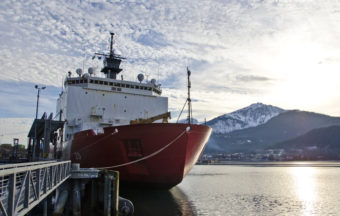
U.S. Coast Guard Capt. Thomas D’Arcy aboard his command, the cutter Kimball, during an Unalaska port call. The Kimball encountered several Chinese and Russian warships off Alaska in late September. (Maggie Nelson/KUCB)

The U.S. Coast Guard cutter Kimball calls Honolulu home, but recently it’s seen a lot of action in the Aleutians.

Just last month while on a routine patrol, the vessel encountered a group of seven Russian and Chinese warships traveling together through the Bering Sea. The Kimball’s commander, Capt. Thomas C. D’Arcy, recalled the encounter during a port call in Unalaska last weekend.

“We tracked them from about Kiska Island and then down through the pass,” D’Arcy said, pointing at a map of the Bering Sea. “So I’m assuming that they came up into the Bowers Ridge area and then moved in formation.”

The path the ships took was similar to that of a group of Chinese vessels that the Coast Guard tracked and followed in the region just about a year ago, according to D’Arcy.

The Kimball — which carries about 120 crew members, defensive weapons and a helicopter — came within about a mile of the group and made radio contact with them. Crew members on the foreign warships responded, but never declared who was coordinating the formation, he said.

While the group didn’t break any rules or give reason for direct contact, D’Arcy said the Kimball accompanied the ships until they passed into the Pacific side of the Aleutian Islands, where they split up.

He said they encountered the warships in the Bering Sea, in the U.S. Exclusive Economic Zone — an area up to 200 nautical miles offshore, where the U.S. has jurisdiction over natural resources. The formation never entered U.S. territorial seas.

A Coast Guardsman aboard the cutter Kimball monitors a vessel from a group of Chinese and Russian warships in late September 2022. (Courtesy U.S. Coast Guard)

NATO officials have warned of a strategic Arctic partnership between Russia and China that challenges the organization’s values and interests. For D’Arcy, Russia’s persistence to militarize and develop a presence in the Arctic is concerning. But, he said part of the Coast Guard’s duty is to ensure that the U.S. sovereign interests are protected and to spend more time in the region.

The most important piece for the Coast Guard is to make sure that we’re there and that we’re observing what’s happening, whether it’s a foreign vessel that’s coming up to do research or another naval vessel from a different country that’s operating in that area, especially if it’s anywhere near our interested waters,” D’Arcy said.

On Saturday, the crew of the 418-foot vessel welcomed more than 100 guests for tours, while docked up at Unalaska’s spit.

D’Arcy said he was excited to host the community, especially after about two years of limited interaction with locals due to the COVID-19 pandemic.

“It’s great to have the crew interact with the local community,” D’Arcy said. “The Coast Guard’s presence has been here since like the 1880s. We’ve been part of Unalaska. We’re not always the same ship or the same crew, but I think being able to demystify what we’re doing here was one of the goals that we had for this visit.”

Unalaska residents tour the U.S. Coast Guard cutter Kimball during an October 2022 port call. (Courtesy U.S. Coast Guard)

About half of the visitors that boarded the ship throughout the day on Saturday were school-aged kids, he said.

“We had stations out where they could try on gear, ask questions of our specialists — whether that was our cooks or maritime law enforcement specialists,” D’Arcy said. “We had our unmanned aerial surveillance aircraft out.”

D’Arcy said the event is meant to show Unalaskans that the Coast Guard cares about their well being and safety, but it’s also a great chance for the crew to get to know the island community.

Unalaska residents tour the U.S. Coast Guard cutter Kimball during an October 2022 port call. (Courtesy U.S. Coast Guard)

“When we say, ‘Hey, we want to do open tours,’ we have more volunteers than needed,” he said. “Everyone was like, ‘Come on, can I wear (my fancy uniform)?’ … They’re eager to show what they do. And it makes me proud.”

Unalaska residents tour the U.S. Coast Guard cutter Kimball during an October 2022 port call. (Courtesy U.S. Coast Guard)

This is D’Arcy’s second trip to Unalaska, and it’s the Kimball’s second deployment to the state. Right now, the ship is about two months into its roughly three-month station in the area.

D’Arcy didn’t comment on the strategic implications of the foreign warships the Kimball encountered last month. But he said the cutter is staged for just about anything and will continue monitoring the area for foreign military activity.

“Kimball will be ready and respond,” he said. “But if there is no foreign presence and no threat there, no adversarial strategic competitor operating in our waters, then we shift to the next tasking and priority.”

For now, the Kimball will continue patrolling near Unalaska in the Bering Sea region and into the Arctic.

As the fall weather builds and fishing seasons begin picking up, D’Arcy said the crew is preparing for weather-related accidents and enforcement of fishing regulations.

Pentagon asks for proposals to build small nuclear power plant at Eielson

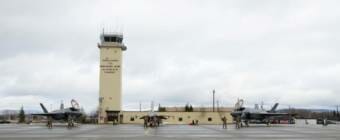
Two F-35s, with an F-16 parked in the middle, at Eielson Air Force Base on April 21, 2020. (Sean Martin/354th Fighter Wing)

Pentagon officials have taken another step toward building a small nuclear power plant for Eielson Air Force Base. On Monday, they released a request for proposals that invites contractors to outline how they’d design, build and deploy a so-called microreactor at Eielson within five years.

Air Force officials announced last year that they’d selected Eielson as the site of a pilot project that would prove the viability of small-scale nuclear power plants at military installations.

“This is really about energy resilience,” said Mark Correll, a former Air Force deputy assistant secretary for environment, safety and infrastructure.

Correll said last November that the project at Eielson is meant to help demonstrate a microreactor’s capability to provide power in case the base’s main source of electricity — a 70-year-old, 15-megawatt coal-fired heat and power plant — goes offline.

“We’re looking to make sure that at any point in time, any of our bases with any mission will have the power it needs, where it needs it, when it needs it, in the quantities that it needs, to assure that we can continue to do the defense mission that we have,” he said.

The United Coalition for Advanced Nuclear Power is backing the Eielson project.

“There’s both a geopolitical reason, as well as an energy-resilience reason. Which is why Eielson is so exciting,” says Lucian Niemeyer, a principal with UCAN, a Washington, D.C.-based organization that advocates for nuclear-powered electrical generation.

Niemeyer says the Eielson microreactor may demonstrate that the technology holds promise for the Interior’s other remotely located military installations.

“Eielson relies on a coal plant with oil backup in a very critical area of the country,” he said in an interview Monday.

Critical because of the area’s national security assets — Eielson’s two squadrons of advanced F-35 fighters; Fort Wainwright’s airborne units; and the missile-defense installations at Fort Greely and Clear Space Force Station.

“Nuclear power can serve a significant capability to run these critical bases and assets on reliable power for a period of five to 10 years without refueling,” Niemeyer said.

The request for proposals calls for construction of a facility to accommodate a micronuclear reactor that would generate up to 5 megawatts and operate for 10 years, until its fuel is spent. The plan calls for construction to begin in three years and for the reactor to begin generating power in 2027.

Correll, who talked about the project in a news conference held after it was announced, said the microreactor would be self-contained in a structure that’s about the size of a CONEX shipping container that’ll be located in a site of about 5 acres. He said it won’t cost the Air Force any money upfront. Instead, it’ll pay for it through power purchases from the company that’ll build and operate it, at a rate that’s competitive with what the base pays now.

Niemeyer says the Pentagon and industry likely will learn a lot from how the facility performs.

“I think the lessons we learn from that are going to drive maybe a decision to start looking at other locations,” he said.

Air Force officials say they’ll conduct a conference and site visit to Eielson on Oct. 12 for industry representatives considering submitting proposals for the project.

Rep. Peltola’s first bill passes House

Rep. Mary Peltola on the House floor advocating for her first bill on Sept. 28, 2022. (Screenshot from CSPAN)

U.S. Rep. Mary Peltola’s first bill, which would establish an Office of Food Security in the Department of Veterans Affairs, has passed the House.

Peltola’s bill advanced Thursday afternoon on a 376-49 vote, with significant GOP support. Many far-right Republicans from the Freedom Caucus voted against it.

The vote came just a day after Peltola spoke on the House floor to advocate her proposal.

“I rise today to speak on a topic of vital importance to my state, where veterans comprise about 10% of the population, and I know many veterans who face food insecurity,” she said Wednesday.

The office would coordinate with the Department of Defense and the Department of Agriculture, which is in charge of the food-stamp Supplemental Nutrition Assistance Program.

According to researchers from the Rand Corporation, veterans who are disabled, unemployed and who served in the years since 9/11 are at higher risk of food insecurity than other veterans. The scope of the problem is not clear, but Rand researcher Tamara Dubowitz said one argument in favor of getting more needy veterans on SNAP benefits is that improved nutrition would save on health-care costs.

“I think others would say, ‘Look, these are people who have given to our country and we owe it to them to make sure that they have the basics,'” Dubowitz said. “And, you know, SNAP is something that allows them to not be living in on shaky ground.”

Peltola cited a Center for Strategic and International Studies study that said food insecurity among veterans and service members is a national security concern, in part because it adds stress to military families and may harm recruitment.

“I know this bill will not solve the problem entirely, but I believe it can help Alaska and throughout the country,” Peltola said.

Josh Wilson, a spokesman for Peltola’s congressional office, said her staff – hired just days ago – drafted the bill with the staff from the House Veterans Affairs Committee.

Peltola’s office also announced that she now has a second committee assignment: Education and Labor. She’s also on the House Natural Resources Committee.

This story has been updated to indicate that the bill has passed.

Alaska National Guard begins to mobilize in wake of Western Alaska storm

Debris strewn along a flooded shoreline
Major flooding in Hooper Bay on Saturday, Sept. 17, 2022. (Photo courtesy of Lola Cernek)

The Alaska National Guard is activating all guard members in the western region of the state and is deploying more to the area.

Maj. Gen. Torrence Saxe said at a Sept. 18 press conference that troops would help with debris removal and damage assessment, with additional guard members going to Hooper Bay, Nome and Bethel.

“It is critical to have boots on the ground,” Saxe said.

Saxe said that having troops in hub communities will allow them to deploy to smaller villages more quickly.

The American Red Cross is also sending out volunteers. The state has identified five communities that have been impacted the most by the storm: Hooper Bay, Scammon Bay, Golovin, Newtok and Nome.

As of Sept. 18, three communities had a boil water advisory in effect: Elim, Unalakleet and Hooper Bay. Multiple communities, including Hooper Bay, had lost power at their airports.

Gov. Mike Dunleavy said at the press conference that he hopes the recovery response moves quickly and efforts wrap up before freeze-up begins in about three weeks.

“Wherever there is help that is needed, we’ll be getting that out there as soon as possible,” Dunleavy said.

Dunleavy issued a disaster declaration on Sept. 17 to free up state resources.

The damage from the storm ranges across a thousand miles of Western Alaska, from Kuskokwim Bay all the way up through the Bering Strait. University of Alaska Fairbanks climate expert Rick Thoman said that the widespread, severe damage due to this storm is part of what made it unusual. So is the timing. It’s the strongest September storm since records began over 70 years ago.

“We had the absolute perfect set up for a big Bering Sea storm,” Thoman said.

Thoman said that Typhoon Merbok, the source of Alaska’s storm, formed in a part of the North Pacific where typhoons don’t usually form because the water usually isn’t warm enough. But the water there was the warmest it had been in the last century.

“And after it developed and started moving north, then it moved over water that was as much as 7 degrees warmer than the long term normal,” he said. “That is a dramatic difference from normal. For the open ocean, that is really amazing.”

Thoman said that as climate change continues to cause sea water temperatures to warm, storms like this one could become more common in Alaska.

In Hooper Bay, a resident named Ben called in to KYUK on Sept. 17 to describe the scene in the village. Hundreds of people were sheltering at the school due to severe damage and power outages.

“Now, this is a wake up call. We don’t know what our future, but we can’t be ignorant or ignore it also. So we need to face the facts and reality. These storms are getting worse and worse,” he said.

Also taking stock of the damage as the storm blows over is Rep. Mary Peltola, who is from the Yukon-Kuskokwim Delta, home to some of the hardest-hit communities.

Peltola, who was briefed by Federal Emergency Management Agency officials on Saturday, has been in touch with Dunleavy and a number of mayors in affected communities.  She’s worried about damage to subsistence harvests amid the flooding and power outages, as well as damage to infrastructure and equipment.

“Those are the kind of assessments that I’m going to be waiting patiently to — or not so patiently, actually — to start hearing back on,” Peltola said.

Peltola said that she and Alaska Sens. Lisa Murkowski and Dan Sullivan will be working on securing federal disaster funding.

Joe Gerace’s lies went way beyond Anchorage. Multiple agencies investigate how they were duped

Joe Gerace, as acting Anchorage health director, takes journalists on a tour of the Sullivan Arena shelter on Nov. 1, 2021. (Jeff Chen/Alaska Public Media)

Joe Gerace lied his way into more than a high-paying job running the Anchorage Health Department. New reporting reveals that Gerace — who resigned from the city on Aug. 8 shortly before Alaska Public Media exposed his phony medical, educational and military credentials — also successfully deceived a state commission overseeing EMT training, a state paramilitary organization and the Alaska Department of Health. None appear to have taken the basic steps needed to debunk the false claims on his resume, allowing him to attain a seat on a state task force, a prestigious volunteer gig and an EMT license.

An investigation published last month in collaboration with American Public Media showed that Gerace falsely claimed to be a physician’s assistant with two master’s degrees and a high-ranking position in the Alaska National Guard. In fact, he had none of those qualifications.

In the weeks since, at least four government agencies have launched their own inquiries to find out how Gerace’s lies went undetected.

The Alaska State Defense Force, a volunteer-based state-run organization that helps the Alaska National Guard during disasters, expelled Gerace late last month after concluding that he “misrepresented his qualifications and experience during the ASDF application process and during his time in the organization,” a statement from the state Department of Military and Veterans Affairs said.

A bald man in uniform sits at a table covered with Girl Scout cookies, with an American flag behind him
In this 2020 photograph shared to the Alaska National Guard’s Facebook page, Gerace poses in uniform behind an assortment of Girl Scout cookies. The post was part of a feature called “Faces of the Alaska State Defense Force.” Because Gerace never served in combat, his uniform should not have included a patch below the blue and yellow insignia on his right shoulder, according to Alan Brown, a spokesman for the Alaska Department of Military and Veterans Affairs. The Facebook post originally claimed Gerace “studied medicine at the university [sic] of Virginia,” which Gerace admits was not true.
“I took some liberties, yes,” Gerace said in an early September interview. “I’m not proud of that. I’m actually highly embarrassed by it,” he said, adding, “nothing justifies what I did.”

The inquiry, led by ASDF Commander Simon Brown II, found that Gerace had falsely told the organization that he retired from the Army after more than 20 years of service with a rank of lieutenant colonel. In fact, he left after only eight years, mostly in the Reserve, as a lowly E-4 specialist. The ASDF’s procedures require applicants to submit their military discharge papers when they join, which is how the organization decides what rank they receive and how much to pay them when they help with disaster response. But the organization did not verify their authenticity at the time.

“I want to take full responsibility for having those gaps,” Brown said. He vowed to enact more stringent controls going forward. “If you want to come in and say you have certain qualifications, you will have to present proof. And that proof will be double-checked at the source it came from.”

Brown determined that Gerace violated four sections of the Alaska Code of Military Justice: fraudulent enlistment, false official statements, conduct unbecoming an officer and wearing an Army combat patch on his uniform in spite of never seeing battle during his relatively brief military career. Those violations could have resulted in a court martial and jail time, but instead Gerace received an “other than honorable discharge” from the ASDF.

Gerace also fooled the Alaska Council on Emergency Medical Services, a board appointed by the governor to provide advice on EMT training and related issues. It named Gerace to a state task force. Among his duties was writing test questions about neurological disorders for aspiring EMTs.

The resume he submitted to the medical services board in 2020 falsely claimed that he held a master’s degree in business administration, a lie he repeated the following year when he applied for the health director job in Anchorage. Gerace also said he worked for 20 years in emergency medical services in Washington State, where records show he was licensed as an EMT for just two years from 1991-1993.

Gerace has been exaggerating his EMT career for years, records show. A King County, Washington, Sheriff’s report from 2003 describes Gerace pretending to be a firefighter when he was arrested for failing to appear before a judge in a child-support case.

""
A King County Sheriff’s Office report from 2003 noted Gerace “lied about being a firefighter.”

“When I confronted Gerace at the jail about the fact that he is not a firefighter with Fire District 10, he then said he knew that and just said that, but is really a volunteer somewhere else but wouldn’t give us that information,” Deputy Jana Wilson wrote in her report. Fire District 10 told her Gerace had been “let go” years earlier and had “no attachment to the fire department whatsoever.” Wilson also called the state board of volunteer firefighters, which confirmed that Gerace hadn’t been an active volunteer in the state for a decade.

Wilson may have done more to check Gerace’s claims while executing a routine bench warrant than Mayor Dave Bronson’s office, the Anchorage Assembly, the city’s human resources department, the Alaska Department of Military and Veterans Affairs, which oversees the ASDF, or the Alaska Department of Health.

The state health department has suspended Gerace’s EMT license amid an investigation and declined to comment further. His application contained now familiar lies about master’s degrees. It also claimed he held an EMT license in New Jersey, and it included a screenshot of an online license verification belonging to a firefighter there who also happens to be named Joseph Gerace.

""
This screenshot was included in Gerace’s 2019 application.

“I’m not real happy about it,” said the New Jersey Gerace upon learning that someone in Alaska appeared to be impersonating him. “I’m hoping it’s an honest mistake.”

The Alaska Gerace is contesting the suspension of his license. In an interview, he said he meets the qualifications required to be an advanced EMT, and he suggested that someone other than him may have filled out the state application. He declined to say who.

But Gerace admitted that he had a long history of embellishing his resume and has lived in fear he would one day be exposed.

“Whoever cheats on their resume, wherever, you know, it’s a ticking time bomb, and I would recommend they don’t do it,” he said.

It seemed his falsehoods might unravel before he was confirmed as health director last year. A former employee of Gerace from a previous job warned members of the Assembly and Mayor Bronson during a confirmation hearing that she suspected his qualifications had been falsified.

Bronson’s administration says it is investigating how it failed to catch Gerace’s fake credentials before he was confirmed despite the warning from Gerace’s former employee. In an emailed statement, Corey Allen Young, a spokesperson for the mayor said, “The investigation is ongoing and should be wrapped up soon.”

Anchorage Assembly Chair Suzanne LaFrance wants the Bronson administration to provide more information on Gerace’s hiring. In addition, LaFrance said, Municipal Manager Amy Demboski has offered to brief Assembly members on how the administration plans to respond in what LaFrance described as “another situation where a person with fraudulent credentials is put forward by the mayor.”

“We, the Assembly, put together a list of questions so that we can be sure to understand how the situation with a former [health department] director happened,” she said. “And to make sure that we’re doing everything … reasonable to prevent another situation from happening.”

The Assembly’s staff is also researching whether it could pass an ordinance to strengthen its role in vetting mayoral nominees.

The Assembly’s audit committee, under member Felix Rivera, is set to discuss a possible audit of Gerace’s actions as head of the health department during a Sept. 15 meeting.

Alaska Public Media reporter Chris Klint contributed reporting to this story.

This story was produced as a collaboration between American Public Media Reports and Alaska Public Media. 

Amid driver shortage, airmen will drive school buses on Joint Base Elmendorf-Richardson

A jet taking off from a military base
An F-22 taking off from Joint Base Elmendorf-Richardson during exercises in 2015. (Photo by Zachariah Hughes/Alaska Public Media)

Active duty airmen will soon drive school buses for students at Joint Base Elmendorf-Richardson.

Anchorage School District officials announced Friday that the airmen will drive students for 90 days starting Thursday. It’s the latest effort by the district to address an ongoing shortage of bus drivers that has left most students going weeks without bus service and some families scrambling to find their children rides to school.

The district is continuing to hire and train drivers to get more bus service to students, according to Superintendent Jharrett Bryantt. The district is currently down 66 drivers. Twenty-five new hires are in training, and 17 others will be returning to the district from other jobs by Sept. 19, he said.

That means the district will likely only be down 24 drivers by the end of September. They’re currently interviewing 21 additional candidates.

“We’re in arm’s reach of our goal of being fully staffed by October,” Bryantt said in an interview Friday.

Bryantt said the airmen driving JBER students to school means the four drivers who currently staff the routes on base can move to other routes in the district. As new drivers have started working, the district has reinstated routes based on student needs and safety.

The district’s chief operating officer, Rob Holland, said six routes were reinstated this week. Those reinstated routes will be staffed all nine weeks and will not be subject to rotating cancellations. The second cohort of routes will have bus service starting Sept. 12.

The district has also been working with the Municipality of Anchorage and the State of Alaska to adjust traffic flow since more parents have been driving to schools and more kids have been walking, said Bryantt.

“We’ve been working with both muni and state traffic engineers to make adjustments to traffic lights as appropriate, to monitor traffic and to make sure students are safe if they’re walking to school,” he said.

For example, he wrote in a message to families Friday, adjustments at the intersection of Abbott Road and Elmore Road made traffic 30 minutes quicker this week than last week.

Bryantt said almost 2,000 people have signed up to volunteer for the district, and most of them have asked to be crossing guards and bus attendants.

The district has also started a third-party audit of its transportation operations to avoid similar shortages in the future, said Bryantt. He said that could lead to changes for the district, including using a new kind of routing software, adjusting school start times and combining routes.

“I believe that there are systemic inefficiencies with ASD transportation,” he said. “We’re hoping to ensure that ASD is among the most efficient school systems in the country when it comes to busing.”

Site notifications
Update notification options
Subscribe to notifications