Military

Operation Santa heads to Chevak and Buckland in Western Alaska

Members of the Alaska Air National Guard board a C-130 plane at Joint Base Elmendorf-Richardson in Anchorage on Dec. 2, 2021, to participate in Operation Santa. (Jeff Chen/Alaska Public Media)

A camouflaged Santa whirled into Buckland on a funny-looking sleigh this year. As part of its annual Operation Santa Claus, the Alaska National Guard delivered 261 presents to the community in northwest Alaska on December 14. Santa says he’ll drop off 360 gifts to Chevak after the holidays and once weather conditions allow.

Azara Mohammadi, tribal liaison for the Alaska National Guard, coordinated with the Native Village of Buckland and Chevak Native Village to organize and shop for gifts. The Salvation Army made the purchases, and volunteers wrapped gifts that began their journey to the two predominantly Alaska Native communities at the start of the month.

Randell Andrew, a sergeant with the Active Guard Reserve in Bethel, operates a forklift to unload 2,770-pounds of presents from an Operation Santa flight on Dec. 2, 2021. Presents will be delivered to Chevak as part of Operation Santa. (Jeff Chen/Alaska Public Media)

On December 2, 24 Guard members boarded a C-130 plane loaded with 631 presents. The gifts were offloaded in Bethel and Nome, where they would be stored until delivery to the two communities. The Chevak-bound presents are still in Bethel, as of Christmas Eve.

Joseph Sallaffie, a sergeant with the Active Guard Reserve in Bethel, said Operation Santa helps the communities a lot during the holidays.

“Yesterday, me and my wife went to the local store here to look for some water and Gatorade, and we just had a hard time getting cases of water, so imagine if Bethel stores are having a hard time, imagine what the village stores are going through,” he said.

Dana Rosso, a public affairs specialist with the Alaska National Guard, said Operation Santa began in 1956, when St. Mary’s Mission was hit with spring floods and then a drought – impacting subsistence fishing and hunting. Rosso said the Air National Guard flew in donated gifts and supplies to help residents that year.

Rosso said Operation Santa recipient communities are identified by Alaska’s Division of Homeland Security and Emergency Management as communities that have experienced particular hardship that year. The tribes in Chevak and Buckland could not be reached by time of publication.

No Guard members wore masks on the trip to Bethel and Nome, but Rosso said service members selected for the mission came from the same unit and office area, in order to lower the risk of Covid transmission. December 2, the day of the initial Operation Santa flight, was also the national deadline for Air National Guard service members to be vaccinated. Rosso said he did not have current vaccination numbers for the Alaska National Guard.

Members of the Alaska Air National Guard ride on a C-130 plane to Bethel on Dec. 2, 2021, the first stop in Operation Santa. (Jeff Chen/Alaska Public Media)

“This means a whole lot since, like I mentioned, Covid-19 and hard times – this means a whole lot,” Sallaffie said. “It’s kind of hard for them to enjoy a Christmas like it used to be, but with all this, it makes a difference.”

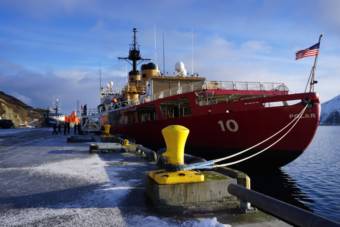
Sullivan still seeking a ‘bridge’ ship to fill the icebreaker gap

The Aiviq in Unalaska in August 2016.( Photo by Sarah Hansen/KUCB)

The Coast Guard’s first heavy icebreaker in nearly 50 years is due in 2025. U.S. Sen. Dan Sullivan says the country can’t wait that long.

Sullivan is among those advocating for leasing or buying a medium-weight icebreaker in the meantime, to bridge the gap until the new billion-dollar icebreaker is ready. At a hearing in October, he prodded the head of the Coast Guard, asking if “we’ve made progress” on a short-term icebreaker lease.

The Coast Guard commandant said he’s considering acquiring an icebreaker to serve in the gap years. That’s a shift that began to surface last year. Before that, the Coast Guard adamantly rejected using the only icebreaking ship on the market.

Eventually, the Coast Guard will have a fleet of new heavy icebreakers, built to its specifications. Congress has authorized three and fully funded the first two, but complications from the COVID-19 pandemic have delayed the start of construction by a year. After delivery, the Coast Guard needs to test and ready its new ship for service, pushing the icebreaker’s first mission to 2027.

At stake in the icebreaker lease debate is the nation’s ability to assert its presence in the Arctic during the gap. Also on the line: millions of dollars and the fortunes of a politically influential company that owns an underemployed icebreaker.

Sullivan has said it’s the mission that he cares about. The Coast Guard’s only heavy icebreaker in service is nearly 50 years old and needs constant maintenance.

“We’re one catastrophic maintenance failure away from having no heavy icebreaking capacity at all,” said a Sullivan spokesman.

Discussions about leasing a ready-made icebreaker get specific in a hurry. The country has just two major icebreakers in private hands, according to the Congressional Research Service. One ship is leased to the National Science Foundation. The other is the Aiviq, a $200 million vessel that’s been wearing a metaphorical “lease me” sign for years.

The Aiviq’s owner, Louisiana-based company Edison Chouest, built it to support Royal Dutch Shell’s plan to drill in Arctic waters. But Shell gave up that plan in 2015, and Edison Chouest has been trying to find work for its icebreaker ever since.

Alaska Congressman Don Young tried pressing the Coast Guard to accept the Aiviq back in 2016.

“I know you’ve got the proposal on your desk, by the way,” a frustrated Young told the Coast Guard’s second in command, at a 2016 hearing. “It’s already been laid on your desk and it’s an automatic no. Why?”

The vice commandant of the Coast Guard at the time, Adm. Charles Michel, insisted the ship wasn’t suitable for the Coast Guard’s many missions, including military service.

“Military service,” Young scoffed. “I’m talking about moving ice!”

In the 2020 election, the owners and executives of Edison Chouest were among Young’s top campaign donors.

In 2016, the shipbuilders made political contributions totaling more than $2 million, mostly to Republicans, including the campaigns of both Alaska senators.

Edison Chouest also spends $300,000 a year to lobby Congress, partly on federal ship acquisition. The company did not respond to a phone message seeking information for this story.

At the October hearing, Sen. Sullivan didn’t mention the Aiviq or any specific icebreaker that might be for lease. While the Aiviq is the only domestic icebreaker available, the Trump White House was considering leasing Finnish icebreakers, Sullivan said last December. But no contract was signed and after the Biden administration began the next month, the whole leasing idea seemed to stall.

The merits of leasing a polar icebreaker did not get high marks in an extensive study a few years ago.

“We looked at all the leasing issues,” said retired Navy Adm. Richard West, who chaired a National Academies of Sciences committee that explored icebreaker acquisition, at the request of Congress. “We said leasing should be limited strictly to a one-time look at a specific mission, for a short period of time.”

West said the peer-reviewed 2017 report found buying would be cheaper than leasing.

His committee instead recommended “enhanced maintenance,” to keep the old Polar Star in service for another 10 years, until the new ice breakers are ready. That’s what the Coast Guard is doing, but in 2021, with the new heavy icebreakers still years away, the idea of leasing an ice breaker for the gap years is still on the table.

Meanwhile, the Aiviq has a new summer gig in Antarctica. Six years after it lost the job it was built for, the ship is now chartered by the Australian Antarctic Division to support its current research season.

https://www.facebook.com/259670439520404/posts/277963587691089

Chair of Nuclear Regulatory Commission touts safety of small reactors like the one planned for Eielson

Christopher Hanson is chairman of the Nuclear Regulatory Commission. (NRC)

The chairman of the U.S. Nuclear Regulatory Commission said he’s intrigued by the kind of small nuclear power plant the military wants to install at Eielson Air Force Base near Fairbanks.

“The safety features that they have …(are) kind of passive safety features, right?” Chairman Christopher Hanson said at a U.S. Senate hearing last week. “It doesn’t have as many moving parts, so there aren’t as many things to break, or pay attention to.”

The Air Force announced in October that it has chosen Eielson for a first-of-its-kind mini reactor. It would supply about half of the electricity the base needs. Eielson now primarily relies on a 70-year-old coal-burning power plant.

Hanson said the Nuclear Regulatory Commission is reviewing several concepts for micro-reactors and one license application.

He told U.S. Sen. Dan Sullivan the technology could be a boon for remote areas because they don’t need new fuel every year or two, as standard large reactors do.

“Some of these micro-reactors don’t have to be refueled for 10 or even 20 years, depending on the fuel formulation,” Hanson said. “So that has the potential, as you point out, to bring down the delivered cost of energy. Which of course is, I know, of great concern to Alaskans.”

According to the U.S. Energy Department, most micro-reactor designs rely on highly concentrated uranium-235.

Massive radioactive disasters in the Soviet Union and Japan have damaged the reputation of nuclear power, which a lot of Americans have never trusted. Despite concerns about radioactive waste and pollution, some advocates say nuclear power is a solution to climate change.

The Air Force hopes to have a micro-reactor running at Eielson by the end of 2027. It would be licensed by the Nuclear Regulatory Commission and owned by a commercial enterprise.

Cleanup of contaminated WWII military sites on Unalaska could start next year

An abandoned concrete pillbox with a mountain in the background
Military sites, ranging from abandoned pill boxes to quonset huts, are scattered all over the island. Many pose no threat, and are popular tourist attractions. (Theo Greenly/KUCB)

Unalaska may be one step closer to cleaning up some of the contaminated military sites left over from World War II.

Formerly Used Defense Sites — or FUDS — are properties the military used for things like defense or weapons testing. And as anyone who has spent any time in Unalaska knows, there are World War II sites all over the island.

Rena Flint is the project coordinator for the Amaknak FUDS, which covers 190 thousand acres across Unalaska and Amaknak Islands. While the U.S. Army Corps of Engineers has taken strides to clean up some of those places, she says it’s been a long road with lots of red tape.

“The restoration history in this area is very, very, very long. So we’re reframing all the history, we’re trying to put it into bite-sized pieces,” Flint said. “We’re at a jumping off point right now.”

Last year, Flint helped organize a group of community members to determine the best plan for moving forward.

Police Chief Jay King is one of those community members. He says the group discussed which sites to focus on first, including places like Little South America and Summer Bay. He says the group ultimately prioritized “residential and recreational areas for our families.”

“Trying to make sure that ‘I serve and protect; doesn’t necessarily mean always fighting crime,” King said. “It also means making sure the environment and the surroundings are safe for families.”

Flint said cleanup of contaminated sites in the Unalaska Valley could begin as early as next summer if the corps approves funding, which she anticipates they will. When that happens, the corps will move in with machinery to start removing contaminated soil from several locations in the valley, including a fuel tank storage unit up Ski Bowl.

“It’s an area where we would like to do additional removal action. And so that would be [with] an excavator, and it would also be a dewatering plan. So we would have some equipment on site to deal with the shallow water and remove soil,” Flint said.

In the meantime, the corps may be adding another site to its list. The Unalaska Airport Master Plan, which aims to improve Tom Madsen Airport, creates a new challenge.

Thomas Roufos works for the city’s planning department. He says the airport master plan proposes an object-free buffer zone off the runway to protect aircraft coming in and out of town. And that zone is currently where the World War II Visitor Center is located.

“The proposal is to basically pick up the museum and move it down the road across Terminal Drive,” Roufos said.

The corps will visit Unalaska again in January. They say they expect to know by then if funding is approved for the cleanup to begin in the Unalaska Valley next summer.

Nearly 80 years after his death, Unangax̂ soldier will finally receive burial ceremony

The grave marker for Army Pvt. George Fox, who was killed in action in World War II and has been buried in an unmarked grave for almost 80 years. (Photo by Maggie Nelson/KUCB)

Army Pvt. George Fox is the only known Unangax̂ soldier killed in action in World War II and any war since. He’s also been buried in an unmarked grave in Unalaska for over 70 years. Now, nearly a decade of work will culminate in a Memorial Day 2022 ceremony to recognize and honor him.

Michael Livingston is the cultural heritage specialist for the Aleutian Pribilof Islands Association and one of the people who has made Fox’s long-awaited commemoration happen.

“The procession will start in the parking lot of the Russian Orthodox Church and proceed down Bayview Drive to Memorial Park, where there will be some speeches,” Livingston said. “The gravestone will be placed at Pvt. George Fox’s gravesite next to his mother, Emma Fox.”

Fox was born in 1920 on Unga Island, the largest of the Shumagin islands, about 250 miles northeast of Unalaska. Census data shows that he and his mother moved to Unalaska by 1929, and he joined the military when he was about 21 years old, according to Livingston.

Fox was killed fighting in Ardea, Italy, in 1944. About five years later, his body was returned to Unalaska. After a small procession, he was buried next to his mother in an unmarked grave, Livingston said.

It took a lot of work to confirm that Fox was buried in Unalaska, Livingston said. That was just the start of the battle in getting Fox a proper gravestone.

“Request after request was ignored,” he said. “I’d fill out all the paperwork and send it in and expect a response. I’d wait weeks and months, and nothing would happen.”

Livingston said he provided over a dozen pages of evidence that Fox was an active U.S. Army soldier, but his appeals continually met resistance. That’s until he contacted Sen. Dan Sullivan.

“Sen. Sullivan’s office made it very clear that Pvt. George Fox was serving, he was killed in action and that the gravestone needed to be ordered,” he said.

The gravestone was finally ordered this summer, largely in thanks to Sullivan, Livingston said.

He said it was a huge relief to finally see the photos of the marker and know that it was awaiting placement at the Russian Orthodox Church in Unalaska.

“It was also a big relief to actually get the date pinned down,” Livingston said. “Memorial Day 2022 is an excellent date to honor Pvt. George Fox because that’s a national holiday.”

Livingston is glad to see progress being made for Fox, but he sees a big difference in how others — who are not people of color — are sometimes recognized with greater honor and more immediate attention.

“When you compare some of what occurred during World War II, or shortly after World War II, people who were white were highly honored,” Livingston said. “Their gravestones were ordered very quickly after their passing, even if their passing was not honorable, even if … people weren’t killed in action, which is one of the highest honors in the United States military.”

It’s also an honor in Unangax̂ culture to die in battle, according to Livingston.

“Back before Europeans arrived in the Aleutians in 1741, people who died in battle were elevated,” he said. “Songs were written about them so they wouldn’t be forgotten.”

For Livingston, this gravestone represents a fight for racial and social justice.

The marker is solid granite and nearly four feet tall. It includes Fox’s name, his date of birth, his honors — including a Purple Heart and his recognition as an “Unangax̂ warrior” — and at the bottom is a special engraving of Fox’s own words.

“We found a letter that he wrote from Anzio beach to his father in Unga,” Livingston said. “We were able to have engraved three words from that letter, and those words are: ‘wish all love’.”

Fox’s ceremony is scheduled for Memorial Day 2022 and is hosted by the Unga Tribal Council, Ounalashka Corporation, the Qawalangin Tribe of Unalaska, the Aleutian Pribilof Islands Association and the Aleut Corporation.

While the list of dignitaries for the event is growing, Livingston said it includes Unangax̂ Elder Gertrude Svarny, Sen. Dan Sullivan, members of the Unga Tribal Council and the Qawalangin Tribe, as well as Ounalashka Corporation shareholders.

Livingston said they are hoping to include a military color guard, a marching band as well as a 21-gun salute to honor Fox.

New program funds veterans-choice caretakers in Alaska ‘they can hire and fire and train whoever they’d like’

Veteran Joe Hotch at Picture Point in Haines. Hotch has been using a new program that lets veterans choose their own caretakers which allows him to continue living at home, instead of an assisted living facility. (Photo courtesy Mel G Photography)

Veterans Day reminds Americans to honor those who’ve served the country, but many senior veterans need help on a daily basis.

To help facilitate that, Southeast Alaska Independent Living (SAIL) is offering a program in which veterans can choose their own caretakers. It also allows those seniors to continue living at home, instead of an assisted living facility.

There are about 77,000 veterans in Alaska, but according to AARP, only about 29 percent of them access Veterans Affairs benefits. That’s why Janine Allen, who works in SAIL’s Haines office, wants to spread the word about their services.    

“I feel like anything we can do to promote veterans being able to obtain the care they need and be able to live happy lives at home is really what SAIL is all about,” she said.

SAIL’s newest program is called VOICE, which stands for Veteran Options for Independence, Choice and Empowerment. 

“It’s a veteran-directed program. So it’s designed for veterans that need assistance with their daily living, but they want to remain at home,” said SAIL Assistant Director Sierra Jimenez. 

Interested veterans need to enroll in VA Health Care and meet the criteria for nursing-home level care. Then the VA will give them a monthly budget. 

“Then they can hire and fire and train whoever they’d like,” Jimenez said. “It can be a family member, a spouse, it can be the neighbor. Our job is to help coordinate it and kind of be the in-between [person] with the VA and just make sure that the program is on track, answer any questions and help with paperwork.”

At that point, all the veteran has to do is submit time sheets for their chosen employees. Jimenez said the program is especially helpful for those who live in more rural parts of Alaska where there’s a shortage of care workers.

“So even though they qualify for services, they can’t get employees to provide them,” Jimenez said. “[VOICE] also allows people to hire a family member who is already doing the work. It can relieve some of the stress if they had to quit their job to take care of their spouse. Now they can get paid to do that.”

91-year-old veteran and Haines resident, Joe Hotch has been using the VOICE program for a year and a half. His wife Georgiana Hotch said Joe was able to hire two caretakers, set their wages and use any leftover funds to meet other needs, like purchasing a bed rail.

“That helps him to get out of bed in the morning or in the middle of the night,” she said. “It really helped him to regain independence at his age.”

Georgiana is not retired yet. She said VOICE allows her to continue to work without worrying about her husband.

“It has helped Joe and I immensely,” she said. “We’re very thankful.” 

SAIL offers VOICE throughout Southeast Alaska; partner organizations offer it in the Mat-Su and on the Kenai Peninsula. For more information about the program, you can contact your local SAIL office or visit its website.

Correction: This story has been updated to show that SAIL only offers VOICE throughout Southeast Alaska, partner organizations offer those services in the Mat-Su and on the Kenai Peninsula.

Site notifications
Update notification options
Subscribe to notifications