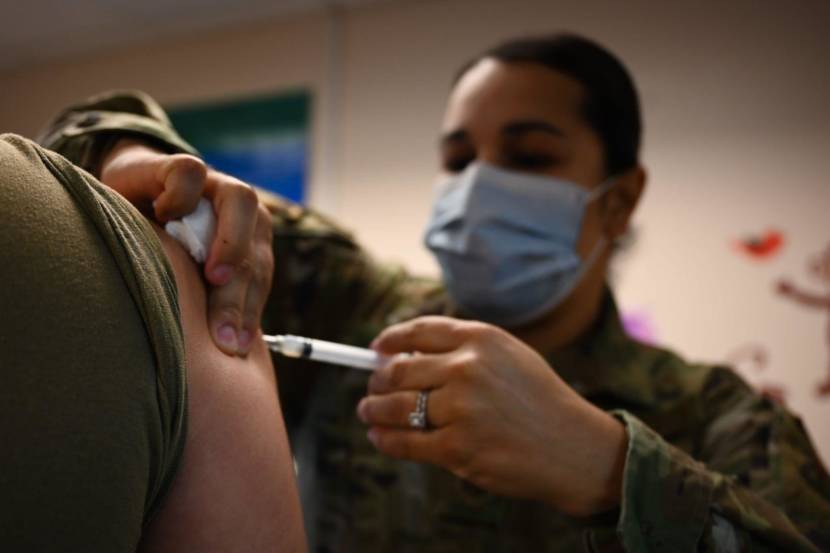
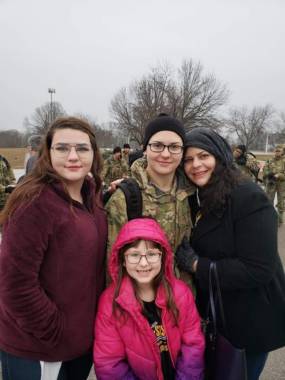
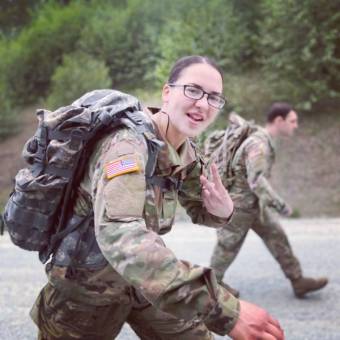
In April, Tanana Chiefs Conference donated hundreds of vaccine doses to Eielson Air Force Base. (courtesy of Eielson Air Force Base)
U.S. military service members in Alaska and worldwide will be required to get COVID-19 vaccines beginning next month.
Defense Secretary Lloyd Austin announced yesterday that he’s ordering mandatory vaccinations in response to President Biden’s request to add the COVID-19 vaccine to the list of required vaccinations for service members.
Austin says the new policy will become effective either when the president approves his plan to implement the it by mid-September or when U.S. Food and Drug Administration fully approves licensure of one of the widely available COVID-19 vaccines — whichever comes first. In a news release, Austin said the Pfizer-BioNTech vaccine is likely to achieve full FDA licensure early next month.
Austin said he consulted with Joint Chiefs of Staff chairman Army Gen. Mark Milley, the armed services secretaries and medical professionals on the vaccine-mandate plan.
As the U.S. nears President Joe Biden’s August deadline to withdraw troops from Afghanistan, the politics and logistics of getting everyone out of there are complicated and shifting all over the country. And the effects of the U.S. military pulling out are still being discovered.
Former Juneau resident Heather Barr is keeping an eye on the region. She’s living in Pakistan now working for Human Rights Watch.
KTOO’s Lyndsey Brollini caught up with Barr during a brief visit back to town to find out more about her work in human rights and the current situation in Afghanistan.
Listen:
This transcript has been edited for length and clarity.
Brollini: I’m interested in hearing about your journey. Like, you know, you came from Juneau. How did you end up working with Human Rights Watch in Afghanistan?
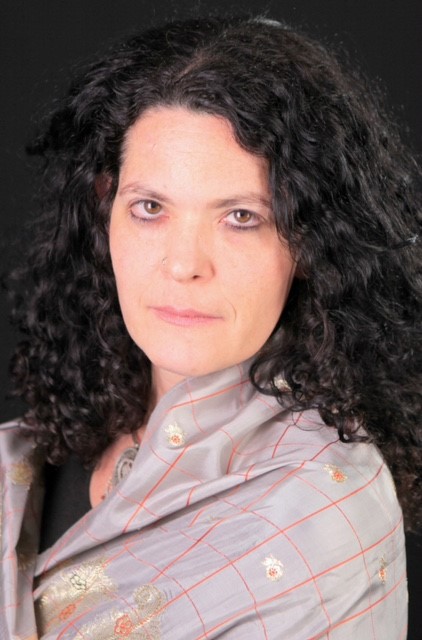
Heather Barr, co-director of the Women’s Rights division at the Human Rights Watch. (Photo courtesy of Heather Barr.)
Barr: I left Juneau and moved to Seattle first. And then I went to London and the United Kingdom. And traveled around for about a year and a half in Africa and Asia. And then moved to New York for about 12 years, went to law school, worked as a prisoners rights lawyer in New York, and then decided to go back to school and study international human rights. Went back to London to do that. And then joined the United Nations. Firstly, in Africa, in a small country called Burundi, and then in Afghanistan. And then while I was in Afghanistan, I stayed there for six years, I left the UN and joined the organization I work for now, Human Rights Watch.
Brollini: So what is the kind of work that you do at the Human Rights Watch?
Barr: So we document human rights abuses and try to advocate for an end to human rights abuses. I moved over to the Women’s Rights Division about seven years ago. And since then, I’ve been working on lots of different issues, including girls’ access to education, child marriage. I worked in human trafficking. Our approach is always to collect evidence about what’s actually happening on the ground and then use that evidence to try and make governments or international organizations like the UN or companies stop whatever abuses are going on.
Brollini: How did you get involved in human rights?
Barr: I don’t know, I got really into punk rock music when I was a teenager in Juneau still. It was really hard to buy albums back then, but you can order them through the mail. And I started reading magazines about music, but also about politics. And so that made me think about things in some different ways. And then when I first got to New York, the first full-time job I had was working in the shelter for homeless women. After working there for a while, I was less interested in trying to change the clients and more interested in trying to change the way the government worked and how it was behaving in the sense that it was making it impossible for the women I worked with to get housing and to get health care and to get drug treatment and to get public benefits and so on. So I guess that’s how I got interested in human rights.
Brollini: Wow. I love that it started with, like, punk rock and magazines and stuff. How is the situation like in Afghanistan, you know, with the U.S. military leaving? And how is that impacting, like, the human rights there?
Barr: So, the last two months have been a disaster, honestly, since President Biden announced that the U.S. was withdrawing unconditionally. The Taliban have really gone on the offensive and tried to take over as many areas of the country as they can. It’s been really clear, from the way they behaved in those areas, that they haven’t changed at all since 2001. So everything you read about before 2001, about how they treated women, not allowing women out of the house without male family members escorting them, not allowing women and girls to go to school, not allowing women to work. All of that is happening again. That doesn’t mean that the US military should have stayed forever, or even that the US military should have stayed longer. But I think that the way that U.S. government has behaved is sort of as if they don’t really care what happens. They didn’t really do any planning or think very much about, you know, what the immediate consequences would be or what the long-term consequences would be, or what this would mean for women’s rights. And so I found that really frustrating.
Brollini: What would you say to people who think that, you know, this issue doesn’t really affect them too much because Afghanistan is such a faraway place?
Barr: Well, you know, we pay taxes, we vote. So when our government invades another country, drops bombs on another country, that’s our decision too, you know? We paid for that invasion, we paid for those bombs, we elected those politicians. So it’s not that far away, in a way. And one of the things that really gets me is that it’s been 20 years since the Taliban were pushed out of power. And in those 20 years, a whole generation of young women and girls have grown up, thinking that they were gonna have freedom and be able to study and be able to work and walk down the street if they wanted to. And thinking that, you know, this dark time during the Taliban period was a sad story that they heard from their mother and from their grandmother that would never happen again. And now it is happening again. And it’s our actions, as Americans that, you know, created this sequence of events and I don’t see how we can feel like, what’s happening to those girls and young women has nothing to do with us.
Brollini: What do you wish that people here knew about the war, the U.S. involvement, how that impacts the region and the world?
Barr: I think when you picture a war on the other side of the world, it’s easy to not really imagine humans there, you know? You just imagine bombs rolling all the time and things blowing up. But there are also people who are trying to feed their families or, you know, who have a big exam that they’re studying for or who applied for a job and are waiting to find out whether they got it or not. The way that families are trying to live in Afghanistan is actually not that different from how families are trying to live in Juneau or anywhere else in the U.S. We need to have compassion for those families the same as we would for the one across the road, you know?
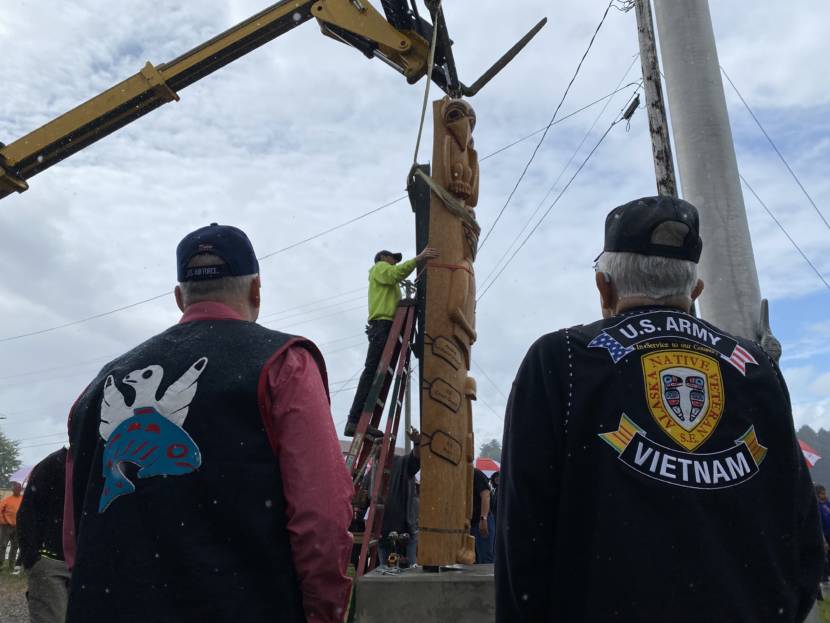
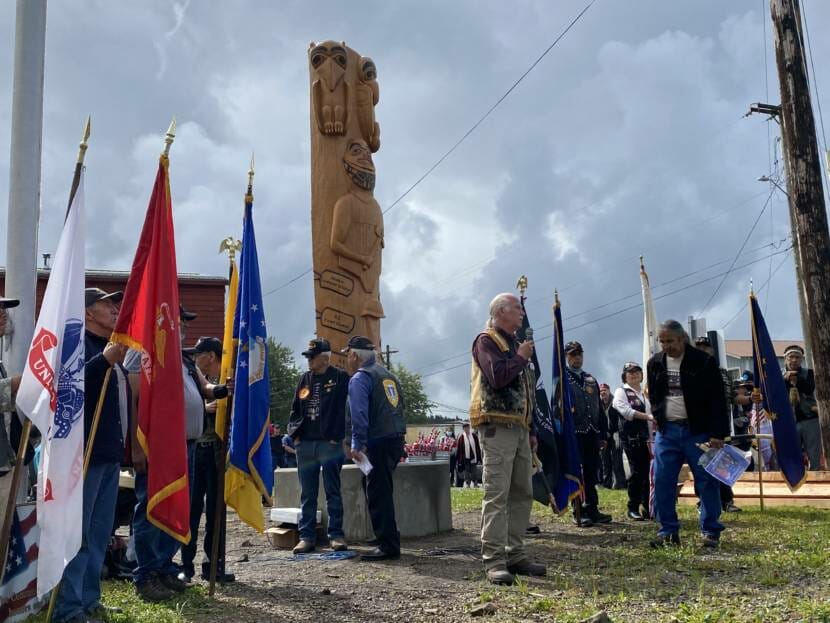
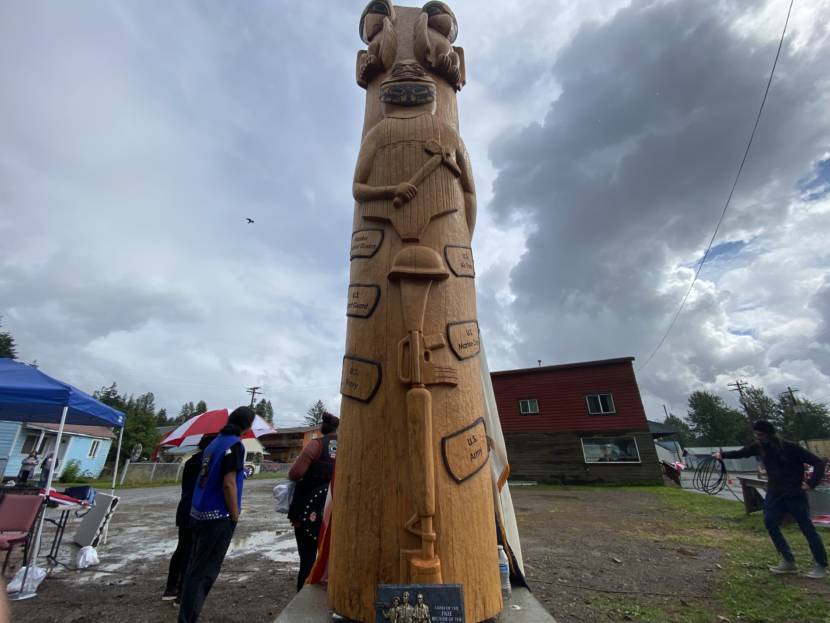
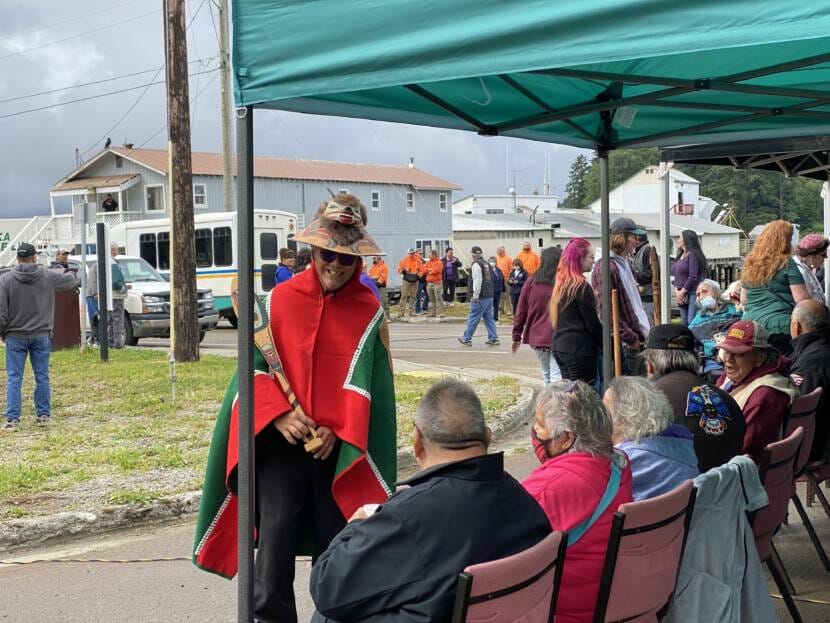
Veterans and their families came together for a totem pole raising ceremony in Hoonah on Saturday, July 24. (Photo by Bridget Dowd / KTOO).
A two-year project honoring Alaska’s veterans is finally complete. On an emotional weekend in Hoonah, service members and their families gathered to celebrate.
A few hundred people sat for five hours in the rain on Saturday to witness the raising of a totem pole honoring the community’s service men and women.
There are a lot of veterans in Hoonah. At least 10% of the population has served in the military — one of the highest numbers per capita in the country. Even before Alaska was a state, many Alaska Natives stepped up to fight for the United States.
Local artist Gordon Greenwald explains his totem pole design. (Photo by Bridget Dowd / KTOO).
Local artist Gordon Greenwald designed and carved the totem pole.
“All you men and women that have stepped forward, we have tried to honor you the best we could with our hands and our tools,” he said.
He’s not a veteran himself, but he wanted to pay tribute to those who’ve served.
“Gunalchéesh,” Greenwald said. “May our hands do you justice. Thank you.”
Veterans and their families came together for a totem pole raising ceremony in Hoonah on Saturday, July 24. (Photo by Bridget Dowd / KTOO).
The base of the pole honors the fallen soldier. Moving upward, there are carvings of combat boots from Operation Desert Storm, a Vietnam-era M16 rifle and a World War II helmet.
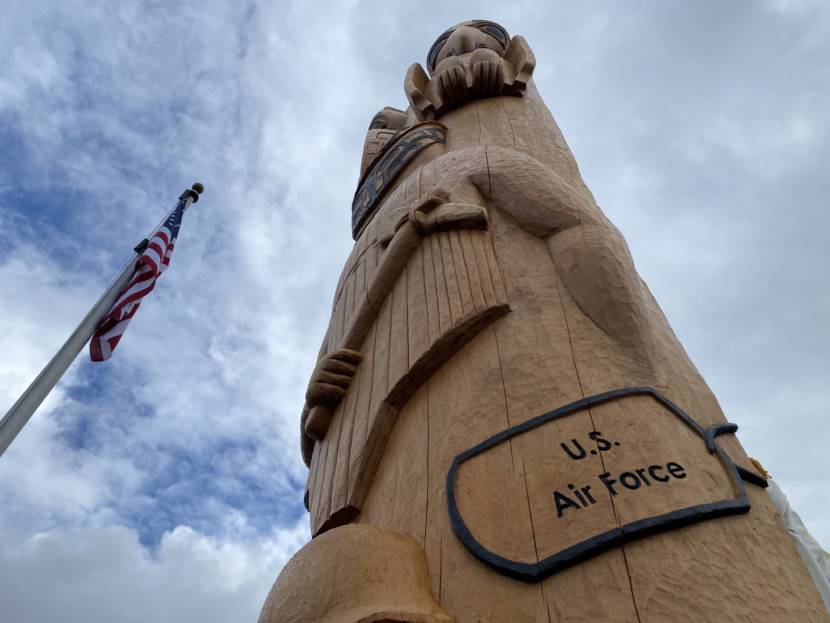
Toward the middle are carved dog tags representing each branch of the service, including the Alaska Territorial Guard, and a Tlingit warrior dressed in armor.
Toward the middle of the totem pole are carved dog tags representing each branch of the service, including the Alaska Territorial Guard, and a Tlingit warrior dressed in armor. (Photo by Bridget Dowd / KTOO).
“And on the top are the eagle and raven,” Greenwald said. “Now you notice that the eagle and raven are turned slightly back to back. It’s not the cold shoulder, but all you military veterans know ‘I’ve got your back, buddy.’”
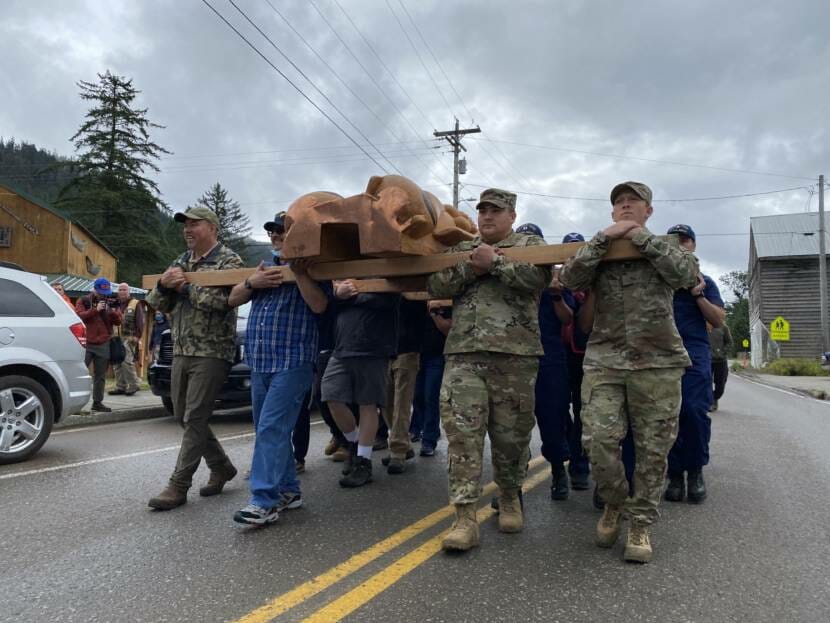
Veterans carry a totem pole to its permanent location in Hoonah. The pole was raised during a ceremony on Saturday July 24. (Photo by Bridget Dowd / KTOO).
Veteran commanders traveled from Sitka, Juneau and Kake to join those from Hoonah. William “Ozzie” Sheakley was the emcee.
“I’m the commander for Juneau Vets so they asked me to emcee over here since I’ve been doing it for a while,” Sheakley said. “The carvers finished last summer, but we weren’t ready to put it up because of the COVID. We wanted to put it up when it was mostly all clear.”
When there was a break in the ceremony for lunch, Sheakley caught up with Hoonah Veterans Commander James Lindoff Jr.
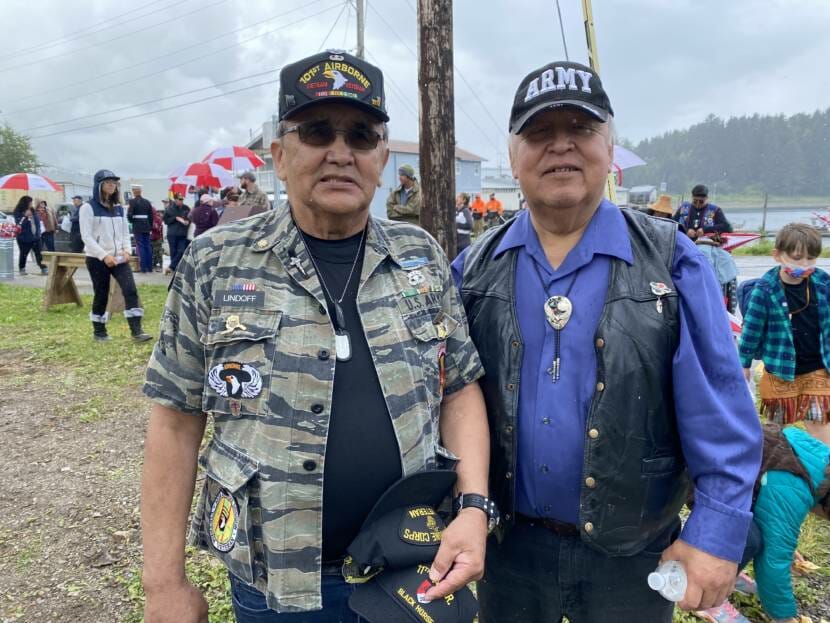
Veterans James Lindoff Jr. and William “Ozzie” Sheakley pose during a totem pole raising ceremony in Hoonah on Saturday, July 24. (Photo by Bridget Dowd / KTOO).
“We were up in Wasilla in ‘98,” Lindoff said. “They got a wall. I told my cousin — he’s passed on — but I told him, ‘We’ll get ours. We’ll get our own.’ Which we are.”
Lindoff was in Vietnam in 1967 and 1968.
He joked as it started to drizzle again.
“Here comes the rain,” he said. I’m gonna lose my curls now.”
And there was plenty of chanting, singing and dancing to be seen throughout the day; the rain not hindering anyone’s ability to appreciate the weight and joy of the occasion.
There are a lot of veterans in Hoonah. At least 10 percent of the population has served in the military — one of the highest numbers per capita in the country. (Photo by Bridget Dowd / KTOO).
The project is a collaboration between the City of Hoonah, the Huna Heritage Foundation, the Hoonah Veterans Committee and Hoonah clan representatives.
The land was donated by Korean War veteran Stanley “Steamie” Thompson who passed away in April. His wife Judy Thompson spoke on his behalf.
“Steamie was born and raised in Hoonah and he was very proud to be from Hoonah,” she said. “He was very proud of his heritage. He was very proud of his family and he was very proud to be a veteran and so that’s why he wanted to dedicate this land to the Huna Heritage Foundation.”
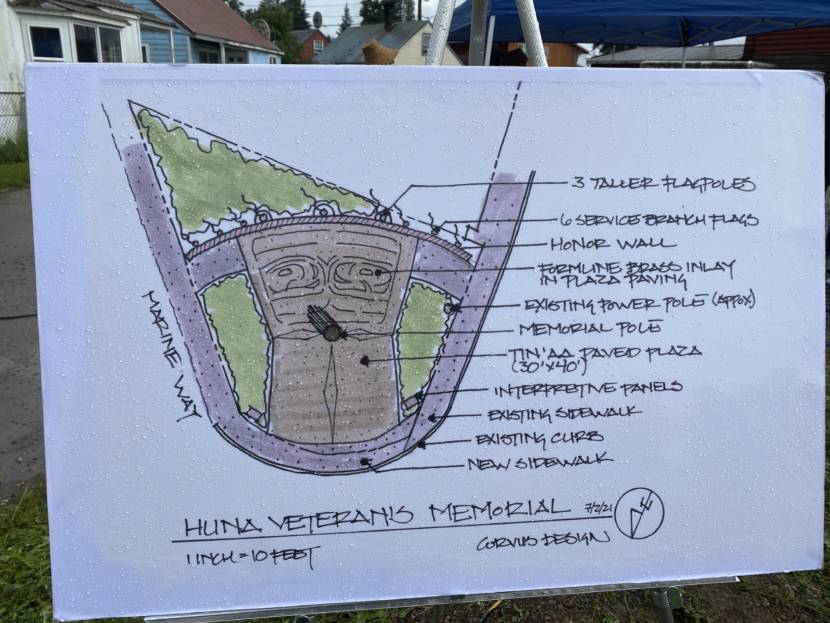
Huna Heritage Foundation Executive Director Amelia Wilson said the totem pole is just the first piece of what will eventually be Huna Veteran’s Memorial Park.
The new totem pole is just the first piece of what will eventually be Huna Veteran’s Memorial Park. (Photo by Bridget Dowd / KTOO).
“There will be a memorial wall honoring those Hoonah Veterans who have passed on and that will be behind the totem pole,” Wilson said. “Then there will be some concrete work in the shape of a Tin’aa, which is like a copper shield and it’ll have some brass inlays and then we’ll have some native plants that will be used for landscaping around it to kind of enclose the space in a natural way.”
Wilson added that it felt good to be able to gather for something positive because the few occasions they’d been able to get together recently were for funerals or the passing of loved ones.
“I think in our community and most other communities too, if you haven’t served yourself, somebody in your family or in your social network has served,” Wilson said. “So it’s really something that can unite us and it really showed at the event.”
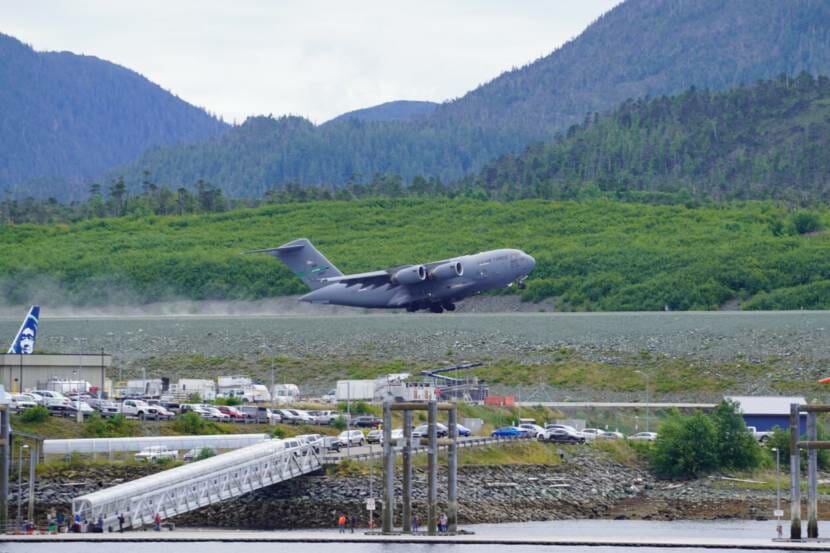
A C-17 Globemaster from Joint Base Lewis-McChord takes off from Ketchikan International Airport Monday afternoon. The military transport plane arrived Sunday. (Eric Stone/KRBD)
A heavy military cargo plane landed at Ketchikan’s airport over the weekend. But military officials are mum on what the Washington state-based C-17 Globemaster is doing here.
Ketchikan’s airport manager Alex Peura says the civilian airport has only been given a bare-bones briefing.
“They scheduled a few days before they arrived that they’d be here from 1:00 in the afternoon on Sunday, and they were departing 1:00 in the afternoon today, Monday. And other than that, I really don’t know any more about it — why they’re here, what they’re doing, where they’re heading,” he said in a phone interview Monday.
Military officials in Tacoma confirmed the C-17’s presence in Ketchikan was related to a “current mission.” But Air Force spokeswoman Sarah Amato of the 62nd Airlift Wing at Joint Base Lewis-McChord declined to comment further, citing operational security concerns.
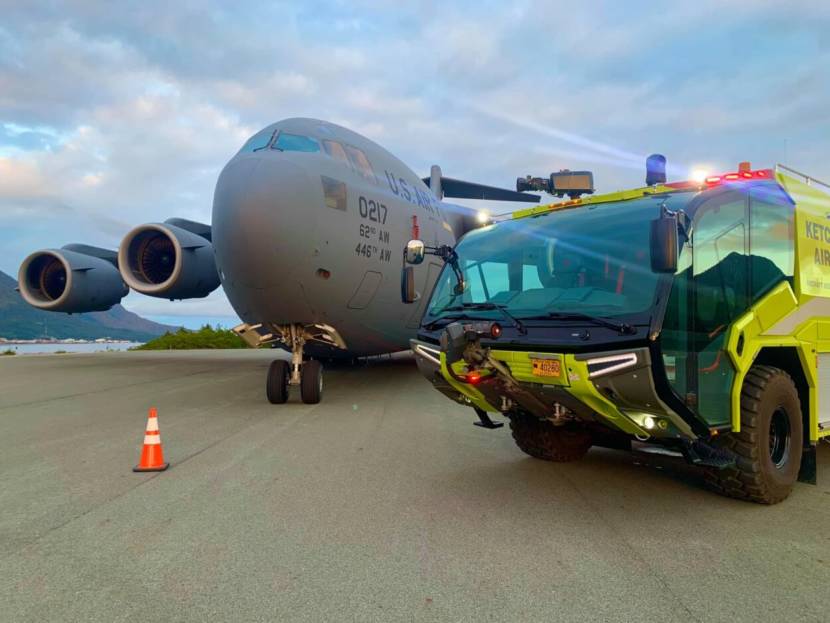
Though an airport fire truck approached the plane with lights flashing at least once on Sunday, Peura says it was just a drill.
One of Ketchikan’s airport fire trucks posed for a photo with the visiting cargo plane Sunday. (Photo courtesy of Nathan Whatmore)
“They do random training, they fire them up, they run them down the runway frequently, just to keep them going … I don’t think that had anything to do with the aircraft being here,” he said.
A representative of the company that handles ground operations at Ketchikan’s airport said the plane took on fuel while in town. Peura says it’s relatively common for military aircraft to overnight and refuel at Ketchikan’s airport en route to other destinations.
A Fort Wainwright soldier who fatally shot a Black Lives Matter protester in Texas last year was indicted last week by a grand jury in Austin, Texas.
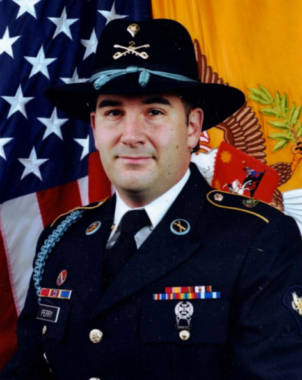
Army Sgt. Daniel Perry (U.S. Army photo)
Sgt. Daniel Perry was stationed at Fort Hood when he shot the protester on July 25, 2020, but on Sept. 1 he began a new tour at Fort Wainwright. A Fairbanks civil rights advocate worries the case could inflame local racial tensions.
A U.S. Army Alaska spokesperson said Wednesday that Perry is assigned to the 1st Stryker Brigade Combat Team. But the spokesperson could not answer other questions about why the 34-year-old infantryman was allowed to be stationed here despite facing a trial.
Travis County, Texas, Sheriff’s Office spokesperson Kristen Dark said Perry was formally charged on July 1.
“He was booked into the Travis County Jail on two charges: murder and deadly conduct,” she said in an interview Wednesday.
A local television news outlet says Perry flew from Alaska to Texas last week to surrender to authorities after a warrant was issued for his arrest. Dark said he was released soon after posting a $300,000 bond.
“He was booked into the Travis County Jail around 2:20 that afternoon, and he was released from custody at 2:36, I believe,” she said.
Perry was off-duty that summer night, working a side gig as an Uber driver. He reportedly was waiting for a fare when he encountered protesters at a downtown intersection around 10 p.m.
According to the indictment, as Perry tried to turn onto a cross street, he “recklessly engage[d] in conduct that placed a group of protesters walking in the roadway … in imminent danger of serious bodily injury.” The indictment said he was texting on his cellphone while making the turn as pedestrians were in the crosswalk. Then he drove into a group of people who were in the street. That’s the basis of the deadly conduct charge.
The indictment said Perry threatened one of the pedestrians and drove toward that person. But he wasn’t able to get very far because the street was filled with protesters.
One of them was 28-year-old Garrett Foster, who was carrying an AK-47, which is allowed under Texas’s open-carry laws.
Foster reportedly approached the car and Perry perceived that he was threatening him with the rifle, although eyewitnesses dispute that. Police say Perry drew his pistol, which he was legally allowed to carry, and shot Foster, fatally wounding him. An eyewitness recorded and posted a video of the incident.
Perry then drove away and later called police, who detained him briefly until he claimed he shot in self-defense. Perry and his lawyers argue he was justified to use deadly force under Texas’s Stand Your Ground law. Austin Police say they’re still investigating the shooting.
Both Perry and Foster are white. But BLM supporters say the shooting shows police don’t place a high priority on protecting protesters.
A Fairbanks civil-rights advocate said he’s also troubled about the case and its potential to further inflame local residents and activists who are angered over police brutality toward Alaska Natives and other people of color.
“There’s Blue Lives Matter marches that are going on,” said Bennie Colbert, a former head of the Fairbanks NAACP chapter. “There’s still a lot of activism with the Natives and the police department, and things of that nature. And then here we have the military situation. ”
Colbert said in an interview Tuesday that he’s speaking as a concerned citizen about the case. He said he’s troubled that Army officials permitted Perry to come to Fort Wainwright despite the fatal shooting and, now, the indictment.
“I think the military, somebody, should have taken this into consideration before bringing this into our small community,” Colbert said.
“This could be a volatile situation,” he said. “So, people need to sit down and discuss it.”
According to the Travis County District Court Clerk’s office, the next court proceeding in the case is scheduled for July 22.
A person in the Travis County Attorney’s office who spoke off the record said barring a plea deal or dismissal of charges, it may take a while for the case to come to trial because of a backlog of cases leftover from the pandemic shutdown.
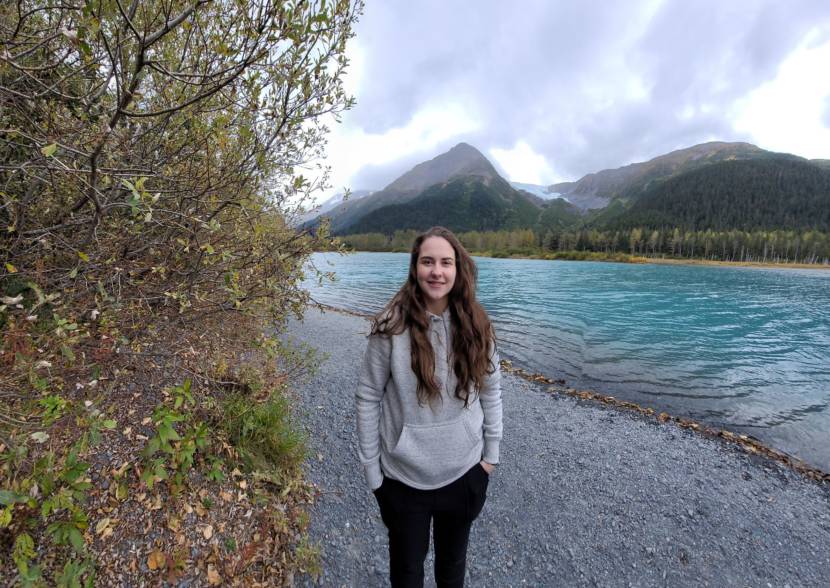
Kaylie Harris poses for a photograph taken by her mom during her visit to Alaska in September 2020. (Photo courtesy of Carey Harris Stickford)
Content warning: This story mentions suicide and sexual assault.
The memory of Kaylie Harris in an airport last year, staring at her plane ticket to Alaska, is so vivid for her mom Carey Harris Stickford.
“I said, ‘What are you looking at?’” Stickford recalled. “And she goes, ‘My dream.’ Sorry, I don’t mean to cry. ‘My dream. I’m getting to fulfill my dream. Not only am I a military police officer, but I’m going to the one place I’ve wanted to be.’”
Just after graduating high school in Ohio, Harris joined the U.S. Army. She went through training to become a military police officer. And then she got stationed at Joint Base Elmendorf-Richardson in Anchorage. Her top pick.
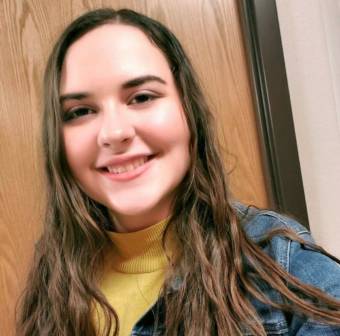
Kaylie Harris (Photo courtesy of Carey Harris Stickford)
But, just over a year later, on May 3 at 6:40 a.m., her mom’s doorbell rang in Ohio.
“I opened it,” Stickford said. “And it was two chaplains from the Army. And the first thing I said to them was, ‘My daughter’s dead. She killed herself. Why didn’t you call me back?’”
Pvt. 1st Class Kaylie Harris died by suicide on JBER on May 2. She was 21.
What Stickford learned after Harris’ death — through the military, her daughter’s friends and what her daughter left behind — stunned her.
Stickford said her daughter had reported to the military that she was sexually assaulted by an airman on JBER in late January — 10 days after she came out as a lesbian on Facebook.
Now, Stickford is telling the story of her daughter’s death to highlight what she sees as major lapses in the military’s response. And she wants changes to how the military handles sexual assault investigations, mental health and harassment of LGBTQ troops. It also comes amid a national spar over whether to overhaul the military justice system.
“I can’t bring Kaylie back,” Stickford said. “But I can make sure that what happened to Kaylie doesn’t happen to somebody else. That’s my goal.”
‘How many alarms’
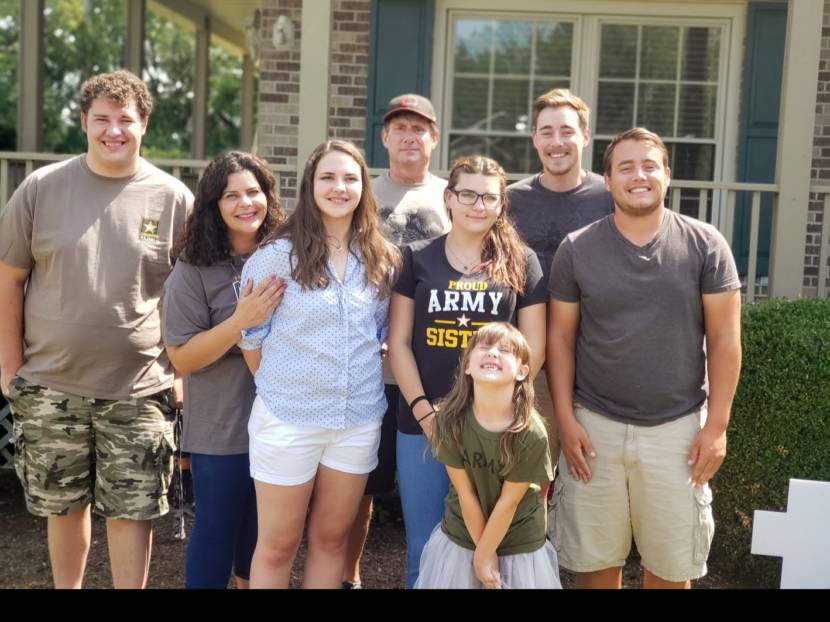
Kaylie Harris (center) poses for a photograph with her mom, Carey Harris Stickford (left) and her friends and family during a going-away party before she left for training in August 2019. (Photo courtesy Carey Harris Stickford)
USA Today was among the first publications to report on Harris’ death, describing it as “a confluence of currents that have ripped the military for decades: sexual assault, suicide and integrating LGBTQ troops.”
The issues are particularly pervasive in Alaska — a state with a high rate of sexual assaults and also a high rate of suicides, including among the soldiers stationed here. USA Today reported that the suicide rate among soldiers in Alaska appears to be nearly four times higher than the general U.S. rate.
Kaylie Harris (center) poses for a photograph with her mom, Carey Harris Stickford (right) and her two sisters, Lillian (left) and Josie. (Photo courtesy of Carey Harris Stickford)
Stickford said she could tell something was wrong with her daughter earlier this year. She just couldn’t figure out what it was.
The mother and daughter had been really close. Then, suddenly, Harris became distant, said Stickford. Not calling. Not responding to messages. Forgetting family birthdays.
“She was supposed to get ready for her sister’s wedding. She wouldn’t respond to getting a dress, things like that,” said Stickford. “She had more of an angry tone to her like, ‘You just need to leave me alone.’”
At the end of March, Stickford became increasingly worried. She started making calls to try to get help: To a military suicide hotline, to JBER’s family center, to her daughter’s commanding officer. She got little response.
“How many alarms can I yell through from Ohio to Alaska?” Stickford said.
An ongoing investigation
As Stickford retraced Harris’ steps, thousands of miles away in Alaska, she said she found a series of red flags that the military failed to act on.
She learned that her daughter’s accused attacker had harassed her in front of others in the past.
“What I’ve gathered from her peer troops is that this airman would give her a hard time saying all, you know, ‘Harris, you’re a lesbian because you’ve never been with a real man,’” said Stickford.
The military isn’t disclosing much publicly about the reported sexual assault and is handling the investigation internally.
In a written statement, JBER spokesman Major Michael Hertzog II said the alleged sexual assault is still under investigation, and no charges have been filed.
He said JBER is mourning the loss of Harris.
“We are fully committed to the investigative process, and we will not rest until that process is complete,” said his statement.
According to military officials, the airman accused of assaulting Harris remains on base.
A photo of Kaylie Harris in Alaska given to her mom, Carey Harris Stickford, by a friend for Harris’ memorial services. (Photo courtesy Carey Harris of Stickford)
‘I want to protect’
Stickford is angry.
In the past couple months, she said, she learned that the military had put Harris in mental health treatment and under a do-not-arm order in late March after she told a friend she had thoughts of suicide.
And then, on April 27, as the military continued to investigate the reported sexual assault, Stickford said Harris encountered her alleged attacker again, during a training on base. They were both assigned to the same building.
Stickford said she doesn’t know what happened between the two of them then.
“I was told that she was in extreme distress and had to be physically removed from the building,” Stickford said.
Still, she said, her daughter was allowed to go back to her military police job at the end of that week, and to have a gun again.
She bought one on base two days later and took her life.
“Something happened in that hallway that made her decide that I can no longer live in this world after trying so hard,” Stickford said. “And that’s what was so heartbreaking to me.”
Harris named her alleged attacker in a suicide note.
Hertzog said after the sexual assault report, commanders placed the accused in another duty location and issued a Military Protective Order. He said the military is investigating if any contact occurred during that protective order.
Stickford said she believes her daughter would still be alive if the military took her sexual assault report and her declining mental health more seriously.
She wants her daughter’s story known.
“I want to protect. That’s the mother instinct in me. I am a mama bear, you know, and now I don’t have her to protect anymore,” she said. “But I’m going to do everything I can to protect anybody I can.”
Stickford also wants changes to military law. She wants it to include hate crimes to protect LGBTQ troops.
If you or someone you know is struggling with mental health or having thoughts of self-harm or suicide, there are many resources to help: Contact the Alaska Careline at 1-877-266-4357 or text 4help to 839863. You can also call the National Suicide Prevention Lifeline at 1-800-273-8255. View warning signs of suicide from the National Institute of Mental Health.
Close
Update notification options
Subscribe to notifications
Subscribe
Get notifications about news related to the topics you care about. You can unsubscribe anytime.