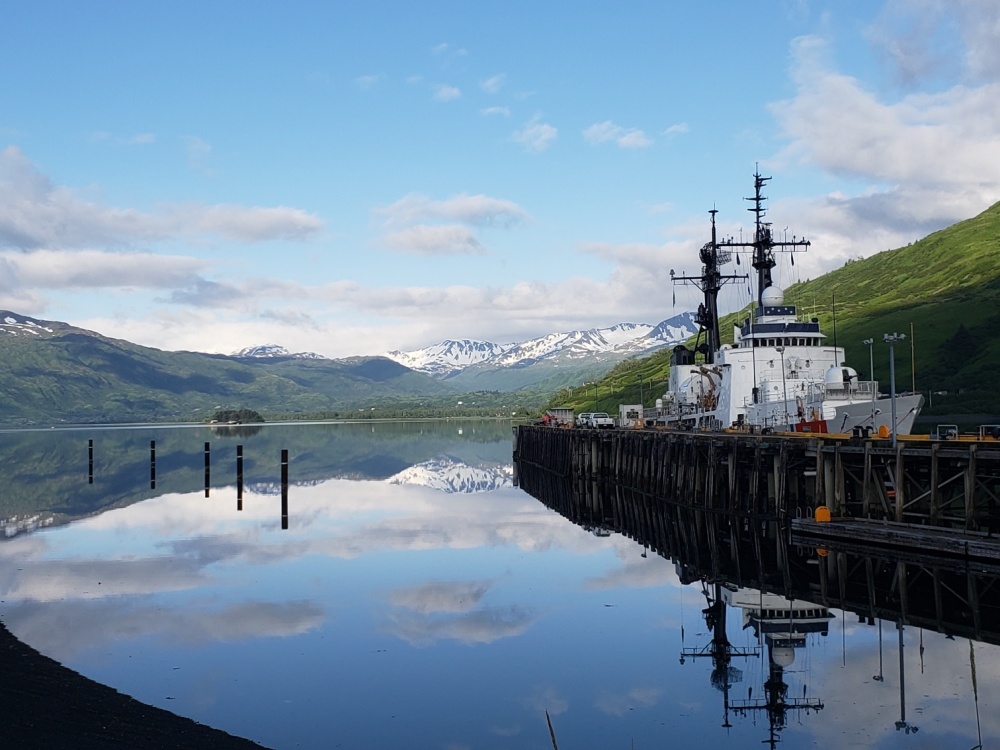
The Coast Guard Cutter Douglas Munro sits moored in its homeport in Kodiak, June 22, 2019. (Public domain photo by Ensign Jacob Marx/U.S. Coast Guard)
The U.S. Coast Guard says a seaman will face a court martial on murder and other charges in the death of a fellow seaman.
Ethan Tucker is charged in the January 2019 death of 19-year-old Seaman Ethan Kelch of Virginia Beach, Virginia, while their vessel — the Kodiak-based Cutter Douglas Munro — was stopped in Unalaska for repairs last winter.
Military prosecutors allege the 21-year-old Tucker, of Ludington, Michigan, beat Kelch and dragged his body to the water where he was left to drown.
During an October hearing, Tucker’s defense attorney, Navy Cmdr. Justin Henderson, painted a very different picture of what happened. Henderson said a bystander took video that night showing Tucker’s efforts to get Kelch out of the water, before he collapsed, exhausted and intoxicated.
According to a Coast Guard spokesperson, the decision to proceed to court martial was made last week.
Tucker is charged with six violations of the Uniform Code of Military Justice — including murder, aggravated assault and involuntary manslaughter.
He is currently restricted to the Coast Guard base in Alameda, California. The court martial is expected to take place in 2020.
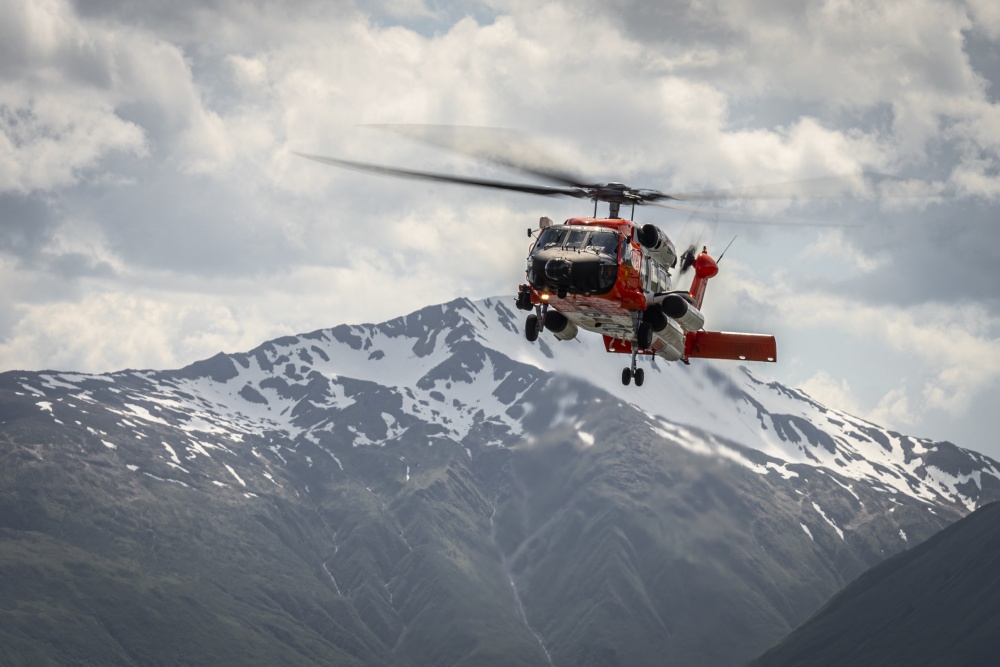
An aircrew aboard an MH-60 Jayhawk helicopter makes an approach on their return to Coast Guard Air Station Kodiak, June 5, 2019. (Public domain photo by Petty Officer 1st Class Bradley Pigage/U.S. Coast Guard)
The U.S. Coast Guard has released the names of the crew members of the FV Scandies Rose.
The five missing are Gary Cobban Jr. (Master), David Lee Cobban, Arthur Ganacias, Brock Rainey and Seth Rousseau-Gano. The two survivors are Dean Gribble Jr. and John Lawler. They were treated for hypothermia at a hospital in Kodiak, but sustained no other serious injuries. (Read more.)
Original story
The U.S. Coast Guard suspended its search on Wednesday evening for five people feared lost after their 130-foot fishing boat sank on New Year’s Eve near Sutwik Island, off the Alaska Peninsula.
The Coast Guard rescued two people and have suspended the search for the rest of the FV Scandies Rose’s seven-person crew.
According to the Coast Guard, the search spanned over 20 hours, 1,400 square miles, and included four MH-60 Jayhawk helicopter crews, two HC-130 Hercules airplane crews, and the Coast Guard Cutter Mellon.
Rear Adm. Matthew Bell, 17th District Commander, said Wednesday evening that after exhausting all leads and careful consideration of survival probability, the Coast Guard decided to suspend its active search pending new information or developments.
“The decision to suspend an active search-and-rescue case is never easy, and it’s only made after careful consideration of a myriad of factors,” said Bell. “Our deepest condolences to the friends and families impacted by this tragedy.”
Rescuers on scene said the elements were against them: 40 mph winds, well-below-freezing temperatures, and high seas as they searched for the boat and crew.
Petty Officer Evan Grills is the rescue swimmer who rescued two crew members from a life raft.
“When we were down there, it was pretty wild,” said Grills. “It was 20-30 foot seas, and tremendously cold, so the dexterity in my hands was starting to go. And just trying to battle keeping situational awareness between the helicopter, table management, keeping the survivor’s face out of the water, and making sure we both didn’t get tumbled in waves … it was definitely challenging.”
Coast Guard spokesperson Melissa McKenzie said the pair that was rescued at about 2 a.m. New Year’s Day were wearing Gumby survival suits.
“When our helicopter crew arrived on scene, they found two life rafts in the search area,” said McKenzie. “One had two survivors (in it) and the other one was empty.”
The 34-year-old and 36-year-old survivors reportedly had spent four hours in the life raft. They were hypothermic and admitted into a Kodiak hospital but had no other injuries.
Lt. Jon Ardan, co-pilot on the MH-60 Jayhawk helicopter, said the life raft was within 10 miles of the Scandies Rose’s last known position. No wreckage or debris had been found as of Wednesday evening.
“We landed back in Kodiak with not a lot of fuel, so we didn’t have very much time to search for additional survivors, or even to search for the (two we rescued),” said Ardan. “So it was truly a miracle that we found them so expeditiously, that we were able to pick them up without incident, and that we started making our way back home with a good tailwind to push us.”
The Coast Guard has not determined the cause of the incident off the Alaska Peninsula, about 170 miles west of Kodiak Island.
The Scandies Rose is homeported in Dutch Harbor. Its website describes the 41-year-old ship as a steel-hulled crabbing vessel that works in a number of fisheries, including as a summer salmon tender in Southeast Alaska and Bristol Bay.
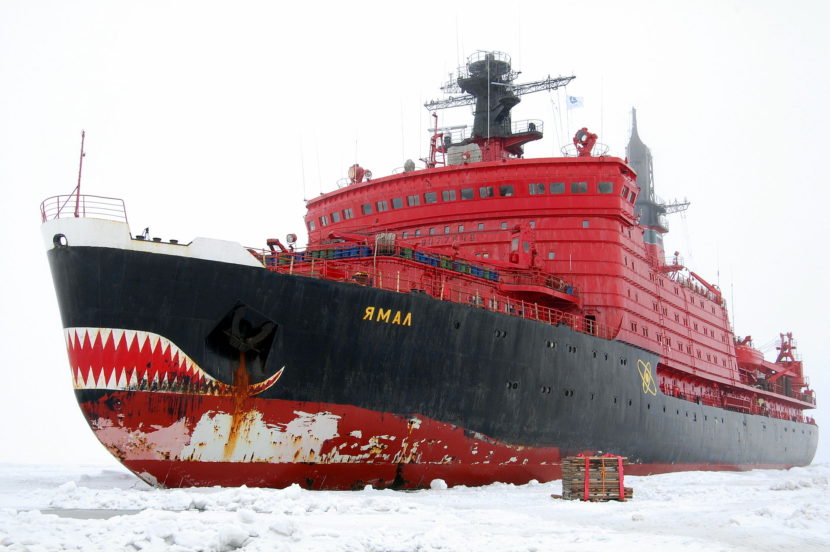
Icebreaker Yamal during removal of manned drifting station North Pole-36. August 2009. (Creative Commons photo by Pink floyd88)
Russia and China have stepped up their game in the Arctic this year, while the United States is just waking to the strategic power competition in the region.
That’s what Heather Conley, a Russia expert at the Center for Strategic and International Studies, and other witnesses told a U.S. Senate panel on Thursday.
Conley said perhaps the year’s most troubling news was about Russian missiles.
“Four days ago, the announcement by the Russian military (was) that they are placing S400s at each of their military units across the Russian Arctic, calling it a de facto anti-missile dome,” Conley said. “So, today we are already potentially losing access to the Arctic because of Russia’s growing military footprint.”
Congress has finally agreed to allow the Coast Guard to begin building six new icebreakers, after a decade of talking about it. Conley said Congress needs to fund an ongoing Arctic initiative so it doesn’t wait another decade to build other necessities, like an Arctic port.
Conley said Russia and China are able to assert themselves in the Arctic now because they committed to their strategic initiatives years ago.
“We continue to believe that we can just hold this minimalist position, do the bare minimum, and it’s going to be OK, and I want to challenge that notion,” Conley said.
Sherri Goodman, a senior strategist at the Center for Climate and Security, said Russia is increasing its control over the Northern Sea Route and becoming more aggressive with U.S. allies in the Arctic.
“Just last month, Russia tested a hyper-sonic missile for the first time in the Arctic and plans to launch their first weaponized icebreaker by 2023,” Goodman said.
Showing how far America lags behind, Sen. Dan Sullivan asked the hearing witnesses if the United States is able to assert its presence to counter foreign overreach in Arctic waters.
“Does the U.S. military have the capability to do a freedom of navigation operation in the Arctic?” he asked.
The U.S. conducts freedom of navigation operations, or FONOPS, by sailing in international waters to assert its rights and counter any disputed territorial claims.
Conley answered definitively: “No, neither the Navy nor the Coast Guard could do a freedom of navigation operation in the Arctic today.”
No one disagreed.
The hearing was in the Commerce Committee’s Subcommittee on Security, which Sullivan chairs.
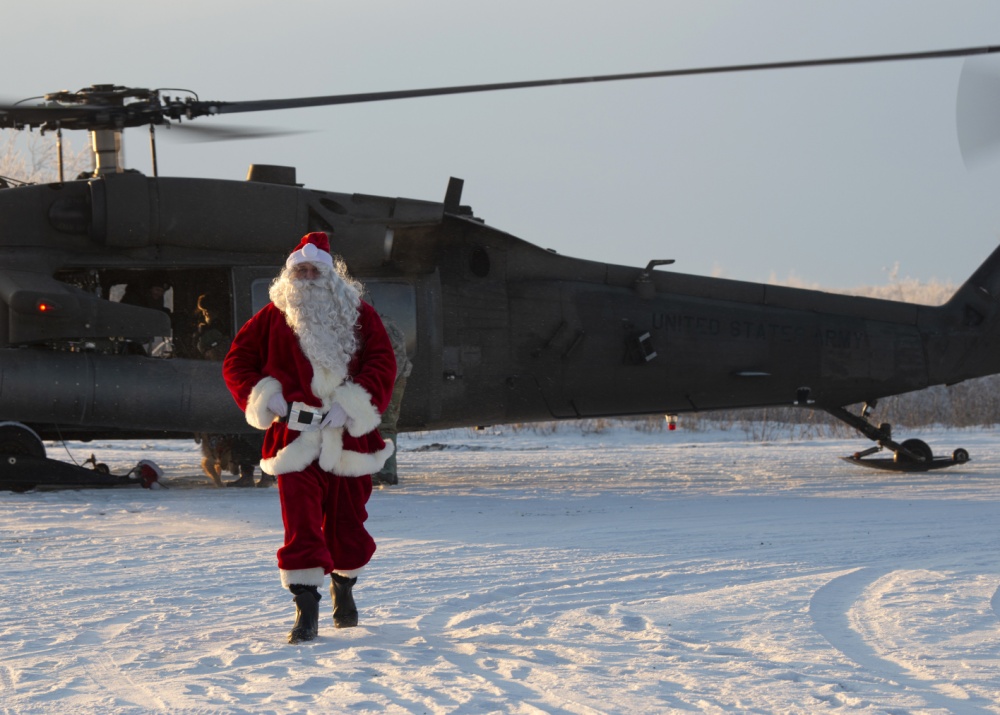
Alaska Army National Guard Sgt. 1st Class Nicholas Mikos, an UH-60 helicopter repairer assigned to the Bethel Army Aviation Facility, dresses as Santa for Operation Santa Claus in Napakiak on Dec. 3. (Public domain photo by U.S. Air Force Airman 1st Class Emily Farnsworth)
Santa Claus delivered presents to Napakiak a little early this year — on Dec. 3, instead of the night before Christmas.
And instead of arriving behind flying reindeer, he arrived in a Black Hawk helicopter.
U.S. Army Sgt. 1st Class Nicholas Mikos is waiting for the Black Hawk helicopter to land outside the National Guard hangar in Bethel. The sun is just peeking over the horizon at 10 a.m., but everyone has been up much earlier.
“I feel great!” Mikos said.
The sergeant has played Santa Claus before, in the Alaska National Guard’s “Operation Santa.” It’s a tradition that dates back to 1956. Each year, the National Guard flies to small, remote Alaskan communities off the road system, bringing presents, ice cream and Santa.
Napakiak was the second village this year; Santa visited Tuntutuliak a week prior.
Mikos and roughly 20 other volunteers are setting up the gym at the Napakiak school. Bags featuring characters from the Disney movie “Frozen” are for babies and toddlers. Older students receive backpacks filled with snacks, toothbrushes and school supplies.
The adults are not left out: They get cheerfully-colored hats knitted by women in Florida.
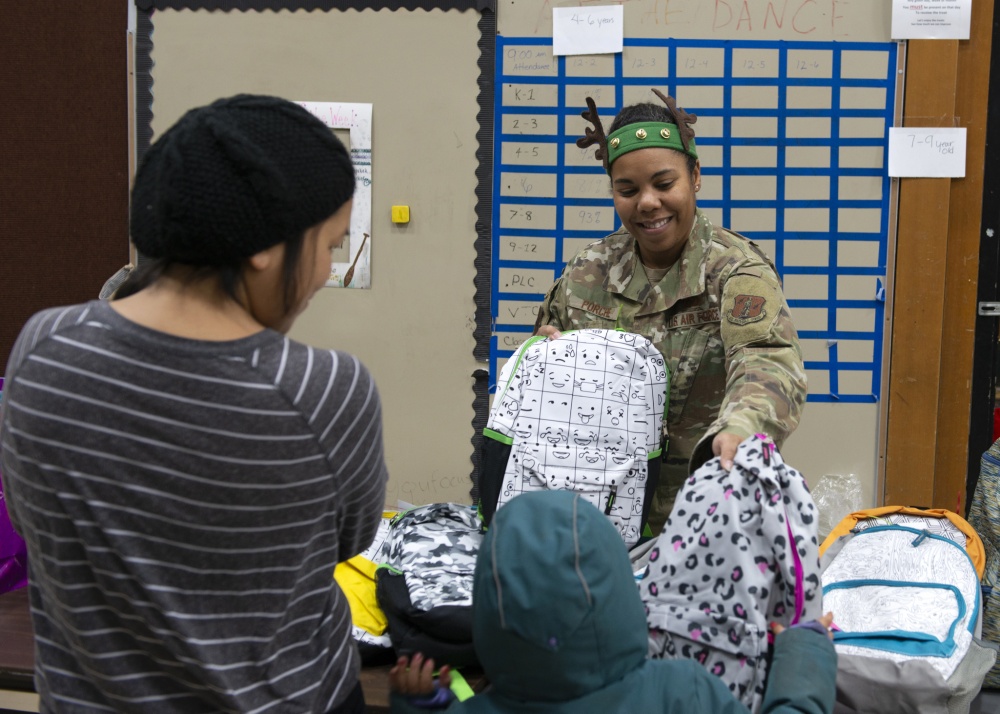
Alaska Air National Guard Senior Master Sgt. Saroya Porche, 176th Force Support Flight superintendent of manpower and personnel, hands out backpacks during Operation Santa Claus in Napakiak on Dec. 3. (Public domain photo by U.S. Air Force Airman 1st Class Emily Farnsworth)
When everything is ready, the children file in to sit in the middle of the gym floor and start singing Christmas carols.
Then the big moment: Santa walks in.
While some kids and their parents line up for Santa, others line up for ice cream. They can choose caramel or chocolate toppings, as well as sprinkles and cherries.
Not everyone knew Operation Santa was coming to Napakiak. Trisha White saw the Black Hawk helicopter circling the village earlier in the morning.
“We didn’t know what was going on,” White said.
So she and her partner, Jonathan Nelson, called around and realized that Santa was on his way.
“A couple hours later, we found out everyone was here,” White said. So they brought their daughter to share in the fun.
Meanwhile, 16-year-old Natalia Ayagalria is admiring her new backpack.
“I got a free backpack that says ‘Peace Frogs,’ and it’s purple,” Ayagalria said.
Ayagalria hopes Santa will come back again.
“I hope it happens because it’s, like, a community activity that’s pretty cool, and not this many people always go to activities,” Ayagalria said.
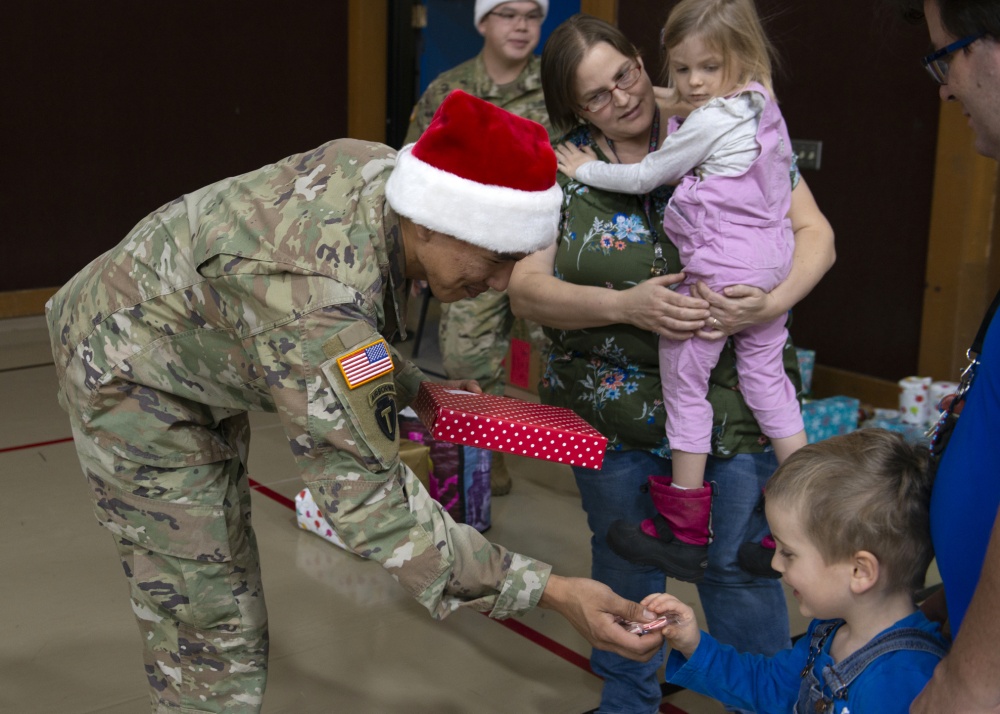
Alaska Army National Guard Sgt. Randall Andrew, an infantryman assigned to the Bethel Army Aviation Facility, gives a child a gift during Operation Santa Claus in Napakiak on Dec. 3. (Public domain photo U.S. Air Force by Airman 1st Class Emily Farnsworth)
For many kids, this was their first time at Operation Santa. For Maj. Gen. Torrence Saxe — the adjutant general for the Alaska National Guard, and the commissioner of the Alaska Department of Military and Veterans Affairs — it was his first time too.
“I haven’t seen kids that excited over Santa for a long time,” Saxe said.
He doled out the cherries for the ice cream line. He has a pretty good idea of the favorite toppings.
“I’m gonna say chocolate with sprinkles and one cherry. I only had two people in the entire room that did not want a cherry,” Saxe said.
Two hours later, it’s over, and everyone packs up. Santa gets into the Black Hawk and takes off.
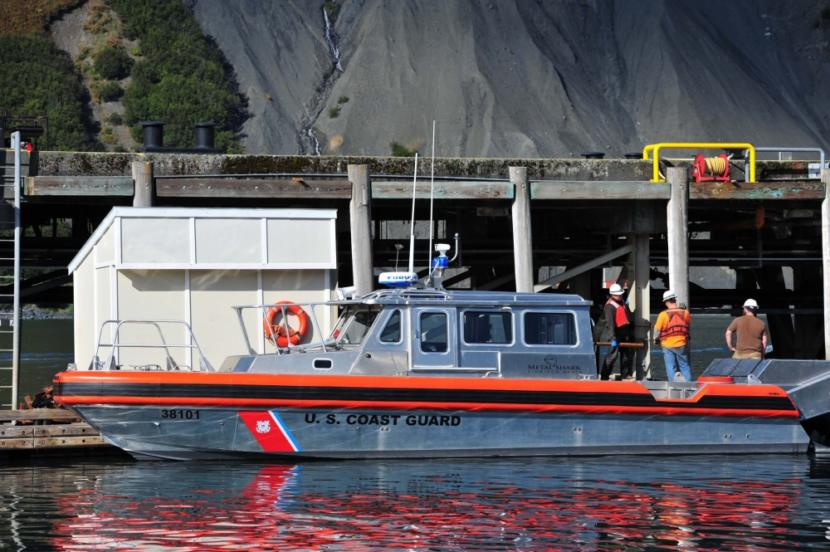
A Coast Guard 38-foot special purpose craft training boat sits at the fuel pier in Womens Bay at Coast Guard Base Kodiak, Sept. 23, 2011. A vessel similar to this one was involved in a collision with a Navy boat in Womens Bay on Wednesday. (Public domain photo by Petty Officer 2nd Class Charly Hengen/U.S. Coast Guard)
Six Coast Guard service members and three Navy sailors were hospitalized in Kodiak on Wednesday evening after a Coast Guard and Navy vessel collision, according to a statement released by Coast Guard Public Affairs late Wednesday night.
The collision occurred around 7:30 p.m in Womens Bay, according to Coast Guard Public Affairs Lt. Cmdr. Scott McCann. All six service members aboard the the Coast Guard vessel were transported to the Providence Kodiak Island Medical Center with apparently minor injuries.
“The injuries were to the extent that our Coast Guard members were released from the hospital last night,” McCann said
According to Kodiak Fire Department Chief Jim Mullican, one injured service member was medevaced to Anchorage at 11:30 p.m. Wednesday. The medevaced individual was likely one of the three Navy sailors.
In an emailed statement, Naval Special Warfare Command Lt. Matthew Stroup said that the injured Navy sailors are in stable condition.
McCann confirmed that the two vessels were Coast Guard and Navy “small boats.” The Coast Guard small boat was a 38-foot special purpose training boat. The Navy boat was a Naval Special Warfare combatant craft, according to Stroup.
The collision caused damages to both boats, but details around the cause of the collision remain unclear, said McCann.
“We will be doing an investigation into who was at fault and why it happened and what type of damage was sustained to both boats,” he said.
He added that such investigations can take weeks to months to complete.
Both the Coast Guard and Navy vessels involved are now moored at the Coast Guard base, but it’s also unclear how they made it back to port.
According to McCann, the collision occurred as the Coast Guard small boat was coming back from performing hoisting exercises with a Coast Guard helicopter, a part of routine search and rescue training. The Navy boat was not involved in the Coast Guard training exercise, though Stroup’s statement did say it was completing “routine training operations” when the collision occurred.
A new lawsuit challenges the initial denial of a $1,606 permanent fund dividend payment to the same-sex spouse of a member of the military stationed outside Alaska. (Photo by Rachel Waldholz/Alaska Public Media)
As many as seven people were initially denied their 2019 permanent fund dividends because they’re married to same-sex members of the military or students living outside the state, according to an anonymous state worker quoted in newly-filed court documents.
The documents are part of a suit filed in federal court Wednesday by Denali Nicole Smith, the spouse of a member of the military, who claims the state denied her this year’s $1,606 PFD because of an Alaska law against same-sex marriages. A federal judge struck down that law in 2014.
After the lawsuit was filed, the state agreed to pay Smith’s PFD, but it would not promise she wouldn’t be denied payments in the future, according to the documents filed Monday.
The new filings quote an anonymous state worker inside the Alaska Permanent Fund Dividend Division, and they appear to contradict a press release from Alaska Attorney General Kevin Clarkson’s office Friday that said there is no one else “similarly situated” to Smith.
Clarkson also accused Smith’s attorney, Caitlin Shortell, of filing a “false lawsuit” that ignored that the state had already reversed itself and agreed to pay Smith’s dividend.
“No one disagrees that the denial letter never should have been sent,” Clarkson was quoted as saying in his press release. “But the division promptly remedied the action once it figured out its mistake.”
Clarkson said questions were raised over the summer about a PFD Division statute booklet that still included the invalidated same-sex marriage law, and that applications that could have been denied on that basis were placed “on hold.” But Smith’s, for a reason that Clarkson did not specify, was “inadvertently” denied instead.
Shortell and Smith, in two separate declarations filed with the court, argue that Clarkson’s statement is false, that as many as six other applications were denied — not just placed on hold — and that the denials were only fixed after the lawsuit was filed.
The documents also describe the series of events leading up to the lawsuit.
After hearing about Smith’s denial in September, Shortell published a Facebook post asking for information or evidence about others denied their dividends on a similar basis, Shortell wrote in her declaration.
The same day, Shortell said she heard from a worker in the PFD Division who confirmed that the state still denied the payments to same-sex spouses and children of same-sex spouses accompanying military members and students outside the state. The employee gave Shortell other details about the state’s practices and “told me that they would provide me information to assist me in this lawsuit and would testify truthfully to these facts under subpoena,” Shortell said.
After the lawsuit was filed last week, the employee told Shortell that the PFD Division’s management asked employees to identify and pay any dividends denied based on the invalidated same-sex marriage statute, and that “approximately seven” cases had been found. But workers have not yet been asked to reverse and pay any denials predating 2019, Shortell said, which, along with Smith’s experience this year, “created the factual basis for the above-captioned lawsuit.”
In a footnote, Shortell said she’s keeping the employee’s name confidential because of their fear of being fired “for having confirmed the unconstitutional actions of state officials in this lawsuit.”
“The PFD employee is referred to with the pronoun ‘they’ to preserve their anonymity,” Shortell wrote.
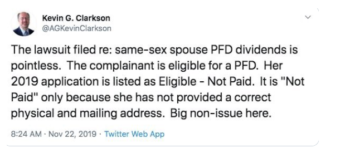
Clarkson criticized Smith’s lawsuit in a tweet Friday that called it “pointless” and a “big non-issue,” saying she was eligible for a 2019 dividend and that it had gone unpaid only because Smith has not provided a correct address. After deleting the tweet, Clarkson issued his prepared statement, which also criticized Shortell for filing a “false lawsuit, knowing full well that the (PFD) Division had already changed course and had in fact informed her that her client’s dividend was scheduled for payment before the lawsuit was filed.”
Alaska Attorney General Kevin Clarkson’s since-deleted tweet from Friday. (Alaska Public Media screenshot)
Smith, in her own declaration, said she filed her lawsuit because the state only reversed itself after she hired an attorney, refused to clearly explain why and wouldn’t guarantee that she wouldn’t be denied in the future.
After her initial denial in September, Smith said she notified state officials that Shortell was representing her and requested relevant documents. A PFD specialist then emailed Smith and Shortell in early November to say that her dividend would be paid, Smith said.
The specialist “did not explain the reason for the reversal in eligibility,” Smith said. In a follow-up phone call, another PFD Division employee told Smith that the state’s lawyers “realized it was wrong what they did,” but would not guarantee that her dividend would not be denied again in the future and refused to give Smith a written explanation for the reversal.
Smith said she subsequently filed the lawsuit because “it appeared to me that the PFD representatives were trying to placate me by promising to pay me my 2019 PFD only after I retained an attorney and to deter me from challenging their practices against me and other same-sex accompanying spouses.”
Smith’s lawsuit asks a federal judge not just to order the state to allow her to receive her own dividend, but also to permanently block Alaska from denying dividends to same-sex spouses of military members and students who live outside the state. It also asks for an order requiring the state to pay all dividends, plus interest, to anyone denied them after the 2014 ruling invalidating Alaska’s same-sex marriage laws.
Both Smith and Shortell said in their declarations that Clarkson’s press release Friday was “false” and “defamatory” and, according to Shortell, “was published with an intent and an effect of prejudicing the public, court, and the legal community and to detract attention from state officials’ ongoing discriminatory practices against Ms. Smith and others who file civil rights lawsuits against state officials and their counsel.”
A spokesperson for Clarkson did not immediately respond to a request for comment on Shortell’s statements.
Close
Update notification options
Subscribe to notifications
Subscribe
Get notifications about news related to the topics you care about. You can unsubscribe anytime.