Military

Saddled with problems, new F-35 fighter jets can’t get enough spare parts

A USMC F-35B at Joint Base Elmondorf-Richardson as part of Northern Edge exercises in 2019 (Photo: Zachariah Hughes, Alaska Public Media – Anchorage)
A USMC F-35B at Joint Base Elmendorf-Richardson as part of Northern Edge exercises in 2019 (Photo: Zachariah Hughes, Alaska Public Media – Anchorage)

A new government report is flagging more problems with the new generation of fighter jets scheduled to come to Alaska in the next few years. Plagued by cost overruns, technical problems and a lack of accountability, it’s the latest review to find fault with both the product and process behind the F-35 program.

It’s already the Department of Defense’s most expensive weapon system. The Pentagon is projected to spend around $406 billion dollars buying its fleet of F-35 fighter jets over the next several years, but it will cost taxpayers another $1 trillion dollars to maintain and operate all those planes during their life cycle. And a report this week from the Government Accountability Office essentially says that is on the low end of estimates.

Alaska is scheduled to get 54 of the new planes, which will be housed at Eielson Air Force Base, and bring an estimated 3,500 military personnel, family members, and contractors to the area.

This is not the first time government inspectors have raised concerns about cost overruns and technical problems with the F-35 program. This new GAO report covers some of the contributing factors, and offers recommendations to mitigate them, many of which the agency has made before, only for the Pentagon to take little or no action.

One worsening problem has to do with spare parts. There aren’t enough of them. The military and its primary contractor on the F-35, Lockheed Martin, are trying a novel supply chain model, but it isn’t working well. When crews can’t get the spare parts they need, they can’t fly training missions.

Nor can parts be quickly repaired. The GAO report found that when it comes to building up the capacity to fix broken parts, the Pentagon is currently eight years behind schedule, contributing to substantial backlogs. In a six month period during 2018, investigators found that F-35 aircraft couldn’t fly around 30 percent of the time because of parts shortages. That’s three times higher than the program’s target of 10 percent.

The authors of the report say these and other problems are going to make the F-35s significantly more expensive than the Pentagon is currently calculating. One instance they offer: “Between the program’s 2014 and its 2015 estimates, the costs of initial spare parts over the life cycle increased by $447 million. The lack of cost information continues to be a challenge for DOD.”

But no one can say just how much the overages may eventually hit, because, as the authors note, there is a lack of crucial information within the Defense Department about what the program’s real costs are. One of the core issues they cite is “insufficient planning” around the project.

Here’s what to do on Veterans Day in Juneau

U.S. Coast Guard color guard
The U.S. Coast Guard color guard presents the colors during a Veterans Day observance in 2015. (Photo by Matt Miller/KTOO)

Monday is Veterans Day.

In Juneau, John Cooper commands Auke Bay Post 25 of the American Legion. That’s the veterans organization Congress chartered 100 years ago.

Cooper was active duty in the Air Force in the Vietnam War era. He said the legion advocates for veterans issues, provides a place for vets to get together and talk, and helps connect them with services.

And on Monday, “On the 11th hour of the 11th day of the 11th month, the armistice ending World War I was signed. And this year, on the 11th hour of the 11th day of the 11th month, we will have a ceremony in Centennial Hall honoring veterans,” he said.

Coast Guard Rear Adm. Matthew Bell, commander of District 17, will be the featured speaker.

Cooper said the issues Alaska vets face are similar to veterans everywhere: injuries, post-traumatic stress, dealing with the federal Veterans Administration. He said there’s a huge need, and that the VA is gradually getting up to speed to meet it.

Cooper said there have been good stories, too.

“I do know a number of people have gotten significant help with their problems, including surgeries that are necessary from injuries received while they were on active duty. Those are successes,” he said.

Cooper also shared some advice for how to observe the holiday.

“If you’re a member of any military organization — Alaska Native Vets, Military Order of the Purple Heart, (Disabled American Veterans), any of those organizations that require you to be a veteran — wear your head gear and show off that you’re proud of what you are.”

For non-vets, Cooper suggests showing up at some events to show support to vets and their families, and to thank them for their service.

In addition to the ceremony at Centennial Hall, there are several other Veterans Days events coming up in Juneau:

  • VFW Taku Post 5559 is holding an 8K race at 9 a.m. Saturday that starts at the Brotherhood Bridge.
  • The Juneau chapter of Veterans for Peace has a ceremony planned outside the state Capitol building at 10:30 a.m. Monday.
  • The American Legion is also hosting a public open house with free chili at its lodge at Mile 13 at 11:30 a.m. Monday.

Alaska mariners raise concerns about Coast Guard’s emergency radio outages

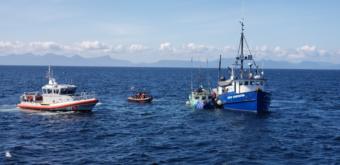
Coast Guard Station Ketchikan and Coast Guard Cutter Adelie boat crews assisted in dewatering and towing a fishing vessel that began taking on water near Ketchikan, Aug. 28, 2019. (Courtesy photo from U.S. Coast Guard)

Mariners in distress are without a decades-old means of contacting the Coast Guard in much of coastal Alaska.

The federal search-and-rescue agency said its VHF signal is experiencing outages, making communication on channel 16 unreliable. The issue has been ongoing since this summer.

As Sitka fishers go, Matt Donohoe is somewhat of a veteran. This summer he was trolling for salmon when he heard a distress call over his VHF radio.

“A boat called mayday, but it was on channel 16, and I expected the Coast Guard to respond and they didn’t,” he said.

It turns out it wasn’t too serious — the skipper had broken down and was drifting. Donohoe continued to try and reach the Coast Guard over his radio as well, with little luck. He was relieved that nobody’s lives were at risk that day.

“But there’s a problem with the infrastructure, and it needs to be addressed before somebody dies,” he said.

His story isn’t unique. In fact, fishers across Southeast Alaska have been reporting similar problems. The Coast Guard first publicly acknowledged the problem last month, but it has been broadcasting automated notices this summer to mariners — guys like Joe Donohue, who trolls around Sitka.

“I wrote down where the outages were, and it was from Yakutat all the way down to Cape Edgecumbe,” Donohue said. “I had a bunch of friends that were just finishing up with seining, were getting ready to go longlining, and I thought, ‘Boy I hope they get that fixed.’”

It hasn’t been fixed. At least eight Coast Guard towers are down in Alaska. The outages are affecting Prince William Sound all the way down to Sitka and other Southeast communities.

Some of these repeaters have been completely down since June.

Coast Guard Lt. Scott McCann said repairing these remote towers isn’t a simple task.

“In most cases these towers are only accessible by helicopter. And in that case, the helicopter can only fly when the weather is conducive to flying up to the top of the mountain and dropping off personnel and parts,” he said.

But this is the Coast Guard, isn’t flying helicopters in remote stormy conditions what they do?

“True, the Coast Guard has a reputation for flying in nasty weather, but these tower maintenance contracts are with other agencies. So they have different flight standards, and you want them to be safe when they go out there,” McCann said.

That contractor is Lynxnet, LLC, a Virginia-based subsidiary of NANA Regional Corp., the regional Native corporation based in Kotzebue. Neither the company nor the Native corporation responded to requests for comment.

But if inclement weather held up the contractor in the summer, the dark and frigid winter certainly won’t help.

In the meantime, the Coast Guard has been advising mariners to carry backup communication devices, like satellite phones and high frequency radios.

Those are much more expensive. The industry wants assurances if they need the Coast Guard they can use the radio that’s found on every deck of every boat in the fleet — not to mention anglers and hunters with only handheld equipment.

“VHF radios have been for decades the primary go-to source to get a hold of the Coast Guard,” said Jerry Dzugan, the director of the Alaska Marine Education Safety Association in Sitka. “That’s what we’ve taught everyone in our classes for decades, so what they’re saying is ‘Well you’re going to have these other things instead,’ and that’s unacceptable.”

The Coast Guard also recommends mariners have working emergency position indicating radio beacons, or EPIRBs. But Dzugan said that’s a last resort option.

“Fishermen don’t want to hit the panic button if you don’t really have to. Which means that it’s going to delay a problem,” he said.

An EPIRB sends a continuous radio signal to search-and-rescue units in order to provide the exact location of the vessel in distress. But VHF radios allow mariners to check in with the Coast Guard before a situation gets to that point.

“The Coast Guard’s always saying ‘if you have a problem let us know, even if it’s not an emergency yet, so we can keep an eye on you’,” Dzugan said.

McCann urges mariners to be patient. He said they’ll be fixed — eventually.

“These towers are here to stay. VHF is here to stay,” he said.

Fishers and industry groups have been in contact with U.S. Sen. Lisa Murkowski’s office to try and speed up the process. Murkowski’s office released a short statement saying it’s aware of the issues.

With additional reporting from KCAW’s Katherine Rose in Sitka.

Citing executive order, Fort Wainwright evicts public employee union

(Photo courtesy of U.S. Army)

Fort Wainwright officials are evicting the union that represents federal employees from its office on post.

The head of the American Federation of Government Employees Local 1834, which represents 1,000 or so federal workers on Fort Wainwright, said the union and post officials have for decades maintained good relations — until recently.

“It’s been within the last year that the relationship has completely soured,” said Local 1834 President Bill Ward.

He said that’s when Wainwright officials told him that a new federal policy requires the union to pay rent for office space on post at fair market value. Ward refused and was told the union will have to rent space off-post.

“We got the notice that we’re evicted from the offices that we’ve been in since 1972, and that we’ve got 30 days to get out,” he said in an interview last week.

Ward said post officials also cut the amount of on-duty time he can spend working on union issues by 75%. He said Army officials cite executive orders issued last year by President Donald Trump to justify their actions.

“The stance that we’ve been given was that, ‘It’s an executive order, and we have to follow it,’” he said.

Ward said more than two dozen AFGE officials use the Wainwright office for training and other official business.

Fort Wainwright officials declined interview requests to talk about the dispute, citing ongoing collective bargaining. But they emailed a statement that said they’re evicting the Local 1834 “in accordance with Executive Order 13837, which prohibits government agencies from providing free or discounted office space to labor organizations.”

“They want to destroy the union,” said Dave Owens, the national representative for AFGE’s Alaska office. “Their goal is to get rid of us, so we’re actually no longer a hindrance.”

Owens works with all the AFGE locals in the state, which represent about 10,500 federal employees in Alaska. He said it’s important for the union to have a presence on post, because it’s much easier for civilian workers to stop by during lunchtime or before or after work.

“It’s convenient to the employees,” he said in an interview Tuesday.

Owens said Fort Wainwright’s local has accepted offers from the Laborers Union and the International Brotherhood of Electrical Workers to use their offices in Fairbanks. And he said that’s probably what the AFGE Local 1101 representing workers at Joint Base Elmendorf-Richardson in Anchorage will do when base officials order them to pay rent or move.

“They’re going to kick us off the base,” he said. “That’s on JBER. That will happen within the next two months.”

JBER officials said Wednesday they’re negotiating with the Local 1101, but they haven’t issued an eviction notice.

AFGE anticipates it will have to leave offices at JBER, as well as at the Department of Veterans Affairs regional office in Anchorage, sometime around December or January. Those two installations have around 2,100 employees currently served by the union, according to Owens, ranging from tradesmen to office workers and nurses. The union said it’s looking for offices off-base.

Owens said AFGE has successfully fought many of the executive order’s provisions in court and will continue to do so.

Alaska Public Media reporter Zachariah Hughes contributed reporting in Anchorage.

Coast Guard weighs dropping radio-based NAVTEX system to communicate with mariners

Fishing boats wait for an opener in the city harbor in Chignik. (Photo by Alex Hager/KDLG)

For decades, the Coast Guard’s NAVTEX towers have broadcast from Cape Cod to Kodiak Island. The global system broadcasts weather and safety information to boats large and small.

The International Maritime Organization developed the NAVTEX system decades ago as a means to get weather and urgent information to ships on the water. It’s low-tech. Receivers spit out basic telex-type messages onto paper or on a screen.

“The most common thing that you would see is a weather message, but you will also get public safety information messages,” said Derrick Croinex, the Coast Guard chief of spectrum management and telecommunications.

“We need to replace it because the infrastructure is old and it’s failing,” Croinex said.

But before the federal government commits to an expensive upgrade, Croinex said it wants to gauge how vital the service really is.

Right now, the International Maritime Organization is working on upgrading the text-only NAVTEX system to something called NAVDAT. The new system will include images and graphics. And when that system is ready, larger vessels will be required to upgrade to it.

But not if the Coast Guard phases out these radio-based systems completely.

“Our view is, it may be better and more reliable for people to actually switch to satellite,” Croinex said.

But some mariners are urging the Coast Guard to keep the free, low-tech service rather than switch over to subscription-based satellites.

In September, the Coast Guard made its case in a notice in the federal register. More than 50 people have commented so far, almost all in favor of keeping NAVTEX.

“It’s pretty deeply embedded across the fleet,” said Pete Devaris. “We find it on board, everything from ocean-going tugs to the commercial fishing fleet.”

Devaris was a Kodiak-based commercial fisherman for years. “It’s relatively cheap. We can buy used NAVTEX receivers on eBay for 100 bucks. And (International Maritime Organization) satellite services are a subscription service, so we’re talking about retrofitting, you know, an entire fleet with new technology, some that might not be available to the smaller vessels,” he said.

Piggybacking on commercial satellites would be much cheaper for the federal government. Croinex said feedback will help the Coast Guard justify investment in radio transmitters.

“We haven’t made a decision yet. We’re trying to get public opinion on this. Because we want to know, (does) the switch to satellite make more sense for people?” Croinex said.

Ed Page is the executive director of the Juneau-based Marine Exchange of Alaska. It provides real-time marine vessel tracking. Page said he’s concerned about a proposal that would migrate a free maritime service over to fee-based satellite platforms.

“I suspect some vessel operators will not pay for these added costs and go without accurate weather and safety information,” he wrote in an email.

The Coast Guard is accepting comments online through Nov. 12.

Editor’s Note: An earlier version of this article incorrectly reported that NAVTEX broadcasts were available via VHF radios and misidentified Pete Devaris.

Murkowski and Sullivan condemn Trump’s Syria decision

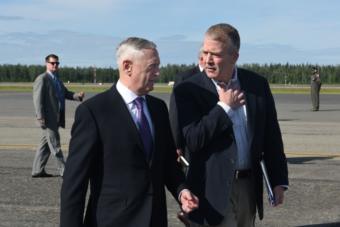
U.S. Secretary of Defense James Mattis speaks with U.S. Sen. Dan Sullivan, R-Alaska, on June 25, 2018, on the Eielson Air Force Base flight line. (Public domain photo Airman 1st Class Eric M. Fisher/U.S. Air Force)

Both of Alaska’s U.S. senators have joined the chorus of Republicans criticizing President Donald Trump’s decision to pull U.S. troops from northern Syria.

Trump announced the move Sunday night. It paves the way for Turkey to proceed with a planned operation against the Kurds.

Sens. Lisa Murkowski and Dan Sullivan, both Republicans, issued statements on social media.

Murkowski weighed in Tuesday, saying the withdrawal betrays America’s Kurdish allies and aids a resurgence of the Islamic State militant group.

Sullivan’s post, issued late Monday, says U.S. troops should not be in Syria indefinitely. But he says abandoning the Kurds will make it harder for America to attract battlefield allies in the future.

In a rare showing of bipartisan criticism, Congress members of both parties have condemned Trump’s decision.

Site notifications
Update notification options
Subscribe to notifications