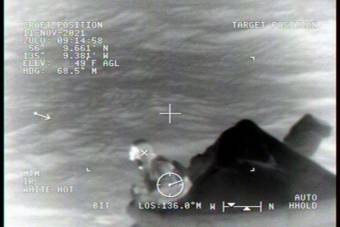
Denali Pass is the V-shaped notch in the upper left quadrant, at18,200 feet. The flat plateau below it to the right is where the high camp sits. Adam Rawski was traversing from the notch to that flat section when he fell, according to park officials. (NPS Photo/Jeff Pflueger)
A man climbing Denali in May made a false report of hypothermia in an attempt to get a helicopter rescue after his failed summit attempt on North America’s highest peak, according to federal charges.
Dr. Jason Lance is an Ogden, Utah-based radiologist who now faces charges of interfering with a government employee, violating a lawful order and making a false report.
According to the charges, here’s what happened:
Lance was climbing with another man, named only as “A.R.” in the charges but identified as Adam Rawski by the National Park Service in a May news release, because of what happened next.
Lance and Rawski were ascending Denali’s popular West Buttress route. They weren’t registered as climbing partners, and the charges say they had just teamed up that day at a camp at 14,200 feet.
Higher up, somewhere between 18,600 and 19,200 feet, Rawski started to show signs of altitude sickness. At some point, Lance took Rawski’s Garmin InReach satellite communication device.
Lance left Rawski with another two-person team of climbers and continued up the mountain. The other team decided to abandon their own summit attempt to help Rawski back down.
Later, Lance also turned around and met up with Rawski and the other two climbers. As the four were descending together, with Lance and Rawski unroped, Rawski fell about 1,000 feet down a slope called the Autobahn and lay motionless at the bottom.
Lance hit the S.O.S. button on Rawski’s device. A Park Service helicopter picked up a mountaineering ranger already on the mountain, and they rescued Rawski, who was unresponsive and later listed in critical condition.
Lance still had Rawski’s device, and in subsequent messages with Park Service personnel, he said he didn’t have the right gear to descend on his own. The Park Service continued to tell Lance he needed to get down the mountain and refused to send a helicopter.
The other two-person team, apparently in the same location as Lance, sent a message saying there had been an accident but that they were OK.
According to the charges, Lance sent another message requesting a helicopter evacuation, apparently for the other climbers: “Cant decend safely. Patients in shock. Early hypothermia..”
Later, the other two climbers said they were never hypothermic or in any form of medical shock, and that they had tried for hours to convince Lance to descend.
Lance insisted they stay put and said the Park Service was obligated to rescue them because, “We’ve paid our fee,” according to the charges.
Because of his message about hypothermia, the Park Service did launch a helicopter. But before the helicopter reached them, Lance and the other two climbers had finally started to head down.
Once they were all safe farther down the mountain, a mountaineering ranger with law enforcement credentials tried to talk to Lance about what had happened. Lance said he was a medical professional and could recognize hypothermia, even if the climbers he said were suffering from it disagreed.
Then, in what sounded like a tense exchange, the ranger stood outside Lance’s tent, asking for the Garmin InReach while Lance appeared to be deleting messages from the device. He eventually handed it over, the charges say.
Lance did not immediately respond to a message left at his Ogden, Utah radiology practice. It remains unclear what happened to Rawski.
The incident at the heart of the charges appears to be just one that irked Denali mountaineering rangers during the 2021 climbing season, enough so that they wrote a terse statement about inexperienced, over-eager climbers without the proper gear and the dangers of climbing with unfamiliar, last-minute partners.
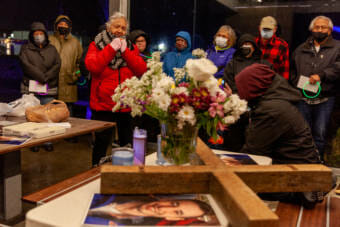
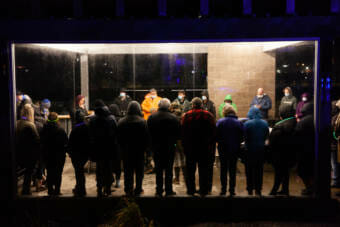
Barbara Charles shares memories of her grandson, Doug Farnsworth, during a vigil for him on Wednesday, Oct. 27, 2021, at Overstreet Park in Juneau. Farnsworth had been missing for a month. (Rashah McChesney/KTOO)
Content warning: This article contains descriptions of human remains that may be difficult for some readers.
Juneau police and Doug Farnsworth’s family say his body has been found. It’s not clear yet how he died.
“A hiker was doing their normal hike with their dog, and their dog ran up the hill above Flume, kind of by Gold Creek. And that’s where he found the remains of my brother,” said Doug Farnsworth’s sister, Kiersten Farnsworth.
Farnsworth has been missing since late September. A truck he’d been driving was found close to the Perseverance Trail, near downtown Juneau. At first there was a large search and rescue operation that included Alaska State Troopers, the Coast Guard and a local canine group, but they found no trace of him. For the last month, ground searches were largely organized by family and friends.
When the hiker stumbled on the remains on Sunday afternoon, Kiersten Farnsworth said it wasn’t a whole body, but there was enough to identify her brother.
“They did find some bones and his clothes and the gun and a phone. So we can’t really determine how death was, just because most of him is missing,” she said.
She said she got a call from Juneau police at about 8 p.m. on Sunday night.
“I was really upset last night,” she said. “I’d say the hardest part is calling family member after family member, re-explaining everything.”
She said those calls have been complicated by how quickly the police posted on social media that he’d been found. JPD updated its missing persons post on Facebook at 8:10 p.m.
“I was really surprised at how quick they jumped the gun to post though because I barely had time to call the family,” she said. “I mean, it took three days to make a post about him missing, but it took them hours to say that they found (him).”
She said police are supposed to be out in the woods today looking for more remains.
Juneau police reported on Monday that the body was found in the woods near Irwin Street. According to a media release, they’ve sent Farnsworth’s remains to the medical examiner in Anchorage for an autopsy and are still investigating.
Kiersten Farnsworth lives in Arizona, but she and her brother were raised in Juneau. She said she’s been inundated with messages and calls as news spreads that her brother has been found.
Phone calls to family have been hard.
“They’re destroyed,” she said. “They’re pretty crushed. A lot of them are stuck in this question as well — what happened?”
Now Farnsworth says she’s working on getting the money to travel back to Juneau so they can lay him to rest. And she’s looking for more information about the hiker so she can give them the $5,000 reward her family offered for information about Doug Farnsworth’s disappearance.
“That dog deserves a trophy,” she said.
And she’s working on repurposing a Facebook group that’s gathered nearly 800 members. She said she wants it to be a place where people can go to coordinate searches for other people who go missing in Juneau.
She’s said she’s building a roadmap of sorts — a packet with templates for missing-person fliers and links to local aid organizations. She envisions a group where people can post about where they’ve searched and link to maps, a place for the community to work together outside of official search and rescue channels.
“I don’t think anybody should have to go through somebody missing and then feel like they’re not important enough to look for,” she said.
Correction: This story has been corrected with the time frame Doug Farnsworth disappeared and to reflect that while he and his sister were raised in Juneau, they were born in Arizona.
The seven Pilot Station hunters wait for a charter plane at the Bering Air terminal in Nome on Nov. 6, 2021. The group removed their masks for the photo. From left to right: Andrew Makaily III, Neil Makaily, Robert Myers, Andrew Makaily IV, Ronnie Paul, Rex Nick, Dimitri Nick. (Anna Rose MacArthur/KYUK)
Seven subsistence hunters from Pilot Station in Southwest Alaska spent seven nights stranded at a fish camp after the lower Yukon River unexpectedly froze, blocking their way home.
On the eighth night, Thursday, the U.S. Coast Guard airlifted them out and flew them north to Nome.
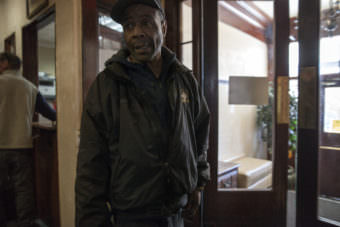
The next morning, at the hotel where the group had stayed the night, two of the hunters walked to the lobby. Signs said masks were required, and a hotel worker asked them to put theirs on.
The men said they’d been stranded on the Yukon for a week and didn’t have any masks. They’d left the fish camp with the clothes on their backs and what they could fit in their pockets, which meant their phones and GPS.
They were wearing the same clothes they’d worn for a week and a half.
“Same socks, same shorts,” said Rex Nick, one of the hunters laughing and stretching out his legs, which were covered in torn, black Carhartt bibs.
“It was really good to take a shower,” said Robert Myers, another hunter. “I feel clean, but my clothes are dirty.”
The men had left Pilot Station 12 days earlier to boat down to the coast to hunt seal and beluga whale. Nick originally wanted the hunting trip to be over a weekend for students in the village.
“Some of the kids don’t get a chance to go out hunting, or some of their parents might not have a boat or a father-figure type,” Nick said.
The group delayed the trip for weeks waiting for a break in the weather. Finally, it cleared on Oct. 25. Because it was a Monday, they didn’t take students out of school, but one hunter brought his 14-year-old son. There were two brothers and two father-son pairs in the group. The rest are friends.
“Nobody is starving,” Nick said. “But it’s good to have that extra food for the winter ahead.”
Nick is 43 years old. Myers is 38. They’ve made this trip many times in their lives, often multiple times a year. The seven hunters loaded into two boats and made the three-hour trip to the coast. The plan was to go down Monday, hunt Tuesday and return Wednesday.
And, at first, the plan worked out. They went down and took three seal and two beluga.
The hunters pulled their boats onto the shore at the fish camp where they stayed for seven nights. (Rex Nick)
But on Wednesday, Oct. 27, when they were set to return home, they awoke to a frozen river.
“The ice was so thick flowing down the river. It was forming so fast. It was freezing so fast. Just amazing. I’d never seen anything like that,” Nick said.
From all their years on the river, they never expected it to freeze so early or so quickly. There had been no ice when they left home. Using an axe, oars and their body weight, they hacked the boats free and used the weight of the skiffs to push open a path upriver to Alakanuk. A trip that would’ve taken an hour and a half in open water took five hours.
They stayed the night in Alakanuk.
The next morning, Oct. 28, ice was flowing downriver, but other boats were moving between the sheets. The hunters decided to head home. Everything was fine until they reached a narrow part of the river near Emmonak.
The ice jammed, turned jagged and began crashing into the boats.
“That’s the first time I really got scared,” Nick said, “when I thought the ice was going to either damage my boat and sink my boat or flip my boat over. I’ve never been scared like that by ice before.”
The hunters stayed at a fish camp about 20 miles east of Emmonak for seven nights after the Yukon River unexpectedly froze. (Rex Nick)
Nick is second-in-command of Pilot Station Search and Rescue. He said he knew that it was too dangerous to keep going. The group decided to stop and found a friend’s nearby fish camp, about 20 miles east of Emmonak. The hunting group would remain there for the next seven nights.
“God bless the family that had that fish camp,” Nick said.
The camp had containers of frozen rain water, a wood stove, firewood and food.
“Oatmeal, coffee, some noodles, dry eggs, things like that,” Nick said.
The group also had their seal and beluga meat and food from their camping trip. Another friend had a fish camp just a five-minute walk away. It had a cell phone booster and a generator. They used it to contact their families.
The group also had a VHF radio and a Garmin inReach satellite device. The first day at the camp, they texted nearby friends about their situation, but no one could come overland or by river to help. The trails were not yet fully frozen. Their friends contacted Alaska State Troopers.
On day three at camp, Oct. 31, 2021, Alaska State Troopers flew over and dropped food, supplies medicine and Halloween candy for the hunters. (Rex Nick)
On day three at the camp, Oct. 31, the troopers flew over and dropped food, supplies and medication needed by one of the hunters.
And to Nick’s relief: Copenhagen Fine Cut Snuff. With tobacco, he said, he eats less. There was another treat too.
“We got some Halloween candy. They left a note on there [saying], ‘Happy Halloween,’” Nick said.
The group stayed together in one of the fish camps in a single room about 12 feet by 20 feet, sleeping in sleeping bags from their camping trip. Staying together conserved firewood and concentrated heat. Also, Nick said, “There’s safety in numbers.”
Each day they rationed their food, water and firewood, only burning wood before going to sleep and a bit when waking up. During the day, they created their own entertainment.
“We took out our .22s and started killing mice. We probably killed about 50 mice,” Nick said.
One day a hunter killed a beaver, which they boiled into soup. Another day they found a fox in a snare that had been set by the owner of the fish camp and killed it. Once they set a net in the river but didn’t catch anything. Time moved slowly.
On the fifth day at the camp, Nov. 2, a pilot twice tried to land. In a video Nick took on his phone, the small red and white plane swoops close to the beach. Nick urges it on.
“Come on. You can do it. Land. Come on,” he said in the recording.
When the wheels look a few feet above the snowy riverbank, it veers back up and flies away. A trooper spokesperson said that 20-knot crosswinds prevented a landing.
Emmonak Search and Rescue coordinated another food drop for that day. This one contained ground beef and other hearty food.
The hunters set a net near the camp but did not catch any fish. (Rex Nick)
By now, the hunters had become frustrated with the rescue response. State troopers were coordinating the effort, but Nick said that they would not hear from them for entire days at a time.
Trooper spokesperson Austin McDaniel said troopers “maintained consistent and frequent contact with the group directly via a satellite communications device and through their communication with third parties that the group was communicating directly with.”
McDaniel also said, “We had our search and rescue coordinator, who was a lieutenant here in Anchorage, working on this day in and day out. We had a trooper out in Emmonak working on trying to find solutions to get these folks out of there every single day.”
The hunters said they had heard planes flying every day they were at the camp. Flight logs show planes landing each day in nearby Emmonak, except for one day that the hunters were stranded.
Nick said he expected a quicker rescue. The longer someone is stranded, he said, the more likely that person will be in danger. He’s helped look for many people with his village’s search and rescue group.
“The very first day we find out somebody is missing, we’re working on trying to get him home. We’re out there looking day or night, storm or clear skies,” he said.
He questioned whether the response was slowed because the group had supplies to survive the elements. McDaniel, the troopers spokesman, said no.
“The amount or quantity of supplies played no role in the efforts made by troopers to respond to extract the group,” McDaniel said.
Nick also questioned if because the group was all Alaska Native that slowed the response.
“Well, that’s absolutely not the case,” McDaniel said. “We perform search and rescue missions across the state, and there’s never any consideration given to the race, gender, any of those. None of those questions ever come up when we’re planning a response to a search and rescue operation.”
Regardless, Nick said, being stranded for a week took a toll on the hunters, as well as their wives, children, friends and community.
“All these years you help people so much, and when it comes down to needing help, it’s like it’s not there. Just beat you up inside. It just hurts,” Nick said, his voice cracking.
One of the hunters missed his cousin’s funeral. Nick missed his daughter’s 12th birthday. He said that the worst part of the ordeal was the worry it placed on his wife.
On the eighth day at the camp, Nov. 4, the hunters were about to burn the last of the firewood when they saw a U.S. Coast Guard plane overhead. It dropped food and a handwritten note that said to bring the radio with them when the H60 picked them up and to enjoy the pizza. The bag contained seven slices. The note ended with a big smiley face.
They turned on the VHF. The pilot told them to stay on channel 16. A helicopter was coming. Hours later, past 8 p.m. on the eighth night at the camp, they heard the chopper.
“It was getting louder and louder, and we’re like, ‘Where is it? Where is it?’ Then all of a sudden, we see lights,” Myers said.
The U.S. Coast Guard landed in Nome with the seven hunters on Nov. 4, 2021. (Rex Nick)
The helicopter circled and landed. The hunters climbed aboard. They left behind their boats, supplies and seal and beluga meat. They said that everything is well stored, and they’ll return in spring to gather their belongings. The Coast Guard flew them north to Nome.
The hunters said that everyone in the group was healthy, but the Coast Guard told them they’d be taken to the hospital to be checked out. A Coast Guard spokesperson said that it’s not required for paramedics to accompany rescue missions.
When they landed in Nome, Nick said that a trooper picked them up and then asked them where they wanted to go. They never went to the hospital.
“We were freaked out when they asked us where we wanted to go. We thought they had a place for us. We didn’t know what to say. They asked if we had family or friends. We don’t know nobody here,” Nick said.
A trooper spokesperson didn’t respond to a question by publication of this story about why the officer didn’t have a plan to house the men.
The trooper took them to a hotel, where the hunters paid $450 plus tax for two rooms for the night. The next day, a trooper spokesperson told KYUK that the troopers would cover the hunters’ lodging and airfare home.
Troopers and the Coast Guard said that they rescued the hunters as soon as their resources and the weather allowed. The helicopter had to fly from the Coast Guard base in Kodiak.
On Nov. 6, after spending two nights in Nome, a plane flew the group to Pilot Station. They landed around 1:15 p.m. It had been 13 days since they left home.
The hunters thank everyone who helped them, especially the owners of the fish camps where they stayed.
KYUK reporter Olivia Ebertz contributed reporting to this story.
Emmonak during winter. A group of seven hunters was stranded at a fish camp 20 miles east of Emmonak for a week before being rescued on Thursday night. (Photo from Calista Corporation)
Seven hunters, including a child, from Pilot Station were rescued after being stuck at a fish camp for one week. The group was headed upriver after fall seal hunting. They got stuck outside of the Yukon River community of Emmonak on their way home.
The group was rescued Thursday night by the U.S. Coast Guard, according to Pilot Station Search and Rescue. A Coast Guard spokesperson said the group was immediately transported to the airport in Nome where they were checked for injuries.
It’s traditional for hunters from lower Yukon River villages to travel down to the coast in the fall to hunt for seal to stock their freezers for the winter. Especially this year, since subsistence fishing for most salmon species was closed after the Yukon River saw a massive chum salmon collapse.
Normally hunters are able to get to the coast and back home this time of year without any problem, but former Pilot Station Mayor Abraham Kelly said that winter weather snuck up on them this year.
“It got cold a lot faster than what we thought,” Kelly said.
As the hunters made their way upriver, ice began forming across the water. Just past Emmonak, they couldn’t go any further. Four of the seven hunters volunteer with the local search and rescue in Pilot Station, so they knew to contact the nearby Emmonak Search and Rescue from their inReach device. According to Emmonak Search and Rescue, the hunters provided their location and the Emmonak group directed them to the nearest fish camp.
The hunters were forced to pull over their boat on Oct. 29. Between what they brought and what was at the fish camp, they had enough to feed themselves and stay warm for several days. But according to Alaska State Troopers, the weather soon turned foggy and turbulent and it was too risky to land an aircraft. On Sunday — day three — troopers were able to do a fly-by drop-off of food, supplies and medicine needed by one of the hunters in the group.
The group needed to be rescued by air because the river and overland trails aren’t frozen enough yet for snowmachines or other vehicles. The entire area is off the road system.
Back in Pilot Station, the head of the local search and rescue group, Paul Fancyboy, got word that his friends and his second-in-command were stuck near Emmonak. He was concerned that no one had rescued them yet. So on Monday — day four — he said he called Gov. Mike Dunleavy’s office. He reached an aide.
“He said he was taking notes and he’s gonna give it to the governor,” Fancyboy said. “I wouldn’t know why he hasn’t called me back about why it took so long for those guys to get rescued.”
Fancyboy said the governor never called him back. The governor’s office said they provided Fancyboy with another number to call.
The next day — day five — troopers attempted to evacuate the group with a fixed-wing plane. But according to a spokesperson for Emmonak Search and Rescue, the pilot couldn’t land due to a heavy crosswind. The spokesperson said the men were starting to get agitated that it had been five days and no one had picked them up yet.
Emmonak Search and Rescue coordinated another fly-by food drop, this time food was donated by the local AC store and the village store and the flight was donated by Grant Aviation. The drop included a charger for the hunters’ inReach satellite. The group is using it to communicate with Emmonak Search and Rescue. The mood at camp briefly lifted, plus the weather was looking good for the next day.
Emmonak Search and Rescue told the hunters to pack up their gear and get ready. The U.S. Coast Guard’s helicopter in Nome prepared to pick them up. But on Wednesday — day six — the chopper never came. The weather turned once more, according to Kelly.
“Finally they were gonna pick them up yesterday morning, and then that fog rolled in again so they canceled the chopper from Nome,” Kelly said.
He said that another fog bank had rolled in on Thursday, and the Coast Guard confirmed that they had not been able to get the boaters. Emmonak Search and Rescue coordinated a third food drop, and Kelly was concerned about the group’s ability to keep warm.
Fancyboy, the head of Pilot Station Search and Rescue, said that the whole village was worried about the hunters. He said the youngest in the group was a grade-school kid who missed school this week. Fancyboy said he’s frustrated.
“I don’t know what’s taking them so long,” he said. “It is not acceptable.”
A spokesperson from Emmonak Search and Rescue also demanded to know why it had been taking so long for government rescue agencies to get the hunters.
According to a report from troopers, the Coast Guard helicopter in Nome had been unable to launch Thursday due to mechanical issues, and there were no private helicopters available in the area to help. Troopers said two U.S. Army helicopters from Fort Wainwright were traveling to the area and planned to pick up the group on Friday.
The group ended up being picked up Thursday night. Medical personnel met the hunters at the airport checked them for injuries and they were brought to a hotel, according to a troopers spokesperson.
Pilot Station Search and Rescue said the group initially believed they would be paying out-of-pocket for the hotel and travel home, but troopers told KYUK they would be covering the costs of lodging and airfare home to Pilot Station.
Petty Officer Rafael Aguero recovers 8-month old puppy Grace. (Courtesy U.S. Coast Guard)
The fishing vessel Laura, a 93-foot trawler based out of Kodiak, capsized Monday morning after striking rocks near Sitkalidak Island. The four-person crew safely boarded a life raft. But their puppy, Grace — an eight-month-old, 80-pound lab mix — jumped into the freezing water and was presumed lost.
A Coast Guard UH-60 swept a five-mile area with no luck before turning back to nearby Air Station Kodiak to return the crew to dry land.
The next day, another Coast Guard helicopter crew searched the area for evidence of a fuel spill from the F/V Laura — but they still held a shred of hope that Grace might still be alive. And there she was, on a nearby beach.
Petty Officer Rafael Aguero, a Coast Guard rescue swimmer, went and got her. He says Grace was on “a narrow beach with about 20- to 40-foot cliffs all around her.”
“I was able to find a way to sort of scramble down that cliff to grab her,” Aguero said. “She was definitely in a little bit of a shock. Definitely hypothermic. So I looked up to her, and I knew she was going to be okay. She wagged her tail a little bit. And then I went, picked her up and scrambled back up the cliffs back to the helicopter.”
Aguero and his crew were amazed to find her unharmed.
“To go through those conditions and spend 36 hours alone in the wilderness like that on the beach with the cold, and she was otherwise okay, from what I can tell. But it’s absolutely incredible that we found that dog,” he said.
Grace was reunited with her owner at Air Station Kodiak around 1:30 p.m. Tuesday. And she’s doing just fine.
The ship hasn’t fared as well. The wreck is still on the rocks, and according to the Alaska Department of Environmental Conservation, a five-mile oil sheen has been sighted about a mile from where it hit the rocks.
Spill responders say they are monitoring the situation. The vessel’s owner estimates there were about 3,000 gallons of diesel aboard.
Emmonak during winter. A group of seven hunters has been stranded at a fish camp 20 miles east of Emmonak for five days, according to Emmonak Search and Rescue and Alaska State Troopers. (Photo from Calista Corporation)
A group of seven hunters has been stuck at a fish camp on the Yukon River for five days, according to reports from Emmonak Search and Rescue and Alaska State Troopers.
Emmonak Search and Rescue said that the group was on its way back from a hunting trip, but stopped off at a fish camp when the ice buildup became too thick for them to boat back down. They’re currently stuck about 20 miles east of Emmonak.
The group has been in communication with local search and rescue groups via an InReach satellite communication device. The boaters have shelter, supplies and have been able to stay warm.
Monday was the first time rescuers were able to reach the group’s location. Alaska State Troopers were able to drop off food and medications.
A spokesperson for the Alaska State Troopers said that the troopers have known of the hunters’ location for four days. He said that troopers are waiting for a break in the foggy, turbulent weather so that they can charter an aircraft to pick the trapped hunters up from the fish camp east of Emmonak.
Close
Update notification options
Subscribe to notifications
Subscribe
Get notifications about news related to the topics you care about. You can unsubscribe anytime.