A map showing VHF signal coverage areas in Southeast Alaska. (Graphic courtesy of U.S. Coast Guard)
The U.S. Coast Guard reports intermittent VHF outages on the emergency Channel 16 but says the situation has improved in the past two years. That’s according to Commander Lyle Kessler, a Coast Guard spokesman.
“I think it was, in 2019. In January, we had our worst that we had had, I believe was 19 sites that we had down at one time. And, like, right now, there’s only three sites down. It’s been getting better and better. We switched contractors a couple years ago, and we also made some improvements to the contract that allowed the contractors to do maintenance while they were doing repairs at the same time. So enable them to do more work essentially, than what the old contract had,” Kessler said.
Relay towers near Mt. McArthur, Cape Fanshaw and Bede Island are at best semi-functional, and at the worst completely inoperable. The affected areas include the inland waters north of Afognak Island, the coast near Mt. McArthur west of Wrangell, and the area of Stephens Passage and Frederick Sound east of Kake.
The Coast Guard says that these outages are expected to continue for the time being. Kessler says the remoteness of the locations and extreme weather of late have made repairs difficult.
“The Coast Guard over the past couple years have been going through a process of upgrading all of the power generation and microwave links up to more current technology, the microwaves are, I think, like 1960s 1970s technology or something,” Kessler said. “So next summer, all the sites should have new power generation capabilities and new microwave links. And that’s been the majority of the reason that sites have been down.”
Kessler advises mariners to keep a secondary means of communications onboard their vessels such as a cell phone or satellite phone. And to file a float plan and carry emergency equipment onboard.
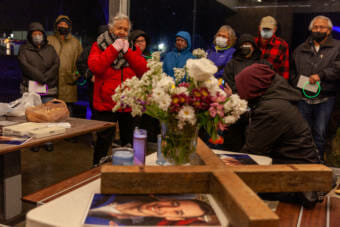
Barbara Charles shares memories of her grandson, Doug Farnsworth, during a vigil for him on Wednesday, Oct. 27, 2021, at Overstreet Park in Juneau, Alaska. Farnsworth has been missing for a month. (Rashah McChesney/KTOO)
Nearly 50 people crowded into a shelter at Overstreet Park at a candlelight vigil for missing Juneau man Doug Farnsworth. Dozens more watched livestreams and left hundreds of comments.
Despite the darkness, rain and biting wind, they spent more than an hour talking about their memories of loving and being loved by Farnsworth. He was last seen more than a month ago walking on a trail near downtown.
No one said it explicitly, but the knowing laughter and the memories people shared with his grandmother on Wednesday evening made it clear that Doug Farnsworth knew how to have a good time.
“I had a lot of crazy times with your grandson,” said one woman who didn’t identify herself. “I won’t say what I did with him — with our friends — but I really appreciate you sharing him with us, cause he was a light.”
Jayme Donahue cries during a vigil for her friend Doug Farnsworth on Oct. 27, 2021, in Juneau. Farnsworth disappeared in late September and has been missing for a month. (Rashah McChesney/KTOO)
Jayme Donahue said it was deeper than just good times.
“You know, I just — I didn’t have like the picture-perfect upbringing, and I was always running from my home,” she said. “His home was always open to me, and he had this kind spirit that I just clung too.”
Donahue said the process of physically searching for his body has been really emotional for her. She said she searched the beach front along Overstreet Park where the group stood overlooking Gastineau Channel. She wiped away tears several times as she asked people at the vigil to remember to reach out to each other. To push past discomfort and social norms and connect with others.
“I just really encourage people to judge less and feel more and be there for those they love,” she said.
She said she didn’t always do that for Doug when he reached out to her, even though they’ve been friends since middle school.
“I would give anything to go back,” she said. “I don’t have our messages, I don’t have our pictures … I’m really ashamed of that, and I’m really broken-hearted over that. I just encourage everybody to not hold back. Tell people you love them, tell people how much they mean to you, how special they are to you. I would give anything to tell Doug how special he is to me. I would give anything to tell him all of the things I love about him, and I can’t.”
About 50 people showed up to a vigil for Juneau man Doug Farnsworth on Oct. 27, 2021, in Juneau. He has been missing for a month. (Rashah McChesney/KTOO)
Farnsworth is a 32-year-old Juneau man whose family reported him missing on Sept. 29. His older sister, Kiersten Farnsworth, says she and other family members believe he is dead. They’re offering a $5,000 reward for anyone who helps them find his body.
Kiersten Farnsworth lives in Arizona and flew up to Juneau to look for him. She has since had to go home. But she has been very active on social media, organizing search efforts and checking in with police and Alaska State Troopers with whatever information she can find. Juneau Police said Thursday that it’s an active case and they’re following up on leads, but they don’t have any updates.
Even though she’s thousands of miles away, she organized the candlelight vigil for her brother. Then she lit a candle of her own and watched from afar, commenting online as each person spoke about him. She said she doesn’t want people to forget that he’s still missing.
Dozens of residents attended a vigil for Juneau man Doug Farnsworth on Oct. 27, 2021, in Juneau. (Rashah McChesney/KTOO)
Barbara Charles, Farnsworth’s grandmother, thanked everyone for coming out and continuing to search for her grandson. She said she misses him running into her home, wrapping his arms around her and telling her she is the most beautiful woman in the world.
Juneau family members carried a large wooden cross and photos to put in the center of the group. They tried to light candles, but the wind didn’t cooperate. Someone else passed around glow sticks for people to hold. There were a lot of hugs and inside jokes.
A woman livestreams a vigil for Juneau man Doug Farnsworth on Oct. 27, 2021, in Juneau. (Rashah McChesney/KTOO)
It’s tricky to piece together exactly where Doug Farnsworth went the night he vanished, but Kiersten Farnsworth has footage of a truck he was driving on Basin Road at around 4:30 a.m. Then someone sent her a screenshot of him walking down the nearby Flume Trail at nearly 7 a.m. She asked that anyone who lives in that area check their game cameras and surveillance videos from Sept. 29 to try and spot him.
The Farnsworths are Lingít, and they have a lot of extended family in town. As the vigil wound down, one woman stepped forward to tell the crowd that there is no goodbye in the language, only the parting phrase “I will see you again.”
“So tsu yei ikḵwasatéen tsá tsú — until we meet again. That’s how deep that word and phrase is,” she said.
Correction: A previous version of this story misnamed the bridge the crowd gathered near for the vigil, it is the Douglas Bridge.
Screenshot from a U.S. Coast Guard video of the medevac of an injured fisherman from the Patricia Lee.
The U.S. Coast Guard medevaced a man Tuesday night from a fishing boat approximately 200 miles southwest of Unalaska, according to a USCG statement.
The Coast Guard command center in Juneau received a call from the fishing boat Patricia Lee at about 4 p.m. requesting a medevac after one of their crew members “sustained serious injuries to his pelvic region” from getting pinned by a crab pot.
A Coast Guard MH-60 Jayhawk helicopter crew from Air Station Kodiak hoisted the injured fisherman from the fishing boat at about 11:50 p.m, according to the statement. He was flown to Unalaska and placed in the care of LifeMed personnel.
While the 117-foot vessel made its way toward Dutch Harbor, the command center directed the launch of the Air Station Kodiak helicopter crew from Cold Bay, the statement said. A Coast Guard C-130 Hercules aircraft crew and an additional MH-60 Jayhawk aircraft crew were also launched from Air Station Kodiak to provide back up.
“Thanks to the cooperation among air crew members, the command center team and the crew aboard Patricia Lee, our Kodiak team was able to hoist and deliver this young individual to a higher level of care,” Lt. Robert McConnel, Air Station Kodiak operations duty officer for the case, said in a statement. “Our crews routinely train for the treacherous Alaska night conditions they encountered yesterday. It feels good to see our team execute when someone’s life is on the line.”
Weather at the time included 40 mph winds gusting to 55 and 14-foot seas, with rain, snow and sleet squalls.
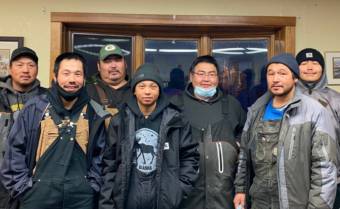
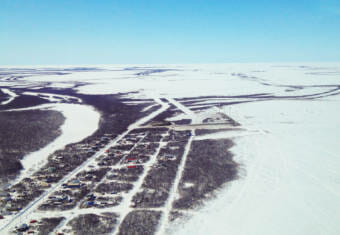
Kake’s waterfront in May 2021 (Joe Viechnicki/KFSK)
A Kake man who was reported missing on Saturday was found dead near the small Southeast community on Monday.
Alaska State Troopers say 55-year-old David Dalton was last seen just after noon on Friday, Oct. 15. He was reported missing to troopers on Oct. 16, and his pickup truck was discovered near Sitkum Creek that day. Local search teams found some items belonging to Dalton about 50 yards from his truck.
Searchers also learned about a possible sighting of an emergency flare in the area of the community’s landfill, but a U.S. Coast Guard helicopter was not able to locate any signs of people there.
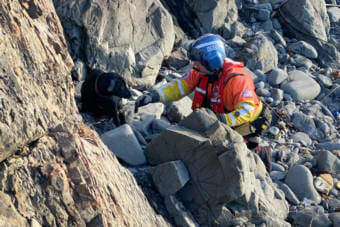
Sitka Mountain Rescue and two K-9 teams with the Juneau-based SEADOGS helped the Coast Guard with the search. One of those K-9 teams found Dalton’s body just before noon on Monday, Oct. 18 about two and a half miles from his truck.
Troopers say it appears that Dalton succumbed to the elements. His body has been sent to state medical examiner’s office for an autopsy.
Local temperatures dropped into the 20s and 30s over the weekend.
The Coast Guard rescued a man on Oct. 11 about 145 miles west of Sitka. (Image from U.S. Coast Guard)
A U.S. Coast Guard helicopter crew rescued a man whose sailboat had overturned on Oct. 11 while sailing solo across the Gulf of Alaska about 145 miles west of Sitka.
The Coast Guard received an emergency call shortly after 3 p.m. alerting them to the GPS location of a mariner in distress.
Coast Guard Commander Rand Semke was the co-pilot on the case. He said they gathered little information from an emergency beacon signal, but not much more than the location, and the name and registration information for the Ananda — a small sailing yacht on a long-distance voyage.
“We did not know anything about the nature of distress, we could make some assumptions based on the weather that we were seeing that a sailboat out there would be having some difficulty,” Semke said. “But we didn’t know how many people were on board or really why the beacon was activated.”
Semke and three other helicopter crew members from Air Station Sitka took off around 4 p.m., heading into a storm that was blowing 70 knots with 25-foot seas.
“So that was that was primarily what was going through our mind is can we do this with the weather and the gas on the helicopter in the amount of time that we can,” Semke said. “We wanted to get going quickly because a rescue in this type of weather is much easier to accomplish in the daylight than at night. And we knew sunset was coming quick.”
A U.S. Coast Guard crew rescued a man whose sailboat overturned while sailing solo across the Gulf of Alaska about 145 miles west of Sitka. A commander said the radio beacon that sent the man’s geolocation to the Coast Guard saved his life.
Semke said about a quarter of an hour before they reached the source of the emergency beacon’s signal, they made contact with the mariner on the radio, and learned that his 33-foot sailboat was adrift on its side. It had lost its sails and rigging and had a broken rudder.
The unnamed sailor told them he was alone and was still aboard the crippled vessel in his Gumby survival suit.
About five minutes before the rescue team sighted the Ananda, they’d lost radio contact. Luckily, rescue swimmer Juan Espinosa Gomez was able to spot the vessel – a tiny spot lit up on their infrared cameras. The team hovered over the drifting sailboat and lowered Espinosa Gomez into the hostile waters.
“The seas were all still 30 feet. And as I came across the back or the stern of the boat, I made eye contact to the survivor and I yelled at him to get in the water. He looked back at me he retreated back into his cabin, came back out with some luggage,” Espinosa Gomez said. “He had like a Pelican case wrapped in a life vest. And I commanded him to climb up and jump off the leeward side of the vessel so that the wind wouldn’t get in between him and the vessel.”
Espinosa Gomez said he helped the man swim away from the Ananda, and as it drifted away they were hoisted in the air by the rest of the crew. The man was cold, but not hypothermic, and had no apparent physical injuries. The team then made its way to Yakutat, landing around 8 p.m., and the man was treated by medics on the ground.
Coast Guard Commander Semke said there are a lot of lessons to learn from the man’s hazardous voyage, but first and foremost is preparation.
“Especially open ocean voyages, that can be certainly hazardous especially in this area. So using really all available tools for anticipating weather forecasts and sea state,” Semke said. “Where this mariner did succeed was his preparation in putting his survival suit on early and being ready to abandon ship if necessary, as well as monitoring [VHF] channel 16, which is always something that really every mariner should do, no matter how short their voyage.”
But the biggest factor in the man’s survival? The radio beacon that sent his geolocation to the Coast Guard.
“Without that there really is no way the Coast Guard would have been alerted to his distress,” Semke said. “So that really was what saved his life,” Semke said.
Troopers located Christerpher Perez’s remains on Catalina Island, circled, about seven miles west of Klawock. (Chart: NOAA)
The body of a Prince of Wales Island man who went missing more than four years ago has been identified by authorities.
Christerpher Perez. (courtesy of Alaska Department of Public Safety)
Alaska State Troopers say Christerpher Perez set out on a canoe near Klawock in Dec. 2016 but was not reported missing until eight months later.
A statement from the Department of Public Safety says the state medical examiner’s office ID’ed skeletal remains discovered Aug. 2 on the shores of Catalina Island, an uninhabited islet about seven miles west of Klawock.
Authorities say they haven’t determined the cause, manner or approximate date of death. Perez would have turned 52 this past April. His family has been notified.
Close
Update notification options
Subscribe to notifications
Subscribe
Get notifications about news related to the topics you care about. You can unsubscribe anytime.