Archives for:

"Roadless Rule"

Juneau crowd questions forest service on new roads in the Tongass

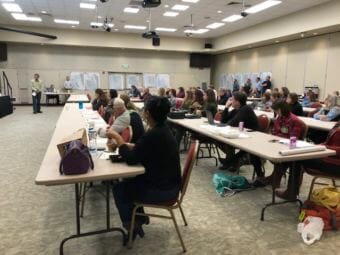
the meeting was held at Elizabeth Peratrovich Hall on Sept. 14, 2018. (Photo by Elizabeth Jenkins/Alaska's Energy Desk)
The meeting was held at Elizabeth Peratrovich Hall on Sept. 14, 2018. (Photo by Elizabeth Jenkins/Alaska’s Energy Desk)

The U.S. Forest Service is on a tour through Southeast Alaska and Anchorage to talk about the prospect of building new roads in wilder parts of the Tongass National Forest. The controversial initiative, which was announced in August, is up against a November deadline. That’s when the state hopes to have a proposal ready for environmental analysis.
On Thursday, Sept. 13, the forest service held its first public meeting in Juneau.

The forest service wasn’t taking any formal public comment from the crowd of more than 50 people. Instead, there were maps stuck to walls with blue tape to spur discussion.

After some presentations from the forest service, the floor was opened up for a roughly 40-minute Q&A.

In 2016, a forest service plan for the Tongass included moving away from old growth logging.

It was created with years of community input from people on both sides of aisle, including conversation groups and the timber industry.

Meredith Trainor, the director of the Southeast Alaska Conservation Council, wondered how the possibility of new road building in the Tongass would alter previous plans like the one from 2016.

The prospect of new road building wasn’t on the table then. It’s not for most national forests in the United States.

Alaska has been fighting this for decades, and this latest attempt to green light new roads in the Tongass could potentially change that earlier management decision.

Some in the audience questioned whether that seemed like a good idea.

“It’s a guaranteed slippery slope,” said Bart Koehler. He says he pretty much came out of retirement to make that point.

He used to work for the Southeast Alaska Conservation Council during the heyday of large scale industrial logging.

During his career, he says he saw some positive changes in the way the Tongass was managed, the Roadless Rule being one of them.

Koehler says he’s upset with how the forest service is conducting its current reevaluation.

“This meeting format is a bunch of B.S. — just a pile of bear scat,” Koehler said. “You come, you’re interested and you want to say something and none of these conversations are being recorded.”

Koehler did get his questions in, though, and he’s going to submit a written comment by Oct. 15 when the deadline closes.

A lot of people attending the Juneau meeting wore green stickers that said, “Keep roadless in the Tongass.” Eric Nichols from Alcan Forest Products in Ketchikan wasn’t one of them.

“I’ve been up looking at timber in other places so Juneau was a stopover because of the plane schedule,” Nichols said.

Nichols acknowledged there didn’t seem to be much representation from industry in the room. But he says these issues extend beyond Juneau, to small communities where people are still employed by logging. It’s estimated there are few hundred timber jobs left.

However, Nichols doesn’t think that will be the case for long — if there isn’t easier access to trees.

“We’ve lost the balance. The balance is totally off the scale,” Nichols said. “We’ve got everything in protection for conversation, but very little for what’s going to generate economic activities.”

The next forest service meeting on road building in the Tongass will be in Ketchikan on Sep. 17. The governor’s office still needs to appoint an advisory committee to help inform the decision.

Walker administration looks for panelists to discuss controversial Roadless Rule

Remains of a Tongass clear-cut and logging road north of Ketchikan. (Photo by Ed Schoenfeld/CoastAlaska)

Governor Bill Walker’s administration is looking for Alaskans to serve on an advisory committee that will shape the future of the Tongass National Forest.

In August, the U.S. Forest Service announced it would be considering building new roads in the wilder parts of the Tongass. This is different from the federal legislation most states have to follow.

The committee will discuss which areas in the Tongass could have new roads. Alaska’s congressional delegation has said having enough access to timber and mining opportunities is a priority.

The governor’s office says it’s seeking applications for a “diverse” panel of up to 13 people, including Alaska Native regional corporations and tribes, local governments and environmental groups as well as interests from tourism, mining, energy, timber and fishing.
Meredith Trainor, from the Southeast Alaska Conservation Council, says her organization is still deciding whether they’ll apply.

“Of course, I think any environmental group that’s paying attention to these issues is going consider putting their hat in the ring to be able to be at the table,” Trainor said.

Trainor is skeptical the governor’s office will be able to select a balanced committee to oversee the future of road building in the Tongass, since it was the state that asked for an Alaska Roadless Rule exemption in the first place.

But a spokesperson for the Alaska Division of Forestry says the agency is committed to bringing a broad range of objective people together.

It’s expected the group will be appointed in the next two weeks.

New roads in the Tongass? Here’s a chance to weigh in.

Tongass National Forest
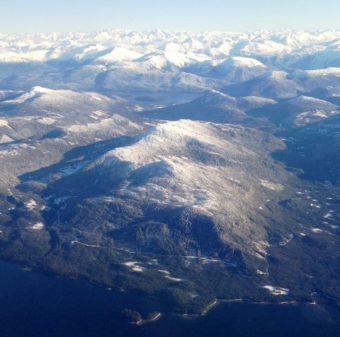
Tongass National Forest (Creative Commons photo by Henry Hartley)

Last month, the U.S. Forest Service announced it would be taking steps to build new roads in the Tongass National Forest. Now, the agency is asking for public comments.

Federal legislation prohibits most states from constructing roads on wilder parts of national lands. But Alaska has been in a decades-long battle to change that.

One of the reasons is having enough access to harvestable timber. Over the summer, Sen. Lisa Murkowski visited the last large mill in the region. But the forest service maintains that Southeast Alaska’s dying timber industry isn’t the only reason the agency is considering the state’s ask. There are other economic opportunities, like mineral exploration, which would benefit from new roads.

This process has drawn sharp criticism from environmental groups and tour operators, who say this conversation shouldn’t be rehashed — especially, since the forest service has already gone to great lengths to collaboratively manage the Tongass.

The forest service hopes to have a decision on Tongass roadbuilding by 2020.

The agency will be holding public meetings throughout Southeast Alaska in September and taking public comment until Oct. 15.

Public meetings are planned for Juneau on Sep. 13, Ketchikan on Sep. 17, Hoonah on Sep. 17, Craig on Sep. 18, Angoon on Sep. 18, Point Baker/Port Protection on Sep. 19, Wrangell on Sep. 24,  Sitka on Sep. 24, Petersburg on Sep. 25, Yakutat on Sep. 25, Kake on Sep. 26,  Anchorage on Sep. 26, and Washington DC on a date to be determined.

Editor’s note: A previous version of the story misstated when the U.S. Forest hopes to have a final decision. That’s planned for 2020, not next year.

Southeast Alaska residents react to Roadless Rule announcement

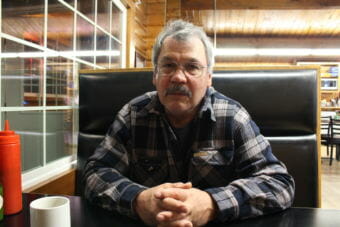
Mike Douville in a diner in Craig. Douville serves on the regional advisory council that makes recs to federal subsistence board. (Photo by Elizabeth Jenkins/Alaska's Energy Desk) 12/18/17
Mike Douville in a diner in Craig. Douville serves on the regional advisory council that makes recommendations to federal subsistence board. (Photo by Elizabeth Jenkins/Alaska’s Energy Desk)

On Thursday, the U.S. Forest Service said it was taking steps with the state to allow new roads to be built in the Tongass National Forest. It’s been a decades-long battle, and people have expressed mixed feelings about the announcement.

Mike Douville has lived on Prince of Wales Island his entire life. But he says the island doesn’t look the same. Now, there are large clear cuts where old growth trees used to be. He’d like to see an end to industrial logging — at least, in his lifetime.

So, hearing that new roads could be built in the Tongass, which would increase access to timber, was a huge disappointment.

“You got to look at the impacts on wildlife as well as people who live here,” Douville said. “I’ve said this before, I’ve lived here since 1949. All of the trees were standing here when I was kid. Now we don’t have that much left.”

But logging isn’t the only reason the forest service and the state want the ability to build roads in the national forest. There are communities in the Tongass that don’t have clear cell phone reception.

Greg Mickelson, with Alaska Power & Telephone, doesn’t provide cell service, but the company could potentially provide the electricity if there were new roads.

“Personally, I think because I’m in the power business, the Roadless Rule [exemption] will be beneficial to us to be able to access future hydroelectric sights,” Mickelson said.

The forest service has already allowed some exceptions for hydro projects like this in the past.

But Mickelson says the ability to construct new roads in the Tongass is also important for local economies — dependent on timber and mining.

The last large mill on Prince of Wales Island, for instance, is the utility’s biggest year-round customer.

“We’re all in this together,” Mickleson said. “I’m not a anti-environmentalist, but I also know that people have to be able to have a job if they want to be able to live.”

Dan Blanchard, the CEO and owner of UnCruise Adventures, says people don’t come to Alaska to see clearcuts. He says tourists want to experience the “pristine wilderness” of the Tongass — roadbuilding unchecked could hurt commercial interests.

But he’s not opposed to new roads being built entirely, and the state has said it will include tour operators in the conversation.

“So, with that I feel a lot more comfortable,” Blanchard said. “Or maybe comfort isn’t the word? Maybe I don’t feel as anxious.”

Blanchard says he’s open to hearing more dialogue. A state-appointed committee will discuss road building in the Tongass for the next two years.

New roads in the Tongass? Forest Service signs off on state’s ask.

Tongass National Forest
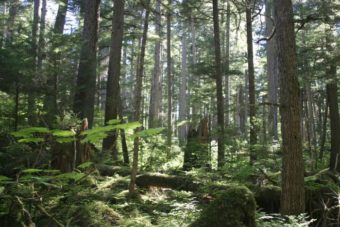
Tongass National Forest (Creative Commons photo by Henry Hartley)

After decades of debate, Alaska is now one step closer to being able to build new roads in the Tongass National Forest.

Timber industry groups have said new roads are critical for keeping the industry alive. Some small tour operators, on the other hand, want the Tongass to stay intact.

On Thursday, the U.S. Forest Service announced it signed an agreement with the state — officially kicking off that process.

They’ll be looking at the roadless rule — the federal regulation most states have to follow that Alaska has been fighting for years — and how it applies to the Tongass.

Chris French, who works in forest service’s Washington, D.C. office, says his visit to Alaska gave him some perspective.

“Everyone had a slightly different opinion and that made us say, ‘this is much broader than just a timber issue.'” French said. “And it’s important that we go through a process where we hear all those voices before we make any decision.”

French says new roads could allow access for cell towers to be built and mineral exploration.

Back in January, the state petitioned the forest service to consider an Alaska exemption to the roadless rule.

The forest service wants to finalize the details in less than two years — pending several rounds of public comment and an environmental assessment. First, the governor’s office will have to assemble an advisory committee to help oversee that.

In 2016, the forest service released a plan for the Tongass. It included phasing out old growth logging and was created with years of community input.

But French says that could change.

“The reality is yes,” French said. “Depending on what comes out of this. Whatever that rule is. If it changes from the status quo, then we’ll likely have to re-look at that plan.”

This latest announcement comes on the heels of a trip Sen. Lisa Murkowski made to a timber mill last month with a top federal official.

Colorado and Idaho have pushed for similar measures to build new roads on their national lands.

Young squeaks roadless rule exemption into agriculture bill

U.S. Rep. Don Young, R-Alaska, in his office in Washington, D.C., in 2017.
U.S. Rep. Don Young, R-Alaska, in his office in Washington, D.C., in 2017. (Photo by Liz Ruskin/Alaska Public Media)

It took some doing, but U.S. Rep. Don Young squeezed the House for votes Thursday night and got an amendment into an agriculture bill to exempt Alaska forests from the Forest Service’s roadless rule.

It was a feat that played out on the House floor like political cinema.

During debate earlier in the day, Young said the rule severely curtails logging and hampers timber management in the Tongass National Forest.

“I’m saying this roadless rule takes away the opportunity for people to survive for their family and take and have a sustainable silvicultural industry, taking care of our forests in Southeast Alaska,” Young said.

The drama came a few hours later, during the vote, when it looked like Young, the most senior member of Congress, might lose. He stalked the aisles with his list, shouting the names of colleagues he needed to get on board. The vote clock ran to zero and he was still short, but the rolls were held open for about 12 extra minutes.

“I need four more votes,” Young shouted at one point.

Young got one yea. Then another. Then Rep. Ryan Costello, R-Pennsylvania, made a big show of changing his vote, from no to yes. Costello looked over at Young, to ensure the favor was noted.

And then Young had it: 208-207. He raised both arms in victory. A few minutes later he and other Congress members were at the elevators to leave for the night.

How did Young get the votes?

“It’s what you call kindness. Kindness,” Young said. “I can be nice.”

Congress members laughed as the elevator doors closed.

The roadless rule has been a thorn in the side of Alaska’s congressional delegation since 2001. Environmental groups and their allies among Southeast Alaska fishermen and business owners say it preserves habitat and protects old-growth trees.

The agriculture bill still has a long way to go. It includes restrictions on food stamps that Democrats oppose. The House is expected to vote on the full bill Friday. The Senate is writing its own version.

Site notifications
Update notification options
Subscribe to notifications