International Brotherhood of Electrical Workers representative Julius Matthew walked the picket line with Wrangell municipal workers Lorne Cook, Dwight Yancey and Andrew Scambler before the strike ended. (Photo courtesy IBEW)
Wrangell officials have pulled out of contact talks with the union representing municipal workers.
Interim Borough Manager Carol Rushmore posted a letter on the municipal website Wednesday evening stating she had decided to not accept the union’s most recent proposal.
Rushmore added that the borough would not make any counteroffers to International Brotherhood of Electrical Workers members.
That could lead them to go back on strike.
Twenty-four utility and other workers went on strike June 22nd after the union and municipality rejected each other’s final contract offers.
Another 35 management and non-union employees remained on the job.
Officials from the borough and the union resumed negotiations June 29.
Union officials could not be reached immediately for comment on Rushmore’s decision.
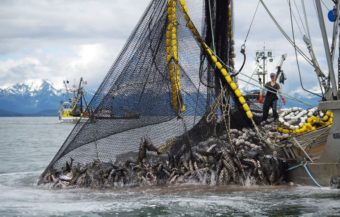
Commercial fishermen pull up a net full of salmon at Juneau’s Amalga Harbor in 2013. Commercial hatchery chum openings begin Thursday and may continue later this month. (Photo courtesy of Dave Harris/Alaska Department of Fish and Game)
Southeast seiners will have a shot at a large run of hatchery chums for six hours Thursday.
The opening is at Amalga Harbor, about 20 miles northwest of downtown Juneau.
“We’ve been doing quite well in recent times and the returns have been strong. We don’t need as many of the fish that come back to the cost recovery area as we used to. So we’re opening up the Amalga special harvest area to the seine fleet,” said Eric Prestegard, the hatchery’s executive director.
About 45 boats were on site by Wednesday afternoon.
Prestegard said there could be as many as 75. He expects them to catch between 1 million and 2 million pounds during the opening.
Cost-recovery harvests, which pay for hatchery operations, have brought in up to 2.2 million pounds since June 28. Those will resume after the commercial opening.
The harvest area is relatively small and can become crowded.
But Prestegard said there have been no major problems in recent years.
“It seems like everybody is able to figure it out and make it work,” he said. “The last couple years have been real good and they’ve done well and no trouble, no accidents or anything like that.”
He said the Amalga Harbor area will reopen to seiners the next three Thursdays if strong chum runs continue.
The Amalga fishery includes ocean waters from Eagle River to the Shrine of Saint Thérèse.
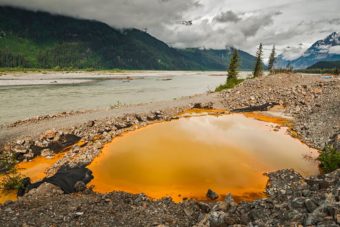
A Tulsequah Chief Mine settling pond overflows at the site about 40 miles northeast of Juneau Sept. 26, 2016. (Photo Courtesy of British Columbia Ministry of Energy and Mines)
Southeast Alaska tribal groups are calling for cleanup of British Columbia’s long-abandoned Tulsequah Chief Mine.
The call comes as a Canadian investment firm shops the prospect to potential new owners.
The Tulsequah Chief is an underground copper, gold, zinc, lead and silver mine about 40 miles northeast of Juneau.
Acidic wastewater has been draining into the Tulsequah River since the mine shut down 60 years ago. The river is a tributary of a waterway that flows through Alaska into the Pacific.
“The Tulsequah Chief Mine has been polluting the Taku River watershed since the 1950s,” said Frederick Olsen Jr., chairman of the United Tribal Transboundary Mining Work Group, which includes 16 tribal governments in Southeast Alaska.
Olsen also is president of the Organized Village of Kasaan, Prince of Wales Island city’s tribal government.
“This is an international issue. It needs international solutions. B.C. cannot be relied upon to clean this up,” he said.
British Columbia has promised to do just that.
B.C. Mines Minister Bill Bennett, center, Lt. Gov. Byron Mallott, center right, and Fish and Game Commissioner Sam Cotton, right, visit a Taku River fish wheel in August, after a stop at the Tulsequah Chief Mine. (Photo courtesy lieutenant governor’s office)
Minister of Mines Bill Bennett visited the Tulsequah Chief in 2015 as part of a Southeast Alaska tour. He was visibly upset by what he saw and promised action.
“It’s still against our rules for that water to be flowing into the Tulsequah River,” he said. “One way or the other, we have to stop it.”
But Bennett is no longer minister of mines. He retired this spring.
His replacement, Rich Coleman, was not immediately available for comment. And he may not be at all.
That’s because his boss, B.C. Premiere Christy Clark, just resigned after losing a vote of confidence in the province’s Legislative Assembly.
Her replacement is from a competing party.
Chris Zimmer is an activist with the group Rivers Without Borders.
“Despite the promises from B.C. that they were going to clean up the mine, it looks like their real hope was to get a new buyer, shift the cleanup responsibility to them and hope that they would then develop the mine,” he said.
Mine owner Chieftain Metals shut down operations last fall, which left the Tulsequah Chief in the hands of an investment company.
Court documents filed in early June show the company has attracted more than a dozen potential buyers and identified one as most likely to take action.
But Chieftain and another companies already have gone out of business trying to reopen the Tulsequah Chief.
Zimmer said a new buyer will have the same problem.
“That’s a recipe for more bankruptcies, more pollution and heavy industrialized mining right above some of the best salmon habitat in the Taku,” he said.
He said studies showing the wastewater does not damage fish are flawed. But officials in Alaska and British Columbia say they’re accurate.
Mine critics have called for involvement in a U.S.-Canada commission that resolves boundary waters disputes.
That hasn’t happened so far.
Tribal officials are worried about damage to subsistence fishing, Olsen said.
“We need the federal government of the United States to uphold its fiduciary trust responsibility to tribal citizens and its federally recognized tribes,” he said. “To citizens of the state of Alaska, it needs to protect us and our way of life from these massive projects.”
Two new British Columbia mines opened recently in transboundary watersheds.
International Brotherhood of Electrical Workers representative Julius Matthew walked the picket line with Wrangell municipal workers Lorne Cook, Dwight Yancey and Andrew Scambler before the strike ended. (Photo courtesy IBEW)
Wrangell’s municipal employees’ strike is over, at least for now.
The International Brotherhood of Electrical Workers and Wrangell Borough officials returned to the bargaining table today. That came as the 24 striking workers went back to their jobs.
IBEW leader Dave Reaves said the union emailed Wrangell Borough officials Wednesday, asking for talks to resume.
“We’d be willing to put the unfair labor practice … in abeyance, which basically means it would be paused or put on hold if they were willing to come back and talk,” Reaves said.
The municipality agreed. Interim Borough Manager Carol Rushmore said the two sides planned to begin talks at 9 a.m. today.
She confirmed that striking workers were back on the job.
Union members went on strike June 22. That came after the union and municipality rejected each other’s final contract offers.
The main difference between the two sides is a wage increase. The borough offered 75 cents an hour, while the union proposed $2.50 an hour.
Union members left the picket line to help with several emergencies during the strike.
Reaves said electrical crews took care of two power outages.
“The first day, there was an eagle that got into some lines. The linemen responded and fixed that. That outage included the hospital,” Reaves said. “The other day there was another outage, a transformer had internal problems and a crew responded and fixed that too.”
During the strike, the municipality hired temporary workers to fill in for striking employees. About 35 managers and other non-union staff continued to work.
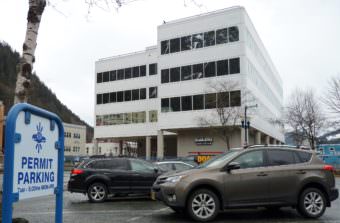
The Sealaska regional Native corporation is headquartered in downtown Juneau. (Photo by Ed Schoenfeld/CoastAlaska News
The management slate won this year’s Sealaska board election.
Three incumbents and a newcomer who ran with them beat out eight independent candidates.
Results were released Saturday via Sealaska’s Facebook page during the Southeast regional Native corporation’s annual meeting, held in Hydaburg, on Prince of Wales Island.
Juneau-based Sealaska has about 22,000 shareholders, which gives it the largest base of Alaska’s dozen regional Native corporations.
Sidney Edenshaw of Hydaburg is one of the three winning incumbents. He’s president of his community’s tribal association and has been on Sealaska’s board for 12 years.
Another is Ed Thomas of Kingston, Washington. The former Juneau resident spent 27 years as president of the Central Council of Tlingit and Haida Indian Tribes of Alaska. He’s been on Sealaska’s board for 27 years.
The third winning incumbent is Ross Soboleff of Juneau. The writer and fisherman won a board seat three years ago after running as an independent.
The fourth winning candidate is Morgan Howard of Kirkland, Washington, who owns a communications company. The board chose him from a group of about 50 shareholders who applied to run on its slate.
The seat he filled was vacated by Rosita Worl. The 30-year board member did not seek re-election this year. She continues to run the Sealaska Heritage Institute, the corporation’s cultural arm.
Eight independent candidates also ran for Sealaska’s board of directors. The highest vote-getters were Karen Taug and Doug Chilton of Juneau, and Nicole Hallingstad of Arlington, Virginia.
Taug works in finance, Chilton is an artist and teacher and Hallingstad works for the National Congress of American Indians. She used to be Sealaska’s corporate secretary.
The board-size measure would have shrunk the 13-member panel to nine members over several years. It targeted long-time incumbents.
Board election results list the number of shares cast for each candidate.
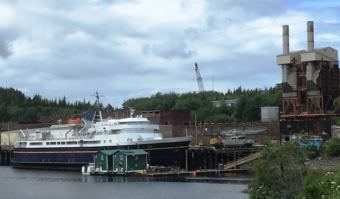
The Alaska Marine Highway System ferry Taku is in storage at Ketchikan’s Ward Cove. The former Ketchikan Pulp Co. mill site, including ferry headquarters, is in the background. (Photo by Leila Kheiry/KRBD)
The Alaska Marine Highway System is advertising the ferry Taku again.
The state listed the ship earlier this year at $1.5 million, then at $700,000.
This time, there’s no advertised minimum said spokeswoman Meadow Bailey.
“We have put the vessel out for open bid two times before and we have not gotten respondents,” she said. “This time we are just approaching it a little differently.”
The 54-year-old ship has been out of service about two years ago. It’s been moored at Ketchikan’s Ward Cove.
Bailey said the state does have a minimum amount, which it calls a reserve price. It’s just not being made public until bids are opened July 7.
“We would reward to the highest bidder above that reserve price if they meet all of the requirements,” she said. “If we happen to not have somebody come in above the reserve price, then we would negotiate with the highest bidder.”
She said the state will re-evaluate the situation if no one bids at all. One option would be to sell the ship for scrap.
The Taku is about 350 feet long. It can carry up to 50 vehicles and 350 passengers. It has 40 staterooms, a cafeteria, observation lounges and a covered solarium.
It sailed mostly Southeast routes.
Close
Update notification options
Subscribe to notifications
Subscribe
Get notifications about news related to the topics you care about. You can unsubscribe anytime.