IBEW Local 1547 is one of the unions that participated in this week’s training on right-to-work laws. (Photo by Casey Kelly/KTOO)
Updated | 11:45 a.m. Thursday
Wrangell’s 24 unionized municipal workers went on strike this morning.
An International Brotherhood of Electrical Workers press release says the employees acted because local officials negotiated in bad faith.
Members authorized a strike earlier this month, after they voted down the municipality’s final contract offer.
The Wrangell Borough Assembly voted Tuesday to put those contract terms into place.
The main difference between the two sides is the amount of an across-the-board raise. The borough offered 75 cents an hour. The union wanted $2.50.
Labor officials say the higher amount would balance out health-insurance premium increases. The municipality says the smaller amount is enough to improve most employees’ overall pay and benefits packages.
Borough and union officials were not immediately available for comment. The previous contract expired three years ago.
A municipal press release says the strike includes public works, water, sewer, sanitation, garage, ports and harbors, electric and pool-maintenance employees.
About 35 managers and non-union staff continue to work. The borough says water, sewer and electrical systems will continue to operate.
Wrangell is a central Southeast Alaska community of about 2,300 residents.
Local officials say Wrangell’s curbside garbage collection will continue for now, though pick-up may be later than usual.
It also says harbors will continue to be staffed, though calls could take longer to be returned.
Wrangell has been advertising for temporary workers to fill in during the strike. There’s no word yet on whether any are on the job today.
Original story | 12:09 p.m. Wednesday
Unionized borough workers want more contract talks
Wrangell’s municipal employees’ union has authorized a strike. But one of its leaders said members don’t really want to.
Mark Armstrong is a shop steward for the International Brotherhood of Electrical Workers, which represents 24 city and borough staffers.
He said the union voted to authorize a strike twice before this year. Both times, municipal officials responded by resuming contract talks.
He hopes that happens again.
“I don’t know anybody who wants a strike,” Armstrong said. “Certainly the community members don’t want us to strike. I’m sure the city isn’t looking forward to a strike. And neither are the union members. The purpose of the strike is just to bring the city back to the table so we can continue negotiations and hopefully reach a contract that’s agreeable to everybody.”
The Borough Assembly scheduled a special meeting at 5:30 this evening to consider the situation.
Wrangell’s unionized workers have been without a contract for three years.
Management and labor made final wage offers earlier this month. The union proposed an across-the-board, $2.50-an-hour raise. The municipality offered 75 cents.
Armstrong said the union’s proposal balances out another contract term that calls for workers to pay 15 percent of their health insurance costs.
“We’re not seeking a wage increase. We’re just trying to compensate wages enough so that in the end, we don’t fall backwards because we’re going to pay that insurance premium,” Armstrong said.
Armstrong said the borough’s offer would essentially cut paychecks by several hundred dollars each.
The municipality has been preparing for a strike.
Interim Borough Manager Carol Rushmore said it’s recruiting temporary, fill-in staff.
And she’s released a list of services that would slow or stop if workers strike. She said some tasks would be covered by about 35 managers and non-union staffers.
Armstrong said the union has not asked for a wage increase to be retroactive to when the previous contract expired.
“We chose not to pursue that because of the extra burden that that would have been on the city,” Armstrong said. “We realize things are extremely tight.”
In a prepared statement, Rushmore recognized the right of union workers to strike. But she said the municipality’s responsibility is to build a budget it can afford, especially given ongoing state spending reductions.
Sealaska corporate headquarters is in Juneau. The Southeast regional Native corporation will hold its annual meeting June 24 in Hydaburg. (Photo by Casey Kelly/KTOO)
Should Southeast’s regional Native corporation shrink its governing board? That’s a question before Sealaska’s more than 22,000 shareholders. Management opposes the change.
Shareholder Karen Taug thinks that’s too many — and costs too much.
“I believe that if we were a moneymaking machine and we were just rolling in successful corporations and we had a lot to manage, I think it’s justified to have more board members,” she said.
But, she said, that’s not the case.
Taug, who works in finance, is one of 12 shareholders running for four seats on Sealaska’s board of directors this spring.
She’s also the author of a resolution to shrink the board from 13 to nine members.
Sealaska opposes the measure, though it would not grant an interview on the topic. A statement on its website said a smaller board would result “in decreased representation of shareholder interests.” It also said fewer seats would lessen the chance of independent candidates being elected.
Part of the resolution would make it harder for longtime board members to win re-election, by prohibiting a management endorsement. Taug reads from her proposal.
“The longest-serving directors will not be eligible for the board slate. However, (they) will be able to run as an independent candidate to begin in the year 2018 and each year thereafter until there are nine members,” she said.
Sealaska opposes the measure, saying it would damage the corporation.
On its website, officials wrote “The resolution as written targets longest-serving directors for removal to accomplish the reduction, regardless of their experience.”
Nicole Hallingstad, also an independent board candidate, said that’s the point.
“I think the current resolution is one more way that shareholders are trying to deliver their message that there are directors who have served far too long on Sealaska’s board,” she said.
Previous resolutions proposed term limits or changes in discretionary voting. All failed.
To pass, a resolution needs to attract more than 50 percent of all shares that could be cast. That’s a higher standard than a majority of just the shares cast that year.
There’s no standard board size for Alaska’s 12 regional Native corporations. Sealaska is one of three with 13 members. Another three have nine. The others range from 11 to 23.
Edgar Blatchford is a former regional Native corporation CEO. He teaches journalism and Native studies at the University of Alaska Anchorage. Blatchford said reducing board size just puts more power in a few shareholders’ hands.
“In my experience in dealing with Chugach Alaska Corp., I think it has left holes in the argument that it has created efficiencies. I think what it has created is a lack of transparency and it has put more corporate control, more board control, in the board of directors,” he said.
Most Sealaska shareholders have already cast their ballots, called proxies, by mail or online. The final deadline is at Sealaska’s annual meeting, June 24, in Hydaburg on Prince of Wales Island. Results will be announced there.
The ballots also list the names of those shareholders running for four board seats.
Occupation: Commercial Fisherman, owner of the F/V Jerilyn, and the Walking Boss Dispatcher for Southeast Stevedoring.
Education: Graduate of Hydaburg High School.
Sealaska positions: Served on the Sealaska Board since March 2005, manager on the Haa Aaní LLC Board.
Directorships: Former Haida Corp. Board member.
Affiliations: President of Hydaburg’s Tribal Association. Member of Hydaburg ANB Camp 6, president of the tribe’s nonprofit foundation, XKKF, Tlingit & Haida Hydaburg Delegate. Shell Fish Preservation Alliance.
Bradley Fluetsch, 54, independent, Lamy, New Mexico.
He has withdrawn from the race but his name remains on the ballot.
Nicole Hallingstad, 51, independent, Arlington, Virginia
Occupation: Director of Operations, National Congress of American Indians.
Education: Bachelor of Arts in History, University of AK Fairbanks; Master of Arts in European History, University of CA Berkeley.
Sealaska positions: Former Sealaska VP & Corporate Secretary, VP of Human Resources, VP of Communications; former Director of Alaska Coastal Aggregates and Haa Aaní Community Development Fund, Inc.
Directorships: Board service for Cancer Connection, Capital Community Broadcasting Inc., Bartlett Hospital Foundation, United Way of SE Alaska.
Affiliations: Member ANS Camp 16 Petersburg; Member of Tlingit & Haida Indian Tribes of Alaska; Individual Member of NCAI.
Morgan Howard, 48, running on the management slate, Kirkland, Washington.
Occupation: Owner of Morgan Howard Communications, LLC.
Education: Bachelor of Arts in Film Production from Columbia College – Hollywood; Bachelor of Science in Communications from Northern Arizona University.
Sealaska positions: Provided communications and public relations services to Sealaska in 2016. Consulting, creative and design services, writing, advertising and media support.
Directorships: Tlingit Haida Tribal Business Corp. (8 Years); Yak-tat Kwaan Inc. (10 years from 2006-2016)
Affiliations: Seattle Chapter of CCTHITA, Treasurer and Delegate; Alaska Native Village CEO Association, Founding Member; Alaska Innovation and Entrepreneurship Group, Founding Member; and Fledge.Co start-up mentor.
Occupation: President and CEO, First Nations Development Institute.
Education: MBA, Finance & Operations Management, University of Washington’s Foster School of Business.
Directorships: Sustainable Agriculture & Food Systems Funders; Three Affiliated Tribes – the Mandan, Hidatsa, and Arikara; Center for Native American Public Radio; The National Center for Family Philanthropy; Native Americans in Philanthropy; First Nations Development Institute; chair of First Nations Oweesta Corp.; and Four Times Foundation.
Ross Soboleff, 65, incumbent running on the management slate, Juneau
Occupation: Writer, small business owner, commercial fisherman.
Education: Bachelor of Science in Community Service and Public Affairs from the University of Oregon.
Sealaska positions: Former VP Corporate Communications of Sealaska. Member of the Sealaska Board of Directors since June 2014. Trustee of the Elders’ Settlement Trust.
Occupation: Retired. Former President of Central Council of the Tlingit and Haida Indian Tribes of Alaska (27 years), President Emeritus.
Education: Associates in Science from Sheldon Jackson College; Bachelor of Science from the University of Alaska Fairbanks; and a Master of Education Administration from Pennsylvania State University.
Sealaska positions: Sealaska Board member since October 1993. Member of the Haa Aaní, LLC Board of Managers, director of the Spruce Root, Inc. Board (formerly known as Haa Aaní Community Development Fund, Inc.).
Directorships: Former director and chairman of Shaan Seet, Inc. (Craig Village Corp.). Former President of Ketchikan Indian Community.
Affiliations: Former president of Ketchikan ANB Camp 14, a former 1st vice-president ANB Grand Camp and the parliamentarian of the 2016 ANB Convention; former executive director of the Ketchikan Indian Education Program; elected secretary of the National Congress of American Indians (NCAI) and parliamentarian; former board member of the Alaska Federation of Natives, member of the Council for the Advancement of Alaska Natives.
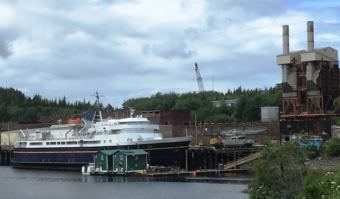
The Alaska Marine Highway System ferry Taku is in storage at Ketchikan’s Ward Cove. The former Ketchikan Pulp Co. mill site, including ferry headquarters, is in the background. (Photo by Leila Kheiry/KRBD)
The price is dropping for the state ferry Taku.
No one submitted a bid during the most recent sale attempt, which ended May 31, Alaska Marine Highway System General Manager John Falvey said.
The minimum bid was $700,000. An earlier attempt priced the ship at $1.5 million.
“We’ve had quite a bit of interest. We’ve probably had upwards of 25 calls or emails with interest,” he said. “But no bids.”
Falvey said the Taku will be put out to bid one more time at a lower, yet-to-be-determined price. That should happen this week.
He said it could be sold for scrap if no one buys the ferry.
The ferry system took the 54-year-old ship out of service about two years ago. It’s been moored at Ketchikan’s Ward Cove.
Falvey said a buyer would have to accept the ferry as-is, where-is.
It’s in pretty good shape, he said. But it would need some upgrades and permits before it could carry passengers again.
“The boat was certified by our Coast Guard. … It was operational. It was safe,” he said. “I would have to assume that it shouldn’t need anything more than minor maintenance to get it running again because it sat so long.”
The Taku has been advertised on the state’s website and through the Passenger Vessel Association, a trade organization.
The Taku is about 350 feet long. It can carry up to 50 vehicles and 350 passengers. It has 40 staterooms, a cafeteria, observation lounges and a covered solarium.
A man police say stole and abandoned about eight vehicles in the past week left this truck high-centered on a large log. Another vehicle was burned. (Photo courtesy Wrangell Police Department)
Wrangell police arrested a man Thursday who allegedly stole and damaged at least eight cars and trucks during the past week.
Police Chief Doug McCloskey said the man won’t be named until he’s formally charged. That could happen Friday.
McCloskey doesn’t have a cost estimate yet, but said it will be a significant amount because of the extent of the damage.
“Everything from just running out of gas to burned. Some of them were wrecked and stuck in the ditch,” he said. “One was up on a log, a 3-foot log. He was just very, very, very tough on the vehicles.”
Some alcohol was involved, McCloskey said, but he’s not sure whether it was a contributing factor.
Multiple charges will be filed, McCloskey said.
“Some of them will actually be felony theft and some of them would actually be more of the criminal trespass end of the joy riding,” he said.
The first thefts happened over the weekend and continued through Wednesday night. McCloskey said the alleged thief was not arrested at the scene of the latest crash.
Nothing like this has happened in Wrangell for at least 25 years, the police chief said.
Drivers move their cars and trucks off the ferry LeConte at the Angoon terminal in 2010. The marine highway used to send the larger fast ferry Fairweather, but replaced its stops with the LeConte. (Photo by Ed Schoenfeld/CoastAlaska News)
“The ferry system is our lifeline. People use it all the time, myself included. So it would be devastating to not have that option available to us,” said Albert Kookesh III, the Southeast island community’s city clerk.
Angoon is an approximately 500-resident town on the west side of Admiralty Island (Photo by Ed Schoenfeld/CoastAlaska News)
Residents sail twice-weekly summer roundtrips to Juneau to shop for groceries, household items and other essentials. Kookesh says Angoon merchants would be left with empty shelves if there’s no service.
“We do have the one store and they utilize the ferry system as well,” he said. “If they have to start shipping their groceries in via a plane or getting their own barge, that definitely hits us in the wallet also.”
Spokeswoman Meadow Bailey doesn’t expect a total shutdown. But there would be cuts.
“It might be some closures or some reductions,” she said. “It might be fewer hours. Really, we’re not sure what the impacts will be yet. That’s what we’re working through with the Department of Law right now.”
They’re considering what services are required by the Alaska Constitution. Others might have to continue in some form because of federal requirements.
Transportation cuts also would hit road maintenance, state-run airports, the Whittier Tunnel and numerous building repair and other capital projects.
Ferry cutbacks would also hurt lodges and guides, as well as personal travel, Kookesh said.
“The ferry system is the most economical way for many of us to travel to and from. And with the summer months coming up, a lot of traveling’s going to be taking place, either from us leaving or from our family coming in,” he said. “Not only does that hurt us getting out of Angoon, it hurts people getting into Angoon also.”
The ferry system sails 10 vessels to and from 35 coastal communities, many without a road connection.
About two-thirds of its budget comes from state general funds. The rest is from ticket sales and other revenues.
Correction: In an earlier version of this story, the caption to the ferry photo misidentified the vessel pictured. It’s the LeConte, not the fast ferry Fairweather.
Dan Blanchard’s Team UnCruise Adventures competes in 2016’s Race to Alaska on board the 25-foot trimaran Un-Screwed. The team can’t race this year. (Photo courtesy Dan Blanchard)
No Alaskans are competing in this year’s Race to Alaska.
The Washington state-to-Ketchikan competition will have close to 40 motorless watercraft. But the only team from the contest’s namesake destination has withdrawn.
Dan Blanchard is CEO of UnCruise Adventures, which sails small tour ships in Southeast Alaska, the Pacific Northwest and some other parts of the world.
He’s also captain of a three-person team that’s sailed a 25-foot trimaran sailboat during the 2015 and 2016 Race to Alaska contests.
As a part-time Juneau resident, and a major race sponsor, he was the only Alaskan entered to sail in this year’s event. But, he had to withdraw.
“Like everyone, sometimes family life and work life and race life all collide at the same time,” he said. “So this year it was just a time constraint. But I certainly plan on being back.”
Past races have attracted a few teams from Ketchikan and elsewhere in Alaska. But most are from Washington state or British Columbia.
Organizer Daniel Evans used to live in Alaska.
While Southeast and Southcentral coasts attract sailboats, he doesn’t think they have much opportunity to prepare for a 750-mile, unsupported journey.
“By and large, the wind in Alaska is blowing too hard or it’s snowing or it’s too cold,” he said. “It’s just a much, much shorter cruising window.”
Blanchard said it’s also a question of timing.
“It’s challenging for Alaskans, particularly when we are very seasonal … in our work life, to bring a boat down to Port Townsend, Washington, and the commitment of what usually ends up being well over a month, even if you have a fairly short passage like we’ve had. It’s just tough to do” he said.
His team finished in about 10 days the first year and five days the second.
While most racers sail the route, others paddle kayaks, row boats or travel by sailboard.
Evans said about half the teams are in vessels of 20 feet or less. Fifteen will travel solo.
“I would describe the people who race as huge adventurers,” he said. “(They’re) people who just decided they wanted to kind of live in their skin and experience something that they would never be ever fully prepared for.”
And it’s not easy. Racers face strong winds, high seas, tidal currents, cold rain and, in some places, narrow passages.
“It’s the most painful thing Blanchard ever done, he said.
“I’ve described it like living inside a clothes washer on full spin for anywhere from six to 20 days. It’s not for the meek” he said.
The Race to Alaska is actually two contests.
The first is a 40-mile qualifying voyage from the Olympic Peninsula to Victoria, on Vancouver Island. About 60 vessels are signed up for that run.
The second is 710 miles from Victoria to Ketchikan. Thirty-seven teams plan to make that journey.
The winner gets $10,000 in cash. The runner-up gets a set of steak knives. Other finishers just get to say they made it alive.
Close
Update notification options
Subscribe to notifications
Subscribe
Get notifications about news related to the topics you care about. You can unsubscribe anytime.