Ed Schoenfeld, CoastAlaska

Cruise-ship tourism will expand next summer

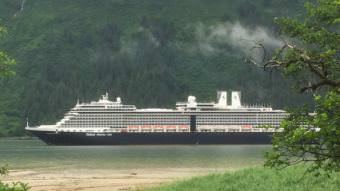
A Holland America cruise ship sails up Juneau's Gastineau Channel June 19 2017. (Photo by Ed Schoenfeld/CoastAlaska News)
A Holland America cruise ship sails up Juneau’s Gastineau Channel June 19, 2017. (Photo by Ed Schoenfeld/CoastAlaska News)

More tourists will come to Alaska next summer on cruise ships.

Research by Wells Fargo Securities predicts about 6 percent growth from this summer’s number, which is 1.06 million passengers. The company projects growth from 5 to 10 percent in other markets around the world.

The numbers are based on capacity, not tickets booked.

Cruise Lines International Association-Alaska President John Binkley said cruise lines are following the money.

“Most of these are publicly traded companies, so they’re looking at where they can take these assets, the ships, and move them to the destination where they’re able to get the best return on investments for their shareholders,” he said.

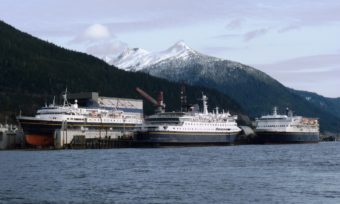
Passengers walk a downtown Juneau dock where three cruise ships are tied up June 11, 2017. (Photo by Ed Schoenfeld/CoastAlaska News)

“Right now, Alaska is popular and people want to travel to Alaska. That allows them to charge a little higher price, because there’s a high demand.”

Binkley said factors include Alaska-based reality TV shows, interest in the Arctic and strong marketing.

He also said many tourists consider the state to be safe and secure.

“Some geopolitical problems around the world in some areas cause people to want to go to a domestic location that’s exotic, like Alaska, rather than a foreign destination where the perceived safety might be in question,” he said.

Binkley expects growth to continue into the 2019 season, though he doesn’t have the numbers yet.

Passenger capacity hovered just under 1 million from 2012-2015.

The Wells Fargo study projects 6 percent market growth worldwide in 2018, the same as in Alaska. More and larger ships are driving the boom.

Australia will have even more capacity, as will Europe, excluding the Mediterranean. The Caribbean and China are expected to see lower growth.

Late state budget delays fall-winter-spring ferry schedule

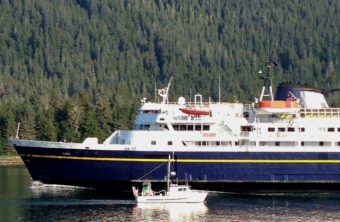
The ferry Malaspina is in drydock and the Columbia is tied up at the Ketchikan Shipyard in February, 2012. Federal funds have covered millions of dollars of repairs. (Photo by Ed Schoenfeld/CoastAlaska News)
The ferry Malaspina is shown in drydock and the Columbia is tied up at the Ketchikan Shipyard in February 2012. Damage to the Columbia is delaying its return to service this fall and the Malaspina will help fill in. (Photo by Ed Schoenfeld/CoastAlaska News)

Alaskans have until the end of the month to tell the Marine Highway System what they think of its fall, winter and spring sailing plans.
The schedule, which is similar to last year’s, came out later than usual and the comment period is shorter.

Last year, the fall-winter-spring ferry schedule was released in May. Residents had about a month to go through it and provide feedback.

This year, it wasn’t made available until mid-July, with a comment deadline two weeks later.

General Manager Capt. John Falvey said that’s because of the end-of-June resolution of the Legislature’s spending battles.

“We can’t put schedules out to comment on until we have a final budget figure,” he said. “Being that we were running a little bit late this year, we just got a late start.”

The ferry system wants a fast turnaround so it can begin taking reservations during the first week of August, he said.

Written comments on the schedule are due by July 30 and a teleconference will be held the following day.

Read the ferry system’s letter to communities, which includes the draft schedule and links for public comments.

Extra ferry life rings lean against other spare parts at the Ketchikan Marine Engineering Facility at Ward Cove. (Photo by Ed Schoenfeld/CoastAlaska News)

Marine Transportation Advisory Board Chairman Robert Venables doesn’t see that as a problem.

“It is a shorter public review and comment period,” he said. “But I think most folks are very familiar with the schedule and the system and their needs. So, it’s best to get that schedule published and open for reservations.”

One reason he isn’t worried is that the schedule is very much like the previous year’s.

Falvey said a few sailings have been added, but not many.

“Operating weeks is about the same, overall. Budget’s about the same, overall,” he said. “What you saw last year is about what you’re going to see this year, overall, with a little bit of a different switch on the ships.”

That’s due to lengthy repairs to the ferry Columbia, which usually sails between Southeast and Bellingham, Washington. It’s been out of service since last September, because of a damaged propeller system.

“Those parts don’t exist. It’s all 1973 vintage and over the winter, that entire system had to be rebuilt in Germany,” he said. “We’re still not there yet.”

The draft fall schedule shows the Columbia resuming service Oct. 1, but Falvey said that’s now pushed back about a month. Other ships will fill in.

The Columbia, the system’s largest ship, was damaged when it struck an underwater object.

Falvey’s not sure what it hit, but it wasn’t a rock.

“There was something floating under water. A lot debris could have been floating 10 to 15 feet under the water,” he said.

This summer’s ferry schedule was published last fall, long before lawmakers decided how much money the system would get.

Officials committed to keeping that schedule, saying any funding cuts would be absorbed later in the fiscal year.

Venables said the system had no choice, since last-minute changes would hurt summer tourism.

It’s not the best way to build a schedule, he said.

“When you have very little notice on what the funding level’s going to be, then that uncertainty leads into the No. 1 revenue-generating month, which is July … it has ripple effects throughout the rest of the year,” he said.

The schedule, which covers October through April, uses nine of the marine highway’s 11 ships.

The fast ferry Chenega is out, in long-term storage, and the mainliner Taku is for sale.

Newly found disease could threaten Southeast Alaska spruce

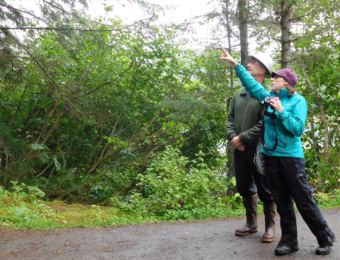
Forest Service Plant Pathologist Robin Mulvey points out infected spruce branches at Juneau's Shrine of St. Therese to shrine volunteer Brian Flory on July 11, 2017. (Photo by Ed Schoenfeld/ CoastAlaska News).
Forest Service Forest Pathologist Robin Mulvey points out infected spruce branches on July 11, 2017. at Juneau’s Shrine of St. Therese to shrine volunteer Brian Flory. (Photo by Ed Schoenfeld/CoastAlaska News).

A fungus that’s damaged trees in Southcentral and Interior Alaska has been discovered for the first time in Southeast.

But there’s a chance its spread could be stopped.

Forest Pathologist Robin Mulvey walks down the causeway to the Shrine of St. Therese, a forested island about 20 miles northwest of downtown Juneau.

“Right here you can see a small tree. It’s about 4 inches in diameter and it’s just a stump now because we removed that tree,” she said. “This was a fairly heavily infected tree, at least in the lower branches.”

The infection was spruce bud blight, which damages or kills the growing tips of branches. It was discovered here in late June, the first reported sighting in the region.

Fruiting bodies of spruce bud blight (Gemmamyces piceae) are shown on white spruce near Anchorage. (Photo by Lori Winton/U.S. Forest Service)

The blight could be a problem, because it infects Sitka spruce, one of the most common trees in Southeast Alaska’s rainforest.

“Right now, I’m considering it potentially a significant threat,” she said. “I’ll be incredibly happy to be wrong about that.”

Mulvey, who works for the U.S. Forest Service, explains that Southeast’s Tongass National Forest has just what the blight likes.

“The ideal weather conditions for the pathogen are temperatures between 55 and 65 degrees Fahrenheit, with precipitation,” she said. “If you’ve been in Juneau this summer, you know we’ve had very conducive weather conditions for this pathogen.”

The fungus is not easy to spot. It’s black and looks like a dead, crusty coating on the buds.

It’s actually a group of small, spherical fruiting structures.

If it doesn’t kill a bud, it hampers its growth, leaving another sign, a small, twisted branch with few needles.

“This is going to spread through spores moving on the air and it’s also going to spread through spores moving through rain splash,” she said.

But no one’s sure how the spruce bud blight found its way to this one, small patch of Southeast forest.

Mulvey said it’s unlikely it came in on the clothes or boots of one of the shrine’s many visitors.

It’s often found on Colorado blue spruce, a common ornamental plant used in landscaping. But her team found no infected trees in the area or at a nearby arboretum.

She said they were looking for another pathogen, the spruce aphid, when they came across the infestation.

“We just happened to turn and look at this spruce tree. And I said, ‘Hey! The shoots on that spruce look a little bit bent.’ So we went in for a closer look,” she said.

Spruce bud blight was first found in Homer four years ago, though it took until last year to figure out what it was. It’s also been identified elsewhere on the Kenai Peninsula and in Anchorage and Fairbanks.

Forest Service Plant Pathologist Lori Winton, who is based in Fairbanks, said her first encounter also was a surprise.

“The first time I saw it, I was skiing in the forest near Anchorage and I pretty much fell face-first right into a tree that had it,” she said.

That was about two years ago, and it wasn’t clear what it was.

Then, an article in a scientific journal described outbreaks on blue spruce plantations in central Europe’s Czech Republic.

“Suddenly, there were DNA sequences available that matched,” she said. “I had an identification and frankly it was a rather alarming identification.”

The potential for extensive damage in Southeast’s forests, or those statewide, is not known. And since no one’s sure how it got to Alaska, it’s not clear how rapidly it could spread.

The first trees hit by spruce bud blight were found at the Shrine of St. Therese, a Catholic church and landmark in Juneau. (Photo by Ed Schoenfeld/CoastAlaska News)
The first Southeast trees found with spruce bud blight were at the Shrine of St. Therese, a Catholic church and landmark in Juneau. (Photo by Ed Schoenfeld/CoastAlaska News)

Winton said there’s also a chance spruce bud blight could have been here all along and just hadn’t been spotted. After all, it is a big state.

“That’s currently the question, is whether it’s native to North America or not — or Alaska,” she said.

She said it could take a year of lab work to figure that out.

The blight has been found in eastern Canada, but not throughout the United States.

Mulvey wonders about the same question back in Juneau.

“Part of me says, ‘What are the chances that we detected the only site of infection in Juneau?’” she said. “I think the chances are pretty small.”

But if it isn’t here naturally, there’s a chance it could be stopped.

“I just have to do what I can to try and prevent any further spread, while it still seems feasible,” she said.

Her team is continuing its search for spruce bud blight in Southeast. It’s also asking for public help.

She suggests checking landscape plants on your own property, because it seems most common in developed areas.

“Look really closely at any dead buds on your spruce trees and if you see these small, spherical black fruiting structures, please give us a call because we’d love to come out and take a look,” she said.

And that’s just what was she doing during our visit to the Juneau landmark.

She and shrine volunteer Brian Flory were using binoculars to check out higher branches near the infected trees that were removed or trimmed. And sure enough, they found more.

Wrangell, workers reach new contract agreement

Wrangell municipal employees represented by the International Brotherhood of Electrical Workers pose on the picket line June 22, 2017. They’ve since reached a new contract agreement with the borough, which now goes before the Assembly. (Photo courtesy IBEW )

Wrangell has a new agreement with its unionized workers.

If approved by the Borough Assembly, it will end three years of sometimes acrimonious talks over wages and benefits.
International Brotherhood of Electrical Workers members went on strike June 22. That came after the Assembly approved the borough’s final contract offer, which workers had already rejected.

The strike ended about a week later after the two sides returned to the bargaining table.

But the municipality rejected a new union contract proposal. Rather than return to the picket lines, workers asked for more negotiations.

Interim Borough Manager Carol Rushmore said the talks led to new terms.

“There’s basically one change from the contract that the Assembly ratified on June 20. And it has to do with the health and wellness benefits – the medical benefit – for union members,” she said.

Assembly members will hold a special meeting at 5:30 p.m. July 13 to consider amending the contract they already passed. Rushmore will recommend approval.

The union voted in favor of the agreement at a July 10 meeting. A representative said it would make no statement at this time.

Twenty-four Wrangell utility and other employees are represented by the International Brotherhood of Electrical Workers. Another 35 management and non-union staffers also work for the borough.

The Assembly will discuss the contract change behind closed doors, then vote in a public meeting.

Murkowski speaks with constituents about health care during Senate recess

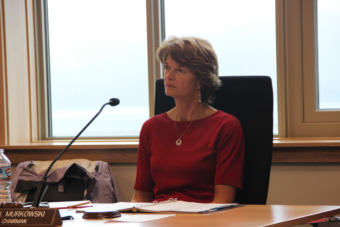
Sen. Lisa Murkowski listens to panelists at a field hearing of the U.S. Senate and Natural Resources Committee in Cordova, Alaska on June 10, 2017. (Photo by Rachel Waldholz/Alaska’s Energy Desk)

Wrangell got some national attention on the Fourth of July, but it wasn’t for its parade..

It was because of a visit from U.S. Senate Lisa Murkowski.

She was one of just four of the Senate’s 52 Republicans to make a public appearance during the national holiday.

Longtime Alaska journalist Julia O’Malley covered Murkowski’s Wrangell visit for the Washington Post.

“I would say 85 or 90 percent of the people who came up were talking about health care and her being sort of moderate on that issue and potentially not voting for the GOP proposal,” O’Malley said. “She certainly didn’t commit to vote one way or another, but seemed very sympathetic to the concerns of people around her who were just dealing with issue of cost and access.”

O’Malley, who stood beside Murkowski, said residents shared health care horror stories.

She said the senator seemed particularly moved when one woman spoke of $10,000 deductibles that discouraged her from seeking medical care.

Murkowski made another appearance on Friday in Homer, where she held a meeting with constituents at City Hall.

In her opening remarks, Murkowski said it was “important” that the Senate delayed the vote on health care reform, and she criticized the lack of transparency in the drafting of the new health care bill.

“You’ve got an effort to advance something quickly because we want to get it behind us,” Murkowski said. “That doesn’t yield good solutions.”

Murkowski spoke in front of a standing-room crowd of more than 100 people.

The questions were overwhelmingly focused on health care with numerous people decrying the current Senate Republican plan, titled Better Care Reconciliation Act of 2017.

Multiple people called for a single-payer system, something the Senator said was unrealistic given the current political climate.

Nobody at the event spoke in favor of the bill.

Health care was not the only topic of conversation during Murkowski’s visit to Homer.

Later in the day, she attended a luncheon hosted by the Homer Katchamek Bay Rotary Club where she was asked about the potential of North Korea launching a weapon that could reach Alaska.

She responded that the country’s missile tests are alarming and that the threat should be taken seriously.

“I think we have seen a level of escalation in this past week and these past few days that most were hoping we would never see,” the senator said. “Maybe this is what precipitates that broader level of engagement from other nations to weigh in.”

Murkowski went on to say that missile defense enhancements coming to Alaska benefit not just the state, but the nation as a whole.

Update: Someone may want to buy the ferry Taku, but they need more time

ferry Taku
The Alaska Marine Highway ferry Taku sails into Wrangell Narrows near Petersburg in 2014. It was tied up the following year and is for sale. (Photo by Ed Schoenfeld/Coastalaska News)

Update, July 11, 2017, 9:30 p.m.: Alaska Marine Highway officials are extending the final bid deadline for the ferry Taku another three weeks.

Spokeswoman Meadow Bailey says it’s because an interested buyer wants to tour the 54-year-old ship.

Bids were originally due by July 7. Officials pushed that back a week and a half on Monday. Now, bids aren’t due until Aug. 8.

***

Someone is interested in buying the retired ferry Taku.

As a result, the Alaska Marine Highway System is giving interested parties an extra week and a half to submit bids.

The 54-year-old ship has been out of service for two years. It’s been put out to bid twice before, first at $1.5 million, then at $700,000.

But no offers were made.

The latest attempt, advertised June 19, listed no minimum price. Bids were scheduled to be opened July 7. That deadline was then extended until July 18.

Ferry spokeswoman Meadow Bailey said the new deadline came at the request of an interested party.

“Obviously, there is not a huge rush on this,” she said. “We have been working with the Taku for several months now. So we were happy to fulfill that request.”

Bailey said the marine highway is not identifying the interested party or parties.

The Taku was tied up in 2015 to save money.

It worked, but needed minor repairs and certifications required for all passenger ships.

It’s been moored at Ketchikan’s Ward Cove since then.

The Taku sailed mostly Southeast routes. It’s about 350 feet long. It can carry up to 50 vehicles and 350 passengers. It has 40 staterooms, a cafeteria, observation lounges and a covered solarium.

If it can’t be sold, it could be scrapped.

Editor’s note: This report was updated with information about a second extension of the bid deadline. 

Site notifications
Update notification options
Subscribe to notifications