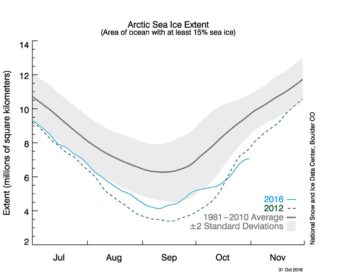
(Image courtesy of National Snow and Ice Data Center)
This late in the fall, Arctic sea ice should be forming near the community of Barrow. Instead, the ocean is open for hundreds of miles.
Barrow also shattered its record for the highest average temperature for October.
Brian Brettschneider is a climatologist in Anchorage who closely tracks Alaska climate data and trends. Alaska’s Energy Desk is checking in with him regularly as part of the segment, Ask A Climatologist.
Brettschneider told Energy Desk editor Annie Feidt Arctic sea ice is at record lows for this time of year.
Transcript:
Brian: As of October 31st, the sea ice was just over seven million square kilometers, which sounds like a lot, but it’s quite a bit lower than any other October 31st on record.
Annie: How concerning is that?
Brian: It’s very concerning because the lack of ice really affects the climate of the entire circumpolar area. So for example Barrow, Kotzebue, all the areas in the northern part of Alaska, saw record warm Octobers in very large part because there’s so much open water with lots of stored heat from the summer months that’s typically locked away by ice at this point in the season.
Annie: How warm was it in Barrow in October?
Brian: It was just over 31 degrees, and that’s by far their warmest October on record- a full 13 degrees above normal.
Annie: And is it the high temperatures making it hard to form sea ice or the lack of sea ice making the temperatures high?
Brian: That all works together- so it’s called a positive feedback. The warm temperatures are really slowing down the creation of new sea ice, and the warm temperatures are adding extra heat to the open water which makes it then even harder to freeze up. So it’s a positive feedback cycle that reinforces itself.
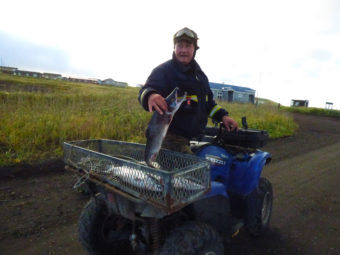
Diodor Stepetin shows off the salmon he caught in St. Paul’s salt lagoon. (Courtesy Lauren Divine)
Gregory Fratis Sr. isn’t a fan of salmon.
“Fresh cooked salmon, uh, uh. I don’t like it,” said Fratis. “I can taste that fishy taste.”
The 76-year-old says salmon aren’t worth the trouble. It takes too more time to catch and process each individual fish. To fill his freezer for the year, he’d rather catch seal, one of the Pribilof Islands’ traditional foods.
“We are the people of the seal,” he said. “That’s part of our diet. We are recognized through the fur seal. It’s our culture, too. The seal has everything to do with us Aleuts as food, as arts and crafts, as everything.”
But Fratis was also one of the first people on the island to go looking for salmon. Back in the early 1980s, someone told him about a salmon he discovered washed up on the beach. Fratis found a net and set out to see if he could catch some. After a bit of trial and error, he caught his first salmon.
“I took it home, excited,” he said. “Looked at it. Cooked it.”
All five salmon species have been found in the island’s salt lagoon. Now, the Aleut Community of St. Paul’s tribal council is hoping to get more residents interested in salmon fishing for two main reasons. First, salmon is a healthy food. Second, fishing is a great form of exercise.
Tribal council president Amos Philemonoff is onboard with the idea.
“Who can deny catching a salmon isn’t fun?” said Philemonoff. “The reward of going home and baking a whole salmon, it’s wonderful.”
Currently, there are no regulations on salmon fishing in St. Paul. The community doesn’t keep a count on how many fish there are, but Philemonoff estimates there are several hundred in the lagoon. That’s not much for a community of 500.
For the most part, residents get their salmon fix by trading with people off the island.
Philemonoff says the community is looking into enhancing the run to increase the amount of healthy food available on the island.
“All of the junk food they’ve got down at the store is pretty cheap,” he said. “You can buy five or six pizzas for a box of ammunition to go get these sea ducks or reindeer. What are you going to do? Are you going to get five pizzas and feed your family or are you going to buy a box of shells?”
Fratis isn’t ready to add salmon to his diet, but he fishes to stay active. It gets him out of the house. In the summers, he’ll spend eight or nine hours in the lagoon walking and catching up with other community members.
Even though he doesn’t enjoy the taste of salmon, he’s looking forward to developing the salmon resource, too.
“Imagine derbys and everything,” said Fratis. “Recreation starts. That gets you out of the house. Who knows? I may start eating salmon.”
Before that can happen, the community needs to establish if it’s even possible to enhance the resource and settle on the simplest way to increase the salmon in St. Paul.
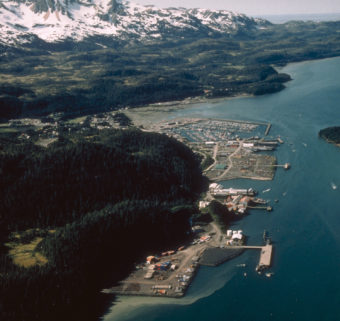
An air pollution control device at the Shoreside Petroleum Inc. facility in Seward. The device is a flare that burns gasoline vapors. (Photo courtesy Environmental Protection Agency)
An Anchorage-based fuel service company violated federal clean air standards for more than a decade. The Environmental Protection Agency announced a fine against Shoreside Petroleum Inc. on Monday.
Shoreside Petroleum was leaking gasoline vapor from its fuel terminals into the air around Seward and Cordova.
The company operates marine terminals throughout Southcentral Alaska where it receives, stores and then ships fuel to customers. And, according to the EPA, the company wasn’t checking for gasoline vapor leaks, loaded fuel into substandard trucks and didn’t have the necessary equipment in place to control emissions.
“If you’ve ever put gasoline in your car and you smell gasoline fumes, that’s the fumes coming from Shoreside’s operations,” said EPA Air Quality Inspector John Pavitt. He handled the agency’s case in Alaska against Shoreside.
Those distinctive fumes don’t just smell bad, they can be hazardous. Pavitt said they contain chemicals that are known to cause cancer, respiratory problems and cardiovascular disease.
The EPA announced $89,000 in fines for the company. But that fine amount could have been much higher.
Pavitt said if the EPA had discovered the violations, the result could have been hundreds of thousands of dollars in fines.
But Shoreside took advantage of a new self-audit program with the EPA that allows companies to self-report violations. That lowers the amount of penalties that they have to pay.
In 2014, the company reported violations dating back to 2005.
No one from the company returned phone calls seeking comment.
After Shoreside reported the violations, it had to buy testing equipment and report the results to the EPA. It also had to pay to install pollution controls and check for leaks. It also had to install new roofs inside its holding tanks. It spent more than $400,000 to bring the two locations up to code.
The EPA estimates those new controls reduced the company’s pollution emissions by nearly 30 tons a year in Seward and 9 tons a year in Cordova.
“According to the information they gave us, they handle more than 5 million gallons a year of product. And so 30 tons is a small amount of what they’re handling,” Pavitt said.
According to the terms of the settlement, Shoreside Petroleum doesn’t have to admit to or deny that it committed the violations. It must pay the fine within 30 days.
Margie Ward says she believes Donald Trump will win the presidency. But if he doesn’t, she worries there will be “a huge change, and it won’t be for the better — maybe what some people refer to as the last days.” (Photo by Rachel Waldholz/Alaska’s Energy Desk)
As election day approaches, we’ve been checking in with voters around the state, asking them what issues matter most and who they’re supporting for president.
On Friday, Alaska’s Energy Desk visited the Trump campaign headquarters in Anchorage, to hear from volunteer Margie Ward.
Ward is 68. Her husband, former state Sen. Jerry Ward, is the Alaska State Director for the Trump campaign. She’s a longtime activist in Republican politics, but she says Donald Trump is the first presidential candidate she’s worked for since Pat Buchanan’s primary run in 1996.
You can find our other interviews with Alaska voters here:
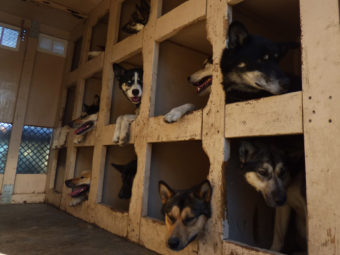
In the winter, Denali’s sled dogs ferry park employees through areas closed to motorized vehicles. (Zoë Sobel/KUCB)
Early on a crisp, fall morning a large white truck sits alone in a dirt parking lot at Riley Creek Campground.
Denali kennel manager Jennifer Raffaeli takes six huskies out of the van, fits them in harnesses, and hooks them to a line attached to a green metal cart that looks like a dune buggy. Raffaeli fastens her helmet.
On the trail, the only sound is the wheels whirring along the ground. The six-dog teams pull two humans around trails that wind in and around the campground.
On this day, each team is running about five miles, and then it’s back to the kennel. By the start of the winter season, the dogs will be doing 20-mile days. Over the course of the winter, they will log around 1,500 miles each.
It may seem backward, but Raffaeli says winter is the easiest time to move cargo through the park.
“Swamps and bogs and thick brush are the norm across Alaska,” said Raffaeli. “That’s challenging and slow going, especially if you are trying to move big heavy objects. When the park is covered with snow and rivers are frozen, you can carry huge loads because you’re not trying to carry them on your back. You’re sliding them over snow and ice, and that’s no problem for these guys.”
Pound-for-pound, Raffaeli says sled dogs are the strongest draft animals on the planet. That makes them the perfect tools for transportation through Denali’s designated wilderness — areas of the park that prohibit motorized vehicles.
Jennifer Raffaeli plays with the kennel’s newest members. (Zoë Sobel/KUCB)
Dogs have been a part of Denali for the entire history of the park. In 1921, Harry Karstens was hired as the park’s first superintendent and insisted on having dogs.
“It made perfect sense as you created a two-million-acre park, which is a huge area to try and cover as one person. You were going to need some dog teams to cover that,” she said.
Back then, Raffaeli says dogs were the only way rangers could traverse the park and protect wildlife, like caribou and Dall sheep, from poaching. But over the years, the role of Denali’s sled dogs has changed.
In 1980, the Alaska National Interest Lands Conservation Act, or ANILCA, labeled the original two million acres of Denali as wilderness — the highest level of federal land protection — and gave renewed purpose to the park’s sled dogs.
“The Wilderness Act requires that land managers look at the minimal tool for the task at hand,” Raffaeli said. “We’re always asking: Can we accomplish this project with dog teams?”
And if they can, they will. Over the winter, the teams are out for up to five weeks at a time. They haul supplies, support glacier research, and monitor man-made noise.
Plus, Raffaeli believes meeting a dog team in the field adds to the wilderness experience for park users.
“To encounter only a dog team on the trail — no snow machines, no other forms of motorized transport — is a form of peace and quiet and wildness that’s getting more and more rare,” she said. “It’s more and more valuable that we continue that heritage here.”
That’s a heritage that in many ways is fading. Denali’s huskies aren’t just the best method of winter transport. They help preserve what many people remember as daily life in Alaska.
But in a rapidly changing climate, Raffaeli is uncertain about the future of the dogs.
“If we start to get warmer winters with less snow, how does that affect the dogs?” Raffaeli said. “How do we evolve to face that new environment? I think those are really valid questions. But at the core of it all, I hope the dogs are always part of the story because they are such a special part of it.”
Back on the trail, the dogs are finishing their 30-minute morning workout. Raffaeli pulls into the campground parking lot and eases the team to a stop.
She jumps off and ladles water into one tin dog bowl after another. The dogs lap it up. When they are done, they go back in the van. It’s time for Raffaeli to get the next team ready for its five miles on the trail.
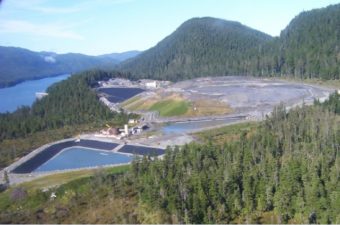
Dry stacked tailings facility at Greens Creek Mine. (Photo courtesy Hecla Mining Company)
Alaska’s Department of Environmental Conservation is working on new guidelines for Hawk Inlet — the location of Hecla’s Greens Creek Mine.
Last spring, an environmental advocacy group found elevated levels of mercury in a seal harvested near the inlet. That sent off alarm bells for a nearby village, which is dependent on subsistence foods.
There was barely an empty seat in the small, rectangular conference room in DEC offices. Staff repeatedly reminded the crowd this wasn’t a hearing. It was a chance for the agency to share a report it collected on Hawk Inlet.
Still, many in the crowd gave passionate testimony, including Albert Howard — Angoon’s mayor and tribal president.
“It’s in the back of our minds everyday now until we actually get answers to what’s happening,” Howard said. “And it’s even more so now because there wasn’t any salmon to speak of for us to fall back on.”
Howard sent a letter to the state earlier this year asking for help. But he doesn’t feel like his concerns were heard. And these new guidelines don’t do enough.
He says people in the village are still scared to harvest seal. And Green Creek mine hasn’t been held responsible for its past violations.
In 1989, the company spilled an unknown amount of ore into the inlet and went through the steps to clean it up. But Howard thinks “the problems still there.”
The village of Angoon is the home to about 400 people. (Photo by Elizabeth Jenkins/KTOO)
Before the Friends of Admiralty Island discovered high levels of mercury in the seal, Hawk Inlet was already listed as an impaired waterbody. That prompts the state to puts together a report to submit to the federal government.
The report on Hawk Inlet details recent and past monitoring tests — including information gathered by the Friends of Admiralty Island.
Gretchen Pikul, an environmental program specialist at DEC, says when the agency crunched all the numbers, it found the inlet to be healthy overall, with a couple of sites that should be monitored more closely.
“This plan doesn’t clean up water but actions do,” Pikul said.
One of the plan’s recommendations is to cast a wider net when it comes to monitoring the area. Another is to post warning signs near the inlet not to gather food near the mine’s loading dock.
But these are suggestions, not requirements. The state can work with the Greens Creek mine to implement the changes when the company’s permit is up for review in about four years. But it can’t force the mine to change anything now. After this story was reported, a DEC representative clarified, “We can alter the permit at any time; it is at DEC’s discretion. Of course, we would prefer to change the permit within the permitting cycle, but we can change the permit at any time.”
Meanwhile, the report didn’t identify how the seal could have had such high levels of mercury. Michelle Hale, the director of DEC, said the mercury could have come from somewhere else.
“It could be air deposition from China,” Hale said. “Because we know that happens in some places. We don’t know that source right now.”
But for Albert Howard, that answer wasn’t satisfying. He still has questions about the historic ore spill. And questions about how today’s monitoring is done.
“I don’t agree with them. Because there’s no checks and balances there,” Howard said. “There’s no, ‘well if you spill ore, this is what’s gonna happen.’ There’s nothing there. There’s no mechanism to prevent them from irreparable harm.”
The Department of Environmental Conservation is taking public comment on the report until Nov. 14.
Correction: It’s the Greens Creek mine’s loading dock area — not discharge area — where the agency is recommending people not collect food nearby. This story has been updated to reflect those changes.
Close
Update notification options
Subscribe to notifications
Subscribe
Get notifications about news related to the topics you care about. You can unsubscribe anytime.