An appeals court today upheld a federal decision to list a species of ice seals as threatened under the Endangered Species Act.
The 9th Circuit Court of Appeals reversed a lower court decision that threw out the listing.
The National Marine Fisheries Service added two Arctic populations of bearded seals to the Endangered Species list in 2012, in part because the sea ice they depend on is rapidly disappearing due to climate change.
Groups including the Alaska Oil and Gas Association and Arctic Slope Regional Corporation sued to stop the listing, saying the decision wasn’t based on science and could restrict development. The seals live in the Bering, Chukchi and Beaufort Seas off Alaska.
A district court judge in Anchorage ruled in their favor, saying long term climate predictions were volatile and the federal agency didn’t have enough data on whether the seals could adapt to the loss of their habitat.
The Appeals court rejected that argument.
The Center for Biological Diversity, which petitioned for the listing in 2008, called today’s decision a “huge victory” –one that shows the importance of the Endangered Species Act to protect animals threatened by climate change.
The Alaska Oil and Gas Association says it’s disappointed with the decision and considering its options moving forward.
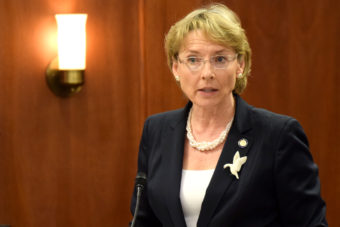
Sen. Cathy Giessel, R-Anchorage, addresses the Alaska Senate, April 15, 2014. Giessel has served in the legislature since 2011. (Photo by Skip Gray/360 North)
She’s a nurse. He likes to fly fish. They both brag about their grandchildren.
And they’re running against each other in what’s been called the nastiest election in Alaska this cycle.
The Anchorage race between Republican Cathy Giessel and independent Vince Beltrami could help determine the balance of power in the state Senate and how Alaska takes on its fiscal crisis.

Giessel, who is 64, has been in the legislature since 2011. She’s a staunch oil industry supporter and chairs the Senate Resources Committee. If re-elected, she and her colleagues will face hard choices to square away Alaska’s finances, on issues like spending cuts, oil taxes and whether to institute an income or sales tax.
But as Giessel talked with voters while knocking doors this week in East Anchorage, there’s one thing she wanted to get straight.
“What the Senate Majority, which has been controlled by Republicans for the last 4 years has done is … brought state spending down,” Giessel said.
This election, Giessel is battling attacks claiming the legislature didn’t do enough to solve the state’s budget shortfall. An ad paid for by Together for Alaska, a political group backing her opponent, states, “Giessel and her do-nothing legislature have sat on their hands, despite being called back into session more times than any legislature in our history.”
Giessel argues the legislature has acted, but she acknowledges to voters that the problem isn’t solved.
“I understand their frustration,” said Giessel. “I also understand when they say to me, there’s more to be done — I agree.”
While knocking doors, Giessel is asking voters if they’d prefer a sales tax or an income tax, proposals that once might have been political suicide in Alaska. She said she’d consider backing either with enough evidence. But she added getting to a long-term solution will involve some complicated math.
“Eleven, 21 and one: to pass anything…it takes 11 senators, 21 representatives and one governor,” said Giessel.
Her challenger, independent Vince Beltrami thinks if voters subtract Giessel and add him instead, the legislature can fix the budget.
Beltrami is 54, and has been president of the AFL-CIO, the state’s top labor organization, since 2006. It’s his first run for office, but he’s been involved in state politics for years.
Independent candidate Vince Beltrami at a debate on Oct. 18. (Photo by Wesley Early/KSKA)
Like Giessel, Beltrami is out knocking doors. I asked how far he’s walked.
“I can tell you exactly because I have a Fitbit thing!” Beltrami said.
So far, he’s logged over 500 miles. Another 150 or so, and Beltrami estimates he will have walked to Juneau.
But he still has a steep climb. He was a registered Democrat until he switched to an independent in 2014. A big part of his district is conservative and home to many oil executives. Scroll down Giessel’s campaign contributor list, you’ll see names like Hilcorp, Caelus Energy, ConocoPhillips. Beltrami said he’s pro-development too. He’s for drilling in the Arctic National Wildlife Refuge, for example.
But when oil taxes come up again, Beltrami said, “I’m going to be a little more discerning, I’m going to ask harder questions, because we have a constitutional obligation to make sure we get the best value for our resources that we can.”
Giessel may have more oil industry supporters, but Beltrami has his own loyal following. Look at his list of contributors: UA Local 375, Laborer’s Local 942, IBEW Local 1547. Union support helped Beltrami raise more money than his opponent between August and October, almost catching up to Giessel’s war chest.
And that has Republicans worried.
“Strike one!” a baseball-themed ad paid for by conservative political group The Truth Alaska begins. “Beltrami has batted well this year, and if he can fill the bases, public unions will control the state legislature.”
Republicans argue Beltrami will put union interests ahead of his constituents. Beltrami disagrees of course, saying he’d take time off as AFL-CIO president while the legislature is in session, although he won’t step down.
Beltrami said, “people will always say you’re a union guy, so you’re going to look out for the unions. Well, we have oil guys who are looking out for oil.”
Conservative commentator Casey Reynolds, editor of the political blog the Midnight Sun, called the race between Giessel and Beltrami, “ground zero in the battles that we are having in Alaska.”
“I would say it’s probably the premiere race that’s going on,” said Reynolds.
That’s because Democrats need just a few wins, and they could cobble together a coalition with moderate Republicans to take control of the state Senate. That means this race in East Anchorage could determine how Alaska addresses its budget woes.
Dallas Roberts shares lettuce from St. Paul’s greenhouse with students. (Photo by Zoë Sobel/Alaska’s Energy Desk)
The Pribilof Islands in the Bering Sea are a magnet for scientists who come to study everything from fur seals to migratory birds. When they leave, that research often leaves with them.
But for the last nine years, the local tribe has found a way to bring it back home. Each fall, a group of scientists return — not to do research, but to share its findings with the students of St. Paul and St. George Islands.
For the first time this year, a former student is now a teacher.
Nineteen-year-old Dallas Roberts is in St. Paul’s greenhouse. It’s a couple of rooms in the basement of the island’s grocery store, lined with trays of plants under bright red and blue lights. He’s surrounded by a gaggle of second and third graders.
Roberts is teaching them how a greenhouse works. It’s part of Bering Sea Days. Since 2008, the Pribilof School District has blown out a week of classes to focus on science from the region.
Roberts grew up in St. Paul. He graduated from the high school last year, and he has fond memories of going through Bering Sea Days as a student.
“I thought it was a blast throughout my whole high school career,” said Roberts. “I think we were all excited to get out of school work for a week.”
Roberts has worked for the local tribe, the Aleut Community of St. Paul Island, since high school. After a year of college, he decided to come back.
“I don’t see myself doing anything different right now,” he said. “I mean the greenhouse is a part of me that I can’t easily give up.”
That’s what Aquilina Lestenkof likes to hear. Lestenkof helped create the program. She hoped to get more kids interested in working in environmental fields on behalf of the community. Creating teachers like Roberts is ultimately her biggest goal.
“When you build people that can speak about environment, that’s one thing,” said Lestenkof. “When you build people who can teach about the environment, that’s a whole other ball game.”
As a teacher, Roberts joins scientists from across the country. Program organizer Lauren Divine said Bering Sea Days exposes kids to things they would never learn in a traditional classroom, like rearticulating baby orca skeletons or the chemistry of sea ice, and connects students to their changing environment.
“People are coming in who have studied something specific to St. Paul, Alaska, the Bering Sea, or the Arctic,” said Divine. “Even though the students are in a region where they can see climate change happening, it’s not something they would be exposed to in a traditional science setting.”
The goal is to make sure that some of the research happening in the Pribilofs is shared with the people who live there — maybe even inspiring the next generation of scientists.
When Roberts decided to come back to the community, he worked out a deal with Divine: If he took online classes, he could work for the tribe’s Environmental Conservation Office.
He said Bering Sea Days applies science to daily island life, like the annual fur seal harvest.
“I grew up doing the seal harvest,” he said. “So learning a different side — not just harvesting them, but learning about their whole body — it’s important for our community to know what the seals eat and how certain climates affect them. Because right now, they’re declining, and I think that hurts us.”
He never imagined that he’d be back as a teacher, but now that’s his favorite part.
“It was amazing to teach younger kids about the greenhouse,” he said. “Even if I didn’t know all the answers, I answered them to the best of what I know.”
And he’s keeping an eye out for students who might follow his footsteps and become teachers themselves.
Bill Briggs is a Hillary Clinton supporter in St. Paul. (Photo by Zoë Sobel/KUCB)
As Election Day approaches, we’re checking in with voters around the state, asking what issues matter to them most — and who they’re supporting for president.
Yesterday we heard from Julie Tisdale, a Trump supporter in Anchorage.
Tonight we hear from Bill Briggs of St. Paul. Briggs is 60. He’s lived in St. Paul for 10 years, and manages the island’s seafood processing plant. And he is definitely not on the Trump train.

He spoke with Zoë Sobel of Alaska’s Energy Desk.
You can find our other interviews with Alaska voters here:
The first snow of the year in Anchorage, Oct. 21, 2016. (Photo by Rachel Waldholz/Alaska’s Energy Desk)
Last week, Juneau saw its first snow before Fairbanks for the first time in some 70 years. With the exception of the Southern Kenai Peninsula and Southeast Alaska, the entire state is below normal for snow — from Anchorage to Fairbanks to Barrow.
That’s leaving a lot of Alaskans wondering, is this a sign of what’s to come?
Brian Brettschneider is a climatologist in Anchorage who closely tracks Alaska climate data and trends. Alaska’s Energy Desk is checking in with him regularly as part of the segment, Ask A Climatologist.
Brettschneider told me that the late snow doesn’t tell us much about what’s to come. In fact, you shouldn’t believe anyone who tells you they know what kind of snow year it’s going to be.
Brian: We can paint with broad brushes that we think it’s going to be a big precipitation winter, or we think it might be a low precipitation winter. But the shades of gray on that continuum are so large, that I’d really be hesitant — and I think most climate scientists would — to say one way or the other.
Rachel: So we can’t predict snow with any kind of confidence. Can we say anything about temperature?
Brian: Well, globally we’ve had month after month after month of record warm temperatures. Here in Alaska, we’re on track for by far our warmest year on record. So we would expect, given no other changes in atmospheric conditions, that we would continue well above normal. Now, we’ll throw a little caveat in there, and that is, NOAA has re-issued their La Nina watch. And typically, when there’s a La Nina, temperatures in Alaska trend toward the cooler side. So, if that does occur, we might expect some lower temperatures. But that’s far from certain.
Rachel: And if we do have a warm winter, does that tell us anything about the amount of snow we might see?
Brian: If you’re in a really marginal snow area, like Juneau or a lot of places in Southeast, where the difference between 30 and 35 degrees is the difference between snow and rain. Here in Anchorage and in much of mainland Alaska, the difference between, say, 25 and 30 degrees isn’t a snow or rain deciding line. It can be a more wet snow and or a more dry snow.
When temperatures are warmer, the air actually can hold a little bit more moisture, so in some cases you end up with more snow with a little bit warmer temperatures. But that doesn’t necessarily play out everywhere.
Rachel: So Alaskans who are wondering what the winter is going to look like are just going to have to wait and see?
Brian: I tell everyone who asks me — and a lot of people do ask me — “What’s the snow going to be like?” I won’t quite say, “Your guess is as good as mine.” But the probabilities are so difficult, it’s really kind of a fool’s errand to state one way or the other.
Do you have a climate question for Brian? Email akenergydesk@alaskapublic.org.
The U.S. Forest Service wrapped up objection hearings Wednesday on a plan that could shape the future of timber in the Tongass National Forest.
It was the last chance for the public to register opposition to to the Tongass Land and Resource Management Plan amendments, which has been nearly three years in the making and will go into effect this winter. The meetings took place during a two week span in Ketchikan and Juneau.
Timber industry reps say the forest service plan transitions too quickly from logging valuable old growth trees to smaller young growth timber. Meanwhile, some environmentalists believe there’s too much old growth left on the table.
Beth Pendleton, of the Forest Service, said the plan outlines a new direction for the Tongass but that doesn’t mean it’s set in stone. This is called adaptive management.
“So, as new information becomes available because we’re moving into a new management regime for example around young growth, that we take that information more real time and make adjustments in the management approach,” Pendleton said.
In all, less than 400 timber industry jobs remain in Southeast.
Pendleton has until Nov. 28 to respond to the objectors about what changes the forest service will incorporate — if any. The final plan is expected to be completed this December.
Close
Update notification options
Subscribe to notifications
Subscribe
Get notifications about news related to the topics you care about. You can unsubscribe anytime.
You can find our other interviews with Alaska voters here:
In Anchorage, a Trump supporter keeps the faith
In St. Paul, this Alaskan vows ‘Never Trump’
Young Clinton fan ‘totes’ her support
For this Anchorage Republican, Johnson trumps Trump
For Trump supporter, Clinton presidency raises fears of ‘last days’