Alaska's Energy Desk

New Southeast atlas identifies valuable habitat and threats

Sockeye salmon. (Photo by Katrina Mueller/USFWS)
(Photo by Katrina Mueller/USFWS)

Audubon Alaska recently released an atlas showing where the most valuable salmon streams and bird habitat are located in Southeast. It also identifies the biggest threats to those areas.

Spread across 200 pages, the ecological atlas of the region includes a lot more than maps. Melanie Smith, the director of conservation science for Audubon Alaska, said the organization wanted to create something both policymakers and regular people could use.

It follows in the footsteps of other atlases Audubon has released about the Arctic and Western Alaska. Smith said this latest Southeast edition is another comprehensive overview that helps provide context.

“What do we know about how this place works?” Smith said. “And why it matters and what types of considerations we should be thinking about when we’re thinking about a sustainable future in the Tongass?”

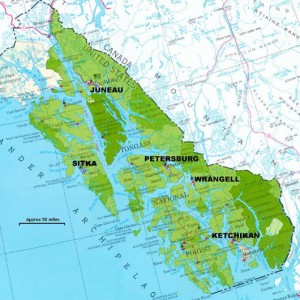
The atlas features bear viewing hotspots and birding locations. But also, what Audubon Alaska believes are human-caused dangers to these environments, like old growth clear cut logging.

Smith said what surprised her the most while putting the atlas together is how quickly the climate is changing.

“I’m sorry to say that Southeast Alaska is supposed to become a little bit of a wetter place,” she said.

The region has enjoyed a recent sunny streak. But Smith said — in the future — more rain could be in the forecast due to warming. Climate projections suggest a 2-degree temperature rise by the year 2050.

“Which also has implications for how productive salmon populations may be so there’s a chain of possible effects.”

Smith said less snow pack and more downpours could affect salmon laying eggs in nearby streams. But for now, the atlas shows where the fishing is ripe in Southeast. And she hopes to encourage readers to keep it that way.

You can learn more about the regional atlas on Thursday in Juneau. Audubon Alaska will be presenting at the University of Alaska Southeast student recreation center at 7 p.m.

Supreme Court surprise: Westlake winner in District 40

12Waldholz_AKSupremeCourt
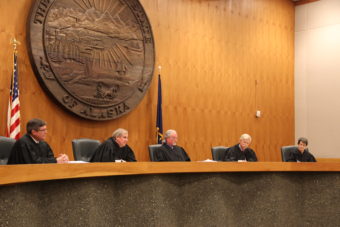
Members of the Alaska Supreme Court today reversed the lower court’s decision and reinstated Dean Westlake as the winner of the Democratic primary in House District 40. (Photo by Rachel Waldholz/Alaska’s Energy Desk)

The Alaska Supreme Court is sending Dean Westlake to Juneau.

In a decision late Wednesday afternoon, the court reinstated Westlake as the winner of the Democratic primary in House District 40, which covers the North Slope and Northwest Arctic.
It reversed a lower court ruling last week which had tipped the election to the incumbent representative, Benjamin Nageak of Barrow.

Reached by cell phone in Kotzebue just after the order was issued, Westlake said he was “absolutely ecstatic.”

“When I got the news, I just had to go for a ride,” Westlake said, laughing. “I was sitting in my office, and I thought, this is wonderful, that people that go to vote understand that absolutely no one is going to take that right away from you.”

Nageak could not immediately be reached.

The Supreme Court heard arguments this morning in the disputed primary election.

The arguments centered on events in the village of Shungnak, where poll workers let all 50 voters cast ballots in both Democratic and Republican primary races in August, instead of requiring them to choose.

The state admitted that was a mistake. But Assistant Attorney General Laura Fox, representing the Division of Elections, argued those votes should still count. Democratic primaries are open to anyone, so all the voters were eligible to participate, and it was only possible to vote once in this race, Fox said.

“They all only got one vote in this race, and this is the only race that’s been challenged, and the only race that the court has to look at here,” Fox said.

Nageak’s lawyers argued that if poll workers had followed the rules, at least a few of those voters would have chosen the Republican ballot and never voted in the Democratic primary at all —  possibly changing the outcome. Westlake won 47 of 50 votes in Shungnak, and he won the race over all by just 8 votes.

Last week, the lower court agreed with Nageak and threw out 12 votes in Shungnak — and two in Kivalina — giving Nageak the win.

The lower court based that number on testimony from former Alaska Republican Party chair Randy Ruedrich, who calculated the average number of voters who chose the Republican-only ballot in the last four elections.

The Alaska Republican Party has supported Nageak’s challenge. Although he’s a Democrat, Nageak caucuses with the Republican majority in the state House.

In its appeal, the state called Ruedrich’s calculation “nonsensical.” Fox pointed out that Ruedrich used raw numbers without adjusting for voter turn-out, and the state’s brief suggested he chose to include only those past elections that favored his conclusion

The justices seemed to agree.

“Is that really a matter for expert testimony? It’s just math,” Justice Joel Bolger said to Nageak’s attorney, Stacey Stone.

Bolger noted that Ruedrich’s math only included elections back to 2008, even though the attorney’s brief included numbers going back to 2006.

“Is there anything in the record that shows why the 2006 results were neglected?” he asked.

“No, your honor, the only reason those results were neglected is because of the speed at which this trial happened,” Stone replied.

“But it only takes a moment to calculate these averages,” Bolger said.

Meanwhile, Chief Justice Craig Stowers seemed troubled that nobody had actually asked anyone in Shungnak how they meant to vote. He said no amount of math could tell the court which ballots voters would have chosen, especially when there was a hotly contested race on the Democratic ballot, and not on the Republican one.

“Could not these villagers, who knew a lot about these candidates, and were very interested in this particular election, have decided to choose all, or substantially all, of the ballots from the ADL?” he asked. The ADL ballot included the Democratic Party, Alaska Independence Party and Libertarian Party primaries.

The five justices arrived at their decision within hours. In a two-paragraph order issued Wednesday afternoon, they reversed the lower court’s decision, upholding the original election results.

Only Justice Daniel Winfree dissented, arguing the entire election should be voided and held again.

Southeast weather: exceedingly beautiful and very unusual

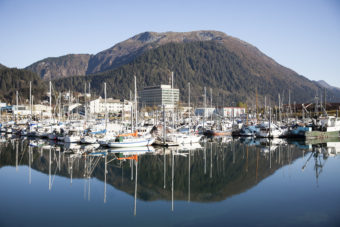
Boats lined up in Harris Harbor on a sunny, clear day Wednesday, Oct. 12, 2016 in downtown Juneau, Alaska. (Photo by Rashah McChesney/Alaska’s Energy Desk)

The weather has been beautiful in Southeast Alaska for two weeks straight.

That is very unusual. September and October are normally the rainiest months in the region.
Brian Brettschneider is a climatologist in Anchorage who closely tracks Alaska climate data and trends. Alaska’s Energy Desk is checking in with him regularly as part of the segment, Ask A Climatologist.

Brettschneider says the two week stretch of sunny weather has been remarkable.

Transcript:

Brian: This is the wettest time of year for almost every place in Southeast and it has just been bone dry and quite sunny since about September 28th.

Annie: And give us an example. Pick one of those weather stations.

Brian: Well, in places like Yakutat and Juneau there’s been no precipitation since September 28th or 29th. And for Yakutat, they should have had 11.5 inches of rain; for Juneau they should have had about four inches of rain during that time period. And neither of those places have ever been completely dry for this time of year before.

Annie: Are we looking at any records here?

A Kayaker on Sitka Sound, Oct. 9th, 2016 (Photo by Emily Kwong/KCAW)
A Kayaker on Sitka Sound, Sunday, Oct. 9th, 2016 (Photo by Emily Kwong/KCAW)

Brian: Well, a lot of times records are kept over a month long period, so it’s too early to say if we’re going to have the record driest October, but for most major stations in Southeast it has been the least rainy period, for say- half a month, during this time of year. Definitely a historic dry spell.

Annie: What might be causing the long dry spell?

Brian: There’s been a high pressure system that’s really been anchored over the eastern half of the state extending down all the way into Southeast. And that prevents any storms from moving in. It’s unusual to have it be so strong and so stable in one spot this time of year. So that’s really led to the record dry spell.

Annie: So can we make any predictions based on that, on what this winter will be like down there?

Brian: It’s really hard to say. We count on these storms to churn up the water and dissipate heat in the Gulf of Alaska and so without these storms it may take longer for that heat to be dissipated which would possibly lead to warmer temperatures. But that could change in a hurry so we just need to keep an eye on that.

District 40 primary fight heads to Alaska Supreme Court

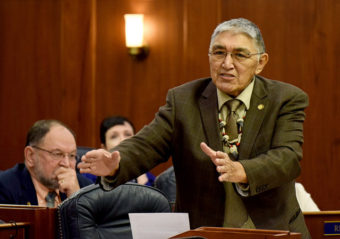
Rep. Benjamin Nageak, D-Barrow, speaks in the Alaska House of Representatives during debate on House Bill 123 to establish a marijuana control board in Alaska, April 14, 2015. (Photo by Skip Gray/360 North)

The Alaska Supreme Court will hear arguments Wednesday in a lawsuit over the Democratic primary in House District 40, which stretches from Kotzebue to Kaktovik.

House District 40, the state's northernmost, includes the North Slope and Northwest Arctic. (Image courtesy of the Division of Elections)
House District 40, the state’s northernmost, includes the North Slope and Northwest Arctic. (Image courtesy Division of Elections)

The outcome could determine the balance of power in the state legislature next year.
The Division of Elections originally declared Dean Westlake of Kotzebue the winner, beating incumbent Rep. Benjamin Nageak of Barrow, by eight votes.

But Nageak challenged those results, pointing to voting irregularities in several precincts. Last week, a Superior Court judge threw out 12 votes from the village of Shungnak and two from Kivalina, giving Nageak a narrow, two-vote win.

The state appealed that decision to the Alaska Supreme Court.

With no other candidates running in the general election, whoever wins the primary will head to Juneau in January, and the decision could tip control of the House. Though both candidates are Democrats, Nageak caucuses with the Republican majority, while Westlake has said he will join other Democrats.

Oral arguments will begin at 10 a.m. Wednesday in the Boney Courthouse in downtown Anchorage. The justices are expected to rule by Friday, Oct. 14 — that’s the deadline for the state to begin mailing out ballots for the general election in November.

Workers hopeful as Agrium takes steps to reopen its Kenai Peninsula plant

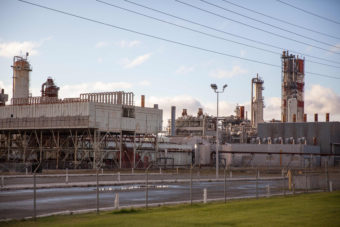
The sun sets over Agrium’s currently dormant fertilizer plant on Sept. 29, 2016 in Nikiski, Alaska. The company is working to get the permits it would need from the state were it to reopen the facility. (Photo by Rashah McChesney/Alaska's Energy Desk)
The sun sets over Agrium’s currently dormant fertilizer plant on Sept. 29, 2016, in Nikiski. The company is working to get the permits it would need from the state were it to reopen the facility. (Photo by Rashah McChesney/Alaska’s Energy Desk)

The Agrium natural gas-to-fertilizer plant in Nikiski has been taking steps to reopen. If it does, then it could add hundreds of high-paying jobs to the struggling Kenai Peninsula economy.

But that depends on a reliable natural gas supply, something that’s far from certain.

Mark Schaafsma worked in the maintenance department at the fertilizer plant in Nikiski for 32 years.

And he was one of the last ones to leave after Agrium announced it was decommissioning the plant in 2007. He said it wasn’t easy.

“I knew the plant was closing and that my career there was coming to an end, but when the day actually arrived, it took me by surprise how emotionally disruptive it was,” he said.

Agrium’s Nikiski plant used natural gas to create fertilizer products.

When it closed, it was the second largest producer of ammonia and urea in the U.S. Most of it was sold overseas to markets like South Korea, Mexico and Taiwan.  

Schaafsma found other work pretty quickly, but the plant’s closure shed hundreds of jobs from the Kenai Peninsula’s economy.

There’s a huge ripple effect,” he said. “Look what happens in the so-called rust belt in mid-America. A lot of little towns have practically dried up and blown away because of the loss of industry.” 

After the plant closed, rumors about it reopening started almost immediately.  

Now, the speculation is bolstered by news that Agrium is seeking a permit to discharge waste from its Nikiski plant.

In 2015, the company received air-quality and pollution permits for the plant.

All three permits would be required for the plant to reopen.

But, there are other barriers. It needs a large, steady supply of natural gas.

Agrium’s Manager of Government Relations Adam Diamond said the company has been in talks with Cook Inlet producers.

“We’re talking volumes that are large volumes. One half of the plant uses 80 million cubic feet of gas a day,” Diamond said.

But, there isn’t yet that volume of extra natural gas flowing out of any of the Cook Inlet reserves. Diamond said Cook Inlet’s natural gas discoveries in the last five years are what piqued the company’s interest in restarting the facility.

“There’s still, you know, ‘We believe there’s X amount of gas in the ground.’ But that’s very different than, there’s X amount of gas flowing through the pipeline,” Diamond said.

The company would also have to spend an estimated $200 million to reopen the facility.

To help the process along, House Speaker Mike Chenault, a Republican from the Kenai, ushered a bill through the last legislative session that would give the company a tax break if it uses gas from a state lease.

In its permit application, the company proposes reopening two of its four production lines and hiring about 140 people. If it can land a large enough natural gas supply, then it could add another 100 jobs.

For Chenault, whose district includes Nikiski, the plant could be a strong economic driver to the area’s battered economy.

“When they were running at their peak performance, they were employing about 400 employees,” Chenault said. “All of them good paying jobs. And all those were local jobs. There wasn’t a week on, week off or two weeks on, two weeks off schedule where you could live outside somewhere else and fly up here.” 

Those kinds of local jobs are important for industry workers who live in Cook Inlet.

Mark Schaafsma’s son, Andy Schaafsma, said a job with Agrium always appealed to him. 

Andy Schaafsma watches his dad talk about his time at Agrium's mothballed Nikiski fertilizer plant on Sept. 29, 2016 in Soldotna, Alaska. Schaafsma, a process technology graduate, says he'd like to work at the plant if it reopens. (Photo by Rashah McChesney/Alaska's Energy Desk)
Andy Schaafsma watches his dad talk about his time at Agrium’s mothballed Nikiski fertilizer plant on Sept. 29, 2016 in Soldotna. Schaafsma, a process technology graduate, said he’d like to work at the plant if it reopens.
(Photo by Rashah McChesney/Alaska’s Energy Desk)

Instead, he worked for two years as a roustabout. He’d spend a week at home with his wife in Soldotna, then a week at a remote production site on the other side of the Cook Inlet.

Both men said the pressure on families can be enormous when oilfield workers spend that much time away from home.

“Just the, flipping back and forth between being completely not there and then being there the entire time is, well it takes some getting used to,” Andy Schaafsma said.

Currently, Andy Schaafsma works brewing beer in Soldotna, but he said he wouldn’t pass up the right opportunity to work at Agrium.

Correction: An earlier version of this story misidentified the location where Andy Schaafsma worked as a roustabout.  He was at a production site on the west side of Cook Inlet, not a platform.

Hoping for jobs and lower fuel costs, Alaska Native corp Ahtna explores for gas

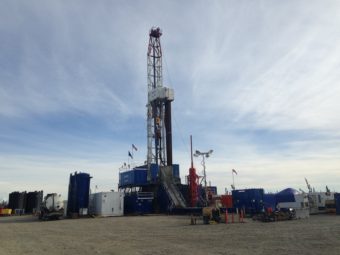
Exploration well Tolsona No. 1 is located about 11 miles west of Glennallen, Alaska.
Exploration well Tolsona No. 1 is located about 11 miles west of Glennallen, Alaska. (Photo by Elizabeth Harball/Alaska’s Energy Desk)

Alaska Native Regional Corporation Ahtna, Inc. is searching for natural gas to reduce local energy costs and provide jobs. Last week, Ahtna, Inc. subsidiary Tolsona Oil & Gas Exploration LLC started drilling an exploration well on state land near Glennallen.

Daniel Lee, oil and gas development manager for Ahtna, gave a tour of the new well on Monday.

“What we’re looking at currently is a great big blue piece of iron, which is a drilling rig,” said Lee. “This is a true exploration, this is a brand new hole that we are drilling in the ground.”

The drill is slowly descending thousands of feet beneath the gravel pad. Ahtna is hoping it will find enough recoverable natural gas to power their eight villages, including Gulkana and Chitina. Ahtna, Inc. president Michelle Anderson explained high fuel costs are a big burden for Interior Alaska.

“To fill your fuel tank up here in the wintertime, for many people, it’s as much as a mortgage payment in Anchorage,” said Anderson.

The Alaska Department of Commerce reports heating fuel prices in Interior Alaska are among the highest in the state. Ahtna hopes natural gas will be a cheaper replacement. They also hope a find will mean more jobs.

Ahtna shareholder and former board member Roy S. Ewan said, “There’s just no work out here. There’s no economic development.”

Ewan said many of Ahtna’s young people move to Anchorage or Fairbanks to find work. Ahtna hopes a natural gas find will change that.

Alaska Native regional corporations driving energy development is a trend worth watching according to Tim Bradner, editor of the Alaska Economic Report. Bradner said in the past, private companies took the lead while Native corporations were either passive partners or bought in later.

“This is kind of a different thing,” said Bradner, “Where the corporations themselves are leading the exploration and putting their own money at risk.”

Fairbanks-based regional Native corporation Doyon, Limited is also exploring for gas in Interior Alaska.

During the tour of Ahtna’s drilling site near Glennallen, Lee said exploration means they might find gas — or they might not.

“Worst case is we get to our targeted depth and there is nothing there, and that’s considered a dry hole,” said Lee. “And with that, you reassess whether you want to move forward with further exploration wells or not.”

Lee said the company chose this spot to drill because it’s promising. However, there’s no guarantee the $11 million project will find what it’s looking for.

Site notifications
Update notification options
Subscribe to notifications