Alaska's Energy Desk

New satellite-based technology aims to crack down on illegal fishing

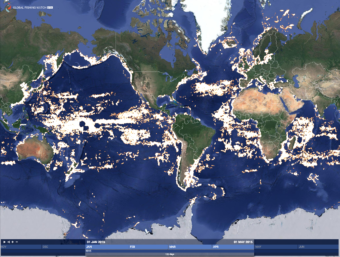
A satellite-based program from Google, Oceana, and SkyTruth hopes to help everyone track the movement of commercial fishing vessels around the world. (Courtesy Oceana.)

Commercial fishing in Alaska is a multibillion dollar industry. But every year, billions of dollars are lost to illegal fishing around the world. A new satellite-based surveillance system makes it easier to track illegal fishing. But some fishermen aren’t ready for Big Brother watching their every move.

Worldwide, overfishing is a huge problem. Jacqueline Savitz, vice president of the conservation group Oceana, says populations of big fish, like halibut, have dropped 90 percent. But the fish can rebound when their habitats are protected.

“We actually see fish stocks coming back and getting to levels where they’re sustainable, so we can continue to live off the interest, if you will, and not fish down the principal,” said Savitz. “But we also have a problem with illegal fishing. It’s about a $23 billion industry globally.”

Now, there’s a new tool for people who want to prevent illegal fishing: Global Fishing Watch. It’s a free, web-based, interactive map of the world’s traceable commercial fishing activity, dating back to January 2012.

It’s based off information gathered from vessels’ Automatic Identification Systems (AIS). The boats broadcast  signals including their location, who they are, and where they’re headed.

Not all boats have to use AIS. Currently, the International Maritime Organization only requires it for large vessels like big oceangoing cargo ships and certain vessels on international voyages

While AIS technology has been around for a while, this is the first time all its information is publicly available.

As ocean traffic increases, Savitz hopes Global Fishing Watch will increase accountability. She points to Alaska’s waters as an example

“There’s a lot of change happening up there with the changing climate and potential new shipping routes through the Arctic and the Bering Strait,” she said. “There are going to be areas that are protected. How are we going to know if they are really being protected?”

That’s what this project hopes to do. But fisherman Roger Rowland doesn’t like the idea that everyone can track his vessel. He wants to protect his fishing hot spots.

“With my salmon fishery, I don’t want people knowing where I am,” said Rowland. “Since I’m not legally required to have it, I turn it off.”

Rowland owns a 58-foot seiner based in Unalaska. Because his boat is small, he isn’t required to constantly run AIS.

Even though Rowland likes his secrecy, he thinks Global Fishing Watch could be helpful for certain fisheries.

“When I’m pot cod fishing, I do have legal areas where I cannot go,” he said. “My boat cannot go inside a ring around a sea lion rookery, and so it’s good for that. Nobody is sneaking in there because someone is watching.”

John Amos is the president of SkyTruth, a nonprofit that uses technology to highlight what’s happening in the environment. He says even though fishermen like Rowland might not want to be tracked, there’s a benefit for people who play by the rules.

“People care about where and how their food is being produced,” said Amos. “Here’s an opportunity for fishing vessel captains to create personal relationships with their consumers at the seafood market or at the restaurant table and say, ‘Look, we are the good guys, and we’re going to show you.’”

There will always be fishermen who turn off their AIS, but Amos believes Global Fishing Watch will help crack down on the amount of unregulated and unreported fishing as well as empower individuals to monitor patches of ocean they care about.

Homer Electric makes bid to deregulate in upcoming vote

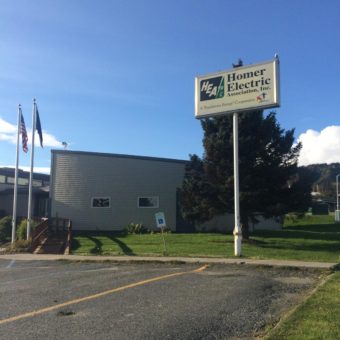
Homer Electric Association's office in Homer, Alaska. (Photo by Daysha Eaton/KBBI)
Homer Electric Association’s office in Homer, Alaska. (Photo by Daysha Eaton/KBBI)

Residents across the Kenai Peninsula will soon vote on whether Homer Electric Association can operate without rate oversight from the Regulatory Commission of Alaska.

The utility says deregulation would save time and money and give it more local control. But it would also allow HEA’s board to raise rates as high as they want.

Brad Janorschke, general manager for Homer Electric Association, says the vote is about local control.

“Giving the Homer Electric Board of Directors the ultimate say or the final authority in the direction of the cooperative, and the rates we set,” Janorschke said.

HEA began the campaign to convince its members to vote “yes” for local control in late August. The cooperative is the only power provider for most of the Kenai Peninsula, with around 23,000 members.

Under the Regulatory Commission of Alaska, or the RCA, cooperative utilities already have a lot of local control. For example, they can can raise their rates up to eight percent, not to exceed 20 percent in a three-year period.

But Janorschke says going before the RCA for final approval of things like tariff changes, line extensions and more, adds an unnecessary layer of bureaucracy and expense.

“Somebody asked me the other day, ‘How much do you think you would save?’ And I said, ‘We’d save a half million a year, easy, just in staff time and attorney fees,’” said Janorschke. “And I had one of the employees I worked with who is involved in a lot of these processes — [he] looked at me and said, ‘No, it’s probably double that.’”

Janorschke says that about 80 percent of cooperatives in the Lower 48 are not regulated.

Unregulated electric cooperatives have elected boards of directors that determine policy matters and approve rates and fees.

But part of the RCA’s job is to look out for ratepayers.

That’s something Homer resident Mike O’Meara feels strongly about. He was a spokesperson for the HEA Members Forum for years. The watchdog group formed in 2009 to counter the cooperative’s efforts to introduce coal power. They were successful and the group stopped meeting regularly in 2013.

“With the issue of deregulation, I’ve started getting emails and telephone calls from people,” said O’Meara.

O’Meara is skeptical of deregulation. He says that, without the RCA, there would be no consumer protection.

“A big part of its job is making sure that ratepayers are treated fairly, that the prices that are charged are within reason, that if there are significant ratepayer complaints, the RCA can intervene,” said O’Meara.

Mike Pate, also from Homer, was on the HEA board for 22 years. But he resigned in 2009 because he says he felt he could no longer trust the administration.

He’s a strong advocate for local control, but has reservations about what HEA is pushing for.

“I will be voting against deregulation. The final reason that I resigned from the board was I did not feel comfortable with the quality, integrity of the information that the board was receiving from the administration,” said Pate.

Bob Pickett is chair of the RCA.

“I would suggest it’s probably the most important deregulation election that the commission has ever been involved with,” said Pickett.

Pickett says other utilities have deregulated in Alaska. Matanuska Telephone Utility went independent earlier this year, but they have competition. HEA is a monopoly.

HEA claims regulatory operating costs could decrease with deregulation. Pickett says that’s very unlikely. He says the cooperative’s debt has grown from 172 million dollars to more than 350 million dollars in five years. He says that debt is having an impact on ratepayers.

“At this point, HEA has, on a per-kilowatt hour charge, the highest rates in the railbelt,” said Pickett.

Janorschke says HEA’s bylaws protect ratepayers from unreasonable rate increases. And he says members can trust the board.

HEA board members respond to the cooperative members, Janorschke says, but he acknowledges their fiduciary responsibility is to the viability of the cooperative.

If the co-op members feel their board is not making the right decisions, they always have the option to vote them out, Janorschke says.

Informational meetings are scheduled for Kenai Peninsula communities in September and October. Ballots will be mailed out in October and must be returned within 30 days. Election results will be made public in December.

Bob Pickett, the chair of the RCA, says he plans to attend both the upcoming HEA informational meetings in Homer on Wednesday September, 28 and in Soldotna on October 10.

State calls a truce in Prudhoe Bay dispute

Andy Mack DNR Commissioner
Alaska Natural Resources Commissioner Andy Mack at a press conference in Anchorage on June 28, 2016. Mack sent a letter Sept. 20 approving the Prudhoe Bay plan of development. (Photo by Graelyn Brashear/Alaska Public Media)

Gov. Bill Walker’s administration has called a truce in its dispute with the big three North Slope oil producers over plans for Prudhoe Bay.

The Department of Natural Resources has approved the field’s latest development plan, ending a standoff that raised fears the Walker administration was threatening companies’ leases at the site, potentially disrupting production at the state’s largest oil field.

The dispute goes back to January, when the Walker administration requested detailed information about how BP, which operates Prudhoe Bay, plans to market the field’s massive natural gas reserves. It was the first time the state has made such a request; Prudhoe doesn’t currently ship gas, only oil.

But the state wants assurances that BP and Prudhoe’s other owners, ExxonMobil and ConocoPhillips, are preparing to make the gas available to a potential North Slope pipeline project.

“The state’s position is that we’re at a point where we need to prepare for major gas sales,” said new DNR Commissioner Andy Mack. Mack spoke by phone from Seoul, South Korea, where he was traveling with the governor and other state officials in an effort to promote Alaska’s gas line project.

BP refused the Walker administration’s request, arguing the information the state wants either doesn’t exist or would be illegal to release under antitrust laws. In June, the state declared the Prudhoe Bay plan incomplete and gave BP two months to try again.

That decision raised concerns the state might be considering action against the companies’ leases if they didn’t cooperate.

But the state reversed course. On Sept. 20, Mack sent a letter approving the companies’ plan (as first reported by the Alaska Journal of Commerce). In an interview, Mack said the state didn’t get all of the information it requested, but the administration has been encouraged by the companies’ public statements in support of a state-led gas line project.

“There’s always a request and then there’s a response, and in many cases it’s not a perfect match, and I think that’s the case here,” he said. “But we felt comfortable at the end of this process that it was the right thing to do for the state of Alaska to approve the plan through 2017.”

The approval letter included the caveat that the state expects more detailed information next year.

State Sen. Cathy Giessel, R-Anchorage, chairs the Senate Resources Committee. She said the letter seems to leave the issue open.

“I think there is definitely a tone of ongoing threat to the leases on the North Slope, based on Commissioner Mack’s letter,” Giessel said. “That’s a concern to me.”

Meanwhile, the head of the state Division of Oil and Gas, Corri Feige, announced plans to resign the same day Mack’s letter was sent. Feige has been the face of the Walker administration in the dispute for the past few months.

Mack said her decision had nothing to do with the Prudhoe Bay plan. A spokesperson for the Division said Feige was not available to comment.

Alaskans weigh in on this year’s smaller dividend check

Anchorage Permanent Fund Dividend Office 2016 03 14
Alaskans file their Permanent Fund dividend applications in downtown Anchorage in March 2016. (Photo by Rachel Waldholz/Alaska Public Media)

It’s PFD announcement day in Alaska — but it’s a little less exciting than usual. That’s because this year, for the first time in the program’s history, it’s been cut.

Gov. Bill Walker announced in a pre-recorded video on Friday exactly how much Alaskans would receive in this year’s Permanent Fund Dividend check: $1,022.

This year’s dividend checks could have been about twice as much, but Walker vetoed half the money appropriated to dividends earlier this year while the state battles a $4 billion deficit.

On Thursday, Alaska’s Energy Desk asked Alaskans how they felt about this year’s smaller dividends. Some people already knew to expect a change.

MCCHESNEY: Do you know how much the PFD is this year?

Benji Neice, of Juneau: What it should be, tomorrow, should be about $1500.

Katrina Dennis, of Juneau: My guess is maybe about, $1200.

Daryl Shaw, of Anchorage: I know it’s not what it should be.

Back in July, Gov. Bill Walker’s veto capped the dividend at about $1,000. Without the veto, there would have been about $1.4 billion available for dividends.

“That number would equal a little bit over $2,000 per Alaskan,” said Ken Alper, director of the Alaska Department of Revenue’s Tax Division.

Alper and Walker argue that with the current budget crunch, the state couldn’t afford that amount. 

As oil prices have crashed over the last two years, the state has covered billions in budget deficits by drawing from its savings accounts. If lawmakers continue on their current path, they’ll burn through the state’s primary savings account in about two years. Then they’ll have to use the account the dividends come out of. Right now that account has about $7 billion in it. At current spending levels it will be drained in a few years as well. Then there wouldn’t be money for the budget or dividends.  

“That could go away in another couple of years and when the governor talks about, in 2020, the dividend would go away unless there’s a fiscal plan, that’s just not an idle threat, it’s a mathematical fact,” said Alper.

Alper and Walker want lawmakers to restructure the permanent fund and pass a combination of taxes and spending cuts to balance the budget. And in the meantime, they say we shouldn’t spend the nearly $700 million it would have taken to give everyone in the state $2,000 checks this year.

For now, that money is just staying in the account.

“It’s not going anywhere, it remains in the earnings reserve, it continues to be invested and it’s going to be producing income for future generations,” said Alper.

A lot of people aren’t happy with the idea that Walker is messing with the Permanent Fund.  One lawmaker sued. For a lot of Alaskans, that fund is inviolate.

That includes Anchorage resident Daryl Shaw, who was born in Alaska. His daughter was born just in time for the first dividend check in 1982. He says when the fund was started, it was supposed to be untouchable.

“I’m not the sharpest tool in the shed and I’m not a politician, but I’m an Alaskan and I just don’t think it’s right for Gov. Walker to actually reach into that fund and be able to even touch it in any way shape or form,” said Shaw.

But the amount of this year’s dividend isn’t uncommon. In fact, if you take an average over the last 33 years, it’s just under $1,100.

We talked to Alaskans in Anchorage, Juneau and Unalaska, and a surprising number said that $1,000 is good enough for them.

John Bosh, of Juneau: That’s fine, you know. It’s better than taxing me.

Suzi Golodoff, of Unalaska: If you’re on a fixed income, it makes a difference. Yeah you count on it, you do. But I guess I’m thinking that $1,000 is a pretty fair cap.

Keith Hermann, of Juneau: I always joke that people call it the permanent dividend funds thinking that the dividends are what’s permanent. The dividends are not permanent, they’re very temporary. They’re a way of getting the public to support the necessity of saving money for the future.

It’s likely that one way or another, the future means smaller dividends.

Meet the skeptics: Questions surround Walker’s gas line plan

Lawmakers from the House and Senate Natural Resources Committees listened to testimony on Aug. 25, 2016. From left: Sen. Mike Dunleavy, R-Wasilla; Sen. Anna MacKinnon, R-Eagle River; Sen. Cathy Giessel, R-Anchorage; Rep. Dave Talerico, R-Healy; Rep. Benjamin Nageak, D-Barrow; and Rep. Bob Herron, D-Bethel. Photo: Rachel Waldholz, Alaska's Energy Desk
Lawmakers from the House and Senate Natural Resources Committees listened to testimony on the gas line on Aug. 25, 2016. From left: Sen. Mike Dunleavy, R-Wasilla; Sen. Anna MacKinnon, R-Eagle River; Sen. Cathy Giessel, R-Anchorage; Rep. Dave Talerico, R-Healy; Rep. Benjamin Nageak, D-Barrow; and Rep. Bob Herron, D-Bethel. (Photo by Rachel Waldholz/Alaska’s Energy Desk)

Gov. Bill Walker is making the case that his new gas line plan will get the project off the drawing board and on to Alaskan soil. But it’s not hard to find skeptics who say Walker is just creating more paperwork.

For the final story in our series Pipeline Promises, Elizabeth Harball talked to the Walker’s critics.


As a new energy reporter in Alaska, it didn’t take long for me to notice that even though state leaders are always talking about the gas line, there’s something left unsaid. I mentioned this to Larry Persily, a gas line expert who now advises the Kenai Peninsula Borough.

HARBALL: It seemed to be this unstated truth that a lot of people don’t believe this is going to happen. This may not even materialize …

PERSILY: Right, oh yes. Even a couple years ago when [Alaska LNG] looked like, hey! People were still like, “Oh, it won’t happen.”

HARBALL: Right, and being a new Alaskan …

PERSILY: Do you have a dog yet?

No dog yet. That being said, this new Alaskan had to learn why so many people think the governor’s plan is doomed.

Skeptics like Persily see big forces working against the project. The biggest is the market: This is an expensive project aimed at supplying a product, gas, that today is plentiful and cheap.

“Prices for the commodity are down, the project is one of the most expensive energy projects ever in the history of the world, so that alone would make a lot of people skeptical,” said Persily. “They look at the price tag, look at what you are going to get for the project at the end and they say, ‘That’s not going to happen, turn the TV back on.'”

Lousy market conditions help explain why the big oil companies are stepping back from the effort to build the gas line. And this plays into another big issue skeptics bring up — one that became clear as I walked into Anchorage Republican State Sen. Cathy Giessel’s office. We spoke sitting between stacks of cardboard boxes. Oil-dependent Alaska can’t afford the legislature’s sleek new building, so lawmakers are moving.

The governor argues Alaska’s dire fiscal situation is one reason to charge ahead. Giessel said it’s a reason to be cautious.

As much as she’s like to see the project built, she said, “We have a significant budget challenge right now and I think that we can overplay our hand and find ourselves in an even worse fiscal predicament if we act rashly.”

Giessel said she’s not sure the state has the capacity to manage the project and she’s not sure how much it’s going to cost to build that capacity. She also said more state control means the state is taking on more responsibility for the project’s risks, as well.

This idea of risk brings us to the other reasons people are skeptical, which have to do with Walker’s plan in particular. That plan, in brief, is for the state to bring in money from outside investors rather than relying on the oil companies to pay for most of the gas line. State leadership may also mean some part of the project may not have to pay federal taxes. In late August, energy analyst David Barrowman of Wood Mackenzie told lawmakers that in theory, elements of Walker’s proposal could be a promising way to bring the project’s total cost down.

“Currently Alaska LNG, in terms of global competitiveness, is quite challenged,” Barrowman said. “But there are levers that can be used.”

Those levers, he said, are exactly the ones Walker is trying to pull to reduce the project’s price tag — attracting third party investors and avoiding some federal taxes. But the next day, the legislature’s energy consultant, Nikos Tsafos, took his turn before lawmakers and tore into Walker’s plan.

“You usually want to take over economic projects, not uneconomic projects,” Tsafos said.

One of Tsafos’ critiques is the idea of outside investors. The oil companies — BP, ExxonMobil and ConocoPhillips — worry their investments in a gas line wouldn’t pay a high enough return to be worthwhile. The governor argues that instead, the state can find outside investors, like pension funds, that would require less of a profit on the project and finance it more cheaply.

In an interview, Tsafos said he’s not sure investors like this actually exist.

“I mean borrowing money — everyone borrows money,” Tsafos said. “The idea that somehow the state of Alaska has discovered that by borrowing money the project could be made cheaper, that doesn’t make any sense, right?”

Tsafos said he’s looked at other projects around the world and can’t find many examples of the kind of investors the governor has in mind backing LNG projects, much less at this massive scale and this early in the game. And Tsafos doubts they’ll accept less profit in return for their investment than the oil companies.

Walker also wants to make the pipeline cheaper by getting out from under some federal taxes. A lot of the state of Alaska’s projects don’t pay federal taxes because they benefit the public. The governor argues if Alaska leads the way, it can make a case that part of the project won’t owe the IRS a check.

But Walker’s skeptics argue that because this project will involve private interests — potentially some of the wealthiest companies in the world — the IRS may not approve of this idea.

“This is not a school or a highway for general public use,” said Persily. “This is really a private undertaking where 95 percent of the gas is going to go not just outside of Alaska, but overseas.”

After hearing all this skepticism, I started to wonder, what’s the downside? What if the project doesn’t work? Will the state lose billions of dollars? Will I have to pack up my bags and move back to Washington, D.C.?

Everyone told me, calm down. Walker is taking one step in what’s going to be a very long journey. Will it cost money? Sure, and that’s important to pay attention to at a time when every dollar for the gas line is one that doesn’t go to other state services.

But Persily said it’s nothing compared to what the state has spent on this project in the past.

“Looking at the hundreds of millions the state has spent in the last 10 years, the billion the companies have spent in the last 10 years on this — if that’s what it takes to put this to rest … if that’s the political price of all this, maybe that’s the way we’ve got to go,” he said.

Persily gives Walker’s plan a 10, maybe 20 percent chance of working. But he’s not losing any sleep over it.

Meanwhile, Walker will spend the next year making a case to the public, lawmakers and the market in hopes of proving his skeptics wrong.

Permanent Fund will not invest in oil tax credits

An Alaska Permanent Fund Corp. sign in the office in Juneau, March 14, 2016. (Photo by Skip Gray/360 North)

The Alaska Permanent Fund Corp. has rejected a proposal from Gov. Bill Walker’s administration to invest in state oil tax credits.

Former Attorney General Craig Richards presented the idea to the fund’s board earlier this month. The administration is looking for ways to ease the pain for smaller oil companies after the governor vetoed $430 million in credits that companies expected would be paid this year.

The Permanent Fund board said in a statement that the expected returns “do not justify taking on the associated risks.”

Site notifications
Update notification options
Subscribe to notifications