The 1970s were a crazy time in Alaska. The state was young and along with that adolescence came its first infatuation, oil. Prudhoe Bay was discovered in 1968 and it changed everything. It was North America’s largest oil field.
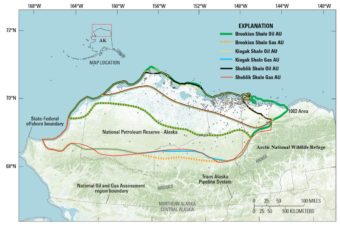
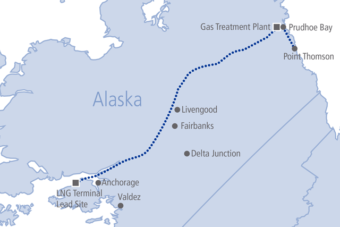
But Alaska wanted more, and even as the behemoth Trans-Alaska Pipeline System was being built, several companies were pursuing natural gas pipeline projects to bring North Slope gas to market.
Bill White, a pipeline historian and former journalist, takes reporter Rashah McChesney on a tour of Anchorage that includes the important sites in the state’s long romance with a gas line.
Pipeline Promises: Alaska's quest for a natural gas line
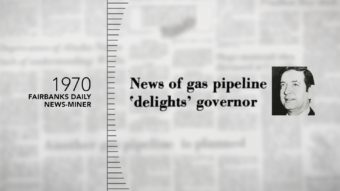
Since the 1970’s Alaskan leaders have dreamed of building a gas pipeline from the North Slope. There have been presidential proclamations, congressional hearings and lots of backroom deals, but no project has come close to breaking ground. This week, in the series Pipeline Promises, Alaska’s Energy Desk is taking a look at that history- asking why the project has failed again and again, and whether it may still have a chance.
Pipeline Promises: Alaska's quest for a natural gas line
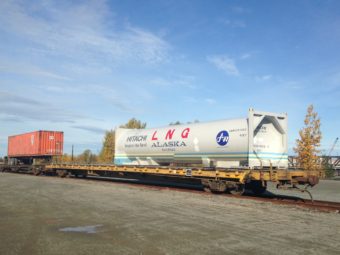
A cryogenic tank container used to carry liquefied natural gas by rail (photo by Elizabeth Harball).
Standing next to a massive cylindrical rail car at the Anchorage Railroad Yard, Alaska Railroad Mechanical Supervisor Josh Cappel asked a fireman to test out the car’s hand-operated braking system.
“Go ahead and fire that thing up tight. Come on, a little tighter than that — there you go!” Cappel joked, drawing laughs from the crowd of about 16 other members of the Anchorage Fire Department.
Starting tomorrow, the Alaska Railroad will be the first in the nation to carry liquefied natural gas by rail. With the Federal Rail Administration’s blessing, LNG will travel the tracks from Anchorage to Fairbanks.
As with any new venture, safety is always a topic of discussion. Cappel said he’s training the Anchorage Fire Department in case the worst happens.
“It’s very important for everyone to understand how rail cars work, especially the fire department,” said Cappel. “If they are responding to any kind of disaster they need to know how these cars work so they don’t get hurt and the people they are rescuing don’t get hurt.”
Over the next four weeks, the Alaska Railroad will complete eight round-trip test runs of liquefied natural gas shipments from Anchorage to Fairbanks. It’s a big first, for Alaska and the U.S. — LNG has never been shipped by rail before. Fairbanks Natural Gas hopes this will be a cheaper, safer way to move the fuel.
Recent oil train explosions in the lower 48 have some people worried about moving train cars filled with fossil fuels through communities. Lois Epstein, an engineer who works for The Wilderness Society, says shipping LNG by rail is generally safer than carrying it in a truck, which is how the LNG is being shipped to Fairbanks now.
“Where I would be concerned, however, is places where the railroad crosses the road because that’s where there are some very real safety issues,” said Epstein.
Collisions with cars crossing the tracks is a concern, but Captain Jared Stiglich with the Anchorage Fire Department says big, fiery explosions aren’t something to worry about with LNG train cars. It’s the extreme cold that’s the problem.
“The biggest concern with LNG is that it’s transported at minus 260 degrees Fahrenheit, so it would freeze-burn anything or anyone.” said Stiglich.
The Alaska Railroad reports most of the LNG’s journey won’t be too close to communities and roadways. But just in case, they’re making sure emergency responders up and down the Railbelt are prepared to handle a new kind of cargo on the tracks.
“For a goodly portion of what we do, we’re off the roadway and out of communities, so folks aren’t going to see us as much while we’re going through,” said Tim Sullivan, External Affairs Manager for the Alaska Railroad. “But it does behoove us to make sure that first responders in the area, even if it’s remote, know what it is we’ve got going on.”
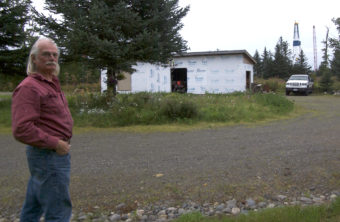
Herff Keith lives next door to BlueCrest Energy’s oil drilling pad. A construction crane and new oil drilling rig can be seen in the background. (Photo by Jenny Neyman/KBBI)
Residents of a tiny Kenai Peninsula subdivision near Anchor Point thought they had a little slice of peace and quiet. But a tract of homestead land to the south held an oil test well. And now it’s home to 38 acres of an active oil well, processing train, natural gas flare, workers’ camp, truck filling station and a five-story rig that is about to start drilling 30 more wells.
When Herff Keith retired from The Alaska Railroad in Anchorage in 2007, he wanted a change of pace. Somewhere he could fish, enjoy the view and relax. He found the perfect spot in a tiny subdivision on the bluff above Cook Inlet, seven miles north of Anchor Point, where he lives with his girlfriend, Colette Bewick.
There’s only one other full-time neighbor. The rest of the handful of houses are vacation properties. To the south is the Hansen homestead, which was mostly vacant when Keith built his house, except for on old test well drilled by ConocoPhillips in 2001. Keith didn’t worry much about it- one capped well, abandoned for years.
But the site is now the centerpiece of BlueCrest Energy, an independent oil company based in Fort Worth, Texas, which is constructing a full-blown oil drilling and production operation on the 38-acre pad.
“And it’s just nonstop. They’ve been building a facility,” he said. “There’s a 52-room hotel next door now. It’s less than 1,000 feet from my property to their property. That’s close.”
Unbeknownst to Keith, BlueCrest confirmed a sizable reservoir of high-quality crude and natural gas out below Cook Inlet. Construction on the pad began in September 2015, with plans to directionally drill for oil from onshore. The company expects the project to last 30 years.
BlueCrest reached out to area residents early on. It’s not the company’s preference to set up shop in a residential area. Representatives keep in touch with neighbors and have held several community meetings to give project updates, answer questions and address concerns.
Larry Burgess, health, safety and environmental manager for BlueCrest, has been the community liaison.
“They could see the well when they moved in over there. They could see this existing well,” he said. “And, unfortunately, they thought that this would never occur. And now it has. I mean, I feel for them… I would hate it if I was them.”
BlueCrest has made efforts to mitigate its impact on the neighborhood.
Ten thousand gallons of water a day are trucked in for use in the camp, rather than drilling a water well in the local aquifer. BlueCrest built a 20-foot earthen berm around the site to dampen the noise. And the company schedules pipe deliveries during the daytime, so the inevitable clanging and banging doesn’t disrupt sleep.
But Burgess acknowledges mitigation can only go so far.
“Those little things, they help. They know we’re doing what we can, but we’re not going to shut this thing in and stop,” he said. “There’s millions of dollars that have been spent here. But we’re not going to ignore them, either. ”
Burgess gave me a tour of the facility in late June. It was a calm day at the site. The well was shut in and the natural gas compressors were off. The gas flare was just a pilot light.
“It’s pretty quiet right now. But it can be noisy,” he said.
The compressors are one of the noisiest things on the pad, even with hospital-grade mufflers installed. Burgess says BlueCrest paid to have a sound survey done to measure noise levels on and around the pad. Even with the compressors running full speed, the highest decibel reading on top of the berm was 61.5, which is about as loud as a conversation.
But Burgess says the noise will get worse when the new rig starts drilling, which should start in mid-October.
“Without question. And I have not pulled any punches with them,” he said. “I told them straight up, this is going to get worse.”
Herff Keith doesn’t want to be around to hear it.
“I am 66 years old. I put my life savings into this place,” he said. “I’ve got a good retirement. And I do not want to sit here next to this noise factory for the next 30 years.”
He can’t imagine who would want to buy his house now, but he plans to list it for sale anyway.
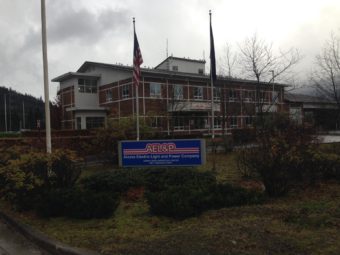
Keeping the lights on in Juneau could be more expensive this fall. Alaska Electric Light & Power – the privately owned electric utility that powers the city – wants to increase its rates. The company announced Friday that, overall, customers can expect to pay 8 percent more on their electric bill by the end of 2017.
According to a press release, rates will increase gradually.
In November, rates could go up by nearly 4 percent, pending approval from the Regulatory Commission of Alaska or RCA. It’s an increase to pay for a backup diesel generation plant in the Mendenhall Valley and improvements to the electric utility’s systems. AEL&P has invested over $50 million for additions and upgrades. The diesel plant makes up about $22 million of that.
In December of 2017, rates will go up another 4.24 percent. Again, pending RCA approval.
It would be the first rate increase since 2010. That increase followed the utility’s Lake Dorothy hydro project coming online.
Editor’s Note: This story has been updated to explain AEL&P’s investment for upgrades and improvements.
Close
Update notification options
Subscribe to notifications
Subscribe
Get notifications about news related to the topics you care about. You can unsubscribe anytime.