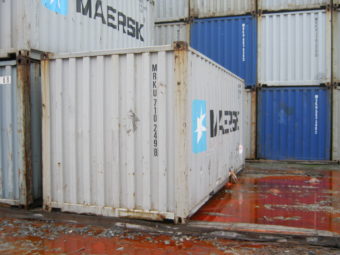
Fish oil pours out of the punctured shipping container. (David Tonon/U.S. Coast Guard)
A forklift punctured a shipping container filled with fish oil in Unalaska on Thursday, spilling it across a shipyard. Fish oil is considered an environmental hazard, but far less damaging than crude oil. Some of the bright orange oil flowed into a storm drain and into the ocean. Resolve Marine stopped it from spreading more by plugging the drain with gravel and dirt.
A couple hundred gallons of the 5,700-gallon bladder made it into the ocean. But U.S. Coast Guard Lt. Andres Ayure said because fish oil is biodegradable, it’s not too hard on the environment.
“Technically, in large quantities it could be seen as a marine pollutant. But in the quantities that we saw and with the weather we had, it will disperse, emulsify very quickly, and not harm the environment,” said Ayure.
Calm seas made it easier to contain and clean up the fish oil. If it had not spilled, the fish oil would have been shipped off the island and processed into products like fish oil supplements.
Shipping company Matson is responsible for the spill and for the cleanup, which Ayure said can be costly. The Coast Guard is also putting together a report on the incident and Matson could face fines and further penalties.
After years of waiting, Juneau Hydropower Inc. was recently awarded a federal license for Sweetheart Lake Dam. It gives the company the go-ahead to start serious planning for a new multimillion dollar hydro facility. It could power a gold mine and supply heat to the downtown core of the capital city with an innovative system.
Duff Mitchell calls getting the Federal Energy Regulatory Commission or FERC license a milestone. He’s the managing director of Juneau Hydropower. After waiting six years, he learned his company was receiving the license in early September.
“I hate to use it but it’d be like a liquor store. You bought all the liquor, you bought the store but you can’t sell it until you get permission. This is the permission,” Mitchell said.
In the U.S., water — like Sweetheart Lake — is considered a public resource. That’s why Juneau Hydropower had to apply for the regulatory license. That public resource could be used to generate electricity from a privately owned dam.
There are still a few more hoops to jump through, but Mitchell thinks they could start some preliminary work at the site as early as this winter.
Once the dam is built, the company plans to power the Kensington Mine, which runs entirely off of diesel. Meanwhile, Mitchell says they’ll also began construction next summer on a seawater heat pump in Juneau.
“And so we’re going to be trying to lay pipe in Juneau this summer, too,” Mitchell said.
The technology works similar to your fridge at home. Except, in this case, it’s warmth that’s transferred away from the water.
It’ll be powered by Sweetheart Lake dam and bring heat to buildings through pipes in the downtown core — displacing heating fuel.
But not everyone has been supportive of the dam project. Back in 2014, the privately-owned utility that services Juneau — AEL&P — sent a critical letter to FERC explaining there wasn’t a need for new hydro.
Tim McLeod — AEL&P’s president says that was before the dam proposal included the district heating idea.
“We did not forecast a load that would justify the project when we submitted that letter,” McLeod said.
Now that district heating is part of the equation, McLeod says he’s isn’t sure. He doesn’t know how much juice it would take to pencil out.
“I don’t have any knowledge of that. That haven’t talked to AEL&P about the heating district,” McLeod said.
But Juneau Hydropower might have to. McLeod says he expects the company will want to use AEL&P’s existing transmission lines. And Duff Mitchell agrees. He says he’ll work with the utility to make it happen.
For district heating to make sense, Mitchell says large Juneau buildings will have to come online, like the capitol complex, state office building and Juneau-Douglas High School. And eventually, people’s homes.
“It’s going to require a subscription. In other words, a lot of the neighborhoods are going to want to do it. It can’t be just one house,” Mitchell said.
He believes there’s interest from the large downtown buildings.
“Yes, the bottom line is that this reduces greenhouse gases. A lot of people are interested because this is the wave of the future.”
He says the Danish government thinks so, too. Denmark has a long history with district heating. And Mitchell says the country’s representatives have their eye on Juneau.
“So they’re working with us however and whenever they can, and they see Juneau as a flagship where they can also sell more Danish pipe and stuff in the future,” Mitchell said.
Mitchell thinks Denmark could help pay for some of the project cost with Danish bonds. And he believes that’s a real possibility, along with financing from the Department of Energy and private investors. A bill that passed the Alaska legislature this year also frees up low-interest loans from a state backed corporation.
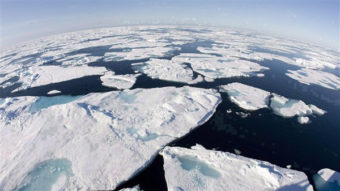
(Graphic from the National Snow and Ice Data Center)
Arctic Sea ice retreated to it’s second lowest level on record this summer. Scientists announced today the ice likely reached its lowest extent on Sept. 10. The Arctic Ocean ended the summer season with 1.6 million square miles of ice, tying 2007 for the second lowest amount.

Mark Serreze is director of the National Snow and Ice Data Center. He says sea ice extent has been on a downward trend since 1979.
“But it looks like over the past decade the loss rate is starting to accelerate,” he said. “It probably has to do with the fact that the ice cover is thinner now, so it doesn’t take as much energy to melt out big portions of it. So we do seem to be in the fast lane, so to speak.”
Serreze says at this rate, the Arctic Ocean is headed for ice free summers sometime in the next few decades.
There was so little Arctic sea ice at the end of the winter, scientists thought 2016 may beat the previous record low, set in 2012. But conditions over the Arctic Ocean this summer were generally cool and cloudy, limiting the rate of sea ice loss.
The ice near Alaska in the Chukchi Sea is still holding up over an important walrus feeding area called Hanna Shoal. Anthony Fischbach is a walrus biologist with the United States Geological Survey.
“The regional presence of sea ice here makes a big difference for Alaskans and the wildlife that we have that depends on it,” he said.
Fischbach doesn’t expect walrus to haul out this year on shore in Northern Alaska in huge numbers like they have most years since 2007. The U.S. Fish and Wildlife Service says there haven’t been any reports of a large haul out near Point Lay.
Mark Wiggin will be the new deputy commissioner at the Department of Natural Resources (Photo courtesy DNR).
The Alaska Department of Natural Resources announced it has hired a new deputy commissioner in charge of oil and gas.
Mark Wiggin left Brooks Range Petroleum to take the post, where he worked as an engineering and development manager.
The deputy commissioner role has been vacant since March, when Marty Rutherford temporarily stepped in to the lead role at the Department of Natural Resources before she became a trustee of the Permanent Fund Corporation Board.
Wiggin will work under Commissioner Andy Mack, who took the reins of the Department in July. (Wiggin is currently vice chair of Alaska Public Media’s board of directors.)
In a press release announcing the hire, Mack touted Wiggin’s three decades of experience in Alaska’s oil fields, including big developments like Lisburne, Alpine and Mustang. Before working at Brooks Range Petroleum, Wiggin was at ASRC Energy Services focusing on the Alaska Gas Pipeline Project and the Nikaitchuq oil field.
“His knowledge of upstream oil and gas issues, his experience in project development, and his work on resource economics and policy will add valuable expertise to DNR,” said Mack.
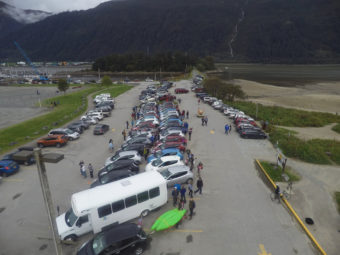
A drone shot of Juneau’s electric vehicle get together. (Photo by Gabe Strong)
If the capital city were a state, then it ranks with places like California when it comes to the number of electric vehicles per capita on the road.
And Juneau’s EVs owners love to show off.
This past weekend, the quiet cars rolled into a local park so the public could take a glimpse.
In total, there are about 80 fully electric vehicles on the roads of Juneau — running off hydropower rather than gasoline. More than 40 of those were parked at Savikko Park in Douglas on Saturday at an electric vehicle get-together.
Clusters of people ogled an espresso-colored car. They talked to the sharply dressed owner, instead of walking their dogs on the nearby trail.
This isn’t just any electric vehicle.
It’s a new Tesla with a price tag of over $109,000.
Myron Klein says, typically, his car doesn’t get this type of attention.
“Not too much. I usually don’t drive it to places with lots of people,” Klein said.
Klein hasn’t had the car very long, so he’s still getting comfortable with busy parking lots.
It’s one of two confirmed Tesla’s in town, and there’s a rumor of a third.
The upscale EV has a longer range than, say, the Nissan Leaf. But with 10 public charging stations, plugging in isn’t a huge problem. There’s a limited road system, after all.
What can be a burdensome, though, for those wanting to join this growing club is getting the cars to Juneau and maintenance.
There’s no Tesla or Nissan dealer in town.
Still, that didn’t stop Kyle Cuzzort from purchasing his blue Nissan Leaf.
He says he did tons lots of research before buying it.
“I do like to do numbers. That’s what I do,” Cuzzort said. “I did the math once and figured how much weight I would lose if I walked the stairs everyday. Two pounds a year.”
Cuzzort took a deep dive into electric vehicle forums and learned the car’s battery could work well in a mild Southeast climate.
He’s owned the car for about three years now.
And compared to what he used to drive, he says powering the Leaf costs much less than what he used to spend on gas. It pencils out to about $25 bucks month.
“What we save in gas, we could take a vacation every year,” he said.
When Cuzzort bought his Leaf around 2013, there were only about seven in town.
Now that number has ballooned far beyond that and the Juneau branch of the Electric Vehicle Association is looking to boost the numbers even more.
This fall, a Nissan tech is traveling to Juneau to service its cars with recall issues. And the association is looking at organizing a “group buy” of Nissan Leafs. It could help offset some of the costs of barging the vehicles here.
Although, Cuzzort clearly loves his car. I can see he’s eyeing the Tesla.
“I would want one,” he said.
He explains if you drive a decent amount of miles, owning a Tesla could be cheaper than owning a minivan — or at least that’s what he’s heard on his forum. A less expensive Tesla model is expected to launch later next year.
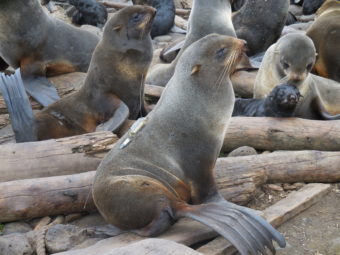
Tracking instruments are temporarily glued to female northern fur seals. (Carey Kuhn/NOAA Fisheries)
The northern fur seals on St. Paul Island are one of the most-studied marine mammals on the planet, but there’s still a lot scientists don’t know.
For the first time this year, scientists are using a device called a Saildrone to track down more information about the seals. The tool could help solve the mystery of why fur seals on the island have been declining since the 1970s.
Scientists have been tagging fur seals to monitor their foraging trips since the early 1970s. This year, they’ve added a new device: the Saildrone. Ecologist Carey Kuhn says the unmanned, wind- and solar-powered contraption can patrol the Bering Sea and measure the amount of available prey.
“We haven’t had the ability to take a boat out and do these types of large-scale prey surveys during the summer months when we want to know what’s going on,” said Kuhn. “The Saildrone has just been groundbreaking for us.”
Imagine the ocean has a bunch of different grocery stores. In the past, scientists could see which stores the seals were visiting, but they couldn’t see what was in them. Scientists can program the Saildrones to visit the feeding areas fur seals are known to frequent and log how much and what kind of fish are there.
https://vimeo.com/167481038
The summer months are especially important, when fur seal moms try to fatten their pups up for the winter. Different seals have different strategies. This year, Kuhn saw one mother who hunted for six days, traveling more than 160 miles north of St. Paul.
“We know that when an animal spends a longer period of time at sea, the pup spends a longer period of time fasting on shore,” she said. “Then its growth rate isn’t as high as a female who could return quickly and feed her pup more often.”
At the end of the month, Kuhn will return to St. Paul to retrieve the seal tags and weigh and measure the pups.
When all the data is in, the team will be able to see where the seals are getting their food and how much there was. Kuhn says those answers are made possible by Saildrones.
“We really think this is going to change the way that we do science because we’ll be able to do things that we haven’t had the ability to do in the past,” she said.
Kuhn says this is the first step of a larger project. Understanding how northern fur seals respond to changes in the distribution and abundance of fish could explain the mysterious decline of fur seals in the Pribilof Islands.
Close
Update notification options
Subscribe to notifications
Subscribe
Get notifications about news related to the topics you care about. You can unsubscribe anytime.