Alaska's Energy Desk

Alaska prepares for vessel disasters

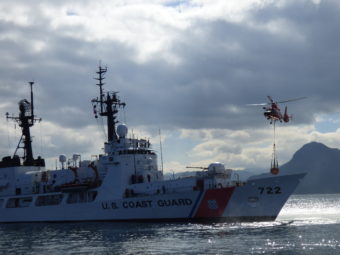
A helicopter practices dropping an Emergency Towing System on the Coast Guard cutter Morgenthau. (Zoe Sobel/KUCB)

On one of the nicest days of the summer, the Coast Guard cutter Morgenthau needs help. The boat is playing the role of distressed vessel. A local tug slowly approaches its bow while crew members ready the Emergency Tow System. Horns blare and bang. One end of the rope is on the tug and the other on the Morgenthau. On both sides, people scramble to secure the lines for towing.

Coast Guard Lt. Andres Ayure is coordinating the drill. He says the practice helps ensure everything is in working order.

“If you don’t exercise it yearly, then with some time, some of these components could start decaying or start to break down,” Ayure said. “We wouldn’t find out until we have an actual emergency, which is not when we want to find out.”

The city purchased its first Emergency Towing System after the 2004 grounding of the Selendang Ayu. When that ship split in half in rough seas off Unalaska’s coast, six people died and thousands of gallons of oil spilled in sensitive coastal habitat

If you ask conservation biologist Rick Steiner, it’s only a matter of time before the next disaster.

“After that you’ll see all these politicians and people running around in their orange suits, clipboards and hardhats saying we need to do something better,” Steiner said. “All of that will be useless at that point.”

As a member of the Shipping Safety Partnership, Steiner has helped institute some improvements in boating safety since the Selendang Ayu’s grounding. The Marine Exchange of Alaska has added more than 100 monitors to track boats 24 hours a day. Last year, the International Maritime Organization approved shipping buffer zones in the Aleutians to keep vessels further from shore.

But Steiner says there’s still a lot to do. He wants better navigation aids, increased financial liability for shippers, and, most important, all-weather rescue tugs.

Members of the Coast Guard secure the Emergency Towing System. (Zoe Sobel/ KUCB)

“Let’s say you get this portable tow package on the bow of a disabled tanker out at Shemya,” he said. “What then? You don’t have an adequate rescue tug of open ocean, powerful thrust and capability to actually hook it and render ‘a save’ in most scenarios.”

Steiner says the smaller, less busy Prince William Sound has 11 tugs. He’d be happy with three for the Aleutians and he wants to use the $5 billion Oil Spill Liability Trust Fund to pay for them.

It’s impossible to eliminate all risk, but Steiner says preventative measures, like buying tugs, would be economical. Oil spills are expensive to clean up and not very effective.

Ed Page knows about the cost of oil spills firsthand. He spent 30 years in the Coast Guard, three of those cleaning up the Exxon Valdez spill.

“Three years, $2 billion, 10,000 people, picked up 10 percent,” Page said. “That’s not a very good return on investment. So you want to say it’s difficult, yeah, that’s almost an understatement. It’s almost an exercise in futility. You got to give it a shot. Picking up 10 percent is better than picking up nothing, but still, prevention is clearly the way to go. There’s no doubt.”

Cleaning up spills in the Aleutians or the Arctic would be even more costly.

Now Page heads up the Marine Exchange of Alaska which works to improve safety by monitoring the locations of vessels in Alaskan waters. He says the size of Alaska’s monitoring network is massive — 1.5 million square miles — larger than anywhere else in the world.

The statewide tracking system provides automatic alerts anytime a ship slows down or gets too close to shore.

But now Page says, larger vessels, some bigger than the Empire State Building, are traversing Alaskan waters. And he says, there are no boats powerful enough to save them.

“They’ve got 18,000 containers and they carry a tremendous amount of oil,” he said. “If you took the containers off the deck and lined them on the dock end-to-end, they would go 60 miles. If that vessel gets in trouble, there’s nobody who can give them a hand.”

The boats are too big to stop in Alaskan ports. Page says they’re only passing through, just like the Selendang Ayu.

The task of improving maritime safety is ongoing. Page says now they’re working on a new device — a parachute ship arrestor — that would work like a huge sea anchor to slow down and stabilize distressed vessels — providing more time for repairs or a rescue.

Alaska Natives protesting Dakota Access pipeline share mixed views on oil

10harballdapl
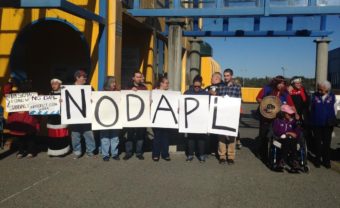
Demonstrators in downtown Anchorage protest the Dakota Access pipeline. (Photo by Elizabeth Harball/Alaska Public Media)

About 60 demonstrators gathered in downtown Anchorage Saturday afternoon to sing, dance and carry signs. Many Alaska Native people were there to support North Dakota’s Standing Rock Sioux tribe in their fight against the Dakota Access oil pipeline.
The Standing Rock Sioux tribe is afraid the pipeline could contaminate their water; the developer claims the pipeline is the safest way to carry the oil. The tribe’s protests have gained national attention.

Late last week, the Obama administration paused the development of the pipeline following the tribe’s protests.

The demonstrators in Anchorage said the pipeline developer isn’t listening to the Standing Rock Sioux’s voices. But because oil is such a big part of Alaska’s economy, some demonstrators also said protesting the North Dakota pipeline wasn’t as simple as being for or against oil.

Kelli Reed organized the demonstration.

“This demonstration is not opposed to oil,” said Reed. “Oil production on the North Slope has been very beneficial for Native Alaskans who live up there. However, what we are objecting to is a silencing of the voice of a people called the Lakota Sioux.”

Gregory Nothstine, a member of the Native Village of Wales, said he supports the Standing Rock Sioux because he feels Native rights are often ignored. But he’s okay with oil development if it’s done responsibly.

“Being for or against the oil pipelines here in Alaska? They’ve been providing revenues for our state for years,” Nothstine said.

Ada Coyle and her daughter Ashley Doctolero were at the demonstration; Doctolero was wearing the traditional regalia of the Kodiak Island’s Sugpiaq people. Coyle said protecting water should be the number one priority.

“You can’t drink or eat money, but the water is there,” said Coyle. “We need it to drink, we need it to cook with, shower with, to cleanse us, you know?”


Oil and subsistence in the warming Arctic: A conversation with Tom Kizzia

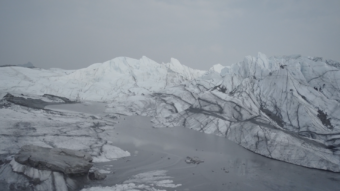
The view from Point Hope, late winter 2015. (Photo by Ellen Chenoweth/University of Alaska Fairbanks)
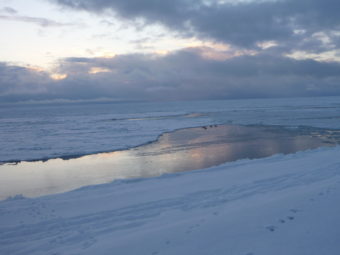
The view from Point Hope, early winter 2015. (Photo by Ellen Chenoweth/University of Alaska Fairbanks)

In the most recent issue of The New Yorker, Alaska writer and longtime former ADN reporter Tom Kizzia looks back at the debate over offshore drilling in North Slope communities. Kizzia visited Point Hope to report on how climate change is affecting the region’s twin pillars: oil development and subsistence hunting.
He spoke with Rachel Waldholz of Alaska’s Energy Desk from Homer, where he lives. His article, Whale hunters of the warming Arctic, appears in the Sept. 12 issue of the magazine.

Steve Oomittuk, who was born and raised in Point Hope, hopes broadband won't aggravate the problem of Western culture overwhelming Native culture – especially among youth. (Image courtesy of Jiri Rezak/Greenpeace)
“I love my way of life,” Steve Oomittuk, a former mayor of Point Hope, told Kizzia. “My grandfather’s life. The cycle of life. The connection to the land, the sea, the sky.”  (Image courtesy of Jiri Rezak/Greenpeace)

Kizzia said it’s easy to label communities as either for or against oil development, but in his reporting he found many residents who could see both sides.

KIZZIA: I think a lot of people really kind of held both opinions at the same time, was my sense. Individually they would sort of lean one way or lean the other, but the flag-waving leaders on either side weren’t as common as the people who had this deep ambivalence or anguish about what they might be doing to their whaling future [if they allowed offshore drilling]. At the same time, if they didn’t have the property tax income [from oil development] to keep civilization running up there, how are they going to live? So that was what was impressive to me, that sort of ambivalence in the middle that so many people had.

WALDHOLZ: What drew you to this particular story?

KIZZIA: Well, I think underlying that debate over offshore oil is the question of how the climate is changing, the ice is melting and what’s going to happen to the ancient culture up there if the ice goes away. They’re looking at a warmer future that’s going to really change the way things are done up there and they’re trying to figure out how to respond to that. In that sense, they’re just like all Americans, but it’s so much more concentrated. You can see the dilemma within the Inupiaq culture in some ways more easily as an outsider than you can when you look at our North American culture. But it’s really the same dilemma.

WALDHOLZ: You open the story with this amazing scene out on the sea ice, and I’m wondering if you can describe that for our listeners.

KIZZIA: It was a year ago in the spring. The ice had gotten so thin that they couldn’t hunt bowheads anymore off of Point Hope. Basically the hunters were just out there on their own, just watching the whales swim by. I saw some amazing photos, you could see the black backs of the whales right there, and you couldn’t catch them.

And while they’re out there, suddenly there are three warning shots. And the warning shots meant the ice lead had broken off behind them and they were on a piece of ice that was threatening to float away and take them out to sea. They got back and they could see a hundred yards of blue water between them and the shore-fast ice. And their solution was to take their snowmachines and get a good running start, and just skip like stones across the open ocean to get back onto the ice on the shore side. It was just a pretty terrifying moment for a lot of people — and something the kids would do, I’m told, in the lagoons up there in the summer, practice with their snowmachines. And it turned out to be a pretty useful technique for saving their lives.

WALDHOLZ: You have this line toward the end of the story where you say people have worried they may need to choose between oil and subsistence — but now they’re facing the prospect of potentially losing both. Is it really that bleak?

KIZZIA: Well, I hope not. I mean, clearly nobody wants that to happen. But I just wanted to describe in broad strokes how that situation is beginning to come into focus as a possibility, and there’s not a real easy checklist of things we can do to deal with that. But I think as a journalist, trying to recognize what the challenges are is sometimes the first step. And in Alaska that’s often clouded by our short term interests — [it’s] hard to see the big picture.

As tiny homes take root, where do you park them in Alaska?

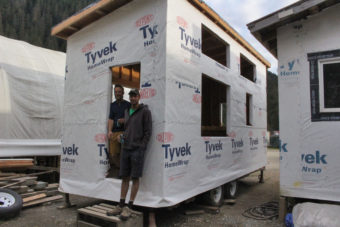
Jason Donig (right) and Jeff Martinson (left) stand in front of the tiny they're building. (Photo by Elizabeth Jenkins/KTOO)
Jason Donig (right) and Jeff Martinson (left) in the yard at AK Reuse. Martinson is the builder of the small home. (Photo by Elizabeth Jenkins/KTOO)

There might be a small solution to the capital city’s housing problem but it’s not without its roadblocks.

A Juneau company is building its first tiny house on wheels to sell commercially and it intends to make more.

The diminutive dwelling is crafted with reclaimed materials and locally-sourced wood.

But the city’s zoning codes haven’t caught up with the tiny house craze.
For 160 square feet, this rolling home feels pretty spacious. Step inside and you’re greeted with high ceilings and large windows. At this point, it’s still a shell which can make identifying the bathroom tricky.

“Right now, I’m in the bathroom?” I ask.

“Nope, you’re still in the kitchen,” Jason Donig explains.

Donig is the owner of AK Reuse, the company constructing the small home.

It’s in an industrial part of town.

For a guy really passionate about recycled materials, it’s the perfect spot to draw inspiration.

There are crates of mismatched drawer pulls, old doors, a vintage gym floor.

“We got a bidet. I don’t know how cool that is,” he says with a laugh.

The bidet isn’t going in the tiny house, but Donig says other pieces from the yard are. People drop off the items at AK Reuse, and he sells them to customers looking for unique or inexpensive home materials.

As a carpenter, Donig says he was frustrated by what others throw away.

This business, I feel good when I come here because it’s not taking things apart and putting it in the dump,” Donig said. “I feel good because we’re reusing what we can. And same with the tiny home.”

Donig says he decided to build small because he saw his friends struggling to save up for a mortgage.

This tiny home is on the high-end — it could cost more than $70,000. But he thinks it could be done for less.

If you’ve watched TV lately, then you’re probably familiar with the idea of families willingly downsizing to 200 square feet.

Donig says he hasn’t seen any of these.

“Me either. ‘Cause I’m afraid,” said Beth Mckibben — a planning manager at the City and Borough of Juneau.

McKibben says she’s afraid because she knows the tiny house zoning issue hasn’t been resolved. Yet, the interest in building small is growing.

Some communities in Alaska are skeptical that this is the solution cities should be looking for when it comes to a tight housing market. Wasilla’s city council recently banned tiny houses for a temporary period, due to concerns about landlords building multiple units on a single lot and what it could do to a neighborhood’s character.

In Juneau, the real issue is what do you do with a house that rolls? You can build a 120-square foot-home on a permanent structure. But can you park one if it’s on wheels in your friend’s backyard?

“Depends on where the house might be so it’s a big fat maybe,” she said.

Maybe because it’s not zoned for every location. Tiny houses on wheels can go in mobile home parks — no problem. But it requires a trip to the planning commission before rolling one onto someone’s private lot.

Jason Donig tiny house (Photo by Elizabeth Jenkins/KTOO)
AK Reuse is using locally-sourced wood from Icy Straights Lumber & Milling for this tiny house. (Photo by Elizabeth Jenkins/KTOO)

So far, Mckibben says no one has appeared before them to get the ultimate OK. But she thinks it’s only a matter of time before more small homes start popping up.

Well, for me, that’s a concern right now. If people are going to buy them, they need to know they can place them somewhere,” she said. “They shouldn’t be making an investment not knowing what they can do with that.”

In Sitka, at least one tiny house on wheels is headed before the planning commission. It would be parked in a residential neighborhood. But nothing’s been decided yet.

Mckibben expects the zoning conversation to happen in Juneau later this year.

Back at the building site, Donig is working on what will become the sleeping loft in the tiny house. He’s talked to people who work at the city about what’s coming down the line. And he thinks they’ll be able to work something out that could keep more tiny houses in production.

Still, if he could change one thing — besides the zoning rules — it would be the namesake of the movement.

“The word tiny home makes me think of something really tiny. I don’t want to live in something called a tiny home, but I want to live in something called a modest home,” Donig said.

He expects this “modest home” to be completed by spring, and he wants to build more after that. Just don’t call him that tiny house guy.

Editor’s Note: The photo caption has been expanded to explain Jeff Martinson’s role in the tiny house build. 

Alaskans paddle to protest North Dakota pipeline

08harballcanoe
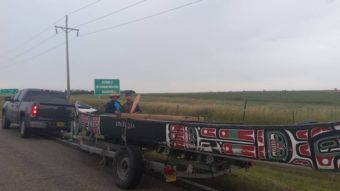
Alaskans arrive on the Standing Rock Indian Reservation to join the protest (Photo courtesy One People Canoe Society).

Members of the One People Canoe Society from Juneau paddled in unison today down the Missouri River in North Dakota. The trip is a show of solidarity with the Standing Rock Sioux who are protesting the Dakota Access Pipeline Project.

If built, the pipeline would carry oil from North Dakota to Illinois. Developer Energy Transfer Partners claims the pipeline is the safest way to carry the oil. But the Standing Rock Sioux are worried the pipeline could contaminate their water.

Catherine Edwards, who is from Juneau but now lives in Washington, is a member of the Tlingit and Haida Central Council. She was standing on a windy hill waiting for her daughter, Miciana Hutcherson, who was helping paddle the canoe. Alaskan and One People Canoe Society member Jim Zeller owns the canoe.

Before they started down the river, Edwards said the group held a ceremony with water from the Pacific Northwest.

“They brought the water down with them… poured it into the river, and said, ‘we now stand with you in your body of water, to keep it protected, to keep it safe,'” said Edwards.

Edwards said there’s a feeling of unity among the protesters.

“You can feel it, you can feel it’s a movement, you can feel it’s a shift, you can feel people coming together and [saying] ‘hi, where are you from, these are our issues, our issues are similar to yours,'” Edwards said. “We all want to stand up here and say, ‘we’re done, we’re done with this. You can’t just walk over us anymore.'”

Several national news outlets have reported some violent clashes between demonstrators and private security guards; the North Dakota governor called in the National Guard on Thursday. But Edwards said organizers are emphasizing non-violent protests.

On Friday, a federal court is expected to rule on whether pipeline construction goes forward.


Site notifications
Update notification options
Subscribe to notifications