Alaska's Energy Desk

Why Alaska utilities can build now, ask for rate increases later

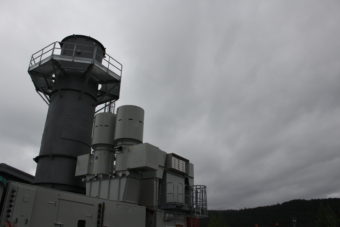
The exhaust stack for diesel turbine. (Photo by Elizabeth Jenkins/KTOO)
The exhaust stack for the diesel turbine. (Photo by Elizabeth Jenkins/KTOO)

Alaska’s privately owned electric utilities can’t increase their rates overnight. They first have to go through a process with the state’s regulatory commission to demonstrate a need. That’s what Juneau’s utility — AEL&P — is at the beginning stages of doing.

But customers get little say about projects already on the books.

Last week, Alaska Electric Light & Power announced Juneau residents could expect to pay 8 percent more on their electric bills by the end of 2017 — pending approval from the Regulatory Commission of Alaska, or RCA.

The community’s last rate permanent increase was six years ago after a new hydro project was built.

“A lot happens in that amount of time,” said Debbie Driscoll, AEL&P’s vice president.

Like investments of over $50 million, according Driscoll. Since 2010, she says the company spent money on improvements to its transmission lines, substation upgrades and — most visibly — a new $22 million backup diesel plant.

“Which is less than half of the $50 million that we’ve invested over the last six years. In addition to those capital investments, we also just have increased costs,” she said.

Driscoll says that comes from normal inflation. And it was necessary to build the diesel plant to avoid rolling blackouts, in case of an emergency, like an avalanche.

The utility is proposing increasing Juneau rates in phases. First, this November by nearly 4 percent and again next year, by about another 4 percent. Essentially, the way it works for the state’s privately-held utilities is build now, ask for rate increases later.

“You have to pay for everything upfront. All the infrastructure. And the regulatory commission allows you to recover that over time,” she said.

Driscoll doesn’t think the utility typically earns everything back.

Still, compared to most other states, the order this happens in is unusual. And in Alaska, it can look like putting the cart before the horse. Or, in this case, the diesel plant and capital improvements before a final say on a rate increase.

“That’s a specific construct the legislature has created,” said Bob Pickett — a commissioner at Alaska’s regulatory authority.

He says in lots of other places, electric utilities have to submit a plan before spending money on projects. That plan can include things like current and projected load growth, how much power will be used over time, community input and ways to reduce the overall costs.

But here, the conversation happens afterward. At least, publicly. And it always has.

“Pretty much. Yeah,” he said.

There is a process of checks and balances. Privately owned utilities, like AEL&P, have to go through hearings with the state’s regulatory commission to establish a need for steeper electric rates.

“It’s like a trial. Yes, that’s probably a way to think about it,” Pickett said.

He says it takes over a year to reach a final decision on a permanent rate increase.

As it currently stands, Debbie Driscoll, from AEL&P, says Juneau’s electric rates are below the national average. And if the regulatory authority approves the full 8 percent, she says the capital city would only be slightly above that. It’s an increase of nearly $7 a month for an average customer in the summer.

“And an increase of $8 a month of during the winter,” Driscoll said.

Comments are open on the rate increase until Oct. 20.

The man with the plan: Can Keith Meyer sell the gas line?

As the state of Alaska takes the lead in the effort to build a natural gas pipeline from the North Slope, it finds itself taking responsibility for what would be one of the largest, most complex projects in the world.

The man in charge is Keith Meyer, the new president of the Alaska Gasline Development Corp.

This week, Alaska’s Energy Desk is digging into the gas line project in the series, Pipeline Promises.

Today, Rachel Waldholz introduces us to the man with the plan.

Keith Meyer took over as the new president of the Alaska Gasline Development Corp. in June 2016. (Photo courtesy of AGDC)

To hear Keith Meyer tell it, this gas line project should not be that hard.

Back in June, when Meyer was about two weeks into his new job, he was called up to testify before lawmakers. And he said it’s always puzzled him that Alaska’s gas line has had so much trouble getting off the ground.

“Yes, it’s a big project,” he said. “[But] it’s not the biggest pipeline, it’s not the highest pipeline, it’s not the largest diameter pipeline, it’s not the largest LNG plant.”

It’s not an engineering problem at all, he said. “This project, I think, where it suffers, is not technical complexity. It’s the paperwork.”

That’s right. The project that’s eluded the state and some of the world’s largest oil companies for some four decades? It’s a paperwork problem.

That take left many people wondering – who is this guy?

“I consider myself a gas guy,” Meyer said, in an interview at AGDC’s offices just after he was hired.

Meyer has a vaguely 1950’s vibe: salt and pepper hair, hipster glasses. He says things like, neat and by golly.

He’s worked on pipeline and natural gas projects for more than 35 years, and said he’s known about Alaska’s project since the very first day of his career, back in 1980.

“And I remember at that time thinking, as a young buck in the industry, wow, that is a neat project,” he said. “You know, someday I might get to work on a project like that…So I was thrilled at the opportunity to be the one to bring it home.”

Meyer comes across as supremely confident he can bring it home.

But he inherited a project in flux. Earlier this year, Alaska’s three partners – ExxonMobil, BP and ConocoPhillips – told the state they likely wouldn’t move the project forward on the expected timeline.

The state decided to take over – which puts Meyer, and AGDC, in charge.

His first challenge is tackling the project’s Achilles heel: its price tag.

“Right now it’s high cost,” he told the Legislature in June. “So now our focus has to be on how do we get the cost reduction. How do we get the cost down?”

Meyer’s answer: re-imagining the project’s financing.

The existing project structure is pretty simple. The state is in a four-way partnership with the oil companies. Each party puts up their $10 to $15 billion – and voila! Project financed.

But with our partners headed for the exits, how does Alaska finance the project on its own?

Meyer said – we don’t have to.

He wants the state to quit acting like a deep-pocketed oil major and start acting like a scrappy pipeline company. You don’t pay for the project yourself. You bring in outside investors. You put together a deal. That’s what he means by “paperwork.”

“This is significantly different than the way it was done [to date],” he said. “However, it’s very similar to the way most of the pipelines in the US have been built and also the way most of the LNG facilities now have been built.”

Gov. Bill Walker has ruled out dipping into the Permanent Fund, the state’s $54 billion piggy bank. Meyer said the project also wouldn’t rely on general obligation bonds — the state’s everyday credit card, used for expenses like highway projects.

Instead, the state would rely on project financing. Essentially, AGDC will go out and try to secure customers — perhaps utilities in Japan that want to buy gas, or the North Slope producers themselves, who would pay to ship their gas down the pipeline. If the state can lock down long-term contracts, it can take those contracts to the bank — or, more likely, to private equity firms — using the contracts as the foundation to secure loans or investors for the first stage of the project.  Once construction is underway, Meyer said, other third-party investors might want a piece of it, such as pension funds, insurance companies, infrastructure investors.

If that sounds pretty complicated — well, it is. But Meyer has some experience in this.

His calling card in the natural gas world is his work on Cheniere Energy’s Sabine Pass import terminal in Louisiana in the mid-2000’s.

“Keith played a huge role in one of the more important players in this remarkable period for energy,” said Wall Street Journal reporter Gregory Zuckerman, who wrote about Cheniere Energy in his 2013 book, The Frackers. “He was part of this effort to import natural gas when it seemed like the country needed it.”

Cheniere Energy managed to do pretty much what Meyer is proposing in Alaska: it didn’t own any gas, it didn’t have deep pockets, but it locked in contracts with big companies that wanted space in its terminal and used those contracts to go out and get financing to build the project.

Zuckerman said Meyer gets part of the credit for that, for promoting the project and making the case to investors.

“He was among the people that concluded some of the best agreements and contracts for Cheniere, according to people close to the matter. So he would be a good person to pull that off,” Zuckerman said. “The challenge, obviously, is that these are really expensive projects. And the energy business, as we’ve learned over the last few years, can change dramatically.”

That’s what happened to Cheniere. The Sabine Pass project was put together in the mid-2000’s, when the U.S. thought it was facing an energy shortage. Then the fracking boom swamped the gas market. Cheniere’s value plunged. The company only saved itself by turning its import project into an export project. By then, Meyer had left the company.

There are major differences between the projects. LNG import projects are by definition simpler and cheaper than export projects. And the Sabine Pass import project was also much smaller than Alaska’s project – something like the difference between financing a Kia and a Tesla.

I asked Meyer if he had ever put together project financing for something the size of the Alaska LNG project, which is estimated to cost at least $45 billion.

“No one has,” he said.

In other words, financing the project as it currently exists would be unprecedented.

Meyer’s goal, of course, is to keep the project well below $45 billion, through a combination of cheaper financing, the potential tax benefits of state ownership, and, perhaps, building it in multiple phases.

But he said he’s under no illusions about the challenges. Alaska’s project is big. It’s expensive. He’s confident there’s a growing market for natural gas, but there are a lot of LNG projects competing to fill that demand.

But, he said, if Alaska waits, the competition will only get worse.

“We’re fighting with some of the biggest companies in the world, some big countries,” he said. “And, by golly, we’ve got to get out there and fight for this Alaskan project.”

In latest high-profile resignation, head of state’s oil and gas division quits

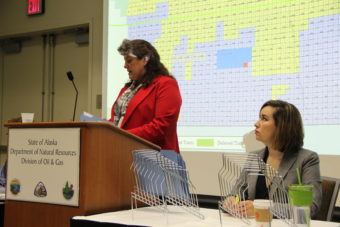
Corri Feige of DNR’s Division of Oil and Gas reads out bids during the state’s annual North Slope lease sale. (Photo: Rachel Waldholz/Alaska's Energy Desk)
Corri Feige of DNR’s Division of Oil and Gas reads out bids during the state’s annual North Slope lease sale. Feige is resigning from her position as the state’s top oil and gas regulator. (Photo: Rachel Waldholz/Alaska’s Energy Desk)


The state’s top oil and gas regulator is stepping down.

Corri Feige emailed colleagues on Tuesday saying her last day is Oct. 3.

“This decision has been incredibly difficult for me, but opportunity rarely knocks at convenient times and in this instance, I have got to answer that knock!,” Feige wrote.

She also said the move would reduce her daily commute and allow her to spend more time with family.

Feige, whose division is a subset of the state’s Department of Natural Resources, didn’t return a message seeking comment.  But spokesperson Diane Hunt said Feige was busy and wouldn’t be available to talk about her decision for the “next few days.”

Feige has been the face of an ongoing fight between the state and the oil companies that control Prudhoe Bay, over the companies’ plans for marketing natural gas from the North Slope.

The state is taking the lead role in a massive project designed to move natural gas from the North Slope to Asian markets. And Feige’s division wants more specific information from the companies on how they plan to make the gas available.

The companies have argued they either don’t have that information or can’t legally share it.

It’s the latest in a series of high profile officials leaving Governor Bill Walker’s oil and gas team. Former Department of Natural Resources Commissioner Mark Myers retired in February, followed by acting commissioner Marty Rutherford, who resigned in June.  


Alaska fisheries escape effects of climate change for now

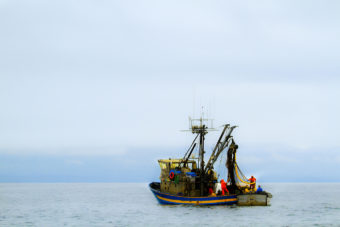
Commercial fishing in Alaska is a multi-billion dollar industry.
Commercial fishing in Alaska is a multi-billion dollar industry. (Aftab Uzzaman/Flickr)

With coastlines eroding, temperatures rising, and sea ice retreating, Alaska is feeling the effects of a warming planet. But a new federal report suggests fisheries in the state haven’t experienced many observable impacts of climate change so far.
Commercial fishing in Alaska is a multi-billion dollar industry. For 18 consecutive years, fishermen have hauled more fish into Dutch Harbor than anywhere else in the country. But at this point, researcher Terry Johnson says climate change isn’t a hot topic in the industry, even though it could affect young fishermen.

“We aren’t talking about next year, but we are talking about within this century or within the working lives of young people who are just coming into the fishery now,” he said.

Johnson says interest in the topic is growing among fishermen.

As a researcher for Sea Grant — an offshoot of the National Oceanic and Atmospheric Administration — he’s synthesized hundreds of scientific papers, interviewed scientists and stakeholders, and combed through popular media to compile this report.

Johnson says climate change will have different effects on different fisheries — salmon might do better in warmer waters, while pollock and crab might fare worse.

Johnson says short-term ocean warming events, like El Niño or the Blob, could preview the long-term effects of climate change on fisheries.

“If 50 years from now, the long-term ambient temperatures are the same as they were last year during a short-term event, you can see how stocks reshuffle themselves,” he said. “Some prosper and some diminish.”

Johnson says so far, observable impacts of long-term climate change on Alaska’s fisheries have been relatively mild. Commercially important fish species are prospering while sport and subsistence resources are within normal ranges. Exceptions like the sweeping decline of Chinook salmon could be tied to climate change or ocean acidification, but the research isn’t there yet.

And Johnson says seeing Alaska’s future is as easy as looking south.

“You want to know what Alaska is going to be like 100 years from now?” Johnson said. “Look at Washington, because the temperatures are warmer there. If nothing changes, eventually we are going to get a similar type of long-term temperature increase here.”

Johnson says fisherman deal with change all the time.

The fishing industry is constantly adapting — from market collapses to advances in technology to shifts in resource management. Johnson says that flexibility has primed them, so they can adjust to climate change.

Ask a Climatologist: The Blob is back

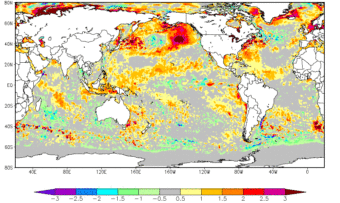
A map of sea surface temperatures from Sept. 19th shows the blob below Alaska. (Graphic courtesy of NOAA)

The Blob is back. The term was coined a few years ago to describe a warm patch of water in the Gulf of Alaska and northern Pacific Ocean. It can turn the weather warm and dry in the state.

Brian Brettschneider is a climatologist in Anchorage who closely tracks Alaska climate data and trends. Alaska’s Energy Desk is checking in with him regularly for the segment- Ask a Climatologist.

Brettschneider says earlier this year, it looked like the Blob was gone, but that wasn’t quite right.

Interview Transcript:

Brian: It’s always been there, it’s just been hovering below the surface, so if you looked at sea surface temperatures, it kind of looked like it was getting back to normal, but all that warmth was just kind of pushed down a little bit and now it’s making its way back to the surface. And it really looks like the blob again.

Annie: And when you look at a map of this, it’s really striking, can you describe it?

Brian: When you look at these maps of sea surface temperatures- the ones that have been released the last few weeks- they really show this very pronounced warm water anomaly sitting just south of mainland Alaska in the Gulf of Alaska. Of course the colors they use in the maps in general for above normal conditions are red, so you have this red circle sitting below Alaska and it really does look like a blob.

Annie: What effect does this have on Alaska?

Brian: When there’s warm waters that surround Alaska it really promotes warm surface temperatures in the state. It also affects the upper level patterns. The last time the blob was this pronounced we had a strong upper level high pressure that set up and that really kept us dry. And then to the downstream side of that in Canada and the northern part of the lower 48, that actually drove their winds, made [them] come from the North, so it made it colder and snowier over there. But over here, in our part of the world, it promoted above normal temperatures and below normal precipitation.

Annie: And what is the connection between the blob and global warming?

Brian: Global warming, I like to say, adds a baseline. It’s like a background noise that gets slightly louder every year. But the blob is something that sits on top of that. So for example, at some point in the past, a blob pattern may have only been two or three degrees above normal, whereas now its four or five, maybe six degrees above normal. So it’s just something that adds on to the background conditions.

Man on a mission: Gov. Walker and the gas line

Bill Walker, fifth from left. As a Valdez City Council member, Walker traveled with a delegation from the Organization for the Management of Alaska Resources (later the Resource Development Council) to meet with California Gov. Jerry Brown to advocate for a gas line, 1977. (Photo courtesy of Bill and Donna Walker)
In 1977, as a Valdez City Council member, Walker traveled with a delegation from the Organization for the Management of Alaska Resources to meet with California Gov. Jerry Brown. (Photo courtesy of Bill and Donna Walker)

The announcement this summer that Alaska will pursue a state-owned natural gas pipeline is a major U-turn after more than a decade of negotiations with the big three North Slope oil companies.

But one person has been advocating this approach all along: Bill Walker.

For years, Walker argued the state should take control of the project, instead of putting its faith in the industry.

Then, he became governor.

This week, Alaska’s Energy Desk is exploring the the state’s 40-year quest for a natural gas pipeline in the series Pipeline Promises.

Today, we look at Gov. Bill Walker’s decades-long mission to build a gas line.

About a year ago, Gov. Bill Walker stood before reporters, addressing his most recent dust-up with the state’s oil companies.

In a moment of exasperation, he said, look. This is about Alaska’s future.

“It has to do with controlling our destiny, and not allowing somebody else to control our destiny,” he said in a press conference before the legislature’s special session on the gas line. “I stand firm on that principle.”

This is the heart of the Bill Walker philosophy: this gas line, this “piece of pipe,” as he calls it, is central to Alaska’s destiny, and it is never going to get built unless the state takes charge. We simply cannot leave it to the oil companies, he argued.

Now, Alaska has a chance to test that theory.

For the man in the driver’s seat, the seeds of this philosophy were planted almost fifty years ago, with the state’s other pipeline – the oil pipeline.

“I graduated from high school in ’69 in Valdez, and I could not afford to go to college,” Walker said in a recent interview. “I mean, there was no way I could afford to go to college.”

Bill Walker during college. (Photo courtesy of Bill and Donna Walker)

What saved him, he said, was early work on the trans-Alaska pipeline. He still remembers getting his dispatch – the piece of paper calling him up for a job on the project.

“I’ve gotten a number of degrees in my life, and I can’t tell you a single name of the person that gave me [them],” he said. “But I can tell you the name of the person who gave me that dispatch. His name was Jim Robinson, it was at the Johnson Trailer Court in Valdez, and I stood there with a couple of my buddies, and I thought, ‘This is my ticket, for my future.'”

Walker says what the last pipeline meant to him, the next line could mean for a whole new generation. Jobs, of course. Revenue for the state. Cheap energy that could launch whole new industries. New incentive for companies to explore the North Slope.

His first encounter with the gas line came a few years after that moment in the Valdez trailer court. Walker was in his mid-20s. He’d just met his wife, and he was serving on the Valdez City Council.

“And the mayor said, ‘who wants to work on the gas line?'” Walker said. “I said, ‘well, I’ll work on the gas line. I worked on the oil line, so I’m happy to work on the gas line.'”

He ended up traveling to California to meet with then- (and now-) Gov. Jerry Brown to advocate for an Alaska LNG line to ship gas to the West Coast. That version of the project, like so many after it, fizzled. But Walker stayed involved in oil and gas — and often found himself at odds with the state’s dominant industry.

In the late 1990s, the gas line came back into his life. He was called to a meeting of mayors from the North Slope, Fairbanks and Valdez. They had formed a group called “Gasline Now!”

“[They said], what can we do to add a few more percentage of return to the gas line, so the producers would build a gas line?” Walker said.

The idea was to jump-start a project by using the local governments’ tax-exempt status to try to tempt the oil companies to the table. The result was the Alaska Gasline Port Authority (AGPA).

Then-Valdez Mayor Bill Walker congratulates Alyeska's Marine Terminal manager on the arrival of the one billionth barrel of oil, 1979. (Photo courtesy of Bill and Donna Walker)
Then-Valdez Mayor Bill Walker congratulates Alyeska’s Marine Terminal manager on the arrival of the one billionth barrel of oil, 1979. (Photo courtesy of Bill and Donna Walker)

Walker ended up working with the Port Authority for more than a decade, trying to advance what he called an All-Alaska Gasline. (During this time, he also represented the City of Valdez in a long-running court battle with the North Slope producers, arguing the companies had undervalued the trans-Alaska pipeline in order to pay lower property taxes.)

Craig Richards went to work for Walker as a 27-year-old lawyer in the early 2000s. He went on to become Walker’s law partner, confidant and ultimately his first attorney general.

“Bill wasn’t doing academic papers. Bill was doing the real deal, he was meeting with Fortune 500 companies, and having real meetings about ways to monetize the gas. It was just very enticing,” Richards recalled.

He said the Port Authority years taught Walker several things. There were moments when Walker thought he’d pulled it off. He brought in big outside companies, like the California utility Sempra Energy, or Mitsubishi, who were interested in a project. They’d reach out to the North Slope companies who controlled the gas.

But, Richards said, “Phone never rang. Dead silence.”

“The answer of course, is that producers weren’t interested at that stage in making a pipeline happen,” Richards said. “They were interested in accomplishing other goals.”

Goals like using gas line negotiations with the state to lock in their oil and gas taxes and a friendly regulatory regime, Richards said.

Critics say the Port Authority never put together enough of a project to merit a real response.

But Richards said for him and Walker, the lessons were clear: The oil companies have their own priorities and their own timeline. If the state wants a gas line, it can’t wait for the companies to lead the way.

“One, he decided that he needed to be governor, if he was going to really see the gas line go to the next phase. And that was the beginning of his political ambitions,” Richards said. “And two, he realized it’s gotta be the state of Alaska that does this. At least in terms of the pre-development work.”

In 2010, Walker ran against then-governor Sean Parnell in the Republican primary, with the gas line as his main issue. An ad from that era features Walker speaking to the camera: “Folks ask me if I’m a one-issue candidate, and I’ll admit and it’s certainly no secret, I am committed to Alaskans building an all-Alaska gas line,” he says.

He lost that year, but ran again in 2014, as an independent. By then, Parnell and Republican lawmakers were advancing a new plan, a partnership with the big three North Slope producers –  ExxonMobil, BP and ConocoPhillips – as well as the pipeline company TransCanada: the Alaska LNG project.

Bill Walker was not a fan.

“The fatal flaw of what [Parnell] is doing is, again, again, he has put control of Alaska’s future in the hands of companies that have competing projects around the world,” he told KTVA’s Rhonda McBride in an interview in May 2014.

Gov. Bill Walker 2015 02 19
Gov. Bill Walker at a press conference Feb. 19, 2015. (Photo by Skip Gray/360 North)

Then, the unexpected happened: Walker won the election.

Former Anchorage Daily News reporter Bill White has researched the history of the gas line. I asked him if Walker’s single-minded pursuit of a state-owned project is his white whale – his Moby Dick.

White: It’s his big obsession, for sure. Remains to be seen if it’s his white whale.

Alaska’s Energy Desk: Why?

White: Well, maybe he’s right. I wouldn’t bet on it, but maybe he’s right.

Now, Walker has a chance to prove it.

When he took office, oil and gas prices were plunging. Suddenly Alaska faced a massive revenue shortfall, and Walker was more convinced than ever that a gas line is the solution.

Low prices also created an opening, changing the dynamics of the Alaska LNG project Walker had inherited from Parnell.

On February 9, 2016, the state’s three oil-company partners sat down with Walker’s team.

“It was a day I’ll never forget,” Walker said.

According to both the governor and ExxonMobil, the companies told him that lousy market conditions and slow negotiations with the state meant they probably couldn’t move the project ahead as planned.

They proposed either slowing down or letting the state take over.

For Walker, this was his moment. And he seized it.

“I thought, my goodness. How long have we waited for this opportunity,” he said. Within months, his administration had announced it would pursue a state-owned project.

For many Alaskans, news that the big three oil companies have stepped back from the project is a sign the state’s gas line dream has hit another wall. But Walker doesn’t see it that way.

“We have proved over the last forty years what won’t work,” he said. “This is the first time we’ve said, let’s try it, one time, like other sovereigns do around the world.”

It’s not a wall, he said. “It’s a starting gate.”

Site notifications
Update notification options
Subscribe to notifications