Alaska's Energy Desk

One last chance to protest at the end of an era for the Tongass

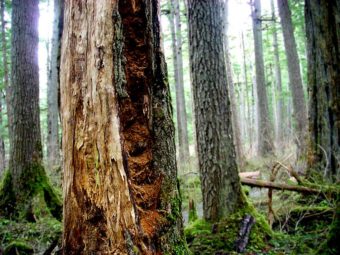
Part of the Tongass National Forest in April 2008. (Creative Commons photo by Xa’at)

The federal government is getting close to finalizing a plan that could shape the future of timber in the Tongass National Forest. Various stakeholders have given input through the years. But if the objection letters are any indication, several agencies and groups are still not content — for different reasons.

Buck Lindekugel has been spending a lot of his time with maps. They’re color coded to show which areas of the Tongass are suitable for timber harvests. And which areas are prioritized for conservation.

“But most of my time has been looking at these heavy books,” he said.

Forest Service books that outline how much timber is harvested from the Tongass.

The agency is expected to finalize a plan for the national forest this winter. Lindekugel is the grassroots attorney for the Southeast Alaska Conservation Council or SEACC. And although the planning phase is almost over, the organization still has issues with what’s left of the table. Namely, so many old growth trees.

Lindekugel says it’s not exactly clear where those trees can be cut down.

“And we think that lack of clarity is going to create confusion … Are they going to be logged or not logged? There’s ambivalence here in the maps,” Lindekugel said.

SEACC isn’t the only organization that thinks the plan needs more work. The forest service received more than two dozen objection letters. Most of the criticism is from timber industry groups that say the plan transitions away from logging more valuable old growth trees too soon.

And to address those concerns, the forest service is trying something new. It’s inviting its biggest critics to come together for one last series of hearings. One of those critics is the state of Alaska.

“Some would describe this as a battle almost among certain groups,” said Chris Maisch, a state forester.

Alaska’s Department of Natural Resources is another agency that doesn’t agree with how the Tongass plan has come together. He says the sixteen year transition period doesn’t give the industry enough time to adapt.

Milling young growth trees requires different equipment.

“And no one is going to make that kind of investment if they’re not certain they have a log supply they can depend on. And unfortunately right now, that’s not the case,” Maisch said.

Recently, a controversial timber sale on Kuiu Island didn’t receive a single bid. All of the wood was approved for export, meaning the logs wouldn’t likely go to Southeast mills.

Buck Lindekugel from SEACC says that makes the point that the timber industry has already transitioned. 20 years ago, it employed about 5,000 people.

“It used to be a main driver. There’s no question that for decades it was. But that industry couldn’t compete in today’s market,” Lindekugel said.

He thinks that’s due in part to Alaska’s remoteness. Tourism, not timber, is the region’s main economic driver.

But Chris Maisch, the state forester, says even though there’s less than 400 jobs left in the industry, he still sees the potential.

“Well, it is worth saving because I think everyone in the state is keenly aware of the financial state the state finds itself, and we need to do everything we can to diversify the state’s economy,” Maisch said.

The forest service is holding its Tongass objection meeting this week in Ketchikan and next in Juneau. Both Maisch and SEACC say they’re not sure what — if anything — will change.

Walrus return to Point Lay — but this year, they’re late

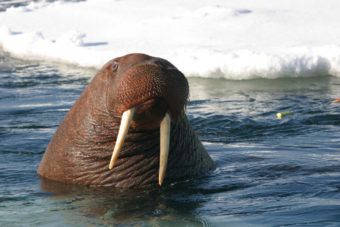
A young Pacific Walrus bull in coastal Alaska waters. (Photo by Joel Garlich-Miller/USFWS)

About a thousand walruses are hauled out on a barrier island near the village of Point Lay, about 180 miles southwest of Barrow.

The haul out is part of an unnerving trend. This year marks the eighth time in a decade that large numbers of walruses have crowded onto land in the area. The animals have been driven to shore as sea ice retreats, limiting access to their usual feeding grounds.

But this year’s haul out — so late in the fall — was a surprise.

Andrea Medeiros is a spokesperson for the U.S. Fish and Wildlife Service. She said scientists were pretty sure it wasn’t going to happen this year. Then, she said, “Next thing I know, I get an email from one of our biologists saying, ‘The walruses are hauling out,’ and I’m like, ‘Ahh!'”

Residents in Point Lay contacted the Fish and Wildlife Service with the news Friday morning.

Medeiros said the haul out is forming about a month later than in the past. Usually at this time, walruses are heading south to Russian waters for the winter. And although sea ice receded to its second lowest level on record this summer, there was lingering ice over the walruses’ traditional feeding grounds.

The Fish and Wildlife Service and the Native village of Point Lay are asking people to stay away from the area during the haul out to avoid disturbing the animals and causing a stampede.

“The risk there is when they are onshore and the animals get spooked, the larger animals will flee to the water and crush the small animals in the process,” Medeiros said. “So it leads to a lot of preventable mortality.”

Biologists are continuing to monitor the haul out as it forms. In the past, up to 40,000 animals have gathered in the area.

Conoco aims to up North Slope production with new drilling rig

06ConocoDrillRig_Harball
Conoco’s new Extended Reach Drilling Rig will allow the company to access more from a single drill site (Image courtesy ConocoPhillips Alaska)

ConocoPhillips Alaska has announced plans for a new drilling rig on the North Slope that will more than double the area it can develop from a single drill site.

The company is calling it a “potential breakthrough” and said the rig will increase production by making development possible in areas that are currently hard to reach.

It will allow Conoco to access an undeveloped field, Fiord West, from existing infrastructure. Fiord West was discovered in 1996.

Conoco spokeswoman Natalie Lowman said the state would not have extended the company’s Fiord West leases without the contract for the new rig.

“In order to retain our leases, such as those around Fiord West, we have to be able to develop them, and the (extended reach drilling) rig allows us to do that,” Lowman said in an email.

Gov. Bill Walker said in a statement, “I applaud ConocoPhillips and Doyon for their work to spur production during fiscally challenging times. This is welcome news, as it fulfills lease terms for Fiord West.”

ConocoPhillips signed a contract with Doyon Drilling, which is under the Fairbanks-based regional Native corporation, to build the new rig.

It will arrive in Alaska in 2020.

Lowman said under the terms of the contract with Doyon, the company can’t release the rig’s total cost.

In Asia, Walker’s gasline team gets audience but no deals

Alaska Gasline Development Corporation President Keith Meyer, Alaska Gov. Bill Walker and Department of Natural Resources Commissioner Andy Mack discuss meetings with potential buyers of Alaska’s LNG during a press conference on Friday Sept. 30, 2016 in Anchorage, Alaska. (Photo by Rashah McChesney)
Alaska Gasline Development Corp. President Keith Meyer, Alaska Gov. Bill Walker and Department of Natural Resources Commissioner Andy Mack discuss meetings with potential buyers of Alaska’s LNG during a press conference on Friday in Anchorage. (Photo by Rashah McChesney/Alaska’s Energy Desk)

Gov. Bill Walker and several of his energy advisers returned this week from a journey to Singapore and South Korea.

The trip comes as the state’s lead partners, ExxonMobil, BP and ConocoPhillips, are backing out of the Alaska LNG megaproject the state is preparing to take over.
Walker says over the last 10 days, his team had 20 meetings with ambassadors from Japan, Qatar, Singapore and others.

They’re working to raise awareness and market the $45 billion to $65 billion Alaska LNG project.

And, while they didn’t return with any firm commitments to buy into the project, Alaska Gasline Development Corp. President Keith Meyer said the team made progress.

“I would say we moved the ball quite a bit. Now we didn’t sign MOUs (memorandums of agreement) and we’re a little ways from that. What we’re doing now is raising awareness. Also correcting, as the governor indicated, correcting some misperceptions out there that the project had stopped. There were some bad headlines preceded us,” Meyer said.

As the state seeks buyers for North Slope natural gas, it must also continue with the regulatory process of permitting the massive project. And it’s unclear exactly how much that’s going to cost the state.

Meyer said the team is working on budget scenarios for different levels of activity, including further engineering work. Though, he says that work takes a lower priority to getting permits and finding funding for the project.

Walker said he confirmed in several meetings that it’s still possible to complete the project by 2025.

Walker and Meyer are aiming to get firm commitments and contracts from buyers within a year.

It’s unclear if the state will move into the next phase of the pipeline, which would require financing an estimated $2 billion in final engineering and design plans.

The state’s financial resources are strained with multibillion-dollar deficits and it’s unknown if the legislature would continue appropriating funds for the project.

But Walker said he thinks the legislature is just as focused on selling the state’s gas as his administration.

“Given our financial situation, some have said, ‘Can we really afford to do this?’” he said. “And I guess, I’d say, ‘Can we really afford not to do this?’”

Walker plans to be in Asia again in November to speak in Tokyo.

Ask a Climatologist: Long temperature streak ends

(Graphic by Brian Brettschneider)

For the first time since February, the statewide temperature index for Alaska dipped below normal earlier this week. Sunday and Monday were both slightly below normal, interrupting a 218 day stretch of above normal temperatures.
Brian Brettschneider is a climatologist in Anchorage who closely tracks Alaska climate data and trends. Alaska’s Energy Desk is checking in with him regularly as part of the segment, Ask A Climatologist.

Brettschneider told Energy Desk editor Annie Feidt that the below normal temps didn’t last long.

Transcript: 

Brian: The mid and long range forecasts are indicating we’re going to go right back to an above normal situation, so it’s a brief respite from the long trend of above normal temperatures.

Annie: And when you look at that long trend, what do you see?

Brian: Well we see that there’s been a regime shift in the last few years, where we’ve been above normal the vast majority of the time. It’s been especially acute this year. So there’s really no way to envision where 2016 isn’t the warmest for Alaska by a wide margin.

Annie: What do you mean regime shift?

Brian: So beginning in June 2013, we saw a shift toward a warmer temperature regime. And there’s a lot of reasons that’s happened and a lot of reason we don’t know why it’s happened, largely probably a result of the Pacific Ocean water temperatures and circulations, but since mid-2013 we’ve been way above normal for extended periods of time, only broken occasionally by short duration below normal stretches.

Annie: And when you talk to your colleagues who are looking at Alaska and also seeing that, what reaction do you get?

Brian: It’s a sense of alarm, because the arctic in general is considered the canary in the coal mine, with reductions in sea ice, shorter periods of snow cover, the global temperature shifts are magnified in Arctic areas, so what we see going on in high latitudes can be a harbinger of the acceleration of temperature regime changes globally.

Fishermen, state, in flux after circuit court overturns state control of Cook Inlet salmon

United Cook Inlet Drift Association Vice-President Erik Huebsch talks about a court ruling in his commercial fishing organization’s favor on Sunday, Sept. 25, 2016 in Kasilof, Alaska. (Photo by Rashah McChesney/Alaska’s Energy Desk)
United Cook Inlet Drift Association Vice-President Erik Huebsch talks about a court ruling in his commercial fishing organization’s favor on Sunday in Kasilof. (Photo by Rashah McChesney/KTOO-Alaska’s Energy Desk)

In Cook Inlet, managing the salmon runs for commercial, sport and subsistence interests is so controversial, it’s often called a fish war.

A group of commercial fishermen who think the state is mismanaging the fisheries, have won the latest battle.

A three-judge panel at the U.S. Ninth Circuit Court of Appeals ruled last week that the area needs federal oversight. But no one knows exactly what that will mean.

The United Cook Inlet Drift Association and the Cook Inlet Fishermen’s Fund say that instead of addressing habitat problems or fighting invasive species that eat salmon in Cook Inlet – the state simply restricted commercial fishing.

So the fishing groups sued the National Marine Fisheries Service. They argued against a 2011 decision to remove several Alaska salmon fisheries — including Cook Inlet — from federal management and transfer the responsibility of managing salmon to the state.  A three-judge panel of the U.S. Ninth Circuit Court of Appeals agreed.

For commercial fishermen like Brian Harrison, in Homer, the court’s decision is a victory. But, he’s not sure what to expect going forward.

“I think we are as in the dark as anyone else. The layman drifters here in Homer. We are hopeful that this will be a place to start to help turn around this fishery and to manage this resource in a way that science tells us is the best way to manage it and not politicians,” Harrison said.

Harrison’s not the only one in the dark. Federal and state fisheries managers will have to work together on a new plan for how to manage the various fisheries.  But, no one is sure what that plan will look like.

“The United States has made it very clear they don’t want to manage salmon. The state has made it very clear that we don’t need the U.S. government to help us manage salmon,” said Alaska Department of Fish and Game commissioner Sam Cotten.

Fish and Game is responsible for day-to-day management of the state’s fisheries.  There is a federal fishery management plan for most of the state, but Cook Inlet, Prince William Sound and Alaska Peninsula salmon fisheries are specifically excluded from that plan. 

Now that a new plan has to be written to include Cook Inlet, it’s not even clear which fishermen are going to be covered under it.

Typically federally fishery management plans don’t include sport or personal use fishing. But because salmon spend their lives in rivers and in the oceans, federal oversight could expand to include them both.  

Cotten said, he doesn’t know which groups will be covered under a new plan.  

“There’s a lot of unanswered questions before we even get to the design of a management plan,” he said.

He said, the National Marine Fisheries Service, or the state, could appeal. 

He doesn’t think there will be a new management plan in place in time for next summer’s fishing season. And, it’s not clear if the ruling allows the state to continue managing the fisheries without a federal plan.

“We do not want to have any areas closed. Most of the area that the people drift in, is federal waters,” Cotten said.

Erik Huebsch, Vice President of the United Cook Inlet Drift Association,  said his group wants to see the state continue to manage the fisheries — but under federal guidelines.

No matter what’s next, Huebsch said he thinks federal oversight will simplify salmon management and that might help calm Cook Inlet’s fish wars.

“It’ll level the playing field, everyone will have the same set of rules to play by. I think that will go a long way to calming some of the angst and some of the contention that goes on over resource management in this area,” he said.

Federal fisheries regulators said developing a new plan could take years. 

Site notifications
Update notification options
Subscribe to notifications