Alaska's Energy Desk

For this Anchorage Republican, Johnson trumps Trump

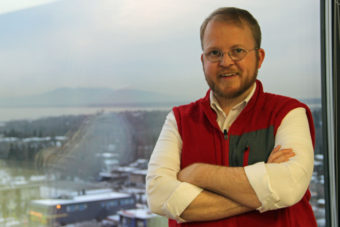
A self-described “progressive Republican,” Sam Moore voted for Mitt Romney, John McCain and George W. Bush. But this time around, he says he can’t support Donald Trump. He’s voting for Libertarian Gary Johnson, instead. (Photo by Rachel Waldholz, Alaska’s Energy Desk – Anchorage)
A self-described “progressive Republican,” Sam Moore voted for Mitt Romney, John McCain and George W. Bush. But this time around, he says he can’t support Donald Trump. He’s voting for Libertarian Gary Johnson, instead. (Photo by Rachel Waldholz/Alaska’s Energy Desk)

Libertarian vice presidential candidate Bill Weld is stumping in Anchorage this week. Weld is running with Gary Johnson, the former New Mexico governor and two-time Libertarian presidential nominee. Weld himself is a former governor of Massachusetts.

Recent polls show the ticket pulling anywhere from 7 to 18 percent of the vote in Alaska.

One of those voters is 31-year-old Samuel Moore, of Anchorage. Moore is a financial analyst who’s active in local Republican politics. But while he voted for Mitt Romney, John McCain and George W. Bush, he says he can’t support Donald Trump.

You can find our other interviews with Alaska voters here:

In Anchorage, a Trump supporter keeps the faith

In St. Paul, this Alaskan vows ‘Never Trump’

Young Clinton fan ‘totes’ her support

For this Anchorage Republican, Johnson trumps Trump

For Trump supporter, Clinton presidency raises fears of ‘last days’

Video: Below ground in the Fairbanks permafrost tunnel

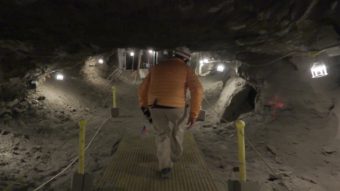
Ancient microbes, unusual ice structures, mammoth bones — there’s a lot happening below the surface in the Fairbanks Permafrost Tunnel Research Facility. The underground laboratory, operated by the Army Corps of Engineers, is kept at a constant 27 degrees Fahrenheit. Environmental science researcher Dr. Andrew Balser leads a tour of the facility and discusses the research taking place there.
Ask a Climatologist: In Anchorage, first snow is right on schedule

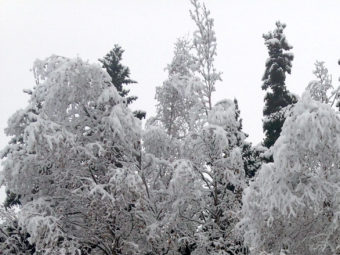
Anchorage was blanketed in snow on Oct. 21st, 2016. (Photo by Elizabeth Harball/Alaska's Energy Desk)
Anchorage was blanketed in snow on Oct. 21st, 2016. (Photo by Elizabeth Harball/Alaska’s Energy Desk)

The first snowfall in Anchorage came nearly right on schedule. On average, the city has at least a trace of the white stuff on October 16th, four days earlier than the date of this year’s first snow.

Anchorage climatologist Brian Brettschneider keeps track of first snowfalls around the state, along with lots of other climate data. Alaska’s Energy Desk is checking in with him regularly as part of the segment, Ask A Climatologist.

Brettschneider says in Anchorage, the first snow isn’t likely to have staying power.

Interview transcript:

Brian: Typically when we get snows in mid to late Oct., usually they will melt out. We don’t usually get our winter snow pack to set in until Nov. 10th in Anchorage. So only about 40 percent of the time when we have snow set in on these dates in Anchorage will it hold on and last throughout the entire winter. So usually it will melt off and we’ll have to start over.

Annie: How does the timing of our first snowfall stack up to normal?

Brian: Typically the first snow is on Oct. 16th and this year it was on Oct. 20th. We actually had two tenths of an inch right before midnight on Oct. 20th, so even though most of it was on Oct. 21st, it goes down in the books as being on Oct. 20th. So that’s four days behind schedule.

Annie: Pretty right on.

Brian: It’s pretty close. If you’re within a week, I would consider that to be right on schedule.

Annie: And what about the rest of the state?

Brian: Most of the rest of the state is on average, pretty typical. Fairbanks was late, they were 19 days late, but Juneau was 19 days early. Places like Bethel, they haven’t had a snow yet, King Salmon, they haven’t had a snow yet, so they’re pretty behind.

Annie: So for those of us in Anchorage who like to ski, should we be excited that this is a sign that this winter will be a snowy one?

Brian: No, you should not be excited because there’s almost no correlation between when the first snow occurs in Anchorage and what the rest of the winter looks like. Two years ago we had our worst, lowest snow winter on record- we had three inches of snow the first week of October. And so everyone was thinking, ‘oh this is going to be a good snow year,’ and it turned out to be the worst ever. So if you look at the numbers over time, there’s very, very little correlation between when the first snow occurs and what the final total for the season is.

Dutch Harbor remains nation’s top fishing port

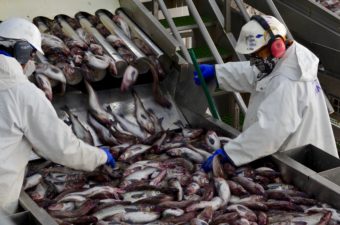
Workers inspect fish unloaded at Unalaska's UniSea plant. (Sarah Hansen/KUCB)
Workers inspect fish unloaded at Unalaska’s UniSea processing plant. (Sarah Hansen/KUCB)

On dinner tables across the country, Americans are eating more fish. The United States is responsible for more fish consumption than all other countries, except for China.

An annual National Oceanic and Atmospheric Administration report shows Americans added almost one pound of fish to their diets in 2015.

For the 19th consecutive year, the port of Dutch Harbor is America’s largest fishing port, hauling in 787 million pounds of seafood. That’s the most seafood ever brought into one port — and more than 250 million pounds above the next port, Kodiak.

(Courtesy NOAA Fisheries)

The $218 million haul is mostly thanks to the large volume of pollock from the Bering Sea, as well as crab and other groundfish.

Frank Kelty was the fisheries analyst for the City of Unalaska, and he says fishing is the community’s main economic engine.

“We have no other main industry,” said Kelty. “Everything feeds off how the fisheries do, and it works its way down through all sectors of the community.”

Although it’s more money than last year, Dutch Harbor’s haul is still behind the nation’s most profitable port, New Bedford, Massachusetts.

As a state, Alaska led the country in volume and value of fish landings — bringing in three times the money and more than five times the amount of seafood as the next largest state.

Glacial fjords home to surprise coral — but maybe not for long

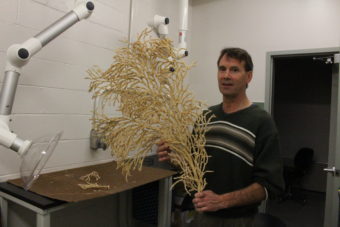
Bob Stone holds a 50 year old red tree coral. (Photo by Elizabeth Jenkins/KTOO)

You might not expect coral to thrive in Southeast Alaska. But it exists in the silty waters of glacial fjords. Now scientists are wondering if the coral, which serves as important fish habitat, could be in danger from an invisible threat — ocean acidification. 

Inside a lab at the National Oceanic and Atmospheric Administration’s Juneau headquarters, Bob Stone is showing me a red tree coral plucked from the bottom of Tracy Arm fjord. This one is dried, the color of ramen noodles.

“If you feel it, it feels like popcorn,” Stone said.

But in the wild, he says it’s an intense red, like the color of salmon roe.

Stone is a fisheries research biologist at NOAA. And — until fairly recently — he didn’t know that coral could exist here.

“Until 2003 nobody did. Or if they did, they weren’t telling.”

Around 2004, someone did tell. Stone was giving a seminar and a person from the audience came up to him. They said they had seen this type of coral in a glacial fjord in Southeast Alaska.

“And I said, ‘no you didn’t’ … and they showed me the specimen and it was indeed that.”

The next year, NOAA received the funding to go see for themselves. Stone had his doubts because red tree coral typically lives far below the ocean’s surface —  in places like the Gulf of Alaska and Bering Sea, at depths of more than 2,000 feet.

Glacial fjords, on the other hand, can be shallow. But its unique landscape replicates the environment of deeper water, so the coral can thrive. For Stone and the other scientists, that was a huge surprise.

“The first time I saw one, I was amazed. I didn’t know what I was looking at,” Stone said. “They’re almost more of an orange color but they’re just a huge reddish orange tree under water. To me, they’re one of the more beautiful animals I’ve ever seen.”

It also serves a very important function. Stone says scientists call the thickets of red tree coral “little forts” because they’re hideout for small species, like fish and crab.

Red tree corals are a focal point of the Deepwater Exploration of Glacier Bay National Park Expedition. These corals have been shown to be the foundation of diverse deepwater communities in Alaska. And can occur as shallow as 6 meters. Here several fish and urchins congregate around a large red tree coral. Image courtesy of NOAA- Alaska Fisheries Science Center and Deep- Sea Coral Research and Technology Program.
Image courtesy of NOAA Alaska Fisheries Science Center and Deep- Sea Coral Research and Technology Program.

But around the same time scientists were discovering just how versatile this coral could be, they were also becoming increasingly concerned about changes in the ocean.

“By the early 2000s, we had recognized the ocean was actually increasing in carbon dioxide level. That ocean acidification was happening,” said Tom Hurst.

He studies the effects of climate change on marine life at a NOAA lab in Oregon. And his primary focus is commercial fisheries in Alaska.

Hurst says, in part, the reason our oceans are becoming more acidic has to do with us.

“Primarily from the burning of fossil fuels,” Hurst said. “So, you’re taking all this carbon that was stored underground in the form of coal and oil. And as we burn it we’re releasing all that carbon into the atmosphere.”

And that becomes carbon dioxide which gets absorbed into the water. Now you’ve got a cocktail for ocean acidification. Still, Hurst says a big piece of the puzzle that’s missing for scientists is what that could mean for marine life.

“We don’t really yet have a good handle on which of those things are going to be affected, how much they’re going to be affected and how those changes are going to ripple through the food web,” Hurst said.

Already, in Washington state, ocean acidification has been linked to oysters not being able to fully develop their shells. As far as we know, that hasn’t happened in Alaska yet.

But scientists have named places like Southeast Alaska and the Aleutian Chain as potentially threatened spots. Hurst says what’s next is figuring out how — not if — ocean acidification will impact different forms of sea life.

Back at the NOAA lab in Juneau, Bob Stone is showing me a baby pollock suspended in a bottle. Typically, the coral helps shield the baby fish from predators.

“This one right here, I actually collected in the coral by hand,” Stone said.

Discovering the red tree coral in the glacial fjords has an added bonus. It makes it easier for scientists to retrieve since it’s in shallow water.  

Now Stone is conducting an experiment to see how much ocean acidification could hurt the coral down the line. It has an easily dissolvable skeleton. And scientists are wondering if the added chemicals in the water could make it harder for the coral to reproduce.

But ocean acidification may not be its only threat. The glacial fjords that are home to this surprise coral are also changing.

“Well, yeah. We now realize that, say for example, in Tracy Arm, that the two main glaciers that are there go up into the alpine, up into the valleys rather, that system will shut off,” Stone said.

When the glaciers disappear, the shallow water coral will, too.

For the first time, Pick.Click.Give. donations take a dip

The Permanent Fund Dividend website prominently features the Pick. Click. Give. program. (Photo by Jeremy Hsieh/KTOO)

It has been a difficult year for nonprofits. The state’s budget is shrinking. Alaskans’ wallets are emptying.

And, for the first time since Alaskans began donating in 2009, the Alaska Community Foundation’s Pick.Click.Give. program saw a drop in donations.

The program allows Alaskans to donate a portion of their annual oil-wealth payments to hundreds of nonprofits statewide.

The people who donated a portion of their Permanent Fund Dividend checks this year were generous. On average, they gave $108 per person, a record high since the program was created by lawmakers in 2008.

But that generosity didn’t make up for the drop in the number of people who decided to donate.

“This was the first year that the program saw a decrease from the year before,” said Jason Grenn, manager of the Alaska Community Foundation’s Pick.Click.Give. program. He’s also an independent candidate for statehouse, challenging Republican Rep. Liz Vazquez for her seat.

Each year, when Alaskans sign up for their PFDs, they have an option to donate $25 or more to hundreds of nonprofit organizations across the state.

And, by most accounts, the program has been successful. Alaskans have given millions to organizations like Catholic Social Services, public media, food banks and Planned Parenthood. This year, nearly $3.2 million was donated to more than 640 nonprofits.

But, that’s down $136,000 from last year.

“I think this year we saw less people giving who maybe realized, ‘Hey, I’m going to maybe need my PFD this year,’” Grenn said.

And, there’s a chance it could get worse for the program, and the nonprofits that depend on it for revenue.

When Alaskans decided to give this year, they didn’t know that Gov. Bill Walker was going to veto half of their dividend checks.

Grenn said that means they could be even less likely to donate next year. He said the Pick.Click.Give. program will emphasize the importance of helping nonprofits, knowing that people might be hesitant to give.

Site notifications
Update notification options
Subscribe to notifications