Alaska's Energy Desk

Warm ocean water leads to heavy rain in Alaska

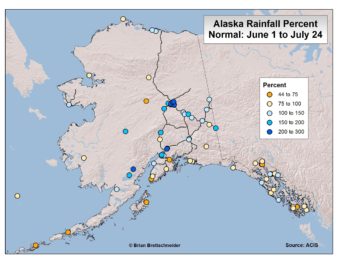
Graphic courtesy of Brian Brettschneider

It’s been unusually wet across a large section of the state this summer.

Brian Brettschneider is a climatologist in Anchorage who closely tracks Alaska climate data and trends. Alaska’s Energy Desk is checking in with him regularly as part of a new segment- Ask a Climatologist.

Brettschneider told Energy Desk editor Annie Feidt that some parts of the state, especially near Fairbanks, have had double their normal rainfall since June. That has been good for tamping down wildfires, but it has its own ties to a warmer world.

Interview transcript:

Annie: Why has it been so wet?

Brian: Well, there’s been a couple of reasons. First and foremost, the ocean temperatures around Alaska have been quite warm, near record warm, and those warm waters provide a nearly endless supply of moisture, much more moisture than is typical for the summer. So when we’ve been having rain showers, all that additional moisture is fuel for these storms and it turns a light to moderate storm into a moderate to heavy rain event.

Annie: At least in Southcentral Alaska, in Anchorage, we haven’t thought of this as a rainy summer. What accounts for that?

Brian: Sometimes the perception can be a little bit different than the reality. So here in Anchorage we had a big rain event in June, over an inch in one day. But even if you back that out, it’s been an above normal rainfall summer. So it’s not just the last few days, it’s not just that one storm, there have been a number of events that have contributed rain and those all add up.

Annie: What about Southeast Alaska, are they in the same boat?

Brian: The switch has been flipped a little bit from the first half of the year. The southern Alaska coast and Southeast were quite wet from January though May. But this summer so far, they’re all below normal for precipitation.


Moody’s downgrades Alaska credit rating; fourth downgrade this year

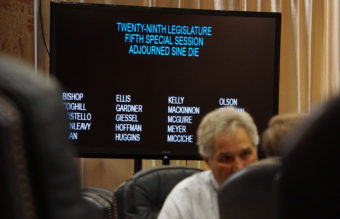
Sens. Pete Kelly, R-Fairbanks, and Charlie Huggins, R-Wasilla, linger after the Senate adjourned sine die, July 18, 2016. (Photo by Jeremy Hsieh/KTOO)

Moody’s Investors Service has downgraded Alaska’s credit rating for the second time in six months, citing the state’s massive budget deficit and its failure to find a long-term political solution.

In a report released Monday, Moody’s wrote that Alaska’s savings accounts will buy the state “several more years” to figure out its fiscal future. But, analysts wrote, the downgrade reflects the state’s “political inability — at least for now” to address the budget challenges brought on by lower oil prices.

The announcement came just a week after the legislature gaveled out of an unprecedented fifth special session without voting on the governor’s proposals to overhaul state finances.

It’s the fourth time since January the state has been downgraded by one of the three major ratings agencies. All three continue to warn further downgrades are possible.
Governor appoints Hollis French to oil and gas commission

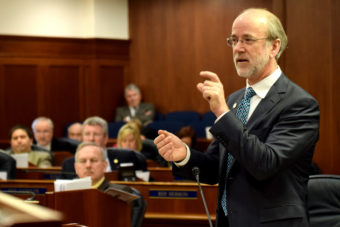
Sen. Hollis French addresses a joint session of the Alaska Legislature during debate about confirmations of the governor's appointees, April 17, 2014. (Photo by Skip Gray/Gavel Alaska)
Sen. Hollis French addresses a joint session of the Alaska Legislature, April 17, 2014. (Photo by Skip Gray/Gavel Alaska)

Gov. Bill Walker has appointed Hollis French to the Alaska Oil and Gas Conservation Commission, or AOGCC. French, a Democrat from Anchorage, served in the Alaska Senate for 12 years. Now he’ll oversee regulation of the state’s oil and gas industry.
The third seat on the AOGCC is designated to a member of the public who is familiar with oil and gas. French says some of his legislative colleagues may be unaware of his background.

“I started my oil and gas career washing pots and pans on an oil rig in Cook Inlet, and the company that ran that platform, Shell, decided to train me to be an operator,” French said.

That’s the person who runs the turbines, pumps and compressors after the oil comes out of the ground. French also worked on the North Slope. In all, he says he spent 18 years working in the industry.

Previously, Gov. Walker appointed Michael Gallagher to the commission. But Gallagher wasn’t confirmed by the legislature. And come January, French will also need enough legislative support to keep his seat.

But French says he’s not worried about his appointment seeming political.

“Really, I have gratitude towards the industry,” French said. “I used my oil industry days off to get an undergraduate degree. I used my oil industry earnings to go away to law school, and so I think that they’ll see we have a lot in common.”

French starts his new job as an AOGCC commissioner on Monday.

North Slope records fall with ‘unprecedented warmth’

(Graphic courtesy Brian Brettschneider)

Climate change is a daily reality in Alaska. Those changes are happening across forests, tundra, in the Arctic ocean and in your backyard.

Brian Brettschneider is a climatologist in Anchorage who closely tracks climate data and trends in the state. Alaska’s Energy Desk is going to be checking in with him regularly.

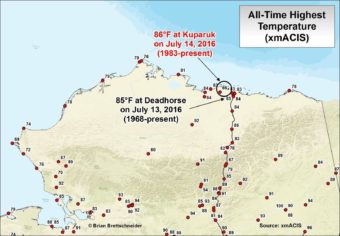
Two all time temperature records were set on the North Slope on July 13 and 14. Deadhorse hit a record high of 85 degrees on July 13, exceeding the previous record by 2 degrees. The next day, Kuparuk recorded a temperature of 86 degrees.
“That is the highest temperature ever recorded in Alaska within about 50 miles of the Arctic ocean,” Brettschneider said. “So really unprecedented warmth for Alaska.”

The normal for Alaska’s northern coast is the mid to upper 50s. Brettschneider calls the last few years in Alaska “relentlessly warm.”

“In 2016, only one day in the entire year has been below normal and that was only a very small amount,” Brettschneider said. “So the temperatures have been warm from basically last Christmas onward and it’s really been peaking in the last few weeks.”

(Graphic courtesy Brian Brettschneider)

Brettschneider says the seasonal outlooks show it’s going to remain above normal in the state for the foreseeable future.

Lawmakers press on North Slope marketing request

North Slop Drill Rigs at night
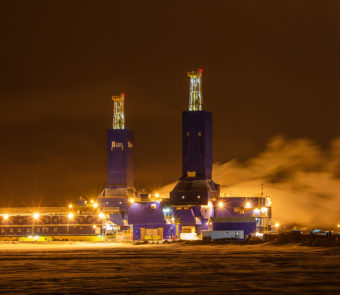
North Slope drill rigs, Dec. 5, 2012. (Creative Commons photo by Kevan Dee)

At a Senate Resource Committee meeting on Tuesday, lawmakers pressed state officials about why the administration is trying to obtain gas marketing information from North Slope oil and gas producers. Gov. Bill Walker has yet to sign off on the oil companies’ 2016 development plan for Prudhoe Bay.

Corri Feige, the director of Alaska’s Division of Oil and Gas, acknowledged it was a new policy. But says it’s within their rights to request the information.

“We are asking for information concerning marketing plans and activities that will result in the commencement of a major gas sale,” Feige said. “And to have those just be adequately explained with anything that is specific and measurable. Are there any timelines that they could share with us at this point in time?”

Feige says the division has a responsibility to make sure there’s “diligence” in the development of the gas. But for some Republican lawmakers, the discussion raised more questions than it answered.

Rep. Craig Johnson, a Republican from Anchorage, thinks the request is a conflict of interest, as the state looks at developing natural gas.

“Until we make a decision how we’re going to take our gas. Are we going to let them market it for us? All we’re doing is asking for a marketing plan from our competitors,” Johnson said. “If I were Wal-Mart and I walked into Kmart and said, ‘Hey, I need to know your marketing plan for the next six years,’ they would throw you out the door.”

BP, ConocoPhillips and ExxonMobil lease the land on the North Slope from the state. The producers have until November to turn in the marketing information. No industry representatives testified at the hearing.

Site notifications
Update notification options
Subscribe to notifications