Alaska's Energy Desk

What killed St. Paul’s woolly mammoths?

A wooly mammoth on display in the Royal BC Museum. (Photo by FunkMonk/Wikimedia commons)
A woolly mammoth on display in the Royal BC Museum. (Photo by FunkMonk/Wikimedia commons)

What killed the woolly mammoths on St. Paul Island? Thirst. For the first time, scientists have pinpointed the date — 5,600 years ago — and a likely cause of extinction. They believe the environmental changes that killed the animals mirror today’s climate changes.

Six thousand years ago, St. Paul Island looked about the same except for one big difference: There were mammoths. And it’s not like they swam there. Penn State University’s Russell Graham says they walked on the Bering Land Bridge.

“As the glaciers melted, the water in the ocean started to rise,” said Graham. “In this process, a group of mammoths was isolated on the island.”

For a while, it was a good strategy for survival. Without predators, mammoths on St. Paul survived thousands of years longer than many other mammoths around the world. But eventually, they met their end. And Graham and a team of scientists wanted to know exactly when that happened.

“We were able to actually pinpoint when the mammoths actually went extinct,” he said. “It wasn’t like, ‘Well, we think it was this time.’ We actually know!”

Graham’s team analyzed a sediment core from a lake on the island. They examined ancient DNA and three species of fungal spores that grow on the dung of large animals.

Matthew Wooller cores Lake Hill Lake, St. Paul island. (Photo courtesy Jack Williams)
Scientist Matthew Wooller cores Lake Hill Lake on St. Paul Island. (Photo courtesy Jack Williams)

All the evidence pointed to one culprit in the mammoths’ extinction: not enough fresh water. As the sea level rose, St. Paul shrunk. Some lakes were lost to the ocean and a more arid climate caused other freshwater sources to evaporate. As island dwellers, Graham says these mammoths were especially vulnerable.

“A change in the climate of the magnitude that caused this extinction on the mainland probably would have been insignificant,” he said. “But because the animals and plants are restricted to the island — and particularly smaller islands — this little change came together with a whole series of things to create a perfect storm that then caused the extinction.”

In the small world of paleoecology, the findings are a really big deal.

“What is especially powerful about this study is that you have completely independent lines of evidence that back up the same story,” said Jacquelyn Gill of the University of Maine.

As an Ice  Age ecologist, she studies the past to put modern-day environmental problems — like climate change — in context. Since climate change and extinction have happened before, scientists can use what they know about various species responses to help protect today’s biodiversity.

Some might say 6,000 years ago is ancient history. But in geological time, it isn’t. While mammoths roamed St. Paul Island, Gill says ancient Egyptian civilization was well underway.

“When you tell someone, ‘You could have had a mammoth-drawn chariot if things had gone differently,’ I think it makes them think a little bit differently about Ice Age ecology and how relevant this work is to the environmental problems we’re facing right now,” said Gill.

The changing climate that claimed the mammoths of St. Paul has struck again. But this time, it’s human-driven. In June, a small Australian rodent became extinct, driving home Graham’s point that island populations are especially vulnerable.

And Graham says it’s not just the rising sea levels that should concern islands and coastal communities. Take a look at Florida.

“They may be waiting for the water to come up and inundate the peninsula,” Graham said. “But in reality, they maybe should be looking behind themselves because they’re probably going to face other issues — like fresh water availability — before that actually happens.”

The vulnerability of island populations is one lesson from the 72-foot-long sediment core. There could be more. Right now, scientists are hard at work analyzing the rest of it — all 18,000 years.

Democrats target their own in state House primary, backing Nageak challenger

Dean Westlake is challenging Barrow Rep. Bennie Nageak in the Democratic primary; in 2014, Westlake lost the race by 131 votes. Photo: Rachel Waldholz/Alaska's Energy Desk
Dean Westlake is challenging Barrow Rep. Bennie Nageak in the Democratic primary; in 2014, Westlake lost the race by 131 votes. Photo: Rachel Waldholz/Alaska’s Energy Desk

Democrats are hoping to take control of the state House this year. To achieve that, they’re gunning for two lawmakers who run as Democrats but largely vote with the Republicans.

One is Rep. Bennie Nageak, D-Barrow, who represents House District 40, which stretches from Kotzebue to Kaktovik.

Listen now

Piles of shoes at the entrance to a Democratic fundraiser for Dean Westlake and Zach Fansler, at the home of oil and gas attorney Robin Brena. The fundraiser was co-hosted by nine House Democrats and former U.S. Senator Mark Begich, among other. Photo: Rachel Waldholz/Alaska's Energy Desk
Piles of shoes at the entrance to a Democratic fundraiser for Dean Westlake and Zach Fansler, at the home of oil and gas attorney Robin Brena. The fundraiser was co-hosted by nine House Democrats and former U.S. Senator Mark Begich, among other. Photo: Rachel Waldholz/Alaska’s Energy Desk

In early August, a who’s who of Alaska Democrats gathered at the home of oil and gas attorney Robin Brena for a fundraiser. Shoes were piled by the door as guests mingled in their socks with former U.S. Senator Mark Begich, among others, eating hors d’oeuvres and taking in the view.

That show of Democratic solidarity and support? It was aimed at unseating two of their own: incumbent state lawmakers Bob Herron of Bethel and Benjamin Nageak of Barrow.

Both lawmakers caucus with the Republican majority in the state legislature, and their colleagues, it’s clear, are fed up.

“I mean, we had Rep. Pruitt say that one of the best Republican members that they have is Ben Nageak,” said House minority leader Chris Tuck, D-Anchorage, citing Anchorage Republican Lance Pruitt. Tuck was one of nine House Democrats who co-hosted the fundraiser. “I just want to have more Democrats, more true Democrats, in the state House.”

Nageak’s challenger, Dean Westlake of Kotzebue, is director of village economic development for NANA, the regional Native corporation for Northwest Alaska. He said he’s running to make sure rural Alaska has a voice in the capital.

“There are a lot of us dissatisfied because the values that we have are not the ones that we see down in Juneau,” he said in an interview.

Westlake ran against Nageak two years ago, losing by just 131 votes.  This time, running with the explicit – and financial – backing of the state Democratic Party, he has high hopes.

Democrats turned out to support Dean Westlake and Zach Fansler, who are challenging incumbent Reps. Bob Herron of Bethel and Bennie Nageak of Barrow. Photo: Rachel Waldholz/Alaska's Energy Desk
Democrats turned out to support Dean Westlake and Zach Fansler, who are challenging incumbent Reps. Bob Herron of Bethel and Bennie Nageak of Barrow. Photo: Rachel Waldholz/Alaska’s Energy Desk

Westlake’s campaign said the fundraiser brought in $6235. (Zach Fansler, who is challenging Herron in House District 38, also raised $5900 at the event.) As of Aug. 9, Westlake’s campaign had brought in a total of $34,864.48, compared with $11,190.11 for Nageak.

If elected, Westlake said, he’d prioritize rural education and community revenue sharing; and he proposed working harder to bring federal money into Alaska villages at a time when state funding for things like water and sewer projects is disappearing.

“One of our values is you always take care of the least of us, and as a representative, that’s what I’d have to do,” Westlake said. “Whoever takes this job, you absolutely have to work with whoever is out there, regardless of party affiliation.”

But the man he’s challenging says the Arctic already has a strong voice in Juneau – his.

“As you probably know, I am a voice that won’t be stopped,” Nageak said in an interview. “And they’re trying to stop me from doing the work I’ve done for the past forty years.”

Nageak, a former North Slope Borough mayor and assembly member, is running for his third term in the state House. He’s co-chair of the House Resources Committee, and he’s known in Juneau for passionate floor speeches, often in defense of resource development and its importance to North Slope communities. In the fight over oil taxes this year, his committee rolled back Governor Bill Walker’s proposal to severely limit tax credits for oil companies.

Rep. Benjamin Nageak, D-Bethel, during debate on the creation of Indigenous Peoples Day, April 1, 2016. (Photo by Skip Gray/360 North)

Nageak is unapologetic about his support for the industry.

“99 percent of the…tax revenues that we get, not only here in the North Slope Borough, but in the state, comes from oil and gas taxes – period.” he said. “So if anything happens to the industry, where are we going to get the money to run the whole state?”

It’s a slight exaggeration: in the years before oil prices fell, up to 90 percent of state general fund spending came from oil revenue

Nageak said he’s disappointed the legislature couldn’t come up with a long-term budget solution this session — and he blamed the gridlock, at least in part, on minority Democrats. But, he said, he’d happily join a Democratic-led majority, if one materializes.

“Who wouldn’t?” he said with a laugh.

The point, he said, is to be in the majority. He pointed to a provision he passed in 2014 which lifted the cap on how much oil revenue the North Slope Borough could devote to government operations — a longtime goal for the region, which he said he couldn’t have achieved in the minority.

One of Nageak’s allies in that fight? Then-Borough Mayor Charlotte Brower, who has since been recalled over the misuse of public money. Nageak defended her during the recall effort this spring, an issue that might come up with Barrow voters.

With no Republican running in House District 40, the race will be decided in the primary on Aug. 16

In Bethel House race, candidates question Democratic cred

If you had to put the two Bethel House candidates somewhere on the political spectrum, they’d both be Democrats. But, maybe with a lowercase “d.”

Each accuses the other of not being Democratic enough.

House District 38 has one of the highest population of voters registered as Democrat. The district encompasses Bethel, the lower Kuskokwim River and several coastal villages.

With no Republican challenger, the race will be decided in the Aug. 16 primary.

Incumbent Bob Herron is running for his fifth term in the legislature. He said he’s been registered as a Democrat since the 1970s, but he votes with the Republican-controlled majority in the House. He’s even joined the Republican leadership team.

Party affiliation doesn’t mean as much in rural parts of the state as it does in urban areas, Herron said.

“When you live in Western Alaska, people vote for the person, not necessarily the party,” he said.

But, his party has had enough.

Democrats are hoping to build a bipartisan coalition in the House, and they see District 38 as key to that effort.

In an unusual move, state Democrats have thrown their support behind a challenger, Zach Fansler, who wasn’t previously registered as a Democrat. Fansler changed his party affiliation the day he filed to be a candidate.

He was either non-partisan or undeclared, though he said he doesn’t remember which.

Fansler’s liberal values align with the Democratic platform — and better reflect the district, he said.

“I’ve always been the person that has been kind of independent,” he said. “It always worried me when we see the exact situation that’s played out. You join a caucus and all of the sudden you are forced to do what they want you to do.”

The district includes more than 30 far-flung communities, from Nunivak Island in the Bering Sea to Russian Mission on the Yukon River and the regional hub, Bethel.

The district has some major challenges.

It’s among the poorest in the state and its schools are some of the lowest performing on the state’s annual exams.

For example, fewer than 10 percent of the Lower Kuskokwim School District students meet state standards for reading and math, according to the state department of education and early development.

In the Bethel census area nearly a quarter of the population lives in poverty, according to the United States Census Bureau.

Herron has a long history in the region. A former Marine, he served as Bethel’s city manager and was a legislative aide for more than a decade.  He also owned Bethel Cablevision and currently owns Golden Eagle LLC, a school bus transportation company.

The best way to represent the district is to join the Majority, Herron said.

“Historically, rural legislators joined whatever majority is, Democratic-led or Republican-led. By joining it you have a better chance of protecting your constituents,” Herron said.

Communities in Herron’s district have seen more than $600 million in capital project funds during his time as a legislator, he said. Programs like power cost equalization would have been harder to defend outside of the majority.

Herron has put the caucus above his district, Fansler said. As a member of the Majority, Herron is  required to  vote with House leadership on the budget, which means opposing amendments from Democrats to restore funding to programs that could benefit his district.

Fansler is a math teacher at the University of Alaska-Fairbanks, an attorney and a former race manager for the Kuskokwim300 sled dog race. He’s currently a city council member in Bethel and works as the development director at Bethel’s public radio station, KYUK.

If elected, Fansler said, then he’ll vote differently, particularly when it comes to what gets cut during tough fiscal times.

“One, I won’t be in the Republican majority,” he said. “So, anytime there’s an amendment that comes forward that said ‘hey, let’s restore funding to Head Start.’ My vote would be yes, let’s do that. Not no, which is what the incumbent did. If there’s a restoration of funding to VPSO programs or to Trooper dispatches, my vote’s going to be yes, not no.”

Fansler will vote to keep money in the state’s revenue sharing program, which helps communities fund basic services, he said.

“If there’s a vote to have other revenue streams. My vote’s going to be yes, not no. Conversely, when it comes to oil tax credits, I’m not going to vote no time and time and time again to rolling those back,” he said.

Fansler is targeting one vote in particular: Herron supported the Legislature’s lawsuit challenging Gov. Bill Walker’s decision to expand Medicaid, which offers health insurance to low income Alaskans.

That vote wasn’t about rejecting the expansion, Herron said. It was about what he considers an overreach of the governor’s power.

The two candidates do agree on some things.

Both say Walker’s budget veto that capped Permanent Fund Dividend checks at $1,000 this year will have a disproportionate impact on the state’s rural residents.

Both are opposed to a statewide sales tax, but say an income tax would spread the burden of paying for state government more evenly.

Shell returns to Unalaska

The Aiviq in Unalaska. Photo: Sarah Hansen/KUCB

UPDATE, 8/8/16:

A fourth vessel associated with Shell’s Arctic efforts has docked in Dutch Harbor. The Nanuq arrived late Friday evening.

ORIGINAL STORY, 8/5/16: 

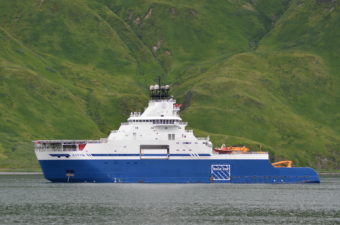
Shell is back in Unalaska. Dutch Harbor was a staging area for Shell’s unsuccessful search for oil in the Arctic Ocean last year. This week, three ships — the Aiviq, the Dino Chouest, and the Ross Chouest — associated with Shell’s Arctic efforts arrived in Unalaska on a mission to remove the last signs of that effort.
A Shell representative says the vessels are “tasked with retrieving more than 50 anchors from the Chukchi and Beaufort seas” and “completing required environmental science monitoring and reporting.”

Meanwhile, a Coast Guard investigation released this week confirms that inaccurate charts are to blame for one of Shell’s major mishaps last summer. The icebreaker Fennica hit a pinnacle of rock near Dutch Harbor, tearing a three-foot hole in its hull and causing the boat to take on water. The original damage was estimated at $100,000 and repairs set back the Fennica’s arrival in the Arctic Ocean by a month.

Coast Guard Lieutenant Rven Garcia said the charts had last been updated in 1935.

“They did have charts, but the actual water depth was significantly shallower than indicated on the chart,” Garcia said. “So the pilot had the proper tools on board, but the chart wasn’t as up-to-date because the survey had not been conducted for that area.”

After the incident, the National Oceanic Atmospheric Administration conducted a new hydrographic survey to map the area.

YCC: Introducing Alaskan kids to the Aleutians and careers with FWS

What happens when five teenagers pile onto a research vessel and go island hopping through the Aleutians in the name of conservation? Science. Education. And maybe a peek into their futures.

It’s all part of an only-in-Alaska version of the federal Youth Conservation Corps or YCC. The goal is to introduce high school students to a stretch of protected land they’ve grown up near, but may not even know exists — all in the hope that someday these young Alaskans will become its next stewards.

Over the course of a season, the research vessel Tiglax can travel 20,000 nautical miles. For a week, five YCC corpsmembers, ranging in age from 16 to 18, join the crew exploring the vast Alaska Maritime National Wildlife Refuge, which stretches from the western end of the Aleutian Chain to islands like St. Lazaria near Sitka and even further north than Point Hope.

“It’s kind of cool being able to be on this huge vessel and have people teach you how they do it,” Aurora Waclawski, 18,  said. “It’s really interesting and awesome.”

She and the rest of the crew grew up in communities around the refuge, ranging from Homer, where she’s from, to Atka. But for most of them, this is the first time they’ve actually traveled through it.

Waclawski heads to college this fall, where she plans to study environmental engineering. The opportunity to explore the Maritime Refuge through the YCC program has been on her bucket list for years.

“Throughout my life, I’ve loved science and all that stuff and that’s kind of why I wanted to do this,” Waclawski said. “It’s cool seeing how this science that I’ve only really seen on paper actually goes on.” Science like surveying seabird colonies, and tracking the reproductive success of puffins on Aiktek.

During a week on the Tiglax, the YCC members see a sliver of the refuge, which provides essential habitat for 40 million seabirds — not to mention marine mammals and other migratory birds — but isn’t exactly a household name in the communities on is borders.

Take 18-year-old crew leader Marieana Larsen. Growing up in Sand Point, she didn’t know much about sea birds. But when she traveled to Saint Paul Island in the Pribilofs for the YCC, she says she finally understood the importance of the refuge.

“We made like 100 rat traps and I thought, ‘this is kind of pointless,'” Larsen said. “And then I thought about it and I was like, ‘oh wow birds are dying. No, rat traps are important.’ Because one rat gets on the island it could destroy all the seabirds and that’s no tourism and that’s no refuge and then people aren’t going to have their cultural foods.”

Larsen will take what she’s learned back to her community. Alongside the crew, she teaches environmental education classes at the annual culture camp in Sand Point.

“Its really fun to do classes with kindergarten through fourth grade and just kind of teach ’em different scientific things about nature because it’s not like they’re learning about it at culture camp,” Larsen said. “They’re learning about the cultural aspects.”

She hopes to bridge the gap — intertwining science with Alaska Native culture and finding more ways to connect kids to their landscape. The YCC crew are paid an hourly wage, with all their expenses covered.

Tiglax captain Billy Pepper said it’s one of the best ways the refuge spends money.

“If you’re going to try and tell somebody that wildlife and the environment is important, it’s harder to convince somebody in their 40s than in their teens,” Pepper said. “And if they get it in their teens they really become advocates for conservation.”

The experience has changed the course of some kids’ lives — giving their ambitions a real-world road test, he said.

“They come on,” Pepper said. “They think they’re going to do something and they’ve got a lot of ambition to do one thing and they’re seasick the whole time. And one kid was going to be a pilot that was the end of that. He couldn’t handle the movement. He didn’t have the make up to do it.”

For some, the experience is more successful. Larson is one of the youngest crew leaders and now, a youth ambassador with the Arctic Council. Since her first time aboard the Tiglax, Larsen slowly has been wiggling her way into the Fish and Wildlife Service, but she’s not the only one. At least four former YCC members have gone on to work for the refuge. Larsen thinks eventually she might like being a Refuge Information Technician or RIT.

“It’s like you’re the middle man for the people they want to talk to and telling them what they are doing on the refuge like with the communities close to it,” Larsen said.

That’s exactly the kind of middle men the program is hoping to create — liaisons between the refuge and the people who live near it. Right now, there is not a RIT position for the Alaska Maritime National Refuge. Staff members know Larsen is interested and said having her stationed in Sand Point representing the refuge is a possibility.

BLM to review new ConocoPhillips project in National Petroleum Reserve

A Doyon drill rig putting in new wells at the ConocoPhillips CD5 drill site on the North Slope. Photo: Rachel Waldholz/APRN

The National Petroleum Reserve Alaska — or NPR-A – was first set aside for oil production nearly a century ago. But it wasn’t until last year that the Reserve produced its first barrels: that’s when ConocoPhillips brought its CD5 unit online.

Now the company is hoping to expand production from the reserve, with a string of new drill sites pushing ever deeper into the NPR-A.

One of those projects — Greater Mooses Tooth 1 — will start construction this winter. And the Bureau of Land Management is launching an environmental review of ConocoPhillips’ most recent proposal — called Greater Mooses Tooth 2.

Listen now

ConocoPhillips first proposed these drill sites over a decade ago, but the development of CD5 ran into a series of obstacles, including negotiations with the village of Nuiqsut over a road through local subsistence grounds. It took ten years to permit and build, starting production last fall.

Now, ConocoPhillips is hoping it’s full steam ahead.

The projects are like stepping stones, each reaching a little further into the National Petroleum Reserve. CD5 sits on Native corporation land right at the edge of the NPR-A. From there, the company plans to build a road to Greater Mooses Tooth 1 — or GMT-1 — which is scheduled to start construction next year.

“And GMT-2 is the next step-out in development,” said Jim Brodie, ConocoPhillips’ project manager for the NPR-A.

Like GMT-1, the GMT-2 site will be a gravel pad with a maximum of about 30 wells, sending oil by new pipelines back to ConocoPhillips’ Alpine facility – and from there, to the trans-Alaska pipeline.

Brodie said the sites are some of the company’s main priorities these days.

“In terms of new development in Alaska, the NPR-A tend to be the most attractive,” he said.

That doesn’t mean they’re cheap. ConocoPhillips officials joke that a billion dollars doesn’t go as far as it used to. The entire Alpine field was a billion dollar development in 2000. Now each new drill site costs about a billion dollars.

That’s largely because of sheer logistics – the further into the Reserve you move, the further from any existing infrastructure, and the more expensive it is.

But ConocoPhillips has also been frustrated by the pace of the permitting process. In July, Alaska’s congressional delegation sent a letter to the Secretary of the Interior, saying, essentially, get a move on.

On July 25, the Bureau of Land Management announced it would start its environmental review, the next step toward approving the project. The Bureau is currently asking the public for input on what it should study.

Stephanie Rice, the project manager for the BLM, said two areas of focus will be impacts on climate change and ensuring the project doesn’t interrupt Nuiqsut’s access to subsistence resources.

“The main subsistence resource is going to be caribou, and making sure roads and pipelines and air traffic do not interfere with caribou migration,” Rice said.

Meanwhile, some conservationists aren’t thrilled with the project. Marissa Knodel is a climate campaigner with Friends of the Earth, in Washington DC. She said the development doesn’t line up with the Obama administration’s commitments on climate change.

“The bottom line is that any new development for oil and gas, like what is being proposed in the National Petroleum Reserve, moves us completely in the opposite direction of where we need to be going in terms of a safe climate future,” Knodel said.

The state of Alaska takes the opposite view: that new oil and gas development is imperative for economic growth and state revenue. And right now, ConocoPhillips’ developments in the NPR-A are among the few potential sources of new oil for the trans-Alaska pipeline.

The public can submit comments on the proposed project here.

Site notifications
Update notification options
Subscribe to notifications