Alaska's Energy Desk

El Nino is out. Will La Nina follow?

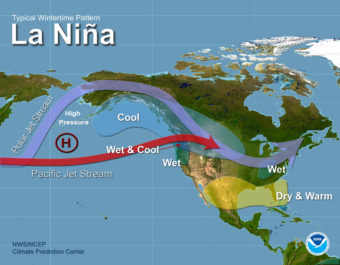
(Graphic courtesy of NOAA)

One of the strongest El Ninos on record ended in May. A strong La Nina would normally follow. But that isn’t a sure bet this time around.

Brian Brettschneider is a climatologist in Anchorage who closely tracks Alaska climate data and trends. Alaska’s Energy Desk is checking in with him regularly as part of a new segment- Ask a Climatologist.

He says both El Nino and La Nina can have a significant impact on winter temperatures in Alaska, but if this La Nina materializes it may be a different story.

Interview transcript:

Brian: We’ve just come out of one of the strongest El Nino’s on record and that’s officially been declared over. And that’s reflected by sea surface temperatures in the central tropical Pacific. Those are now below normal. If they stay below normal for an extended period of time we would then call that La Nina. There’s currently a 60 percent chance, in the latest forecast, that we would enter into an official La Nina.

Annie: What does it mean to be in a La Nina for Alaska?

Brian: If there’s a strong La Nina, Alaska typically experiences cooler temperatures, cooler with respect to normal. If there’s a weak La Nina, that relationship is much less pronounced. So if it is a weak La Nina, we might expect cooler temperatures but there’s so much warmth stored in the North Pacific Ocean it’s going to be really hard to dissipate that warmth, so I’d be surprised if we had a cooler than normal winter.

Annie: What would your guess be (for winter)?

Brian: I’ll defer to official guesses and those official guesses call for a warmer than normal winter- perhaps not record breaking warm, but certainly warmer than we would expect looking at the previous 30 years.

Annie: So some snow?

Brian: Snow is a different beast entirely. The precipitation patterns are much less correlated to the ocean state. So it can be really hit or miss. Last winter, as little snow as there was, it was actually quite a wet winter. And there were avalanches and fatalities and record snow in some spots in the mountains, but not so much down at sea level.

Fire Island Wind sees expansion on the horizon

08182016_fireislandwind_deaton
Crews and visiting journalist check out the first turbine to go up at the CIRI Fire Island wind farm. (Photo by Daysha Eaton, KSKA – Anchorage.)

After years of talks and setbacks, there’s momentum to expand the Fire Island Wind project. The first turbines started spinning on the island near Anchorage four years ago, but a planned expansion has been stalled ever since.

Cook Inlet Region, Incorporated, or CIRI, wants to double the number of wind turbines on Fire Island from 11 to 22. But convincing power companies to pay for its electricity has been hard.

CIRI this week announced it’s nearing a deal with Golden Valley Electric in Fairbanks.

Golden Valley Electric President and CEO Cory Borgeson thinks they can get the power for as low as $56  per megawatt hour — about 40 percent lower than the utility’s average cost of power now.

“It’s not cheap, but we think the benefits of the wind and the reasonable cost that CIRI is providing us [means] it makes economic sense to take a real good hard look at this,” said Borgeson.

Ethan Schutt of CIRI said the talks may be good sign for independent renewable energy producers in Alaska, but he added they’re still fighting an uphill battle. For example, Alaska doesn’t have state-mandated renewable energy targets that power companies have to meet.

“Basically all we have to offer to attract the utilities is the stability of the price and the ultimate price of the delivered power. There’s no other leverage in our system here,” said Schutt.

There’s also the matter of sending power all the way to Fairbanks. Because it moves through other power companies’ territory, it costs more. That’s another sticky issue they’re trying to resolve.

Q&A: DNR commissioner talks about background, Alaska’s resource issues

Andy-Mack-DNR-Commissioner-600x400
Alaska Natural Resources Commissioner Andy Mack at a press conference in Anchorage on June 28, 2016. (Photo by Graelyn Brashear, Alaska Public Media – Anchorage)

The state’s newest Department of Natural Resources Commissioner, Andy Mack, is one of several new additions to Gov. Bill Walker’s cabinet. Here are a few questions that couldn’t be included in the Alaska’s Energy Desk profile of him that ran earlier this week. This interview has been edited for clarity and length.

Alaska’s Energy Desk: The Governor just appointed John Hendrix as the oil and gas advisor, which is a role historically played by the DNR commissioner. What’s the division of responsibility between you, Hendrix and Keith Meyer at the Alaska Gasline Development Corporation?

Mack: I wouldn’t necessarily agree with the fact that the role of oil and gas advisor is historically the DNR commissioner. Every governor has the prerogative and the ability to rearrange their staff how they feel will best suit the needs of the state of Alaska.

The DNR commissioner has very specific regulatory obligations. I think that people shouldn’t forget that there’s some history there and there’s a fairly long history of having people in the Governor’s office with specific oil and gas experience.

Now, with respect to John Hendrix I think, number one, he’s got some incredibly valuable experience that  is very valuable to the Governor.  He has more flexibility than I do though in the sense that he can talk very broadly about policy without worrying as much about the regulatory functions of DNR. So, the distinctions in the roles between myself and John Hendrix are that he doesn’t have a specific regulatory function.

Now, on important decisions, let’s be clear, everybody in the State of Alaska, I think would agree, that the DNR commissioner should be in full consultation with the folks in the Governor’s office.

The second part of the question was on the role and the relationship between the new head of AGDC. It has been discussed quite a bit in the press that the work in the pre-FEED process has been moving along and that that process is, people can see the finish line there and they can see the conclusion of that process. Then really the question is raised well what do we do next?

There was a stage-gate approach which basically said we’re going to walk through this process we’re going to try to work together in an aligned manner and after pre-FEED there are subsequent steps and decisions to be made by the participants in AKLNG.

It’s no secret that not only are there economic headwinds in the oil industry,  but there’s significant economic headwinds in the gas industry too.

There’s been certainly pretty open statements by all of the parties involved and a fairly open discussion about the concerns with being able to move some of the future stages in the AKLNG process.

I think Keith Meyer has been tasked with is ensuring that timing wise the state’s interests are protected. And that we, to the extent possible, move that process along, that project along.

Alaska’s Energy Desk: You’re originally from Soldotna, can you tell me what that experience growing up in Cook Inlet has taught you about resource development there?

Mack: I was born in 1964 in Soldotna and, as a young kid, I had many friends whose families were engaged in the oil and gas industry either as direct employees or as service-side providers.

Nikiski and Kenai and Soldotna and the surrounding areas — it was this incredibly vibrant community and it really was full of hope and a big part of that hope was fueled by this engine, which was driving the local economy.

As I grew up and graduated from Soldotna High School and then went to college, things started to slow down as production waned in Cook Inlet and it got to the point in the 1990s where the economy and production levels were way down the price was was up and down in the 90s. It was actually, for me personally, hard to drive out past Kenai in a sense because there were lots of buildings that had been abandoned where businesses had once operated. People were very uncertain about their economic future and what has been kind of heartening is that a lot of that optimism and a lot of that economy has come back.

But again we’re now in a down-cycle on price so the ability and the willingness of folks to come in and invest in that region again is in question. And I think, I absolutely have personal experiences with that whole region, it’s a little personal to me and it’s very important that we simply understand that as a state what we do financially makes a huge difference.

Alaska’s Energy Desk: DNR identifies a lot of resources, like timber and oil, that the state has available to it for extraction. Are you having these discussions about resources that could be identified in the state that could be used specifically for environmental conservation and not necessarily for resource extraction purposes?

Mack: I think the question is, is there something that’s important enough for the state where they would say this is where we want to go on an issue like that?

So, that would probably have to be an organic conversation among Alaskans.

I think at the end of the day, the administration and the Governor’s going to say what’s in the best interests of Alaska and and that would be kind of the bedrock principle and there’d have to be a very, very forthright conversation about what Alaskans feel is best.

Do they want to extract resources or do they want to extract part of the resource and set aside some of it and that’s really a question for Alaskans.

Historically, the vast majority of Alaskans have come down on the side of – at this point we’d like to extract the resource — but that’s part of the ongoing discussion.  

Alaska’s Energy Desk: What is your vision for oil and gas exploration in the state?

Mack: The ability of the state of Alaska to continue to generate income from oil and gas will be created by our ability to maximize access. We’ve had fairly good access to the areas that we own and we have the ability to lease. I think Alaskans should be very proud of the work we’ve done since oil production began.

As a general rule — it’s not a perfect record — but as a general rule I think we should be very proud of the work we’ve done and the standards we’ve insisted upon as a state in protecting the environment and also ensuring that we maximize production.

There’s tensions between pace and standards but generally speaking in the areas where we’ve had access, we’ve done a good job.

I think the challenge for Alaska is how to approach areas where we historically have not had access or the access is controlled by the federal government and I think part of my experience lends itself very well to ensuring that we can generate access.

I think access in federal areas is going to be driven by a number of factors. A big part and probably one of the principal facts is going to be whether or not local stakeholders, whether or not they support going into areas which are managed by the federal government. I think that there’s a number of things that you have to take into account. But certainly areas and local communities always have an interest in big development projects. Doesn’t matter whether it’s building a highway, whether it’s building a mine, whether it’s drilling for oil or gas.

Alaska’s Energy Desk: So when you say access to areas that are controlled by the federal government, Arctic National Wildlife Refuge? Are you thinking the petroleum reserve?  What are those areas and what’s your strategy?

Mack: The answer is yes ANWR, the Outer Continental Shelf , and the National Petroleum Reserve – Alaska up in the Arctic area, certainly all oil plays that are very important.

Some of those areas are prolific and also economic in the sense that they’re companies that are willing to go out and do the work.

For example, there’s been lots and lots of discussion about what Shell has proposed and what they were doing in their exploration effort and that’s very expensive and very ambitious and very much a play where they were looking for a large field. That’s what their project required is that they find a large bunch of oil.

But, there’s other smaller plays along the North Slope there’s lots of activity.  There’s a number of those more discreet probably lower profile plays/investments/projects that make sense.

My work both prior to Pt Capital and then at Pt Capital was really drilling down on, fundamentally what it would take to do those types of projects and do them in a matter which would result in a program that could actually lead to production but also in a  manner that the stakeholders along the Arctic coast for instance could live with and support. I think those two are compatible concepts.

But, it doesn’t have to be that you have to go out and try to capture a basin, it can be a more graduated series of proposals which are smaller in nature but keep the economy of Alaska ticking along and ultimately do lead to production.


After challenge from their own party, two rural Democrats could lose state House seats

Dean Westlake is challenging Barrow Rep. Bennie Nageak in the Democratic primary; in 2014, Westlake lost the race by 131 votes. Photo: Rachel Waldholz/Alaska's Energy Desk
Dean Westlake is challenging Barrow Rep. Bennie Nageak in the Democratic primary; in 2014, Westlake lost the race by 131 votes. Westlake is winning by five votes, but that state election officials say they still have absentee and questioned ballots to count. (Photo by Rachel Waldholz/Alaska’s Energy Desk)

As votes continue to trickle in, a hotly contested race in the North Slope and Northwest Arctic Borough has two bush Democrats within five votes of each other. 

Rep. Benjamin Nageak raises his fist in solidarity with the effort to reduce domestic violence in Alaska at the Choose Respect rally on the Capitol steps, March 27, 2014. (Photo by Skip Gray/KTOO)

Incumbent Rep. Ben Nageak is slightly behind in his race against newcomer Dean Westlake. All precincts in that district have been counted, but the state Division of Elections still has absentee and questioned ballots to count.

Westlake ran against Nageak two years ago and lost by 131 votes. 

Nageak declined to comment and Westlake is out of reach at his fish camp.

Nageak is one of two rural Democrats targeted by members of their own party for caucusing with the Republican-led majority in the state House.

House Democrats are hoping to build a bipartisan coalition next year.

A challenger to Democrat Rep. Bob Herron is winning the race for House District 38. Zach Fansler has clinched his lead over Herron with nearly 57 percent of the vote. There is one district left to report in that race. It covers Bethel, the lower Kuskokwim River and several coastal villages. 

Herron did not respond to multiple requests for comment, Fansler also has not responded. His campaign manager Mitchel Forbes said they won’t talk about results until every vote has been counted. 

Zach Fansler and Bob Herron
Zach Fansler and Bob Herron meet outside of KYUK for an August 2, 2016 campaign debate in Bethel. (Photo by Geraldine Brink/KYUK)

That district had the largest voter turnout in the state with 21 percent of the registered voters casting a ballot.

With no Republicans in either race, neither candidate will have a general election challenger.

Cleaner electricity for Peninsula village to arrive by way of Anchorage

Wires, tubes, John Deere engines and other equipment fill the inside of Perryville's new powerhouse. (Photo by Annie Feidt, Alaska's Energy Desk - Anchorage)
Wires, tubes, John Deere engines and other equipment fill the inside of Perryville’s new powerhouse. (Photo by Annie Feidt, Alaska’s Energy Desk – Anchorage)

The Native Village of Perryville on the Alaska Peninsula has a new power generator. It will help the village use more renewable power and save on costs. Contractors have almost finished putting it together –- but at the moment, it’s almost 500 miles away from its destination.
Today the powerhouse can be found in an unassuming back lot in Anchorage, in a metal container about half as big as a mobile home. The inside is filled with machinery, wires and colorful tubing, including three green diesel engines.

Alan Fetters, who works for the Alaska Energy Authority, sounded a little like an auto mechanic as he showed off the powerhouse’s shiny new John Deere generators.

“It would be like having an old carbureted car you might have had…like a VW Volkswagen Beetle versus a new fuel-injected [engine],” Fetters said. “You get more power, you get more efficiency, it’s cleaner emissions.”

Perryville’s new power system will also be better at using the electricity generated by the village’s wind farm. The powerhouse also will capture heat from the engines for the village school. It will get electricity to more than 100 people when it’s up and running in October.

A mix of federal and state money paid for the $3.3 million project. Sean Skaling, also of the Alaska Energy Authority, argued that’s a reasonable price tag for reliable power in a rural village.

“The size and the cost of this matches the community need. I think the fundamental point here is you need reliable power — everybody needs it and relies on it and it’s just got to be there all the time, without failure,” said Skaling.

Perryville Village Council leader Gerald Kosbruk says the old powerhouse, a wooden building with a rotting foundation, has generators that need to go.

“One just went out last winter and it’s hard to find parts for them and the one that went out actually couldn’t be rebuilt anymore,” said Kosbruk.

Through what’s called the Rural Power Systems Upgrade program, the Alaska Energy Authority has already fixed up dozens of powerhouses across the state. Dozens more communities like Lime Village, Whale Pass and Kivalina, are on the waiting list.

In a few weeks, Perryville’s powerhouse — which weighs more than ten trucks — will be loaded onto a barge and shipped off to its new home.

On the scene with the Crystal Serenity

081616_CrystalSerenity_Rwaldholz
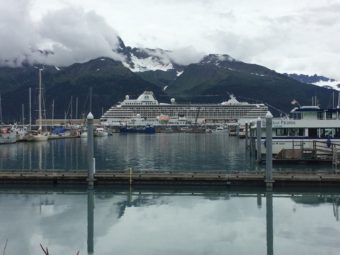
The Crystal Serenity docked in Seward Alaska on Aug. 16th, 2016

The cruise ship Crystal Serenity cast off from Seward Tuesday for a first-of-it’s kind trip through the Arctic’s Northwest Passage to New York City. It’s the first luxury liner to attempt the route — and the largest passenger ship by far.

Many people are wondering if it’s a sign of what’s to come, as the Arctic sees increasingly ice-free summers.

Rachel Waldholz, from Alaska’s Energy Desk was in Seward as passengers boarded the ship.

TOWNSEND: Rachel, remind us why this is a big deal. There’s been a lot of attention to it nationally, internationally. Why is it a big deal?

WALDHOLZ: Well, it’s a big deal because this is a big ship. It can carry more than 1,600 people, including more than 1,000 passengers and more than 600 crew. A ship of that kind hasn’t attempted to cross through the Arctic before. And it’s in a region that hasn’t seen anything remotely on this scale before, it’s not sure the region is prepared for that. There just isn’t the kind of infrastructure or search and rescue capabilities. The towns it’s visiting haven’t seen this kind of tourism and cruise companies haven’t proven yet that they can handle the Arctic safely. This is really the first test. And to that end, it’s been a real wake-up call for authorities about getting ready for more shipping traffic in the Arctic. The U.S. Coast Guard and military actually have a joint exercise planned with Canadian forces next week in the Bering Strait, and they will simulate rescuing 250 people from a cruise ship, and it’ll happen just a few days after the Crystal Serenity passes through the region.

TOWNSEND: Have you been able to get aboard the ship? What’s it like?

WALDHOLZ: Well, I haven’t been able to get on yet. I have a tour scheduled for 3 p.m. and I’m really excited because it’s supposed to be super top-end luxery cruise ship. The basic stateroom is more than $20,000 — the highest end penthouse — which comes with personal butler service — is listed at more than $120,000. So this is really a very high-end cruise. It has as many as eight restaurants, a casino, a dance club, a spa, designer boutiques. That’s probably good, because this is a long trip and there aren’t that many places to stop along the way. It will take more than a month to travel from Seward to New York City. It’s stopping in Kodiak, Unalaska and Nome on its way, as well as several stops in Canada and Greenland.


Site notifications
Update notification options
Subscribe to notifications