Alaska's Energy Desk

Grid referee could ensure cheaper electricity for Alaska’s Railbelt

0826_CrystalSerenity_Nissinen
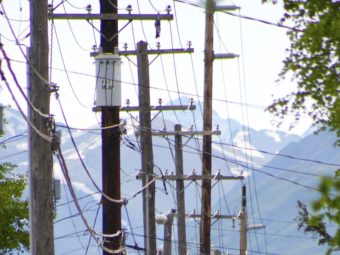
Power poles in Anchorage. (Photo by Antti T. Nissinen via Flickr)

When Chris Rose makes tea in his downtown Anchorage apartment, he uses an electric stove to boil the water — pretty simple stuff. But Rose, who is the executive director of the Renewable Energy Alaska Project, knows how the electricity got to his stove is anything but simple.

“There is a backstory to this whole miracle that we call electricity that we use all the time in our lives but often just take for granted, because all we really want is the light to go on when we flip the switch,” Rose said.

That backstory is especially messy in Alaska. There are six power companies in the Railbelt — the region stretching from Fairbanks to Homer. That’s a lot of utilities for a relatively small population.

Now, for the first time in years, the state is seriously talking about putting a kind of referee in charge of how electricity moves from point A to point B. That could lower Alaskans’ electric bills. The Railbelt’s power companies are working on making this happen, but they’re also nervous about handing over the keys to just anyone.

And in the past, the companies haven’t worked together very well. Rose says that could mean Alaskans are paying more for electricity than they should.

“The utilities collectively have spent more than $1.5 billion on new, mostly natural gas generation over the last five years in the Railbelt,” said Rose. “Some critics would say we didn’t necessarily need all of that had we had regional planning.”

The Regulatory Commission of Alaska keeps tabs on the state’s electric system. Chairman Bob Pickett explained the Railbelt’s grid was set up decades ago, when Alaska’s population was smaller and more spread out. Back then, it made sense for each town to have their own power company.

“When you look at it historically, it’s not really surprising that it happened that way,” said Pickett. “If you were starting from scratch today, you would probably have a different structure.”

In a June 2015 letter, the Commission told Alaska lawmakers the Railbelt power grid needs reform — and maybe a kind of supervisor. That person, or really, a group of people, would look at the whole grid and make sure electricity moves around the region efficiently. Paul Hines, associate professor of electrical engineering at the University of Vermont, says some version of this is pretty common in the rest of the United States.

“Some coordination is definitely a good idea because electricity is one of those things where you’ve got to balance everything within the system at every second of every day,” Hines said. “So that balancing activity for the system as a whole is very important.”

Regional planning has taken on new urgency because Alaska needs new transmission lines, which will cost hundreds of millions of dollars at a time when the state doesn’t have much extra cash to pay for it. So much of the cost could be borne by Alaskans on their electricity bills.

For now, the state is letting the utilities try to work things out themselves. And at least two of them, Chugach Electric Association Inc. and Anchorage Municipal Light & Power, told the Regulatory Commission of Alaska last week they could team up within months, and then expand the partnership to other utilities soon after.

“A year, I think, is really optimistic, it might take us two years, but I really do think that we can pull this together in pretty short order,” said Chugach Electric CEO Lee Thibert.

But some the Railbelt’s power companies aren’t thrilled about a new group of people looking over their shoulders, a group that could include renewable energy advocates like Rose. Rose thinks that a grid overseer could help independent renewable energy producers get electricity on the grid for less money than they do today.

However, Fairbanks-based Golden Valley Electric President Cory Borgeson said he isn’t comfortable rushing into a new way of doing things.

“I called it a legacy project,” said Borgeson. “You make a mistake, we are going to be living with it for a very long time and there could be very big dollars at stake.”

One thing that might take some time is that the companies need to hammer out how each gets paid for the electricity sent in to another company’s territory. If all six companies can’t settle this issue themselves, the state might have to step in.

State takes control of gas line megaproject; consultant warns of major risks

Nikos Tsafos of Enalytica warned lawmakers of major unkowns in a state-led gas line project. "If I were taking over a $50 billion project, I would be a lot more worried than I feel folks are worried," he said. Photo: Rachel Waldholz, Alaska's Energy Desk
Nikos Tsafos of Enalytica warned lawmakers of major unkowns in a state-led gas line project. “If I were taking over a $50 billion project, I would be a lot more worried than I feel folks are worried,” he said. (Photo by Rachel Waldholz, Alaska’s Energy Desk)

The state of Alaska is formally taking over the massive North Slope gas line project.

After months of mixed signals, Gov. Bill Walker’s administration and the state’s three current partners — ExxonMobil, BP and ConocoPhillips — told lawmakers this week that the state will take the lead on the Alaska LNG megaproject as soon as this fall.

It’s a stunning departure from the approach the state has pursued for the last two years, marking yet another phase in Alaska’s decades-long quest for a gas line. And at a joint hearing of the House and Senate Natural Resources committees this week, lawmakers were told the new approach comes with major new risks.

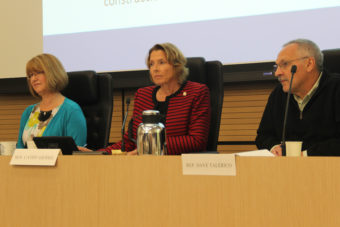
Lawmakers from the House and Senate Natural Resources Committees listened to testimony on Aug. 25, 2016. From left: Sen. Mike Dunleavy, R-Wasilla; Sen. Anna MacKinnon, R-Eagle River; Sen. Cathy Giessel, R-Anchorage; Rep. Dave Talerico, R-Healy; Rep. Benjamin Nageak, D-Barrow; and Rep. Bob Herron, D-Bethel. Photo: Rachel Waldholz, Alaska's Energy Desk
Lawmakers from the House and Senate Natural Resources Committees listened to testimony on Aug. 25, 2016. From left: Sen. Mike Dunleavy, R-Wasilla; Sen. Anna MacKinnon, R-Eagle River; Sen. Cathy Giessel, R-Anchorage; Rep. Dave Talerico, R-Healy; Rep. Benjamin Nageak, D-Barrow; and Rep. Bob Herron, D-Bethel. Photo: Rachel Waldholz, Alaska’s Energy Desk

The legislature’s consultant, Nikos Tsafos of Enalytica, stepped up to the mic at about 3 p.m. Thursday to give his verdict on the state’s newest proposal.

“Let me put this very candidly,” he said. “If I were taking over a $50 billion project, I would be a lot more worried than I feel folks are worried.”

“There’s so much stuff that comes with it,” Tsafos said. “And most of the things that have been offered as reassurance, have yet to reassure me.”

The state’s decision comes with too many unknowns and a plenty of risk, Tsafos said. During an hour of testimony, he sometimes had the air of a man frantically trying to flag down a train before it heads off a cliff, warning that if the three oil companies are stepping back, it likely doesn’t make sense for the state to step forward.

“You usually want to take over economic projects, not uneconomic projects,” he said at one point.

A combination of low oil and gas prices worldwide and the high costs of the Alaska LNG project have prompted the state’s three partners to reconsider their investment.

ConocoPhillips testified Thursday they are unlikely to fund any project into 2017.

ExxonMobil said they were willing to continue the current project, but on a slower timeline.

Gov. Bill Walker’s administration has rejected that proposal, arguing the project must not be delayed, and should come online as scheduled in the mid-2020’s.

The Walker administration is opting to push forward on its own.

The state is ignoring other options, Tsafos said.

“There is a spectrum of where we are right now to the state taking it over, and I can think of about six permutations in between,” he said. “We’ve gone from one to the other, and I have no idea why we we’re not doing any of the things in between.”

At the end of the day, he said, a state-led project could make sense — but Alaska hasn’t yet done the homework to prove that’s true.

Walker administration officials acknowledge there’s work to do.

The new head of the Alaska Gasline Development Corp., Keith Meyer, said he’s considering two major changes.

First, increased — or full — state ownership of the project. That could exempt all or part of the project from federal taxes, and drive down its cost.

Second, he hopes to bring in outside investors who might be willing to accept a lower rate of return than the state’s current oil company partners — for instance, pension or equity funds.

Can you do both at once? Meyer said right now that’s unclear.

“What we’re trying to figure out now, and it’s going to take some significant work, [is] can we have those two things live together?” he told lawmakers Wednesday.

A report from the outside consulting firm Wood Mackenzie offered some support for both of those approaches, suggesting that either could lower the project cost. But lawyers consulted by the legislature cast doubt on whether a project with outside investors would qualify to be exempt from federal taxes.

Speaking after the hearing, House Natural Resources Committee co-chair Dave Talerico, R-Healy, said the two days of testimony had raised more questions than answers.

“One of the biggest things I’m taking away from this is the amount of risk we may be taking on,” Talerico said. “I think that’s a consideration that we really need to think about.”

Lawmakers may not have much time to think.

The project will begin to transition over to the Alaska Gasline Development Corporation in October, with the state expected to take full control by the end of the year.

New Attorney General weighs in against ExxonMobil’s tactics fighting climate change investigations


Jahna Lindemuth was named Alaska's attorney general by Gov. Bill Walker. (Photo by Graelyn Brashear/Alaska Public Media)
Jahna Lindemuth, Alaska’s new attorney general, has waded into a fight over ExxonMobil and how the company fights subpoenas for information about what the company knew about climate change. (Photo by Graelyn Brashear/Alaska Public Media)

ExxonMobil has been the target of a growing number of state attorneys general investigating whether the company lied about its climate change research since last November.

Alaska’s new Attorney General Jahna Lindemuth has jumped into that fight. Some lawmakers say it’s a flip-flop from the state’s original decision not to investigate the company.

Some also say the state shouldn’t waste money getting tangled up in a lawsuit.

While Alaska’s attorney general isn’t yet willing to weigh in on whether ExxonMobil lied about its climate change research, she is ready to battle the company in regards to its tactics in fighting the investigation.

Some states have subpoenaed financial and research records from the company. Exxon has fought back in court by suing to block those subpoenas.

Former Attorney General Craig Richards signed a memo in June cautioning attorneys general nationwide against aligning themselves with environmentalists and investigating the company.

Lindemuth, who took the top lawyer’s job earlier this month, signed onto a amici curiae, or friend of the court, brief arguing against Exxon’s move to block one such investigation.

Exxon is asking a federal court in Texas to block a Massachusetts state subpoena and Lindemuth said this is an issue of federal overreach.

“The issue in that case is whether a large corporation — and it could be Exxon, it could be any large corporation — can go to a jurisdiction outside of the state where those investigations are happening and try to quash the investigation from a federal court in a different state,” she said. 

States should have the right to protect consumers and investigate fraud cases in state courts rather than battling them out in federal courts, Lindemuth said.

Two House Republicans are criticizing her for what they say is a reversal of course for the state: House Speaker Mike Chenault and Judiciary Committee Chair Gabrielle LeDoux say the state shouldn’t have a role in the lawsuit.

LeDoux, a former attorney, said she has not read the brief Lindemuth’s signed, but she doesn’t think the state should get involved.

“I just don’t think that in our time of limited resources that we should be spending money going to war with our major industry,” LeDoux said. 

The attorney general’s office said just because Lindemuth signed the brief, doesn’t mean state will be compelled to appear in court as the lawsuit plays out in other states.  

No one from Exxon returned a phone call seeking comment.

Trawling the ocean floor, scientists discover new snailfish

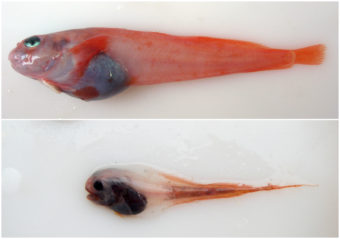
Snailfish can be hard to distinguish. The combed snailfish (top) is found in the Aleutian Islands and the comet snailfish (bottom) lives in the Bering Sea. (Courtesy Jay Orr/NOAA)

While trawling the floor of the Bering Sea and the Aleutian region, scientists have discovered several new species of fish — snailfish. Some were only named last year. Researchers were not looking for them, the trawl was a part of a yearly stock assessment by the federal government that helps set quotas for fisheries.

Snailfish look like overweight tadpoles. They don’t have scales, making them easy to damage. Biologist Jay Orr, of the National Oceanic and Atmospheric Association, says that partly explains why there are so many unnamed species.

“When they come up in the trawls that we use to sample the bottom,” Orr said. “They are tossed about in the nets and pretty well torn up by the time they get to the deck where we do our sorting work.”

But really, the different species are just hard to distinguish. Orr thinks scientists might have avoided identifying them and called all snailfish, snailfish. Now with a special bag attached to the trawl, it’s easier to collect the fish undamaged.

“I was able to see them alive, in good shape and full color.” Orr said. “And began to realize we were seeing different species. And I began to realize we hadn’t seen these species before.”

From the Arctic to Antarctica, there are more than 350 different types of snailfish that live in a variety of environments — from shallow tide pools to the depths of the Marianas Trench. That’s more than four miles below the ocean’s surface, making snailfish the deepest known swimmers in the vertebrate world.

Orr says a lot is still unknown. But it’s important to study snailfish to improve our inventory of the ocean environment.

“To understand biodiversity of the system is to understand how many species are actually out there,” he said. “We can’t really begin to manage the ecosystem until we understand what pieces are there.”

With 86 species of snailfish known to live in Alaska so far, it’s a complex picture for scientists to piece together. But Orr is up to the task. Over his career, he’s discovered 26 different species of snailfish. About a dozen of those still need names.

And now, he’s starting work on a new project — identifying the evolutionary relationships of North Pacific snailfish and piecing together their place in the global snailfish family.

Report: Gas line project not competitive without major changes

Lawmakers listened to testimony from Wood Mackenzie's David Barrowman at a joint hearing of the House and Senate Resources Committees on Aug. 24, 2016. From left: Sen. Anna MacKinnon, R-Eagle River; Sen. Cathy Giessel, R-Anchorage; and Rep. David Talerico, R-Healy. Photo: Rachel Waldholz, Alaska's Energy Desk
Lawmakers listened to testimony from Wood Mackenzie’s David Barrowman at a joint hearing of the House and Senate Resources Committees on Aug. 24, 2016. From left: Sen. Anna MacKinnon, R-Eagle River; Sen. Cathy Giessel, R-Anchorage; and Rep. David Talerico, R-Healy. Photo: Rachel Waldholz, Alaska’s Energy Desk

Alaska’s natural gas pipeline project, as currently envisioned, is not competitive and likely cannot succeed in the current market. That’s the conclusion of a new report from outside consulting firm Wood Mackenzie.

But, the report said, major changes, similar to those being proposed by Gov. Bill Walker’s administration, could make the project more viable.

Under the current model, Alaska is partnering with the three major North Slope producers — ExxonMobil, BP and ConocoPhillips — to build the pipeline.

David Barrowman of consulting firm Wood Mackenzie told lawmakers that the Alaska LNG, as currently envisioned, is likely too expensive to compete with other LNG projects around the world. Photo: Rachel Waldholz, Alaska's Energy Desk
David Barrowman of consulting firm Wood Mackenzie told lawmakers that the Alaska LNG, as currently envisioned, is likely too expensive to compete with other LNG projects around the world. Photo: Rachel Waldholz, Alaska’s Energy Desk

Wood Mackenzie’s David Barrowman told lawmakers on Wednesday that his firm compared that project with other liquefied natural gas projects around the world, and found that it’s simply too expensive.

“The competitiveness of Alaska LNG does not rank well when compared to other…peer projects that could supply North Asia,” Barrowman said. “The ranking means that under current pricing assumptions it would certainly struggle — and even if oil prices rise to about $70 a barrel. Then it would be difficult to make acceptable returns.”

But, Barrowman said, there are ways to lower the project’s cost.

One option is bringing in outside investors to fund the gas line, instead of the partners funding it themselves. Another path is full state ownership, which might lower federal taxes.

Those are both options the state is considering as it seeks to take control of the project, said Keith Meyer, the new head of the Alaska Gasline Development Corporation.

Meyer and Barrowman testified at a joint hearing of the House and Senate Natural Resources Committees. The hearing will continue Thursday with testimony from the state’s three current partners, ExxonMobil, BP and ConocoPhillips.

Weather balloons help solve climate puzzle in Alaska

William Wells releases a weather balloon on Alaska's St. Paul Island. (John Ryan photo)
William Wells releases a weather balloon on Alaska’s St. Paul Island. (John Ryan photo)

Around the world, twice a day, every day, more than 700 weather balloons launch into the air. Fourteen of those balloons are released across Alaska, tracking things like temperature, humidity and wind speed.

They provide a wealth of information for people like Brian Brettschneider, a climatologist in Anchorage. Alaska’s Energy Desk is checking in with him regularly as part of a new segment, Ask A Climatologist.

This week, Brettschneider is responding to a question from a listener named Dennis who asked why surface winds can sometimes be traveling in the opposite direction of winds several thousand feet up.

Interview transcript

Brian: The listener is correct that they can very often be coming from different directions. I looked at the weather balloon reports yesterday from Anchorage and winds at the surface were coming from the southeast and from several thousand feet up, coming from the Northeast. There are a couple of good reasons for that. It’s actually much more pronounced in the wintertime, but the conditions that drive the winds at the upper levels can be in many cases quite a bit different than what’s going on at the surface.

Annie: And weather balloons are the best way to capture these differences?

Brian: Yes, the weather balloon program has gone on since 1948, and it’s an important snapshot in time. So the weather balloon’s the gold standard for those types of observations.

Annie: And we have a lot of them in Alaska.

Brian: Right, we have 14. They ring the coastline and there’s a couple in the interior and they launch twice a day at the exact same time. About 750 to 800 globally all release their balloons at the exact same time, so it’s really important to have that snapshot in time of what’s going on in the atmosphere.

Annie: And as a climatologist, how much attention do you pay to what’s going on with these balloons?

Brian: I think it’s fascinating. From an operation point of view, the meteorologists, the forecasters at the National Weather Service, they play very close attention to how the weather balloon data looks. From a climatological point of view, it’s also very important. So I was able to look at them historically, and look at, say, the amount of moisture in the air, or the temperatures at 5,000 feet. And again sometimes what goes on at the surface kind of masks what the general state of the atmosphere is.

We see that particularly in winter. We can have a very warm air mass at five or ten thousand feet but we have a little bubble of cold air stuck over us at the surface. So in reality, it’s a warm air mass, but we don’t even know it. Without that weather balloon, we would have no idea.

Annie: What happens to the balloons?

Brian: With the low pressure at tens of thousands of feet up, the balloon pops, it has a little parachute, and it slowly makes its way back down to the earth. It has some instructions on it, for if someone finds it, how to return it- they can be refurbished. Here in Alaska, almost none are ever found. In part because most of our stations are along the coast and there’s a high probability that they fall in the water.

A friend of mind actually did find one this summer, in the Chugach mountains, in an isolated spot. That was an uncommon event. I believe less than one percent of the balloons launched in Alaska are ever found. But they’re a very important piece of the climatological puzzle for Alaska.

Site notifications
Update notification options
Subscribe to notifications