Alaska's Energy Desk

As wildfires blaze, Southeast glaciers could be feeling the melt

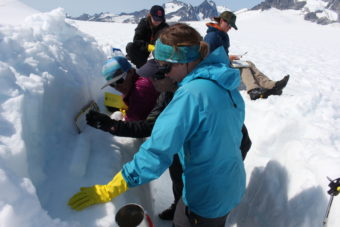
Shad O'Neel releases an ice core onto a work station. (Photo by Elizabeth Jenkins/KTOO)
Shad O’Neel releases an ice core onto a make-shift “work station,” during scientific research on the Juneau ice field. (Photo by Elizabeth Jenkins/KTOO)

Out on the glimmering white expanse of the Juneau ice field, a group of students and scientists work an assembly line of sorts.

It begins with Shad O’Neel, a glaciologist with the United States Geological Survey, who twists a metal tube into the snow and ice to take a core sample.

So you spin it down, it drills its way in, you turn it backwards, catch the snow, you pull it out and hope there’s something inside,” he said.

Scientists are wondering whether the carbon released from interior fires is traveling all the way to Juneau — potentially speeding up glacial melt.

Wildfires are increasing in Alaska, a trend which has largely been attributed to climate change, e.g. less snow cover can mean a longer wildfire season.

The Southeast part of the state typically doesn’t have to worry about fires. It’s a rainforest afterall, but smoke can travel.

Glaciers will document that journey and more, said Natalie Kehrwald, a USGS research geologist from Colorado.

“So it will tell you if it was colder, it will tell you if it was windier, if there was a lot of pollution during that time,” she said.

And it will  reveal whether carbon from wildfires winds up on the ice.

“The glacier surface itself is basically layer upon layer of those snapshots in time,” she said.

Kehrwald wonders whether an increase in interior wildfires is spreading fine amounts of carbon on the Juneau ice field — which could accelerate glacial melt.

That phenomenon has been documented on the ice in Greenland, she said, after smoke from wildfires in Western Canada swept across North America.

Kehrwald leads the team on the ice field to collect the coring samples to see if the same thing is happening in Juneau.

Shad O’Neel pulls up the metal tube:

“So, we’ll just sort of jiggle it a little bit and it get it to come out,” O’Neel said.

Natalie Kehrwald leads a group of Juneau Icefield Program students on how to saw an ice core. (Photo by Elizabeth Jenkins/KTOO)
Natalie Kehrwald leads a group of Juneau Icefield Research Program students on how to saw an ice core. (Photo by Elizabeth Jenkins/KTOO)

He releases a nearly perfect cylinder of snow and ice that’s a couple feet long.

From there, a group of students from the Juneau Icefield Research Program slice it into sections, weigh it and eventually smash it to pieces with a mallet.

They will write down what section the sample belongs to, the deepest part being the oldest. The melted pieces will be sent to Dartmouth College, South Dakota State University and the USGS in Colorado, among other places, to test what the temperature was when the snow fell and what traces of fire could be in the ice.

Sarah Fortner will take some of the samples back to Wittenberg University, where she teaches geology. In the science community, the trickle down consequences of climate change is on everyone’s mind, she said. Ice cores from glaciers around the world have been telling a sad story.

“That’s one of the ways that we know that climate change is happening and that it’s related to our greenhouse gas productions,” Fortner said. “Because ice cores have preserved that record of increased greenhouse gasses all around the world.”

Scientists hope to determine if fire is affecting Juneau’s ice later this year.

At DNR, new leader tackles ‘maze’ of oil and gas development on federal land

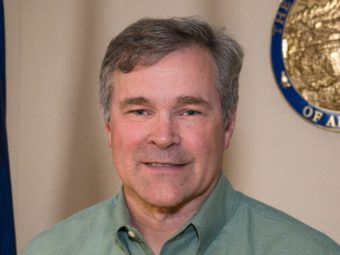
Andy Mack is the state's newest Department of Natural Commissioner. (Photo courtesy State of Alaska)
Andy Mack is the state’s newest Department of Natural Resources Commissioner.
(Photo courtesy State of Alaska)

From Soldotna to the North Slope to Anchorage, the state’s newest natural resources commissioner has spent his career weighing in on energy issues all over the state. Now, Andy Mack has been tapped by Gov. Bill Walker to help guide the state through the maze of federal regulations required to develop oil and gas resources.

He’s has worked as both a civil and criminal defense attorney. He was a legislative aide for a decade and, most recently, managed a private investment firm. But, he’s probably best known for his time spent working on the North Slope.

And the state’s newest DNR commissioner said that when it comes to the state’s future, people should be looking north.

“Without Arctic development the State of Alaska will probably struggle,” Mack said. “I think that we have a lot of tools that are not Arctic related, but I think that if we really want to thrive as a state, all eyes should be on the Arctic.”

But nothing in the Arctic is easy. And, the technical challenge for oil companies mirrors the tricky process of navigating tribal, state and federal land ownership.

Mack has plenty of experience wading through the complex regulatory process of opening up federal land for public and private use. He spent five years working as an adviser to the North Slope Borough during a renaissance/ in exploration and development in the Arctic Ocean.

Mack said he spent a lot of his time at the borough weighing-in on development on federal land like the National Petroleum Reserve-Alaska and the Outer Continental Shelf.

“I think the challenge for Alaska is how to approach areas where we historically have not had access or the access is controlled by the federal government and I think part of my experience lends itself very well to ensuring that we can generate access,” he said.

Key to that access, Mack said, is whether local communities – like Barrow- support going into areas that are managed by the federal government. He said the communities have to balance development and subsistence.

Mack’s experience gaining access to federal lands and building contacts across the state is one of the main reasons Walker hired him.

“It’s a maze that we need to get through that he has worked in his capacity as an attorney and as a consultant for a number of organizations in Alaska that have been in permitting processes with the federal government on oil and gas development and beyond,” Walker said.

Mack joined Walker’s oil and gas team at a contentious time.

The state is battling with BP, ConocoPhillips and ExxonMobil over the details of how the companies will sell natural gas from Prudhoe Bay.

When the producers declined to turn over specific marketing information, Walker refused to sign the annual development plan for the field.

It’s unclear what will come of the state threatening the companies’ leases if they refuse to give in.

But Prudhoe Bay was responsible for nearly half of the state’s oil production last year.

The decision to pursue marketing information pre-dates Mack’s time at DNR. He said he supports the process, but wasn’t ready to weigh-in on whether the state would revoke the leases at Prudhoe Bay.

“We’re in a process, so I’m not going to answer,” he said.

Mack also said he supports another of Walker’s controversial decisions. This year, Walker vetoed about $430 million in tax credit payments owed to oil companies.

Looking ahead, Mack says he’s focused on protecting the state’s interests and encouraging investment in the state’s resources at a time when budget challenges make it seem risky.

“It’s very important that as Alaskans we appreciate what the world markets think of Alaska, that we’re able to attract investment capital and that we’re able to recycle some of the money that we have available here to us in Alaska,” he said.

Mack will also be spending a lot of time working on the state’s response to the Department of the Interior’s five-year plans for offshore oil and gas leases. Right now, those plans include three potential lease sales in Alaska – two in the Arctic and one in Cook Inlet.

Walker’s new oil and gas advisor wants to put some ‘grit’ in the system


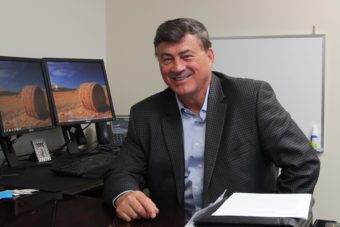
John Hendrix started work as Gov. Bill Walker's chief oil and gas adviser in July 2016. Photo: Rachel Waldholz, Alaska's Energy Desk
John Hendrix started work as Gov. Bill Walker’s chief oil and gas adviser in July 2016. Photo: Rachel Waldholz, Alaska’s Energy Desk

When Gov. Bill Walker announced the creation of a new cabinet position — a chief oil and gas adviser — he framed it as a way to improve his administration’s often rocky relationship with the oil and gas industry.

The man he appointed, John Hendrix, has more than 35 years of experience in oil and gas and has been praised by industry officials.

But in an interview, Hendrix told Alaska’s Energy Desk he’s proposing a tough love approach to the state’s oil companies.

Listen now

Hendrix said he’s been hired to do pretty much one thing: figure out how Alaska can produce more oil.

“There’s no doubt in my mind that there are opportunities…to make more oil with existing infrastructure and existing, producing wells,” he said.

In his newly created role, Hendrix doesn’t have a department to run. Instead, he described his job as finding out what’s standing in the way of oil production — from federal regulations to financing to state policy — and then doing everything he can to remove those barriers.

But, he said, he’s also challenging oil companies to step up. He called it putting “grit in the system.”

“If you have potential and you’re not going after that production potential that’s in the ground, why aren’t you?” he asked.

One example of this approach is the current controversy over Prudhoe Bay. Prudhoe is the state’s largest oil field — and would be the largest source of natural gas, if a pipeline is ever built from the North Slope.

This year, for the first time, the Walker administration requested information from Prudhoe’s leaseholders — BP, ExxonMobil and ConocoPhillips — asking how they plan to market that gas. The companies have so far refused, arguing the request is potentially illegal. In return, the state has rejected the unit’s annual development plan — essentially threatening the companies’ leases if the information isn’t handed over.

Hendrix said the state is well within its rights.

“Let’s go back to grit,” he said, with a laugh. “This is kind of the grit the governor provided to the oil and gas companies. I don’t think they’ve had anybody ask those questions for awhile…so [they were] kind of shell shocked about where the boundaries are, you know, ‘You’re invading my space.'”

But, he said, that’s the whole point.

“This office needs to know, what is the potential of every oil field out there? What are your exploration plays…and why are you not exploring?” he said. “And if you had something you explored, that can be developed, why aren’t you developing it? And I want to know how I can help.”

A Homer High School grad, Hendrix most recently served as the general Mmanager of Alaska operations for Apache, before it pulled out of the state earlier this year.

Before that, he ran Apache’s operations in Egypt and spent 18 years at BP. His job in each case, he said, was often to enter a field and figure out how to make it live up its potential.

Now, he’s one of three new faces at the top of Gov. Walker’s oil and gas team, along with Andy Mack, the new commissioner of Natural Resources, and Keith Meyer, the head of the Alaska Gasline Development Corporation.

As the administration describes it, Meyer is in charge of gas, Mack is focused on wrangling more flexibility out of the federal government — and Hendrix is in charge of oil.

Another gritty issue? Oil and gas tax credits. Walker vetoed about $430 million in payments owed to companies this year. One of Hendrix’s first tasks is reaching out to companies affected by the veto.

He says he supports the governor’s decision – even though Apache received similar credits when it was exploring in the state.

Waldholz: I’m wondering if the John Hendrix who was running Apache a couple years back would have had the same reaction to the governor’s veto?

Hendrix: Oh yeah.

Ultimately, he said, the state can’t spend money it doesn’t have.

Perhaps counterintutively, Hendrix said his real job is building an Alaska that doesn’t rely so heavily on oil. He hopes to use oil and gas as a bridge to that future.

“As a child, and as a young adult, I was always looking up, saying, why aren’t they doing something?” he said. “And now you look back, when you’re 59 years old, and you think, well, maybe it’s time you step forward and help out.”

Walker is hoping Hendrix, and his gritty conversations, can get the state a little closer to that goal.

State fund for renewable power falls prey to budget woes

08112016_Sandpointwind_zsobel
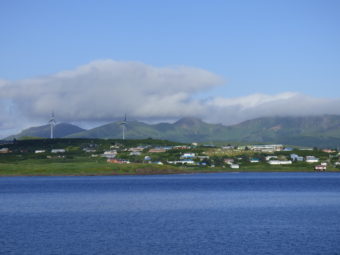
Two wind turbines tower over the city of Sand Point. (Photo by Zoë Sobel/KUCB)

Since 2008, the state has set aside a pot of money for renewable energy projects like small dams and wind turbines. Called the Renewable Energy Fund, the projects it’s backed have replaced tens of millions of gallons of expensive diesel in communities from Skagway to Nome.

But with the current budget crisis, that money has disappeared.
For example, utility TDX Power last year asked the Alaska Energy Authority for about $650,000. The utility needs the money to help improve a wind power system in Sand Point, a community of about 950 on the Alaska Peninsula.

Sand Point City Administrator Andy Varner said an improved wind system would lead to cheaper power.

“Energy is a big issue, it’s a big chunk out of people’s paychecks, it’s a big drain on, in our situation, on the community budget,” said Varner.

If Sand Point’s two wind turbines were more efficient, the town would use less pricey diesel. That means more money for other things, Varner explained.

“You know, fixing up our fire truck, making our roads safer — all the stuff that we need to be doing,” said Varner.

The Alaska Energy Authority also thought improving Sand Point’s wind power system was a good idea. They added it to a list of projects slated to receive funding from the state’s Renewable Energy Fund.

But due to the budget crisis, the legislature didn’t provide money to any Renewable Energy Fund projects this year.

And the state won’t accept applications for new projects this year, either. Sean Skaling of the Alaska Energy Authority said instead, they’re giving the legislature the same list of 39 projects they turned in last year.

“We feel it’s the fairest way to move forward given the financial times in the state and giving those 39 projects another opportunity to get funding, possibly,” said Skaling.

Sand Point’s wind power system is near the top of that list. But Skaling said it’s hard to predict if the projects will get funding the next time around.


Why students and scientists spend summer on ice

Every year, dozens of 20-somethings forego a summer break to live on the Juneau ice field. They slog heavy packs and ski to camps — miles away from the closest cell phone signal or Wi-Fi hotspot. The Juneau Icefield Research Program has been around for 70 years. First, exploring the icy expanse. And later, tracking the rate Southeast glaciers are shrinking.
If you squint, you might think you’re in the desert. Flat, white terrain stretches out as far as the eye can see and rocky peaks dot the horizon. The people, too, appear to be dressed for warm weather. Most are wearing running shorts and t-shirts. Their eyes hidden behind sunglasses to block the glare from snow.

Olivia Truax — a recent graduate from Amherst College — says she can’t imagine her peers would be up for the Juneau ice field.

“Probably not,” she said. “One of my friends was dropping me off at the airport and she was like, ‘you’re off to spend your summer on the ice doing science and skiing and digging. That sounds like my personal hell. Have fun!’”

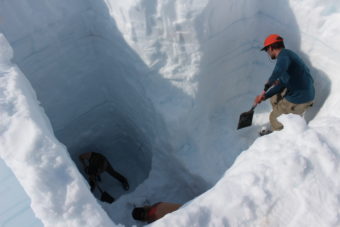
But Truax and the others are clearly having a good time. They’re digging a hole in the snow that’s so deep they had to develop a special strategy. Rather than dropping straight down, the pit resembles a Tetris piece. And working together, each person shovels the snow and ice onto the next platform. This isn’t boot camp. This is science.

By the end of the day, they’ll reach last year’s snow surface which will allow them to measure how much snow is above it and determine how much the ice field is gaining or losing.

“With some fancy math and weather data, we can figure out how much snow can be left,” said Annika Ord, a Southeast resident who’s on safety staff.

The program has the oldest mass balance record in North America. A record of how the Juneau icefield — which feeds more than 30 major glaciers — is changing.

Miles away from the snow pit is Camp 18. It’s a rustic collection of bunkhouses where students and scientists live during their stay. And it feels like it’s on the top of the world. On a clear day, you can see where glaciers meet and flow down the valley.

Like Olivia Truax, you would expect most of the people who attend this program to describe themselves as “outdoorsy” but not Joel Gonzalez-Santiago.

“No, not even a little bit,” he said.”I prefer to be indoors with my computer and maybe some nice music, in a controlled temperature.”

Gonzalez-Santiago is a junior at Elizabeth City State University in North Carolina and a business major. He learned about the program through an academic adviser and decided to give it a shot.

He’s logged a lot of firsts: First time camping overnight, first time seeing skis, first time traveling long distances on skis.

“Back at home, I walk a total of maybe a mile?” said Gonzalez-Santiago. “And that’s to get from my house to the car, to the car to the parking lot and to school. So, it’s different. I’ve never done anything like this before.”

Juneau icefield Research Project Photo by Elizabeth Jenkins/KTOO
At Camp 18, when the weather permits, the classroom is outdoors. (Photo by Elizabeth Jenkins/KTOO)

To get to the 1,500 square mile ice field, students take a trail behind Juneau’s Home Depot. The multi-day trek involves hiking up steep terrain, climbing and eventually skiing on top of glaciers. Gonzalez-Santiago says to get through it, he had to get out of his own head. But he doesn’t regret spending his summer on ice.

He’s excited to send photos of his goggle tan and the landscape back to his grandma in Puerto Rico. And explain to his family what climate change means. That some of the glaciers, where he just spent two months, are disappearing.

“Yeah, I can show them and say, ‘I’ve witnessed this. I see it. You can’t deny it.’” he said.

This summer, the youngest person on the icefield is fresh outta high school. And the oldest person?

“Well, I won’t tell you that,” said Alf Pinchak.

He’s been coming up here since the 1960s. He says when he was a research fellow with the National Science Foundation, it was glacial streams, not human-caused climate change that caught his attention. Pinchak now helps maintain a project that measures the year-round temperature at some of the camps. And he doesn’t think this will be his last trip.

If you read through the Robert Service poems about this kind of country, I think you’ll come to understand why people come back here: ‘it’s the great big broad land up yonder, it’s the forest where service has lease, it’s the beauty throws me with wonder, it’s the stillness that fills me with peace.’”

Back at the dig, the group has carved out a pit in the snow that’s at least as deep as a few flights of stairs. It’s hours of labor but Olivia Truax doesn’t seem to mind. She says it’s a cool feeling to contribute to such a long-running record.

“But also can be kind of sad when I think about the way our models say the Juneau ice field will be in another 70 years,” she says.

Truax imagines — for her own kids someday — the icefield will be a different and far more dangerous place.

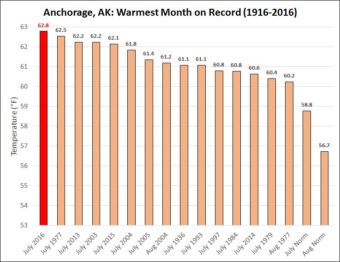
Anchorage logs warmest month on record

Graphic courtesy of Brian Brettschneider

Anchorage just recorded its warmest month on record. July was four degrees above normal, with an average temperature of nearly 63 degrees.

Brian Brettschneider is a climatologist in Anchorage who closely tracks Alaska climate data and trends. Alaska’s Energy Desk is checking in with him regularly as part of a new segment- Ask a Climatologist.

Brettschneider told Energy Desk editor Annie Feidt the record or near record warmth has extended across the state from January through July.

Interview transcript:

Brian: When you add all that up, it puts 2016 way out in front in first place for the warmest year on record. In fact, it’s the first time for the first seven months of the year that Alaska has been, on average, above freezing. And there’s a large gap between the first and second place year.

Annie: And what does that mean for the rest of the year?

Brian: Well, the fact that it’s been so warm for the first seven months, doesn’t necessarily mean anything for the next few months, but if you ask yourself why it’s been so warm for the first seven months, the factors that have made it so warm, are continuing. So we would expect warm months for the rest of 2016 and for 2016 to almost certainly become the warmest year on record for Alaska.

Annie: Why has it been so warm, what are those factors?

Brian: There are several factors. One is globally, the last few years have been the warmest on record. So globally, we’re starting with this very high baseline. And then here locally Alaska is surrounded by waters that are at or near all time record highs, like the Gulf of Alaska and Bering Sea. So we’re just surrounded by this envelop of warm, moist air over this record warm sea surface temperature. And there’s really no place this air can cool off before moving over Alaska.


Site notifications
Update notification options
Subscribe to notifications