Alaska's Energy Desk

Ravn is fighting to keep flying, but a French bank is pushing to sell off the company’s planes

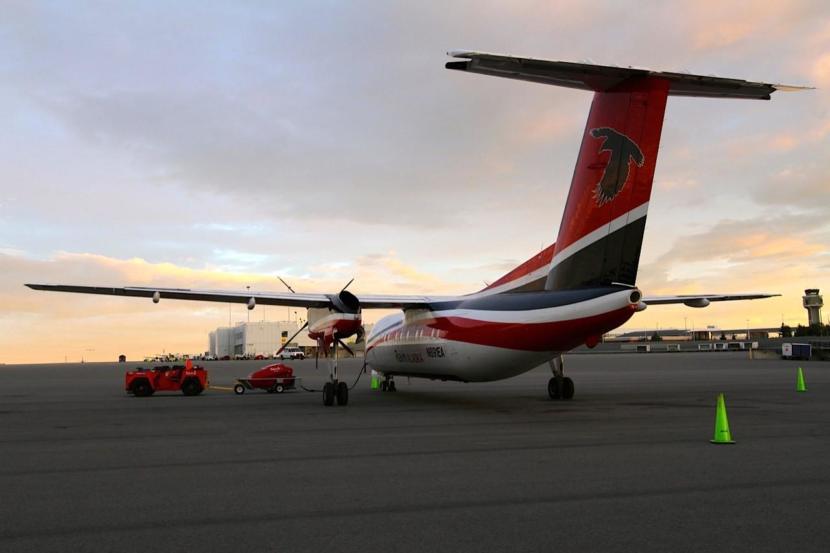
A RavnAir plane sits on the tarmac at Ted Stevens Anchorage International Airport. (Courtesy RavnAir)

Alaska’s largest rural airline is scrambling to find a buyer that can keep the company intact as it emerges from bankruptcy, rather than seeing its planes sold off piecemeal through a liquidation process.

RavnAir Group flew to more than 100 Alaska communities before shutting down and filing for bankruptcy last month amid the COVID-19 pandemic, forcing some remote villages to charter planes to get residents medical care. Ravn is now running for-sale ads in the Anchorage Daily News and the Wall Street Journal, and a half-dozen potential buyers have signed non-disclosure agreements that allow them to review sensitive company data, according to court filings.

Ravn’s management is touting $30 million in federal COVID-19 aid that it says the federal government could grant — if a potential buyer is found.

A full-page ad that Ravn placed in the Anchorage Daily News last week.

But as the federal judge in Ravn’s bankruptcy case pointed out at a hearing Wednesday, that money “ain’t in hand, yet.” And the company still owes $90 million to an array of lenders represented by the French international bank BNP Paribas, whose attorney calls a sale a “Hail Mary” and is pushing to have Ravn’s planes sold off piecemeal through a liquidation process that would shut down the company for good.

“If it comes together that there’s somebody who’s interested in taking the (federal) money and funding a plan, that would be great news,” BNP’s attorney, David Neier, said at the hearing. “But we’re not giving up the liquidation process because there is no other path that has emerged that will work with this estate.”

Ravn is majority-owned by a pair of East Coast private equity companies, J.F. Lehman and Co. and W Capital Partners. Before the pandemic, the company operated 72 planes and had 1,300 workers, and its network extended across the state, from the oil-rich North Slope to the major commercial fishing port of Dutch Harbor in the Aleutian Islands, with dozens of other destinations in between.

The pandemic caused a 90% drop in passenger bookings over three weeks, and Ravn laid off all but 40 of its employees and filed for bankruptcy protection in Delaware.

Since then, Ravn’s management — led by chief executive Dave Pflieger, who collected more than $1.4 million in salary, bonuses and expense payments in the past year, according to court filings — has been fighting to find a buyer that could spare the company from liquidation.

Beyond its newspaper advertisements, it’s promoted petitions and tweeted at President Donald Trump and Treasury Secretary Steven Mnuchin. It also worked closely with Alaska’s Congressional delegation to secure the possible relief money from the federal government, and it says it’s contacted 19 different entities about a possible sale.

The efforts to keep the company intact are aligned with the array of Alaska and other businesses owed millions of dollars by Ravn that are known as the “unsecured creditors” in the bankruptcy case. That means their claims rank behind the $90 million in debts to the “secured creditors” represented by BNP, the French bank.

Ravn estimates that a liquidation would raise no more than $41 million. That would not be enough to pay the claims of the unsecured creditors, which include Anchorage-based Petro Star, GCI and Northern Air Cargo.

So the unsecured creditors’ attorneys hope to see Ravn sold intact, which could allow it to start generating revenue again and make it more likely that the Alaska-based businesses and others are paid off.

At Wednesday’s hearing, an attorney representing the unsecured lenders, Robert Stark, said Ravn has not given itself enough time nor hired an investment banker to help find a buyer. And he argued that the secured lenders are pushing the company too quickly toward liquidation.

“We’re all puppets. And they’re the puppet masters,” Stark said. He added: “This company needs a chance to rehabilitate. It needs to heal, like every other part of this country..”

A spokesman for BNP, the bank that represents the secured creditors, declined to comment. At the hearing, Neier, the bank’s attorney, disputed the “puppet master” remarks and argued that Ravn’s sale efforts are not “illusory.”

“It’s more of a, ‘let’s see if we can do something better in the time we have allowed,’” Neier said.

Neier said that Ravn already faces a revenue shortfall and will need more cash to get through the bankruptcy process. But Stark asked the judge at the hearing, Brendan Shannon, to give Ravn an extra month to find a buyer.

Shannon instead agreed to extend the deadline two weeks, to July 9, saying that Alaska’s required two-week quarantine period for visitors has not given Ravn “a meaningful opportunity to really market these assets,” like its planes.

“By all reports, this company is healthy, profitable and operating,” Shannon said. “If there’s an opportunity to reorganize this, provide these services, save these employees’ jobs, I would be on board with that. I can’t make economic circumstances and I cannot create value, but I can provide opportunity.”

Shannon and Ravn’s attorneys both noted that there are still questions about whether or how the Department of the Treasury would allow a potential buyer to claim the $30 million in federal aid.

“We haven’t received written confirmation, although we’re seeking it from Treasury that they understand that’s how we’re going to be using it and that it would be transferable,” said Jane Kim, a Ravn attorney.

The federal money, and the uncertainty around it, is a big factor in assessing Ravn’s value, according to a person affiliated with a potential buyer, who asked to remain anonymous because of the sensitivity of the bidding process.

“How can any potential buyer take that to the bank?” the person said. “The business itself has no value, unless and until (the chief executive) provides some kind of documentation to support their representation that a successor to Ravn would have access to this money.”

Ravn officials did not respond to requests for comment.
BP has a new online platform to track out-of-state workers’ health. And it wants to share it with other companies.

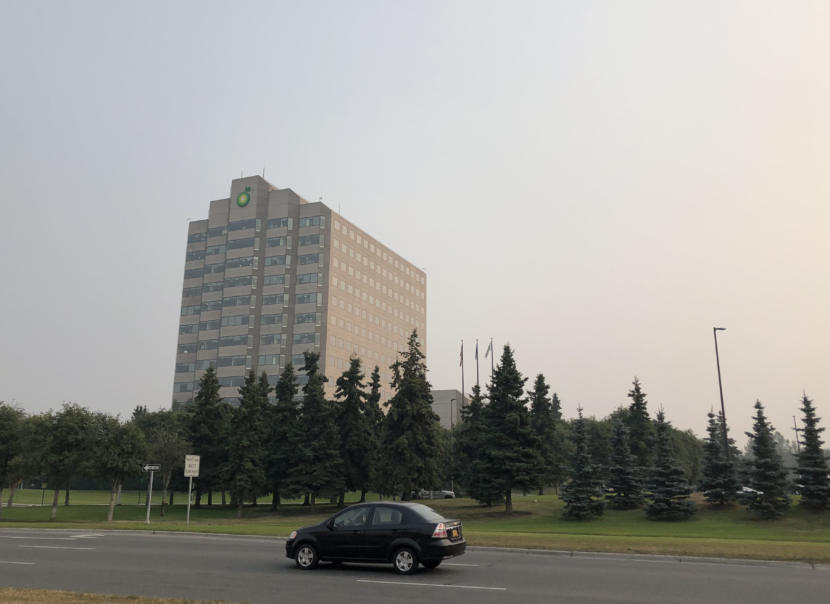
BP’s office building in Anchorage. (Photo by Elizabeth Harball/Alaska’s Energy Desk)

Oil and gas company BP is using a new online platform to track its out-of-state workers’ health. And now, it’s offering the code to the program to other organizations for free.

“It could be applicable to any other industry,” said Jerome Leveque, a data manager at BP Alaska. “It’s not really limited to oil and gas. So, you know, fisheries or tourism or anybody who’s traveling in state or coming from out of state could use this.”

The coronavirus pandemic has forced companies to do business differently and, in some cases, monitor their employees’ health closer than ever.

BP brings hundreds of workers from out of state to Alaska’s North Slope for their shifts at the remote oil fields. But first, the workers must quarantine for two weeks at Anchorage hotels, said BP Alaska spokeswoman Megan Baldino.

That started about two months ago, and prompted the question: What’s the best way to monitor those workers for illness?

Jeremy Zidek, a spokesman for the state Department of Homeland Security and Emergency Management, said companies bringing out-of-state workers to Alaska need to document their plan for screening employees, but they’re given latitude about what measures to use.

BP’s process started with a lot of paper. At first, Leveque said, “everybody was using paper and our medical provider, Beacon, was going door-to-door and filling out papers and taking temperatures twice a day.”

Leveque said BP wanted to find a more efficient way that included less human interaction. So it hired a software company called Resource Data to create a digital hub for its workers. The new platform launched earlier this month.

Now, Leveque said, workers can log in to the program on their cell phones, computers or tablets. Twice a day, while in quarantine, they take their temperatures and type in the results. They check the boxes of any symptoms they’re experiencing.

The platform relies on honesty and the Internet. Leveque said it has sped up the workflow. The program also automatically alerts the company’s medical provider of fevers and other health concerns like a cough or muscle aches.

“We send an immediate text message and alert emails to the medical support teams,” Leveque said. “So we can really deal with any symptoms as rapidly as one can.”

Using the program, BP workers also record their quarantine locations and contact information. The company posts coronavirus-related messages and news. There’s another portal for the screening questions they have to answer before they fly to Prudhoe Bay.

According to Baldino, roughly 50 BP workers are in quarantine on any given day before flying north. BP’s Prudhoe Bay workforce totals about 1,000 employees, and nearly 40% live out of state. So far, BP has reported one of its employees at Prudhoe Bay testing positive for the coronavirus. That happened in late March.

Baldino said employees can still opt to use paper forms to fill out their health information instead of the software. As of last week, workers had filled out more than 700 online quarantine logs, Leveque said.

Baldino said BP expects to use the new program “for the foreseeable future.” BP, however, is also in the process of selling its entire Alaska business to Hilcorp and exiting the state. The company has said it plans to close the deal by the end of next month.

Leveque said he hopes other companies, big and small, can adapt the online program to monitor for illness as the pandemic continues.

Will fiber optic broadband make it to the Aleutians? Decision may depend on USDA grant

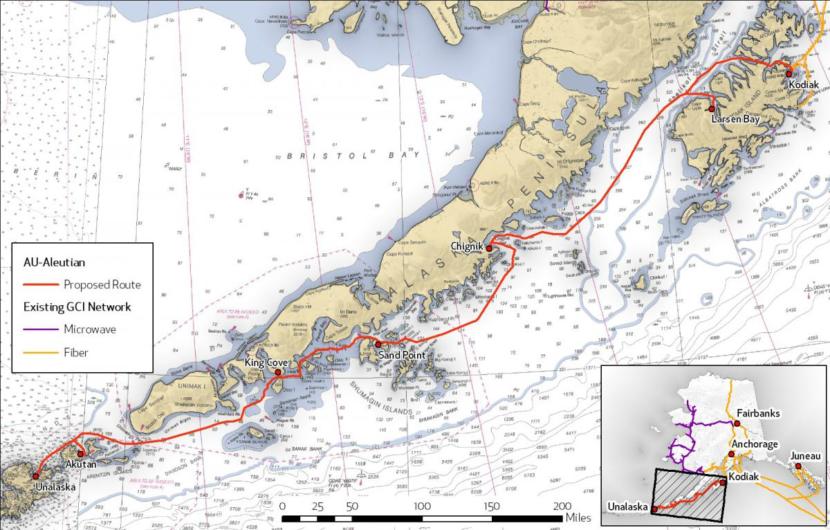
GCI’s proposed project would bring undersea fiber optic cable from Kodiak to Unalaska, spanning approximately 860 miles. (Photo courtesy of GCI)

GCI said it won’t move forward with bringing broadband communications to Unalaska at this time unless they receive a large grant from the USDA.

The company has put in an application for a $25 million grant from the U.S. Department of Agriculture’s Rural Utilities Service (RUS) to bring fiber optic broadband connection to communities along the Aleutian Island chain, where connectivity and bandwidth can often be unreliable or difficult to come by.

The proposed project would bring undersea fiber optic cable from Kodiak to Unalaska, stopping in six communities, and spanning approximately 860 miles.

“Our general plan is to bring an undersea fiber optic cable out to Unalaska that would hook into our existing undersea fiber optic infrastructure in Kodiak,” said Dan Boyette, vice president of GCI. “We then would circle through Whale Pass on the north end of Kodiak Island and go into Larsen Bay, and then from Larsen Bay to Chignik Bay, and then on down the chain making stops in Sand Point, King Cove, Akutan, and then finally Unalaska.”

The company plans to install some branching units to extend service to other places along the way like False Pass and Perryville – which aren’t in the initial project scope, but have potential for fiber optic in the future.

Boyette said GCI has been working on the proposed project for a number of years, and the overall cost is high, coming in at $60 million. He said this high cost makes the business case difficult for them to follow through on, as they are a private corporation, which has a responsibility to its shareholders.

“In order to get the return on the investment down to what’s appropriate for a company like ours, the [USDA’s ReConnect Loan and Grant Program] really fit quite well,” said Boyette. “So we applied for a grant of $25 million from that. And that takes the payback, or the return on investment, down to a period of years that’s acceptable to us and our parent corporation.”

He said he expects to hear if they’ve received the $25 million award sometime between June and September. There are seven applicants in total from Alaska competing for a pot of $200 million.

If they receive the grant, GCI plans to pay for the remainder of the project – $35 million – with it’s own capital.

“But if we don’t get the grant award, we won’t move forward at this time,” said Boyette. “That’s not to say that we won’t apply again in round three. I know that there will be future rounds because the federal government is very determined to use this program to get broadband throughout rural America, just like they did in the 1920s and ’30s, when they used the same program – the Rural Utilities Service – to get electrification throughout rural America.”

Boyette said the company is in the final stages of the permitting process with the U.S. Army Corps of Engineers. And in anticipation of receiving the grant award, they are already assembling a project team, working with an undersea engineer, and working to get the permitting process in Unalaska underway as soon as possible.

If all goes according to plan, Boyette said he anticipates the company will begin the project “in earnest” in January of 2021, and will be able to initiate service in Aleutian communities towards the end of 2022. It will be roughly a two-year process.

Boyette said the company has been working its way through rural Alaska trying to build better communications facilities, and that it’s really time for communities throughout the Aleutian chain to get better connectivity.

“The Aleutian chain is the last part of Alaska that does not have terrestrial broadband service,” he said. “And in today’s world, remaining on satellite service tends to hold back the business community. By bringing fiber optic terrestrial-style broadband, all those barriers go away. So I think that the ability for Unalaska’s economy – as well as the economies of King Cove, Sand Point, and so on – to grow and help those communities become more thriving places, I think is a very real thing. We believe it’s going to be transformational.”

Improved internet services and fiber optic has long been a federal and state lobbying priority for the City of Unalaska, as more and more operational programs are internet-based, posing a challenge to the city as well as local organizations and businesses.

And while many Unalaskans look forward to a broadband fiber optic connection, local internet provider, OptimERA, could be in trouble. But CEO Emmett Fitch, who said the company has looked at bringing fiber optic, as well as a microwave link, to the community in the past, said he’s optimistic.

“If GCI is successful in their application, and are able to get the service in place, then hopefully we can buy capacity from them and continue to do what we’re doing,” said Fitch. “You can’t compete with satellite versus fiber, for the most part. If the fiber lands, whoever controls that fiber is going to pretty much own all of the communications, or has the ability to.”

Fitch said that GCI has communicated in the past that they want to work with other providers in the area. If GCI is successful in bringing fiber optic service to the Aleutians, he said the two companies will hopefully find a way to collaborate so that OptimERA will be able to continue providing service to Unalaska.

Red Dog Mine employees permitted to return to home communities

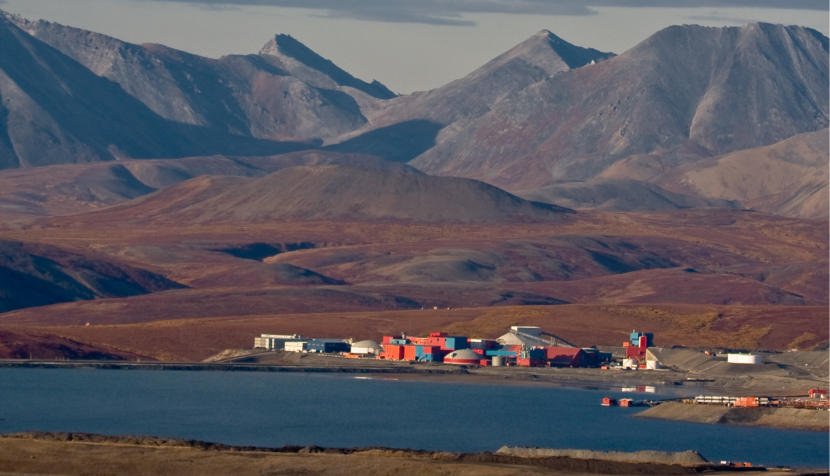
Red Dog Mine (as seen from Anxiety Ridge), Alaska. Red Dog is 90 Miles north of Kotzebue, 50 miles inside the Arctic Circle. (Flickr photo by Jim)

After being kept away from their communities due to coronavirus concerns, Red Dog Mine employees have been allowed to return home.

In March, shortly after COVID-19 health mandates began in the state, flights were suspended from the mine in the Northwest Arctic Borough to surrounding communities. Mine workers were given the option to quarantine in Anchorage, where they could stay with family or use housing approved by the mining company, Teck Alaska Inc. Workers had the option to extend their shift rotations at the mine site, about 90 miles north of Kotzebue.

This week, Teck announced that employees are allowed to return to their home communities under the conditions that they test negative for COVID-19 and adhere to local health protocols.

The change comes as the Northwest Arctic Borough began slowly lifting its “hunker down” mandate. Intrastate travel between communities is now permitted for critical and necessary travel. That includes traveling for health purposes, subsistence, child custody and obtaining goods not available locally.

Additionally, restaurants in the Northwest Arctic Borough can begin allowing dine-in services, however it can only be by reservation. Walk-in dining is prohibited. Restaurants are limited to ten customers for dining indoors.

To date, there have been two positive cases of COVID-19 in the Northwest Arctic Borough.

Meet Lecidea Streveleri: One of the lichens discovered in a “global hotspot” in Glacier Bay

xx
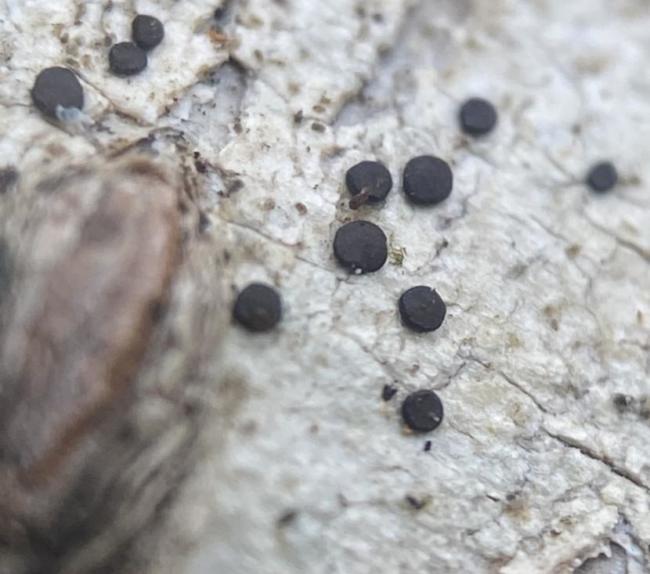
A specimen of Lecidea Streveleri discovered in Glacier Bay National Park. (Photo by Toby Spribille)

Lichens are so plentiful in some parts of Alaska you might not even notice them. But on the ground or growing in the trees is an entire universe that scientists are still trying to understand. 

Recently, 27 new species were discovered in Glacier Bay National Park. And though they now bear the names of some influential people in the region, it’s the lichens that are the center of the story.  

Recently, the University of Alberta completed a study on Glacier Bay, where they counted more than 900 species of lichen. They’re calling it a “global hotspot.” 

Greg Streveler is one of those lichens. It looks a little like chocolate chips on top of a toasted marshmallow. Whitish and grey, it grows on alder bark, and it’s named after a real person who lives in Gustavus. 

Through the years, Streveler made numerous contributions to Glacier Bay National Park, where he worked as a biologist. He’s an extremely humble person. In short, he describes his work as, “basically [greasing] the skids for research in the park.”

Some of that research meant tagging thousands of specimens through the years, essentially helping set up Glacier Bay’s scientific plant collection. Streveler is retired, but a new generation of scientists are still interested in that work. 

So, it seems fitting they would think of Streveler when it came time to name one of the newly discovered species. Streveler reacted in his usual modest way. 

“I laughed,” he said with a chuckle. “I was just thinking, ‘well, Toby found so darn many lichens he had to figure out some name for one of them.'”

Toby is Toby Spribille, a lichenologist at the University of Alberta. He met Streveler briefly and was impressed by his scientific efforts. 

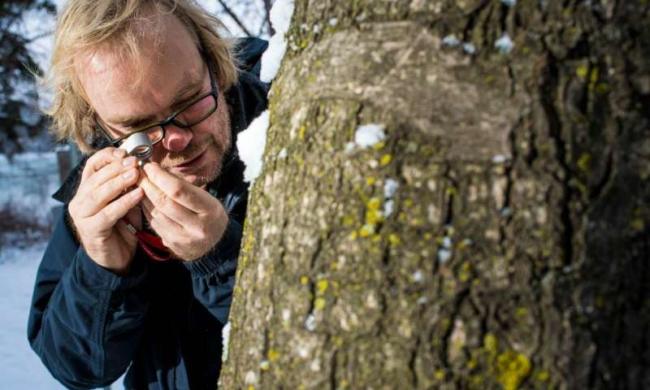
Spribille’s team embarked on a three week field study in Glacier Bay National Park. By night they slept in tents protected by a bear fence. And by day, they meticulously surveyed the landscape — observing lichens through a hand lens. 

“I like to compare it to the field inventory equivalent of the Slow Food Movement,” Spribille said.

Like the Slow Food Movement, Spribille savors each inch across the environment like a six course meal. 

“I’ve always been fascinated by small things that are not greatly valued by the rest of society,” Spribille said.

xx
Toby Spribille’s team also named lichens after other people who’ve made scientific contributions to Glacier Bay, such as ecologist, Karen Dillman, and naturalist, William S. Cooper. (Photo courtesy of the University of Alberta)

For such a small plant, lichens have a lot going on. They’re a symbiosis between fungus and alga that provide sugars for the fungus to live on. Spribille says they’re basically in a long term, stable relationship, and he thinks that’s an uplifting thing to consider — especially right now, when so much of the news is dominated by pathogens, like COVID-19. 

“A lot of science is obsessed with things that can kill us,” Spribille said. “The whole world right now is obsessed with something that can kill us, but much of what we see in the word, the diversity of life and the different forms that are around us … they’re all built on principles of collaboration and mutual benefit between different organisms.”

Glacier Bay National Park is chock full of these feel-good little organisms. Spribille says there seems to be a bottomless variety of lichens thriving: It’s the second largest abundance of lichens recorded in an area of comparable size. 

So why is that important? Spribille is not a fan of justifying somethings value based on human need alone. But he says some species of lichens have been used in clinical trials to treat cancer

There are many reasons to handle these biodiverse areas with care. 

“We tend to value things that have names and that we can associate with. And so, bears and bald eagles get a lot of value because we can relate to them,” Spribille said. “But bears and bald eagles aren’t the only things that inhabit the forests of Southeast Alaska.”

But of course, one little lichen has a name — inspired by Greg Streveler. 

Streveler shares some of Spribille’s views. He sees the value of small, ecological things existing for their own sake, and he’s glad future generations of scientists can appreciate life in Glacier Bay National Park, even at a micro scale. 

“Any place that nature is allowed to kind of take care of itself is just like a spot of gold,” Streveler said.

And now, a lichen named Lecidea Streveleri occupies a spot on an alder tree. But it’s been there all along. 

In the time of social distancing, Alaska holds its first online oil and gas lease sale

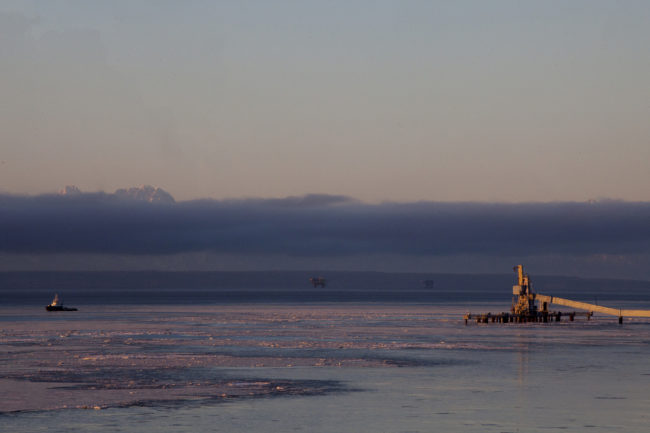
Cook Inlet oil platforms are visible from shore near Kenai, Alaska. (Photo by Rashah McChesney/Alaska’s Energy Desk)

The Alaska Department of Natural Resources announced Thursday that it’s holding its first ever online auction of oil and gas leases.

It’s a new way of doing business for the department in the time of social distancing. Since the state started lease sales in the 1960s, DNR said, it has relied on in-person auctions and sealed bids. Now, the department has hired a Texas-based company called EnergyNet Services to use its internet platform.

In a statement, DNR Commissioner Corri Feige said the online sale allows the state to offer the leases to broader markets. Also, she said, the department is working to find new ways to operate more safely and efficiently due to concerns about the coronavirus.

DNR’s plan to move to online bidding started before the pandemic, said department spokesman Dan Saddler. But, he said, the health-care emergency has underscored another advantage of the transition. Saddler said the department plans to continue with the online process in the future.

“Our new relationship with EnergyNet will bring our leasing program into the 21st century, while making our outstanding hydrocarbon opportunities more visible and attractive in a global marketplace,” Feige said.

The inaugural online auction closes June 11. As part of the annual Cook Inlet and Alaska Peninsula lease sales, the state is offering 1,729 tracts of land that cover nearly 8 million acres, an area about the size of Maryland.

Those interested in the leases can register online, select tracts from interactive maps and submit their bids, according to DNR. Then, they receive online invoices.

Site notifications
Update notification options
Subscribe to notifications