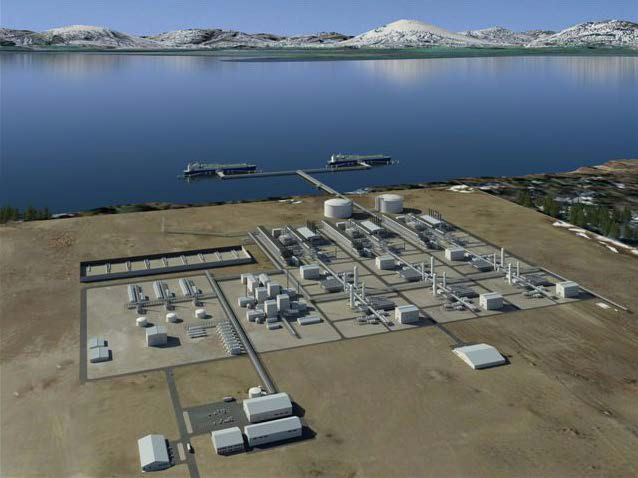
This illustration shows a rendition of what the liquefaction plant in Nikiski could look like if the Alaska LNG project is completed as planned. (Image courtesyAlaska LNG project.)
Alaska’s latest plan to get North Slope natural gas to market got environmental approval from federal energy regulators on Thursday.
Several state lawmakers, Gov. Mike Dunleavy and the state’s congressional delegation congratulated the state’s gas corporation for reaching the milestone.
In a news release Alaska Gasline Development Corporation president Frank Richards said that getting approval from the Federal Energy Regulatory Commission helps make the project less risky for investors and potential partners to consider — because it defines the environmental impacts.
But, there are still a lot of things that have to happen before the project gets off the ground. The state doesn’t have control of all of the land it needs, or the finances to get the $43 billion project built.
The state corporation is still working to make the project economically competitive. The markets the project is targeting are in Asia, where current prices aren’t high enough to make Alaska’s gas financially feasible to develop.
This version kicked off in 2014 as a partnership between the state and its big three oil producers BP, ConocoPhillips and Exxon Mobil. There was a fourth partner, TransCanada.
But, by 2016 those producers backed away from the project, saying the market conditions weren’t right. Then, the state took the lead.
But the state corporation’s board does not want the state to continue being the projects only sponsor. In April the board adopted a plan to bring on new partners to guide the project — the goal is to have those partners in place by January of 2021.
The environmental impact statement released today has its detractors.
Environmental groups like Earthjustice, The Center for Biological Diversity and Sierra Club say the environmental impacts outweigh its benefits.
And one of the four federal commissioners who heads up the regulatory agency shares those concerns. And disagreed with the decision. In his dissent, Richard Glick wrote that the commission is refusing to consider the impact the Alaska LNG project would have on climate change.
He wrote “claiming that a project’s environmental impacts are acceptable while at the same time refusing to assess the significance of the project’s impact on the most important environmental issue of our time is not reasoned decisionmaking.”
Editor’s note: This story has been updated with a change in the headline to reflect that the Alaska LNG project’s environmental impact statement was not significantly delayed, and to add further information from that impact statement.
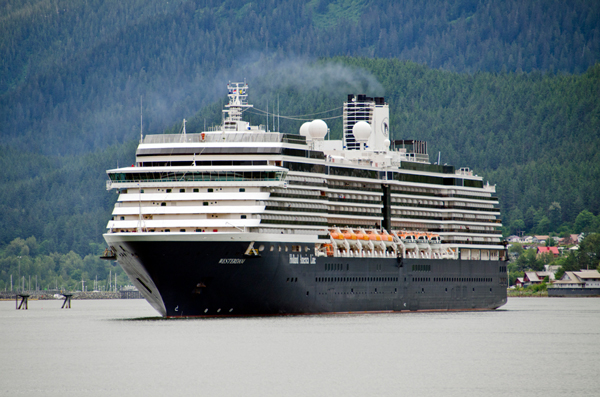
The Holland America Cruise Ship Westerdam prepares to dock in Juneau July 16, 2012. The ship was fined $250 by the National Park Service for illegally discharging grey water in Glacier Bay National Park. (Photo by Heather Bryant/KTOO)
Southeast Alaska’s economy is poised to take a hit as most of the season’s cruises cancel. But a rough year for tourism could be a good moment for science. No cruise ships or tour buses mean researchers will be able to measure the region’s baseline air quality.
Last year, Southeast residents logged forty-five air quality complaints against cruise ships with the state’s Department of Environmental Conservation. Nine of them were in Skagway.
But Skagway Mayor Andrew Cremata said the number logged with city hall is many times that.
“I’d probably put it in the neighborhood of 60 to 70 last year that I personally got, I don’t know about the official number,” he said.
Cremata said one cruise ship company agreed to monitor their emissions this summer. But now that most of the town’s projected arrivals are canceled due to COVID-19 safety concerns, Cremata and regional scientists are interested in a different data set: the baseline.
“It’s something completely different and that’s finding out what the difference is during this time of year now that we have a scenario where there are no buses, very few cars, no cruise ships, fewer planes, to kind of see how that compares,” Cremata said.
The cruise ship industry maintains that the pollution people see is really just vapor—ships mostly use scrubbers to clean the fumes from their heavy oil engines before it’s pumped into the air above port cities.
So the COVID-19 pandemic has the unintended result of providing researchers with something like a control experiment: what is the air quality like in Southeast Alaska without cruise ships?
“I think there is a potential to learn something, for sure,” said Michael Bower, the Program Manager for Southeast Alaska’s Inventory and Monitoring Network.
It’s part of the National Park Service’s regional effort to monitor the health of the ecosystem. He said the air quality program is in early stages, but should be operational in a few weeks. In prior years, he’s seen evidence that increased traffic in Skagway over the summer may affect the air quality.
“When we have done this direct sampling in the past we have had elevated concentrations of nitrogen oxides as well as sulfur dioxide at one of the sites that we’ve sampled that’s near downtown. Whereas we didn’t necessarily have elevated concentrations at other sites that were farther from from the hub of activity in Skagway,” he said.
Those elevated pollutant concentrations made Skagway a priority for Bower’s group for the past few years. He’s not out policing the industry—he says the study also looks at the effects of wildfire season on air quality.
Bower’s monitoring will be carried out in partnership with Skagway’s Klondike Gold Rush National Historical Park. Superintendent Jason Taylor says last year’s wildfires sparked serious air quality concerns, but the park didn’t collect data then.
“When you don’t have data to base decisions on, you’re kind of flying in the dark, right? It’s just a giant gray space and you feel like you need to make or want to make a decision to protect people. And you can’t, because you don’t know what the right decision is,” he said.
The data they plan to collect this year is going to help him make health and safety decisions about when to close the park to visitors and staff. The park is even hiring a new biologist to assist with the effort.
The network usually monitors in Glacier Bay and near Sitka, but this year it’s unlikely. Skagway has an existing partnership with the Department of Environmental Conservation that makes testing possible this year, with increased social distance and travel restrictions.
The Department of Environmental Conservation also conducted an air quality study last year in Juneau. It is unclear at this time whether or not they will continue.
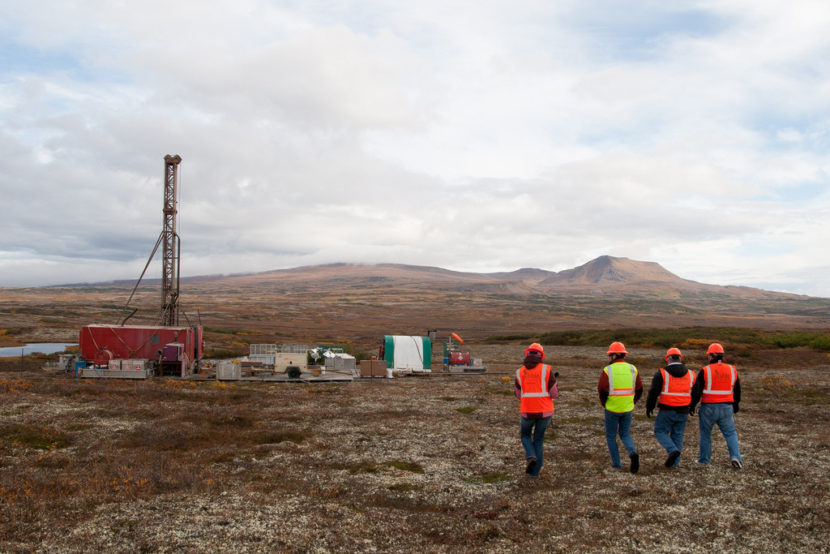
Members of the media walking to an exploratory drill rig at the Pebble Mine Exploratory site in 2013. (Photo by Jason Sear/KDLG)
Pebble Mine opponent Lindsey Bloom thought she had the goods.
When she saw a video showing an executive from Pebble’s parent company make a pitch to potential investors, she considered it proof of what fishermen and environmental groups have been warning – that Pebble is minimizing the scope of the project, but that ultimately it expects to build a more damaging operation.
“One of the ways you ensure you can get a permit is you de-risk it by taking something modest and conservative into the permitting process in the first place. And we did that,” Northern Dynasty Vice President Doug Allen says on the video, filmed at a conference in Toronto in late February.
“Because for whatever reason, cyanide has a bad reputation in the environmental community. And so we have forgone about 12% of our gold recovery, because we don’t have a secondary gold-recovery circuit,” he said. “That’s not necessarily gold lost. We hope it’s gold deferred, because we at a subsequent date will get a permit to add a secondary gold-recovery circuit.”
Lindsey Bloom opposes the Pebble Mine on behalf of the group Commercial Fisherman for Bristol Bay. (Joyanne Bloom)
Bloom, who works for Commercial Fisherman for Bristol Bay, believes that to be evidence of Pebble’s duplicity.
“Who are you lying to, Alaskans or investors? Because you can’t have it both (ways),” she said. “It can’t be a small mine and a big mine. You can’t use cyanide and not use cyanide.”
Bloom thought the video would make headlines. She sent a transcript to multiple new outlets more than a week ago. And then … crickets.
“I haven’t been hearing anything back from reporters. You’re the first one I’ve talked to,” she said. “And I just think that, I don’t know, the airwaves are so crowded right now. So much going on in the world.”
Environmentalists say the Trump administration is taking advantage of the coronavirus pandemic to advance Pebble as well as other Alaska projects and anti-conservation policies, while the public and the press are distracted. Until COVID-19 poses less of a threat, they’ve asked the government to hit the pause button on a host of issues:
An auction of drilling rights in the Arctic National Wildlife Refuge
Rolling back restrictions on hunting and trapping in National Preserves
Allowing brown bear baiting in the Kenai National Wildlife Refuge
The plan to develop Willow, a site in the National Petroleum Reserve-Alaska, near the village of Nuiqsut, that could have as many as 250 oil wells
Nicole Whittington-Evans, Alaska director for Defenders of Wildlife, says she’s disturbed the Bureau of Land Management chose to proceed with public meetings last month on the Willow development. She says people can’t provide meaningful input now.
Instead of the in-person meetings in a series of communities, the BLM had eight Zoom sessions. Whittington-Evans says it suppressed public comment.
“It really switched the power dynamic, incredibly, during these hearings, in terms of who had the control, who would be allowed to speak when when you could actually ask questions and not ask questions,” she said.
One man’s microphone was muted as he was providing his opinion, Whittington-Evans said. He was swearing, she acknowledged, and if it was an in-person meeting he probably would have been asked to leave. But, she said, he would not have been muted.
“You can’t just, like, hold your hand over somebody’s face in a public hearing,” she said.
BLM spokeswoman Lesli Ellis-Wouters said muting was employed once. She said the agency has a responsibility to keep the session suitable for all ages.
Zoom can’t replicate an actual meeting, but it allows for social distancing, and it has some big advantages when it comes to discussing Arctic projects, Ellis-Wouters said.
“One that stuck with me, I think it was our very first meeting, we had participation from Southeast, which had never been done at an in-person meeting before,” Ellis-Wouters said. “And we also, on that same call, we have somebody from Utqiagvik. There’s 1,000 miles in between those two communities, and they were able to come to the same meeting. So we were getting perspectives from people that we traditionally have not heard from before.”
The eight Zoom sessions on Willow drew about 400 unique views, plus another 2,000 views on Facebook live, Ellis-Wouters said. That suggests that far more people tuned in than attended the original set of community meetings that took place pre-pandemic, she said.
In the Zoom sessions, a lot of the Willow opponents said the format, or proceeding at all during a pandemic, was unfair. Project supporters, on the other hand, described it as a brilliant way to do public engagement.
As for Pebble, spokesman Mike Heatwole declined to be interviewed, but he said in an email that Pebble has no current plans to use cyanide. He also pointed out the public input period on the mine ended last year.
At this phase, the U.S. Army Corps of Engineers is working with its cooperating agencies on the final phases before it decides on issuing permits.
One of those cooperating agencies is the Curyung tribe of Dillingham, but its leaders say they have no time to co-operate.
“All of our tribal focus right now has become COVID and maintaining the health and safety of our people here in Bristol Bay,” said tribal administrator Courtenay Carty.
Thousands are flooding into the area to work in the fishery, and the first positive test has already emerged. Carty said she can’t keep up with the Pebble documents or attend the biweekly meetings of cooperating agencies now.
“And so we’re really disenfranchised at this point in time,” she said. “To (not) be able to focus on something as important as the Pebble permitting process, that we’ve dedicated over a decade to, to have it come to decision essentially over summer, in the midst of a global pandemic is unfathomable.”
The executive from Pebble’s parent company told potential investors they expect to have a federal permit by August.
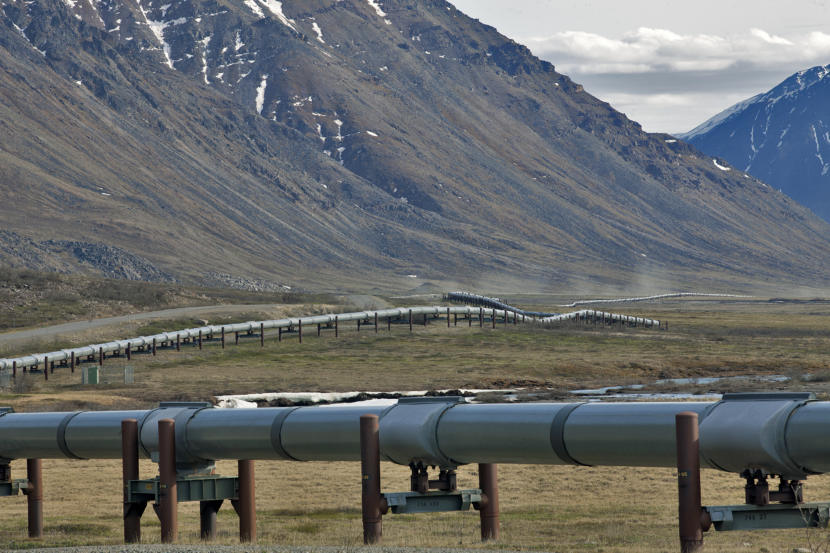
An above-ground section of the Trans-Alaska Pipeline System near the Toolik Field Station in the North Slope Borough. (Photo by Rashah McChesney/Alaska’s Energy Desk)
The operator of the trans-Alaska pipeline is allowing oil companies to send more crude from the North Slope to Valdez as demand creeps back and economies reopen.
Alyeska Pipeline Service Co. had previously imposed a 15% cut to North Slope production as the coronavirus hammered demand for oil and that, paired with an international oil price war, led to a glut of oil on the market. On Friday, Alyeska trimmed the reduction to 5%, or roughly 25,000 barrels of crude a day spread across all fields.
“It is a big deal to be able to adjust a proration and get back to business, where every barrel that producers intend to move, we can move,” said Michelle Egan, a spokeswoman for Alyeska. “That’s what we’re here for.”
In late April, Alyeska had cut oil flow by 10% to avert a storage crunch in Valdez, the town where tankers pick up the crude and deliver it to West Coast refineries. It raised that to the 15% cut on May 8.
Larry Persily, who has long tracked oil and gas markets, described the reduced cut from Alyeska as “the first sliver of good news for Alaska North Slope oil producers.” It indicates there’s a place for the crude to go after it’s pumped from the oil fields at the top of Alaska, he said.
“It’s more of an indication that there’s capacity on the West Coast, at the refineries, and in storage,” he said. “So they’re going to up production because there’s a place to put it. There’s someone who wants it. And prices are higher.”
But, Persily said, there’s still a backlog of bad news for Alaska’s oil industry: Oil producers have recently slashed spending and reduced drilling. Oil field service companies have laid off hundreds of workers. The state’s largest oil producer, ConocoPhillips, also still plans to cut its oil production in half in Alaska for the month of June.
“The decision to curtail production by 100,000 barrels a day in June has been made, and that won’t change,” Conoco Alaska spokeswoman Natalie Lowman wrote in an email.
Alyeska operates the pipeline on behalf of its owners: Conoco, BP and ExxonMobil.
Alyeska reported 450,299 barrels of North Slope crude flowing down the pipeline on Monday. The value of a barrel reached almost $30 by last week — a significant climb from a low of -$2.68 on April 20. It’s still far below the $70 value from early January.
Egan said there’s no timeline for when Alyeska will remove the 5% cut. She said that’s the ultimate goal.
“We’ll make every effort to get back to 100%,” she said. “That’s absolutely where we want to be.”
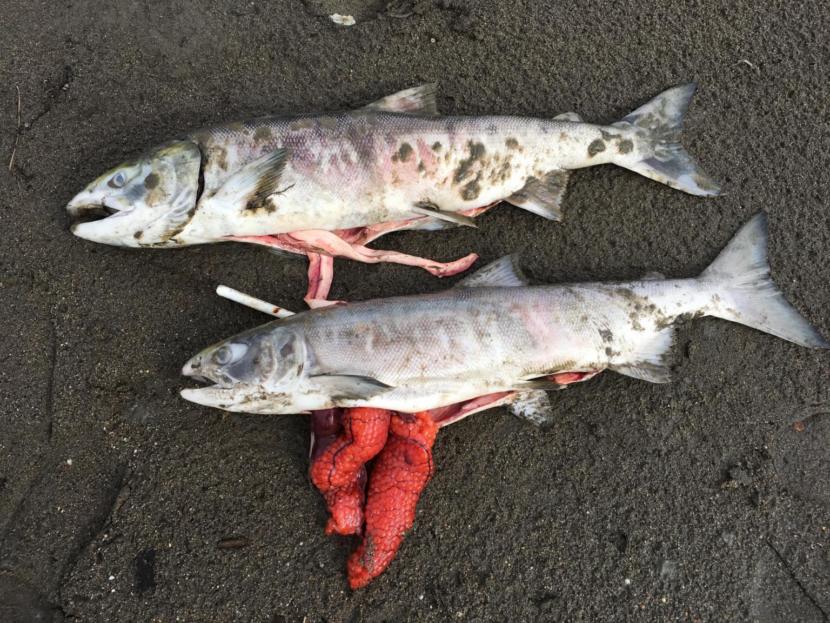
Scientists suspect heat stress killed a large number of summer chum salmon migrating through the Koyukuk River, a tributary of the Yukon. The carcasses held underdeveloped eggs and sperm, indicating that the salmon were far from their spawning grounds, where salmon usually die. (Photo by Stephanie Quinn-Davidson/Yukon River Inter-Tribal Fish Commission)
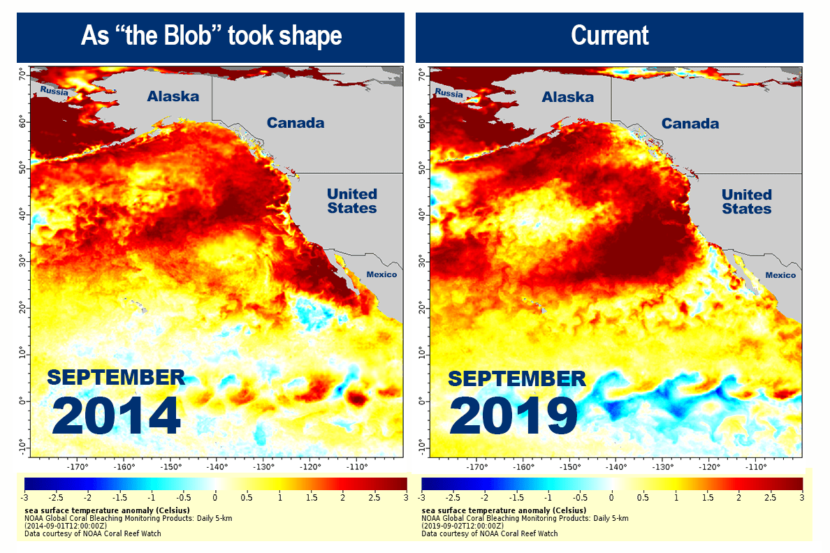
Over the last decade, two massive marine heatwaves, better known as “blobs” swept the North Pacific Ocean, raising surface temperatures more than 5 degrees Fahrenheit causing blooms of toxic algae and major die-offs in the ecosystem. A new study from the University of British Columbia reports that as these heatwaves continue, they may have far more devastating implications to fisheries than previously predicted.
Climate scientists have known for years that global warming would have devastating long-term impacts on marine species. Already, fast-melting Bering Sea ice is threatening spotted seals and other marine mammals. Warming Gulf of Alaska waters wiped out cod eggs in 2019, causing a crash in cod stocks. Record warm waters in the Yukon River last summer killed thousands of migrating salmon with heat stress.
While climate change is steadily warming oceans all over the world, marine heatwaves, like the two North Pacific “blobs,” are causing more dramatic swings in surface temperatures. In 2014 and again in 2019, ocean temperatures in Alaska rose as much as 5 degrees Fahrenheit.
A NOAA map illustrates the similarities between the 2014 “Blob” and the 2019 heat wave event in ocean temperatures (Map courtesy NOAA).
William Cheung, a professor at the University of British Columbia’s Institute for the Oceans and Fisheries said marine heatwaves will be frequent and that will double the damage to northeast Pacific fisheries.
“The normal now is cooler than the normal in the future, 50 or even 100 years later,” said Cheung. “Then on top of that, we add an additional few degrees Celsius. And so that would create additional challenges to fish stocks and fisheries.”
Cheung co-authored a report analyzing the impacts of marine heatwaves on Northeast Pacific fisheries. The study teased out the impacts of high-intensity heatwaves from the average effects of a warming climate over time.
The findings show that by 2050, marine heatwaves will double the impact to important fishery species like pollock, cod and salmon over previous predictions that only took into account the effects of climate change.
It’s an alarming forecast for Alaska, where seafood is a $5.6 billion industry and the state’s largest export, after oil and natural gas. Fisheries are the primary economic driver for coastal Alaskan communities, and carry a globally recognized reputation for healthy management, even as climate change threatens the futures of many essential stocks. According to Alaska Sea Grant, more than 100,000 Alaska Natives and non-natives in rural communities rely on healthy fish stocks for subsistence living.
“It will lead to a variety of impacts on fish stocks, like a decrease in biomass, decrease in potential catches, changes in the distribution from where they are living now,” said Cheung.
The study says previous research “greatly underestimated” the risk to fish stocks in a warming ocean. For instance, prior studies suggested sockeye salmon stocks in the Gulf of Alaska would fall 10 to 20 percent in the next 50 years due to climate change. Cheung’s team estimates the drop is more like 20 to 40 percent when you take heatwaves into account.
Cheung said the compounded impact of heatwaves will affect the entire ecosystem, including marine mammals and seabirds that rely on fish for food. The effects may already be present, he said, in the sweeping seabird die-offs that left almost a million birds starved to death along the West Coast in 2015 during the first “Blob”.
Cheung said there is still a lot of research to be done on the impacts to humans who rely on those fish too.
“We [will] also look at the implications for the dependent human communities, particularly on fisheries that are dependent on these species,” he said. “We are trying to quantify the economics as well as the social impacts associated with … marine heatwave[s].”
The new study models ocean changes on a macro scale. Anne Hollowed, who studies fish stocks for the Alaska Fisheries Science Center said predictions about precisely how and when commercial fish stocks will be impacted is an ongoing field of work.
“How fish move and their availability to coastal communities to harvest them is quite an important issue. To model the very near shore ocean practices requires a finer scale resolution model than the models that William [Cheung] was using,” she said. “You actually need to downscale the global ocean conditions to look at the processes that really govern coastal fish distribution and abundance in areas where coastal communities might be trying to access those fish.”
Hollowed said it’s still too soon to tell how marine heatwaves will impact the future of commercial fisheries, and regulatory agencies are already adopting protocols to use research from Cheung and other scientists to adapt management plans.
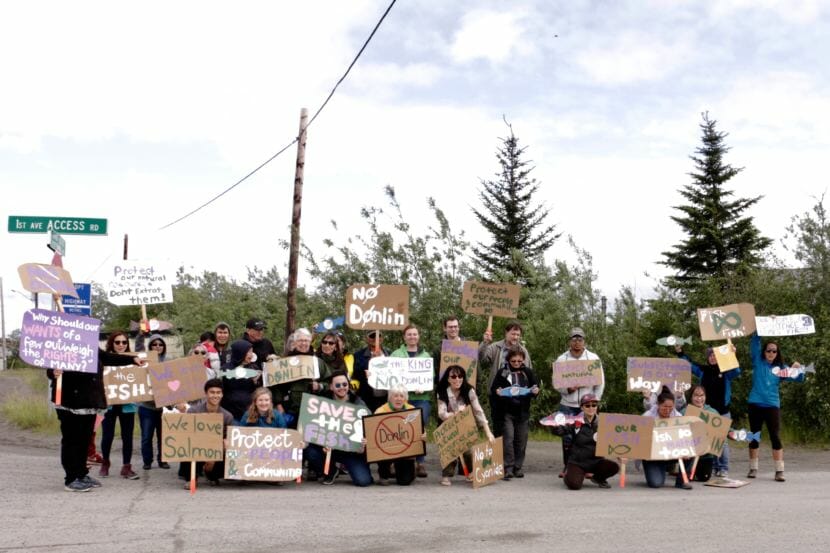
The Orutsararmiut Native Council led a public demonstration against the proposed Donlin Gold mine in Bethel on Friday, June 22. (Photo by Christine Trudeau/KYUK)
Ten tribes have sent a letter protesting the proposed Donlin Gold mine to the two companies trying to build it in the Yukon-Kuskokwim Delta.
The letter came as one of the companies, Novagold, was set to deliver its annual report to its shareholders last weekend.
The company has touted support from the region in its quarterly earnings reports and annual presentations, but this time tribes want to make sure that investors know that not all tribes support the Donlin Gold mine.
“The proposed project poses too much risk to our lands and our food sources which we have an obligation to protect and develop responsibly for future generations,” the letter said.
The letter asked both companies to withdraw their investment in the project. The mineral rights and land belong to two Native corporations formed under the Alaska Native Claims Settlement Act, and those companies have leased their rights to Canadian mining companies Novagold and Barrick Gold. The letter cited concerns about the impact extra barge traffic could have on smelt habitat, the company’s plans to store its mining waste, and the fact that the companies must treat the mine’s wastewater forever.
In a statement, Mark Springer, the executive director of Orutsararmiut Native Council in Bethel, said that the mine would threaten the tribes’ subsistence lifestyle.
“Our gold swims in the Kuskokwim River. It hangs on our fish racks in the summer and sustains us throughout the long winter months until the salmon again return,” Springer said.
Last year, 35 tribes passed a resolution opposing the Donlin Gold mine at the annual Association of Village Council Presidents’ convention. That marked a major turning point in regional support for the gold prospect. The tribes signing the letter were: Orutsararmiut Native Council in Bethel, Tununak, Eek, Chuloonawick, Kasigluk, Chevak, Kotlik, Napakiak, Kongiganak and Ohagamiut Native Council.
Donlin Gold has repeatedly said it plans to build the mine as safely as possible.
Close
Update notification options
Subscribe to notifications
Subscribe
Get notifications about news related to the topics you care about. You can unsubscribe anytime.