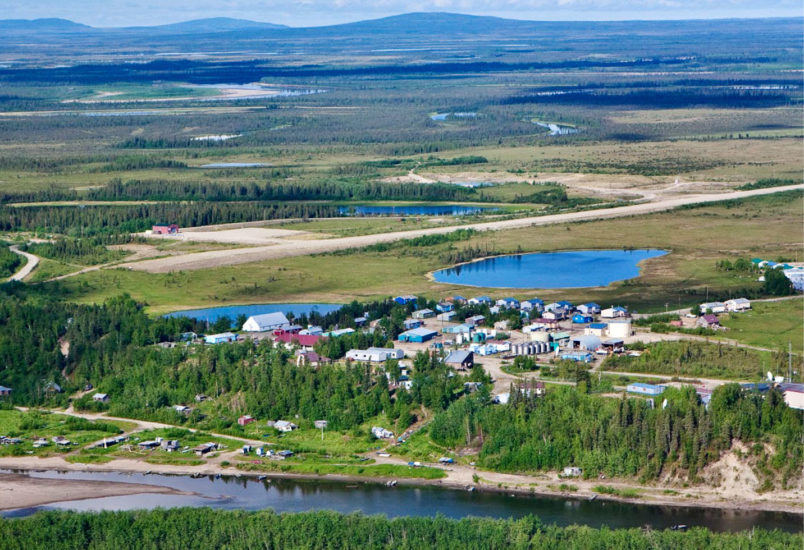
The Native Village of Shungnak (Photo courtesy of Northwest Arctic Borough)
State officials are monitoring a roughly 15,000-gallon heating oil spill in the Northwest Arctic village of Shungnak, according to the state Department of Environment and Conservation.
The Native Village of Shungnak reported the spill at around 1 p.m., Saturday. Officials say a fuel tank for the school in Shungnak was overfilled during a delivery from a barge. The fuel was intended for the local Native store and the Alaska Village Electric Co-op tanks.
A Shungnak response team cleaned up the spilled oil and began pumping it into containers. An excavator was dispatched to the area to remove contaminated soil.
DEC officials say one potential area of risk is the Kobuk River, which is about 160 feet away from the extent of the spill. They also listed Shungnak’s drinking water source as another risk area; it’s about 295 feet away.
DEC and U.S. Environmental Protection Agency officials are in contact with the local response team. COVID-19 travel restrictions have prevented officials from either agency from heading to the spill site.
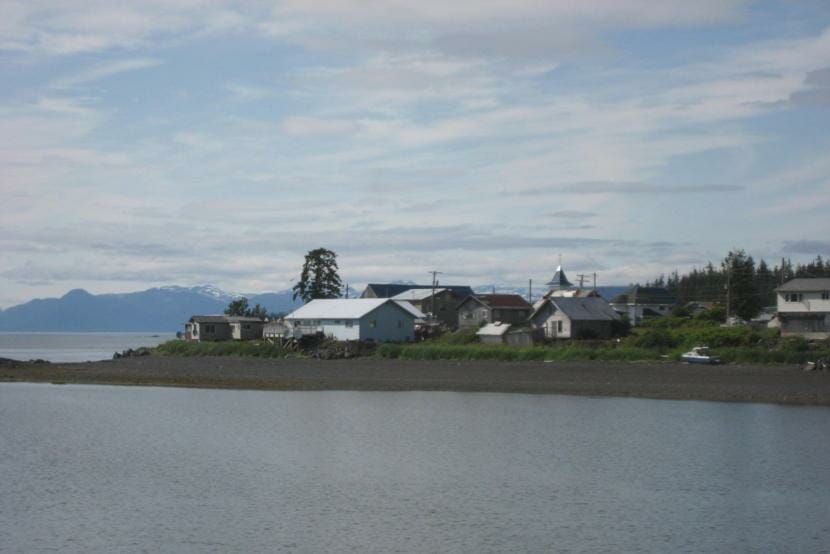
Kake photographed in 2012. (Department of Commerce, Community and Economic Development; Division of Community and Regional Affairs’ Community Photo Library.)
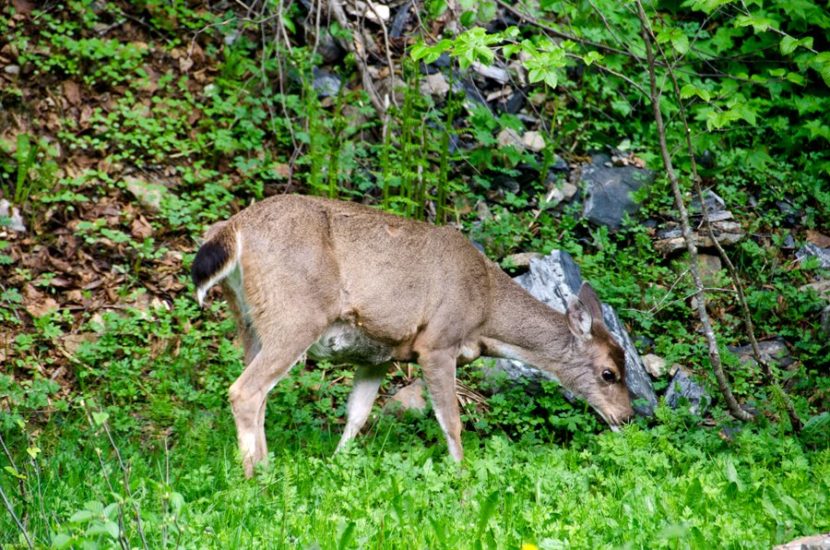
The federal subsistence board approved a special hunting request on Monday that permits the Organized Village of Kake to harvest deer or moose out of season.
The tribal government expressed concern at the beginning of the COVID-19 pandemic that grocery store shelves weren’t fully stocked with items like meat. Kake’s Tribal President also added he was worried about the health of village Elders.
Dave Schmid is the regional forester at the U.S. Forest Service Alaska region. He voted to approve the measure, which passed 7 to 1.
“I would say given the level of food insecurity that you heard from here facing this community, approving this special action — it’s the right thing to do,” he said.
Schmid said that he didn’t foresee any conservation issues related to wildlife population numbers in the vicinity of Kake.
The federal subsistence board has been handling multiple requests across the state. Some communities are worried about the impact of the pandemic on the food supply chain.
Earlier in the month, the agency tried to speed up that process by delegating local land managers to make the call. That process was stalled when a state emergency response group suggested there wasn’t a disruption in the food supply chain.
The Alaska Department of Fish & Game has yet to approve emergency hunting actions on state land.
Tribal governments and other communities in Alaska have been waiting for nearly two months for an answer to emergency hunting requests. The pandemic has caused some food supply disruption concerns, and so at least six small localities across the state have asked for special permission to hunt out of season.
That decision is typically granted by a federal board, but because everything about the pandemic is unprecedented, it hasn’t been simple.
Joel Jackson is the Organized Village of Kake’s Tribal President. When he first approached federal employees about opening the deer and moose season earlier than normal, he didn’t expect the process would take this long and the decision would be passed around to different levels of federal agencies.
“There’s still limitations from our one little store,” Jackson said.
It’s not just food scarcity Jackson is concerned with. Shipments of food are regularly arriving now, but it’s all processed meat slaughtered and packaged from the Lower 48. Jackson doesn’t think that’s as healthy or culturally nourishing for elders in the community — elders who could be especially vulnerable to complications from COVID-19.
Kake isn’t on lockdown anymore, and Jackson says people are traveling in and out of town. He thinks this is a crucial window when residents need to feel their best.
“If this virus ever makes it into our community, which I hope it never does, we need to have our people at the best health they can be by supplying them with the best food that we can give them,” Jackson said.
The federal Office of Subsistence Management is fielding multiple requests like Kake’s, and there isn’t an exact blueprint for how this should be done. The agency is used to responding to emergency hunting actions in the event of storms, but processing this during an ongoing pandemic presents a different set of challenges.
A records request filed by Alaska’s Energy Desk shows how the agency is trying to speed up that process. A U.S. Forest Service ranger district in Petersburg was delegated the authority on June 2 to grant emergency hunting actions for rural subsistence residents — like Kake. That negates some of the bureaucratic rigmarole, and it’s happening in other parts of Alaska, too. Still, there are certain caveats for final approval. One of them is that a state entity has to confirm the need.
Bryan Fisher is an Incident Commander at Alaska’s Unified Command: a central hub for various state agencies to respond to emergency situations, such as a pandemic.
“We just have not seen any supply chain disruptions or any loss of the ability to preserve previously gathered subsistence foods,” Fisher said.
The Unified Command has been helping restock food banks across the state, among other things. But the group has also been tasked by the Alaska Department of Fish & Game to make food need assessments in remote communities.
“They turned to us to do that validation of whether there was a real break down in that supply chain that would cause them to consider opening hunts on state land and working with the subsistence board to figure that out,” Fisher said.
Some clarification: The federal subsistence board approves special actions on federal lands, like emergency hunts. And the state of Alaska has its own process for state lands. In this case, the state Unified Command’s determination also weighs on the Peterburg ranger district’s ability to grant emergency hunts on federal land. In Kake’s situation, that decision was deferred back to the federal subsistence board. Essentially, Kake’s in a similar spot as they were back in April when they first requested the emergency hunting action.
Jackson is disappointed that a decision between a federally recognized tribal government and a federal agency is being delayed further because of input from the state. He says last season’s deer meat is running low in many people’s freezers. The community knows what’s best for them.
“We’ve always been conservationists,” Jackson said. “We’ve always been mindful: Never take too much.”
The federal subsistence board is expected to take this up in a public meeting on Monday, June 22. And Jackson hopes they account for all the ways a household with deer or moose on the dinner plate is a reflection of health during these uncertain times.
Editor’s Note: This story has been updated as new information has become available.
The work camp for the proposed Donlin Gold mine in the Yukon-Kuskokwim Delta. (Krysti Shallenberger / KYUK)
A recent report from a financial research firm says that the proposed Donlin Gold mine in the Yukon-Kuskokwim Delta will never be built. The mine could be one of the biggest gold producers in the world if completed, but the research firm says that it costs too much to actually build. But that firm can make a lot of money off of its report, and one of the mining companies strongly disagrees with its conclusion.
J Capital Research analyst Tim Murray lives in Australia, and what he does is research companies to see if their stock is worth buying or selling. More specifically, they focus on short research.
“That is, we help companies to make money from stocks going down. So we try and identify companies that are overvalued and present them to the market,” Murray said.
The firm acknowledges that they are biased both in bold letters on the report, and on its website. J Capital Research and its clients stand to make a lot of money if Donlin’s stock price declines. And after the firm released its report on Donlin on May 28, NovaGold, one of the companies that’s developing the mine, has seen its stock steadily drop from $10.10 a share to $8.64 on June 10. NovaGold stock closed out at $8.01 on June 16.
The report claims that NovaGold is overvalued because the Donlin Gold mine is actually too expensive to build. Murray claims that NovaGold executives are touting the mine to make themselves richer. NovaGold’s board of directors determines how much stock executives can receive as part of their financial compensation.
“They can make money whilst the market believes in it while [they] issue themselves shares and options. And then they can sell them at inflated prices because they keep pushing the mine. They become personally wealthy,” Murray said.
In response, NovaGold released its own report on June 8. CEO Greg Lang says that the J Capital Research report is misleading.
“It’s indicative of the power of misinformation when it spreads on the internet,” Lang said. His company points out inaccuracies in a line by line analysis. For instance, one argument in J Capital’s report is that employees selling shares indicates that the company is overvalued.
“They made a lot of statements about employees selling shares, my ownership, and so on, which are just simply erroneous. My ownership in NovaGold has steadily increased since I joined the company, and it will continue to do so,” Lang said.
How the stock sales work is complicated. NovaGold Vice President of Corporate Communications Melanie Hennessy said in a email that stock options granted to executives have a five-year limit. That means the executive must sell off those shares in five years in what’s called a stock option exercise, or forfeit them.
“Option exercises usually involve the sale of some shares, but the exercise does not result in a decrease of the number of shares held by a person before they exercised the option. In some cases, an exercise results in an increase in a person’s shareholdings,” Hennessy wrote.
J Capital Research and NovaGold both say that there’s no legal limit to how much stock a company executive can own. Murray said that NovaGold executives selling these shares now instead of waiting for the stock to rise even more when the mine is built shows that the executives themselves don’t believe that will happen.
J Capital Research didn’t stop at the financial inside-baseball. It also focused on the massive infrastructure that Donlin Gold has to build before it can start mining. The mining operations will require a lot of energy, so Donlin Gold has proposed building a 157 megawatt power plantfed by natural gas that will be transported through a 315-mile pipeline. That pipeline crosses mountains and will be built on permafrost. J Capital analysts argued that kind of terrain makes it unlikely that Donlin can build the pipeline, but Lang disagreed.
“We believe it. The pipeline is completely feasible as we’ve presented it. Just because some unknown expert says it can’t be done, I think I would rather put my faith with the Alaska contractors who know and understand Alaska. They’ve walked the pipeline. It’s been well studied. You know, it’s completely feasible,” Lang said.
Donlin Gold hired Alaska engineering firm CH2M Hill to draft pipeline construction plans and eventually build it. Texas-based Jacobs Engineering Group bought CH2M Hill in 2017, but the company is still involved with the Donlin Gold pipeline project.
The J Capital Research report cited growing costs in pipeline construction as another major hurdle facing Donlin’s pipeline project. NovaGold and its partner Barrick Gold, the largest gold mining company in the world, need $6.7 billion up front to build the mine, according to its 2011 feasibility study. The 2011 feasibility study has only been updated once, in 2012. Lang says that it costs tens of millions of dollars to update a feasibility study, and that for a long time, the market price for gold didn’t justify updating it.
“NovaGold has always been very careful with our money. We have a strong treasury, and when us and Barrick think the time is right, we will move forward,” Lang said.
Lang said the companies will start updating the study by the end of 2020, but he didn’t specify what market conditions and gold prices are ideal for building the Donlin mine project. Right now, gold prices are around $1,700 per ounce. That’s considered a good price for gold.
Alaska’s Energy Desk reached out to three financial and research firms to weigh in on the J Capital Research firm report: Morgan Stanley, Wood Mackenzie, and S&P Global. Wood Mackenzie and S&P Global declined to comment; Morgan Stanley didn’t respond.
Two years ago, Alaska’s Energy Desk asked financial firm S&P Global about the Donlin gold mine. Gold prices were hovering at $1,400 an ounce. The firm said then that the gold market was pretty good, but the cost to build the Donlin Gold mine was the biggest hurdle. That’s a common challenge facing Alaska infrastructure projects, because most of them cannot be reached by roads. Donlin Gold wants to build the mine in a remote part of Alaska, and the only way to get there is by a small plane.
NovaGold floated some ideas of reducing the cost in earnings calls, but nothing has been settled on yet. Barrick Gold released its 10-year plan to its investors earlier this year, but Donlin Gold did not appear in it.
In an earnings call in February, a financial analyst asked Barrick Gold CEO Mark Bristow about the Donlin Gold mine’s absence from the plan. Bristow said that the mine would not be feasible at $1,200 per ounce, which is the benchmark they used for planning.
“We’re not going to put Donlin in because we managed at $1,200. We’re not changing the rules in this; we’re showing you that we’ve got visibility on the runway for a 10-year program and there might well be opportunities that we will highlight, but they would need to be opportunities that make it at $1,200 gold price. So that’s, the optionality is what it is and we’ll leave it there,” Bristow said according to the transcript.
J Capital Research’s Murray points to co-owner Barrick Gold for clues that the mine may never be built.
“They say it’s not their plan to build it now. It’s possible they could build it in the future, but my question is more when? I mean, they put out a 10-year plan and Donlin’s not part of that.,” Murray said. “And they’ve said quite clearly that the current plan for the mine doesn’t reach their criteria for development. So what has to change? And they haven’t really said that.”
But Lang says that Novagold and Barrick still plan on building the mine.
“Barrick, NovaGold are completely aligned on where we see this project,” Lang said.
Alaska’s Energy Desk reached out to Barrick Gold for comment, but the company did not respond.
Meanwhile, NovaGold’s stock fell even more the day they released their defense of the mining project.
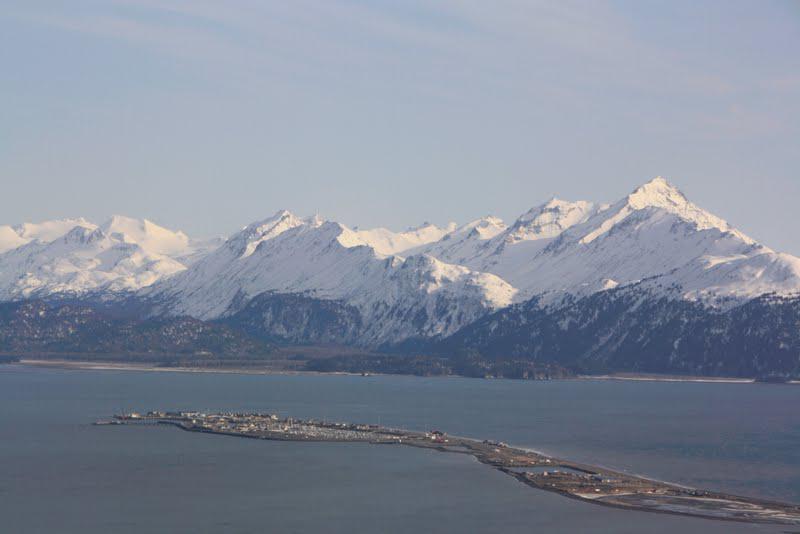
A view of the spit in the southern Kenai Peninsula town of Homer. Homer is one of multiple Kenai communities where cases of COVID-19 have spiked in recent weeks. (KBBI)
COVID-19 has spread quickly in recent weeks on the Kenai Peninsula, which now has a per capita infection rate that’s three times the one found in Anchorage and 62 active cases as of Tuesday, according to state data.
While the Kenai transforms into a tourism and fishing hub during the summer, officials there don’t blame the high case rate on any particular factor — though they say some cases are tied to residents who continue to gather in group settings in spite of public health recommendations against that.
In recent weeks, state health authorities have been forced to enlist workers from other parts of Alaska for the painstaking work of tracking and monitoring the close contacts of sick people on the Kenai, said Leslie Felts, a state nurse manager. As of Wednesday, the state was monitoring 300 people there, she added. (That number includes both confirmed cases and the “close contacts” of those people.)
“Early on, Ketchikan had a lot of activity when we first started down this road with COVID,” Felts said. “Then there was some activity up in the Fairbanks area. Now, it seems like it’s our turn down here on the Kenai Peninsula.”
At 16,000 square miles, the Kenai Peninsula Borough is roughly the same size as Massachusetts and New Jersey combined, with rural fishing communities, Alaska Native villages, tourism destinations and decades-old oil and gas infrastructure.
The Kenai’s infections appear to be concentrated on the southern part of the peninsula, where Homer has 18 active cases — a half-dozen of which appear to stem from the recent landing of the state ferry Tustumena, which had an outbreak of infections among crew.
There are 19 more active cases that the state lists in the “other South” portion of the peninsula. That’s a catch-all category for communities in the southern part of the borough that have fewer than 1,000 people.
The state says that identifying those small communities with active cases could jeopardize people’s privacy, and officials wouldn’t release any details or even make broad characterizations about those “other” cases. But health-care providers chose to run pop-up testing sites in several southern Kenai locations last week.
Those include the village of Seldovia, across Kachemak Bay from Homer, as well as Nikolaevsk, another isolated village inhabited largely by members of a sect of the Russian Orthodox Church known as the Old Believers.
Seldovia’s city manager didn’t respond to a request for comment Wednesday. In Nikolaevsk, “the village is choosing not to comment on the situation,” Nikki Place, the president of the local community council, said in a text message.
Health officials and emergency managers say that they haven’t seen any consistent themes connecting the cases spread across the Kenai, though late last month, Alaska’s chief medical officer, Dr. Anne Zink, said there were clusters that appeared to be associated with “some celebratory gatherings that took place.”
“We have pockets from people in their work setting, in church settings, restaurants, indoor and outdoor gatherings,” said Felts, the public health nurse manager. “It’s pretty broad.”
Another thing that could help explain the southern peninsula’s higher caseload is more widespread testing.
At the early part of the pandemic, Homer’s South Peninsula Hospital was only testing patients with symptoms, at a rate of about six or seven a day, said Ryan Smith, the hospital’s chief executive.
As commercial fisheries started ramping up about two weeks ago, the state sent a Cepheid testing machine, which has good accuracy and can process about four tests an hour.
That’s allowed the hospital to cast a much broader net, and it’s now collecting about 150 samples a day, Smith said. That includes testing patients with symptoms, plus those in the emergency room, along with employees — six of whom have tested positive, said Smith.
The hospital has also worked with partners to offer off-site testing, said Smith. Tests have been collected on Homer’s spit, at a site out the road leading east from town, and in the community of the Anchor Point to the north — and each of those efforts has yielded positive tests, he added.
“We’re going to where the people are, versus forcing them to come, to drive up to the hospital to get tested,” he said.
By contrast, the Central Peninsula Hospital in Soldotna, which serves about two-thirds of the Kenai’s population, has only been able to collect about 35 samples a day, said spokesman Bruce Richards.
The hospital has struggled to put widespread, reliable testing in place, and lacks a machine onsite that’s reliable, Richards said.
The Kenai Peninsula Borough, which owns the hospital, is planning to buy a $400,000 “high-capacity” testing machine with its $37.5 million share of federal coronavirus relief money. But delivery is expected to take at least four months, and in the mean time, the hospital has to have its test kits driven three hours to Anchorage for processing there.
Those current hurdles to widespread testing suggest to Richards, the hospital spokesman, that the central Kenai has less of a window into the spread of COVID-19 than the southern part of the peninsula.
“Are there people walking around that are positive? There are. The only way to find out is rapid, ubiquitous testing and that’s what our goal is,” he said. “The more testing you do, the better a picture you’re going to find.”
For now, in spite of the Kenai’s sharp rise in cases, health-care professionals aren’t calling for a return to stricter social distancing mandates.
As of Wednesday, there were no COVID-19 patients hospitalized in either Kenai or Soldotna. And Smith, the Homer hospital executive, said his facility has spent three months equipping itself for when cases do start to arrive.
“I don’t think there’s any level of panic, and going back to any kind of a lockdown doesn’t seem realistic,” he said. “We feel like we’re pretty well prepared to deal with the activity that we’re seeing right now.”
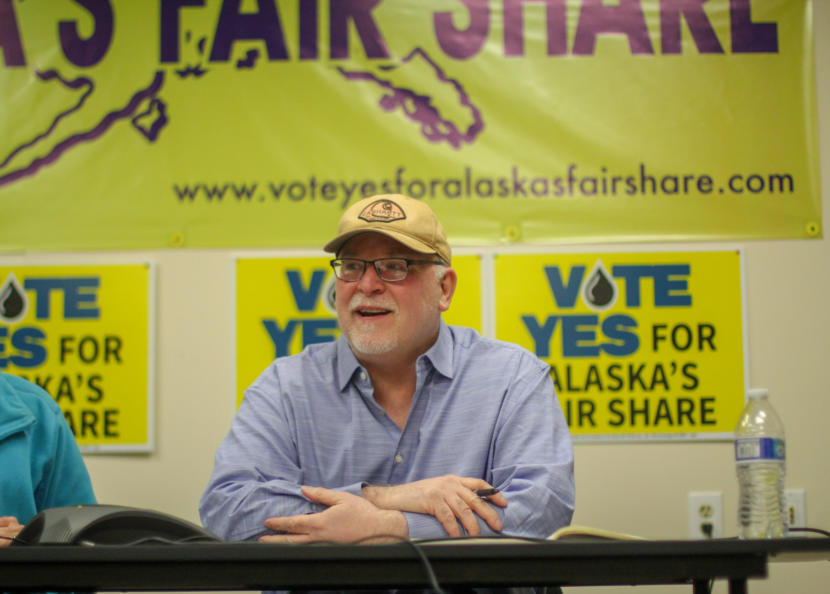
Anchorage attorney Robin Brena sits at a meeting of the citizens initiative campaign to raise taxes on Alaska’s largest oil producers on Thursday, January 16, 2020. (Photo by Nat Herz / Alaska’s Energy Desk)
An Alaska superior court judge has ruled this week that the state must correct part of its summary for a ballot initiative that would raise taxes on the state’s largest oil fields.
Judge William Morse sided with the backers of the initiative and wrote in an 18-page order that the summary provided by Lt. Gov. Kevin Meyer was not impartial, as required by state law. Morse ordered that Meyer delete the problematic sentence from the summary.
That sentence had to do with oil producers’ tax filings for the state’s three largest oil fields: Prudhoe Bay, Kuparuk and Alpine.
The group backing the initiative, often referred to as Ballot Measure 1, says it wants tax filings made public so Alaskans can see producers’ profits, revenues and costs for the fields.
Meyer’s summary of the initiative says — if it became law — the filings would be subject to the state’s normal public records act process. The initiative’s backers objected to that description. They say it’s not the same because the state could decide to keep some of the information confidential through the process.
In his order, Morse said that for now the most important goal is to allow the initiative’s backers to present their vision of transparency and taxation to the voters. He said Meyer placed “his finger on the scales” when he stated the provision did not mean what its backers say they intended.
“By siding with the possibility of confidentiality Meyer has engaged in partisan suasion,” Morse said. “That is improper.”
In a statement Wednesday, the Alaska Department of Law said it was disappointed the court “failed to see the straightforward accuracy” of the sentence.
“It is the State’s position that whether any information would ultimately be withheld under another existing exception or under the privacy clause of the Alaska Constitution are questions for implementation and not addressed in the summary one way or the other,” the statement said.
Initiative chair Robin Brena said in a statement that it was unfortunate the group had to bring a lawsuit to get Meyer “to fulfill his duty to provide a true and impartial summary” of the initiative.
The initiative will appear on the Nov. 3 general election ballot. The initiative group is also facing a lawsuit from industry trade groups.
Close
Update notification options
Subscribe to notifications
Subscribe
Get notifications about news related to the topics you care about. You can unsubscribe anytime.