Alaska coronavirus news

Live updates and information on COVID-19 in Juneau and Alaska
State health officials stress importance of vaccinating youngest Alaskans against COVID

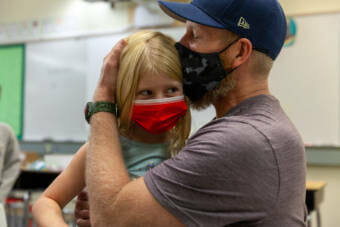
A child gets a kiss from her dad after getting her COVID-19 vaccine during a pediatric clinic at Riverbend Elementary School in Juneau, Alaska. (Photo by Rashah McChesney/KTOO)

Children under 5 years old began getting COVID-19 vaccines in Alaska last week.

In a health presentation to parents Tuesday night, state health officials stressed the importance of getting kids vaccinated and addressed common concerns. Alaska’s chief medical officer, Dr. Anne Zink, said COVID-19 vaccines for the youngest Alaskans have been a long time coming.

“Some of you have had your children during this pandemic and have not had great ways to protect them against the worst of this disease,” she said. “Even though we know that it does not impact children to the same degree as our elders, we know that our children are not immune from this virus.”

The state reported a 26% increase in COVID-19 cases this week compared to the previous week.

Case numbers reported among young children have been lower than older groups. But pediatrician Dr. Mishelle Nace said it’s still worth getting them vaccinated to reduce the likelihood of severe symptoms.

“We want you to know that they’re safe and they are effective,” she said. “It doesn’t change a person’s DNA. It doesn’t impact fertility. It’s not been shown to have long-term impacts from the vaccination, and we know that there’s secondary effects from getting COVID-19.”

The two Alaskans under 19 who have died of COVID were both infants. There have also been more hospitalizations among kids younger than 10 than among older kids. Just 42 kids ages 10 to 19 have been hospitalized in Alaska, while 76 kids under 10 have, according to state data.

In Alaska, 23 kids have had multisystem inflammatory syndrome, or MIS-C, a serious condition that can develop in the weeks after a COVID-19 infection. Eleven of them were younger than 4.

The risk for myocarditis, a type of heart inflammation, is higher from a COVID-19 infection than a vaccination, said pediatric cardiologist Dr. Kevin Kollins.

Health officials also emphasized how thorough the research was on pediatric vaccines before they were authorized. Dr. Lisa Rabinowitz said there were no cases of myocarditis, no allergic reactions and no deaths during trials for the vaccines. Plus, she said, the doses given to older groups have provided scientists with additional data.

“The pediatric population is a protected population, so if you’re wondering why this is coming so late in the game, we really take this population so seriously,” she said. “All the adults, all the older children, those trials happened first. We have the benefit of millions of doses to look at, in terms of safety and efficacy, before they started trials in this younger age group.”

Pfizer has a three-dose pediatric vaccine, and Moderna has a two-dose vaccine. Spacing between the doses varies depending on the brand.

Rabinowitz said not all pediatricians and clinics will have both brands in stock, so parents should opt for whichever one is available from their provider. She said parents should talk to their pediatricians about any questions or concerns.

So far, one in four Alaska kids ages 5 to 11 are fully vaccinated against COVID-19. The state has yet to publish data on vaccine rates for the youngest group.

Correction: An earlier version of this story incorrectly said that Pfizer had a two-dose vaccine for the youngest children and Moderna’s was three doses. It’s the other way around.

Testing and treatment options narrow as Alaska begins ‘privatizing COVID’

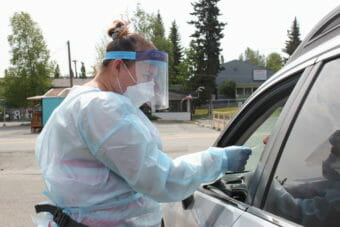
A health worker stands by a driver's window at a drive-through covid testing site
Jessica Haley administers COVID tests at the Fairweather drive-through site on Lake Otis Parkway in Anchorage on June 15, 2022. Fairweather stopped testing uninsured people after federal funding ran out in March. Haley says it’s been hard to turn people away. (Photo by Katie Anastas/Alaska Public Media)

Federal funding to test uninsured people for COVID-19 ran out on March 22. Soon after, the testing sites run by Fairweather in Anchorage started turning away people without insurance.

Jessica Haley, who administers tests at the Fairweather drive-through site on Lake Otis Parkway, said that’s been tough.

“I just refer them to the at-home testing kits,” she said. “And a lot of employers aren’t accepting those because they want the PCR tests.”

Haley’s testing site is one of two in Anchorage run by Fairweather. Jyll Green is their medical services manager. She said that before they stopped testing uninsured patients a few weeks ago, about 40% of people getting tested at their sites were uninsured. And they haven’t just been Alaskans.

“We are getting a lot of tourists from all over the world, maybe not insured, wanting to get tested because they flew and now they have symptoms,” she said. “Or they traveled and they need to get home, but they don’t have insurance.”

What’s happening at Fairweather is part of a larger trend — the public testing and treatment options that have become staples in the last two years are shifting to the private health care industry.
“I think the whole name of the game is that we’re going to start privatizing COVID,” Green said.

Capstone has operated three COVID testing sites in Anchorage and others in Eagle River, Wasilla, Kenai, North Pole, Ketchikan and Juneau — but not for much longer. All Capstone sites will close on June 30.

Matt Jones is Capstone’s director of non-clinical operations. He said keeping drive-up testing sites open is no longer financially viable.

Capstone kept testing uninsured people after March 22. Billing insurance for other patients has allowed them to make up the cost. But now that demand for testing is down, that strategy doesn’t work, Jones said.

“Since that program has ended, and the volume of testing is dropping off significantly — we went from 3,000 tests a day to 200 tests a day — it became financially unsustainable for us,” he said.

Earlier this month, state health commissioner Adam Crum announced that the state’s public health emergency order would end on July 1, but Jones said that wasn’t a factor in the decision to close the sites.

Alaska’s chief medical officer, Dr. Anne Zink, said the public health emergency has no effect on drive-up testing sites or the state’s contracts with the companies running them. Instead, she said, federal funding has started to go away.

“We’ve been planning for the fact that those funds have been going away, and so some of those contracts are scheduled to end as that funding dries up,” Zink said.

In Anchorage, Capstone contracted with the state to run the Alaska Airlines Center testing site at the University of Alaska Anchorage. The site will close with the rest of the Capstone sites on June 30.

Zink said the drop in federal funding is also privatizing treatment options. In Anchorage, Fairweather has a state contract to run a monoclonal antibody infusion clinic at Tikahtnu Commons. That contract also ends on June 30. Green said Fairweather is looking to partner with other groups, like Southcentral Foundation, to continue providing monoclonal antibody infusions.

Zink said federal funding for monoclonal antibody treatments is expected to end in fall. Oral antivirals like Paxlovid are widely available, but they require a prescription.

“As we transition back into the traditional, private health care marketplace, we really encourage people to make sure they have a primary care provider, make sure they have access to testing,” she said. “The federal government continues to have antigen testing that they will send to you. Many health insurance will actually send you antigen testing as well.”

Zink said the state health department will work with private health care providers to keep resources like their testing site locator updated.

People with insurance could notice further changes if the federal emergency order ends. It currently expires on July 15, but officials expect to extend it to October.

If the federal order ends, people with Medicare, Medicaid and private insurance could face out-of-pocket costs for testing and certain treatments. The number of Alaskans covered by DenaliCare — the state’s Medicaid program — increased during the pandemic to nearly one in three residents.

COVID-19 vaccines for kids under 5 are rolling out in Alaska

""
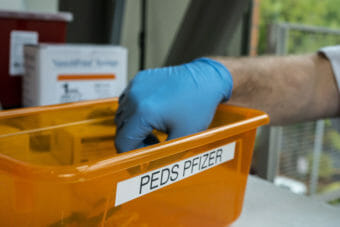
A firefighter prepares pediatric doses of the Pfizer-BioNtech COVID-19 vaccine on November 3, 2021, in Shoreline, Washington. On Monday, providers in Alaska began administering the vaccine to children under 5. (Photo by David Ryder/Getty Images)

Kids as young as 6 months old were able to get a COVID-19 vaccine from at least one vaccine clinic in Alaska on Monday, just two days after the Centers for Disease Control and Prevention signed off on the vaccine. Support service company Fairweather LLC is holding vaccine clinics in two different locations in Anchorage every day for the rest of the month, offering both the Pfizer-BioNTech and Moderna vaccines for kids under age 5.

Kelsey Pistotnik took her 3-year-old daughter Vivienne to get the Moderna vaccine at the Fairweather clinic in Tikahtnu Commons late afternoon on Monday. The Anchorage mom, who’s also part of Alaska’s COVID-19 Vaccine Task Force, said she felt a wave of relief as the vaccine was administered.

A woman holes a child on her knee
Kelsey Pistotnik’s 3-year-old daughter Vivienne Pistotnik gets a COVID-19 vaccine on June 20, 2022, in Anchorage. (Photo provided by Kelsey Pistotnik)

“I would make this decision 10 times over. I am just so relieved to finally have that protection for the most vulnerable in my family,” Pistotnik said.

For other providers around the state, access to the vaccine may take a little longer, according to Dr. Lisa Rabinowitz, staff physician at the Alaska Department of Health and Social Services.

“It will take several days for all the vaccine providers who preordered vaccine to receive it, but parents can check with their pediatrician or local pharmacy to see if they will be offering the vaccine and to make an appointment,” Rabinowitz said.

For public health centers, COVID-19 vaccines for the youngest age group will be available at some but not all, so it’s also wise to check in with your local public health center for more information.

All children, including children who have already had COVID-19, should get vaccinated, according to the CDC. Children under age 5 can be vaccinated with the Pfizer-BioNTech or Moderna vaccines to help protect them from COVID-19. Each is administered with its own timeline. DHSS is not recommending one over the other.

Pfizer-BioNTech is a three-dose series with three weeks between dose 1 and 2, and two months between dose 2 and 3. It’ll take 13 weeks for a kid to complete their primary series.

Moderna is a two-dose series with four weeks between Dose 1 and 2, which means it’ll take six weeks for a kid to complete their primary series.

The clinical trials and studies have shown the benefits of getting vaccinated outweigh the risks, which is why the decisions to authorize these vaccines were unanimous from the U.S. Food and Drug Administration and CDC, said Rabinowitz.

“We’re very encouraged that the vaccines are safe and effective,” she said. “We recommend that Alaska parents talk to their health care provider or pharmacist if they have questions or concerns.”

The Alaska Department of Health and Social Services is also hosting a public webinar for parents to learn more about the pediatric vaccines on Tuesday, June 28, from 7 to 8 p.m. The webinar link will be available to the public prior to the event.

How COVID has impacted children in Alaska

Children under 10 years old account for 2% of the total hospitalizations from COVID-19 among Alaska residents. DHSS does not split that data to account for children under 5. There have been two deaths in Alaska in children under 10 years old from COVID-19. Nationally, children ages 0 to 4 account for around 3.3% of total cases and .1% of total deaths. That’s according to CDC’s COVID data tracker.

“Even with these low percentages of total deaths, it should be noted that COVID-19 is the fourth-leading cause of death in children under 1 year old, and fifth-leading cause in those 1 to 4 years old,” Rabinowitz said, citing national data. “Over half of the children who were hospitalized had no underlying condition.”

In addition, a reported 23 children have been hospitalized with multisystem inflammatory syndrome in children, or MIS-C, Rabinowitz said. “It’s a severe inflammatory condition that kids, especially in that age group, will get after a COVID infection,” she said. “Most of those kids get pretty ill and end up in the ICU.”

Possible side effects of COVID-19 vaccine for babies and toddlers

Rabinowitz said possible side effects of the vaccine are similar to the 5-11 age group.

“Some fatigue and headache were the most common in 2- to 5-year-olds. You can see some irritability and sleepiness, and then the one thing that’s slightly higher in this age group is that fevers were a bit more common,” she said.

Fevers could last up to a couple of days and “treated easily with over-the-counter fever medications,” Rabinowitz said.

Mom Kelsey Pistotnik said her daughter Vivienne hasn’t experienced any side effects so far.

“She seemed just like her normal 3-year-old self, yesterday and today.”

Young kids in Juneau could get their first COVID-19 vaccine dose this week

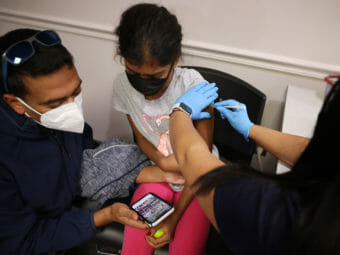
Ciara Sexton winces as Meghan DeSloover gives her a COVID-19 vaccine shot at Dzantik’i Heeni Middle School in Juneau on Nov. 9, 2021. She says getting her ears pierced was worse. (Photo by Jeremy Hsieh/KTOO)

Juneau public health officials say they hope to have COVID-19 vaccines available for children under five by Friday.

The Centers for Disease Control and Prevention recommended vaccine use for children as young as six months this weekend.

One shipment of Moderna vaccines has already arrived at the Juneau Public Health office, but they are waiting for Pfizer vaccines to arrive before opening appointments to Juneau’s youngest residents.
Vaccines will be available through the Juneau Public Health office, SEARHC and Juneau Urgent Care. Juneau Public Health offers vaccine clinics for all ages on Fridays from 8:30 a.m. to 4:00 p.m.

Juneau will receive 200 total doses — 100 Moderna and 100 Pfizer.

This is a developing story and will be updated as more information becomes available.

CDC clears the way for vaccinations for children 6 months to 5 years old

A child receives the Pfizer BioNTech COVID-19 vaccination at the Fairfax County Government Center on November 04, 2021 in Annandale, Virginia. The federal government approved the coronavirus vaccine for children between the ages of 5 and 11 this week. (Photo by Chip Somodevilla/Getty Images)

Providers across the country can start vaccinating kids ages 6 months to 5 years as early as this coming week after regulators cleared the final authorization steps on Saturday.

An independent panel of advisers to the U.S. Centers for Disease Control and Prevention voted on Saturday to recommend vaccinating all children in the age group with one of two separate COVID-19 vaccines manufactured by Moderna and Pfizer-BioNTech.

“I am fully confident that vaccines should be recommended,” said Dr. Grace Lee, the chair of the panel and a pediatrician at Stanford University. “We can clearly prevent hospitalizations and death, and we have the potential to prevent long term complications from infection that we don’t yet understand well.”

CDC director Dr. Rochelle Walensky quickly endorsed the recommendation, the final step before the vaccines could be rolled out.

“We know millions of parents and caregivers are eager to get their young children vaccinated, and with today’s decision, they can,” Walensky said in a statement. “I encourage parents and caregivers with questions to talk to their doctor, nurse, or local pharmacist to learn more about the benefits of vaccinations and the importance of protecting their children by getting them vaccinated.”

During a two-day meeting starting Friday, the panelists reviewed data from clinical trials by both pharmaceutical companies, as well data on the need for vaccines for this age group.

According to the CDC, as of May 28, more than 400 children 0-4 years have died due to COVID.

“Among people ages 1-4, COVID is fifth most common cause of all causes of death,” said Dr. Matthew Daley, speaking at the meeting Friday.

And data from older children and adults show that vaccination prevents death, said Daley, a senior clinician investigator at Kaiser Permanente’s Institute of Health Research. In fact, he added, among people 5 years and older, the unvaccinated are 10 times more likely to die from COVID than the vaccinated.

“Phrased another way, deaths from COVID-19 are preventable through vaccination,” he said.

The vaccine made by Moderna for 6-month-olds to 5-year-olds is a two-dose series, given four weeks apart. The Pfizer-BioNTech vaccine for 6-month-olds to 4-year-olds is a three-dose series. The first two shots are given three weeks apart, and the third one eight weeks after the second shot.

The CDC advisory panel voted 12-0 in favor of recommending both vaccines for this group of children, concluding that both vaccines protect children in this age group against symptomatic COVID-19, and the benefits outweigh possible risk.

“I am tremendously excited,” said Dr. Adam Ratner, head of pediatric infectious diseases at NYU Langone Medical Center and a spokesperson for the American Academy of Pediatrics.

“This is a day a lot of us have been waiting for since the very beginning of the pandemic,” he told NPR.

Many providers across the country have already pre-ordered the vaccine and can start administering it as early as this coming week.

“In early June, our state department of health put out a call for pre-orders,” says Dr. Jennifer Shu, a pediatrician based in Atlanta.

She pre-ordered both the Pfizer and Moderna vaccines and is expecting to start making appointments and giving the shots on Tuesday.

“We’ve had a lot of interest in the vaccine,” she told NPR. “Our phones have been ringing off the hook.”

Data from a survey conducted in February showed that around half of parents of this age group “said they would definitely or probably vaccinate their child once they become eligible,” said the CDC’s Dr. Sarah Oliver, speaking at Saturday’s meeting.

A third of parents said they “definitely or probably would not vaccinate their child,” she added. And a fifth of respondents said they would within three months of vaccines becoming available.

“This infection kills children,” said Dr. Beth Bell, a member of the panel and a public health expert at the University of Washington, speaking at the meeting. “We have an opportunity to prevent that and every parent will want to consider that calculus as well.”

Copyright 2022 NPR. To see more, visit https://www.npr.org.

Large portion of unexpected Alaska deaths in 2020 and 2021 directly tied to COVID-19

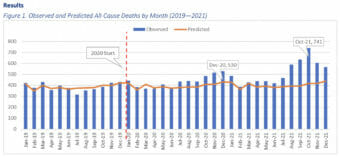
A bar graph showing excess deaths in Alaska by month
This chart shows the difference between the observed number of deaths in Alaska and the number that was predicted, from 2019 to 2021. (Chart prepared by the Alaska Department of Health and Social Services, Division of Public Health)

Nearly 2,000 more people died in Alaska than was expected in 2020 and 2021, according to a new report by the Alaska Department of Health and Social Services. COVID-19 played a direct role in a large proportion of those. While the other unexpected deaths may not be directly related to individuals being infected with COVID, the secondary effects of COVID-19 and the pandemic — like a strained medical system or a decrease in preventive care measures — may be factors.

The 2020-2021 Excess Death Report says “the pandemic significantly impacted Alaska’s mortality rates, which disparately affected populations by sex, race, region, and age.”

“Excess,” or unexpected, deaths is the difference between how many deaths actually occurred and how many deaths were expected to occur based on model predictions.

In total, 1,933 more people died than was predicted in 2020 and 2021. Of those, 1,097 were reported as COVID-19-related deaths. Unexpected deaths spiked in October 2021 when the spread of the highly infectious SARS-COV-2 delta variant was common. In that month, 741 Alaska residents died, 324 more than expected.

Although more elderly Alaskans have a higher risk of dying from COVID-19, the pandemic increased premature deaths among non-elderly adults as well. Rosa Avila, deputy chief of health analytics and vital records with the Alaska Department of Health and Social Services, said that was striking to her. She co-authored the report.

“Since elderly were high-risk for severe outcomes from COVID-19, a lot of people expected we would have excess deaths in those age groups, but we didn’t just see it there. We saw excess deaths between those that were 35 years of age to 64 years of age, so the non-elderly group, and they are quite significant,” Avila said.

Avila was also surprised by the regional nuances.

“In terms of Anchorage being a more dense population, I was at first expecting that excess deaths would be higher in Anchorage, but they were actually, in terms of the rate, higher in the Mat-Su area followed by Gulf Coast. And so those were statistically significant,” she said. The public health Gulf Coast region includes the Kenai Peninsula Borough, the Kodiak Island Borough and the Valdez-Cordova Census Area.

Avila said the impact of COVID-19 is larger than what many may believe.

“Even though you might not consider yourself that at-risk, there are demographics in here that show that people in age groups that we didn’t really consider very high risk are still having excess deaths. And it might not just be specifically because of COVID. It could be also from the strained health care system. So, the impact, I think, is larger than what might have been presented in some people’s minds,” she said.

“We’ve been tracking the number of COVID deaths all along but we forget about how much of a mortality impact there is on people who don’t think that they’re high-risk just because of the indirect impacts from a pandemic in general, and I think that’s what this report helps highlight.”

So far in 2022, 170 Alaska residents have been reported to have died from COVID-19.

Read the Alaska Department of Health and Social Services 2020-2021 Excess Death Report here.

Site notifications
Update notification options
Subscribe to notifications