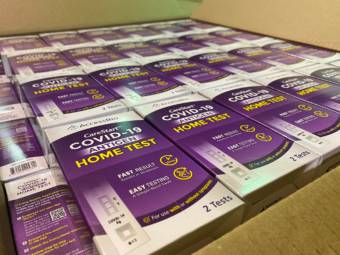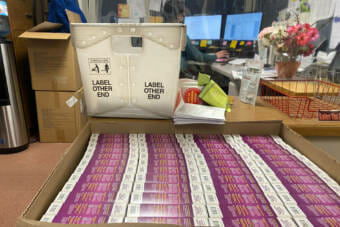
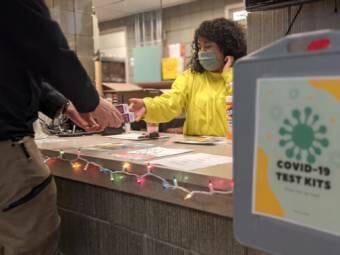
At-home test kits available to the public at City Hall in Juneau. February 24, 2022. (Photo by Claire Stremple/KTOO)
COVID cases have ticked up steadily over the last few weeks in Alaska. But this swell in numbers is not like other COVID surges, which have looked much bigger.
Over the last week, numbers appear to have dropped slightly. There were 2,248 cases reported statewide on Wednesday, and that doesn’t include any positive results from at-home tests.
State epidemiologist Louisa Castrodale said it’s clear there’s a lot of COVID activity in the state, but compared to last year, the state isn’t capturing as many cases in its data.
“We know there’s a lot more over-the-counter testing that people are doing to make decisions, personal health decisions about whether they are gathering with people or traveling or what have you,” she said. “And those are numbers that are not reflected in the overall case counts.”
Castrodale says that taking a look at weekly case counts and trends over time is still useful. For example, Juneau’s test positivity rate spiked to nearly 40% for a couple weeks in May. That means that of all the test results that were reported to the state, close to half of them were positive. That’s usually an indication that not enough testing is happening to capture a true picture of how much of the virus is in the community.
While that percentage may not be the most useful metric for understanding how much COVID is in the community, Castrodale said the rapid increase is certainly an indicator that the virus is circulating.
“We’re kind of evolving in this data presentation of thinking about broader strokes and more global regional trends, and how to look at those numbers and make sense of them,” she said.
That “broad stokes” perspective has been the case for a while, and it’s because the COVID virus and our defenses against it have changed. So while it’s tempting to compare numbers now to numbers from 2020 or 2021, Castrodale said that’s ignoring context.
“We have vaccination in different age groups, we have a different variant that’s spreading, we have different levels of hospitalization relative to what we saw for cases,” she said.
If that all sounds kind of confusing, you’re in good company. Castrodale says even epidemiologists are struggling to find the best way to present COVID data over time.
She said the bottom line is that if case counts or hospitalizations make a big jump — even if it seems small compared to the pre-vaccine and pre-home test days — it’s an indicator that there’s more virus around, and you may want to consider taking precautions.
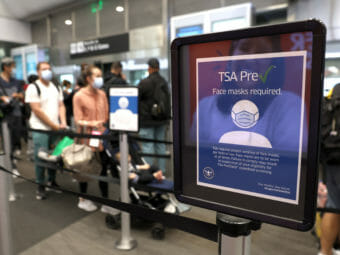
The U.S. Justice Department filed a brief in federal appeals court Tuesday to overturn a federal judge’s decision that declared the government mask mandate on planes, trains and buses unlawful. Here, a sign stating that masks are required at San Francisco International Airport stands in a terminal after the federal mask mandate was overturned. (Justin Sullivan/Getty Images)
The Justice Department asked a federal appeals court on Tuesday to overturn last month’s court decision by a federal judge that declared the mandate requiring masks on airplanes and other public transportation unlawful.
In a 48-page document filed in the 11th U.S. Circuit Court of Appeals, the Justice Department argues that the order issued by the Centers for Disease Control and Prevention in early 2021 “falls easily within the CDC’s statutory authority.”

Last month, the Justice Department said that it would appeal U.S. District Judge Kathryn Kimball Mizelle’s decision to strike down the CDC’s mask mandate for public transportation if the agency determines the mandate is still needed to protect public health.
“None of the district court’s quarrels with the CDC order comes close to showing that the CDC has acted outside the ‘zone of reasonableness,'” the Justice Department said in the brief.
“The findings in the CDC order provide ample support for the agency’s determination that there was good cause to make the order effective without delay.”
The CDC did not immediately respond to immediate requests for comment on the issue.
In her ruling, Mizelle argued that the mandate violates the Administrative Procedure Act because the agency failed to prove its decision regarding implementing the mandate.
“The court concludes that the mask mandate exceeds the CDC’s statutory authority and violates the procedures required for agency rulemaking under the APA,” Mizelle wrote.
Transportation companies, such as Uber, Lyft and Amtrak; as well as Delta, Southwest and American Airlines made masks optional soon after the decision.
NPR’s Ayana Archie contributed to this report.
Copyright 2022 NPR. To see more, visit https://www.npr.org.
Celebration 2018 grand processional June 6, 2018, Juneau. Celebration hasn’t been celebrated in person since then due to the COVID-19 pandemic. (Photo by Adelyn Baxter/KTOO)
It has been 40 years since the first Celebration, which was hosted to celebrate the survival of Lingit, Haida and Tsimshian cultures.
This year, the theme is Celebration 2022: Celebrating 10,000 Years of Cultural Survival. This will be the first time the event has been in person since 2018, and after two years in a pandemic, the term “survival” is even more meaningful.
Sealaska Heritage Institute President Rosita Worl said that, especially before the vaccine, the organization was committed to keeping the community as safe as possible.
“We saw how [the pandemic] was affecting our elders,” Worl said. “And so the elders became kind of a symbol, a critical symbol for us of the survival of our culture.”
Worl said that this is something they’ve anticipated and planned for since the official decision back in January to host Celebration in person.
“We’re monitoring those numbers very closely,” Worl said.
The gathering has become a vital time for Southeast Alaska Native communities to connect, she said.
“Over 40 years, it is now significant for us to gather together to celebrate our culture,” Worl said. “You put that on top of all of these other events where we were not able to gather, and it becomes really important.”
Around 1,200 dancers are registered to perform, and Worl is expecting around 3,000 people to attend. This is smaller than the usual crowd of 5,000, but higher transportation costs and tight lodging options have prevented some from coming.
To limit spread during the events, all staff will be tested daily, temperatures will be taken at the door of each event, and masks will be required. Moderators will enforce the mask requirement.
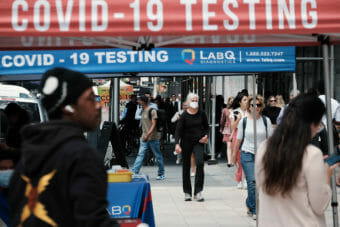
People walk past a Covid testing site on May 17. in New York City. New York’s health commissioner, Dr. Ashwin Vasan, has moved from a “medium” COVID-19 alert level to a “high” alert level in all the five boroughs following a surge in cases. (Photo by Spencer Platt/Getty Images)
Cases of COVID-19 are — yet again — on the rise. The U.S. is seeing an average of more than 100,000 reported new cases across the country every day. That’s nearly double the rate a month ago and four times higher than this time last year.
And the real number of cases is likely much higher than that, according to health officials. Because many people now rely on at-home tests, “we’re clearly undercounting infections,” White House COVID-19 Response Coordinator Dr. Ashish Jha told reporters at the most recent COVID press briefing. Hospitalizations are trending upwards too, though only gradually still in most places.
Yet in most places, health officials haven’t called for any new COVID restrictions. So how big is the surge, really? And is there anything you should be doing about it?
Measuring the true number of infections
Official undercounts of cases are not exactly a new problem. At the beginning of the pandemic, many cases went undetected because tests were unreliable and supply was limited.
“We saw early on – in March 2020 – that maybe one in 10, maybe one in 12 infections were actually being captured,” says Jeffrey Shaman, an infectious disease specialist at Columbia University whose lab has worked to model the true number of infections.
Very early research efforts to figure out how many infections were out in the community involved testing a sample of residents for SARS-CoV-2 antibodies. As the pandemic progressed, that method didn’t work as well, Shaman explains, because antibodies after infection waned over time and because vaccinations complicated the antibody picture.
Shaman’s research group turned to using models to estimate the “ascertainment rate” – the portion of real infections that were being captured in official case counts. That rate has fluctuated – at the end of 2020, they estimated one in four cases were being counted. During the omicron surge it was closer to one in six.
Now with the widespread availability of at-home rapid tests that aren’t reported to health departments, Shaman thinks the true number of cases may be in the ballpark of eight times higher than case counts. In other words, instead of 100,000 new cases a day, the true number may be 800,000 cases per day.
Take that estimate with a giant grain of salt, he advises. It’s getting harder to get a firm handle on the current ascertainment rate.
Ellume COVID-19 home tests are seen at a CVS in the Navy Yard neighborhood of Washington, D.C., where senior citizens received free tests that are covered by Medicare on Monday, April 4. (Photo by Tom Williams/CQ-Roll Call, Inc via Getty Images)
Wastewater surveillance sites across the country reinforce the idea that the virus is on the rise. More than half of sites have seen “modest increases” in levels of virus according to CDC, although the system doesn’t cover the whole country and is not yet set up to offer people an ongoing estimate of the true number of cases beyond official counts.
All of this is a predictable consequence of having easy, ubiquitous at-home tests, says Gigi Gronvall, a senior scholar at the Johns Hopkins Center for Health Security.
“For people to have that information at their fingertips to be able to get the results that they need so that they can act on them immediately – that’s totally worth it,” she says. But it does come at the expense of the data, “and so you have to infer that there are higher numbers of cases than are being reported.”
The next surge could be worse
As an epidemiologist, this uncertainty is not ideal, says Katelyn Jetelina, adjunct professor at University of Texas Health Science Center, who writes the Your Local Epidemiologist newsletter. And even if case counts are much higher than they appear, this summer may not see a health care crisis like previous surges, she says.
As the weather warms up and people spend more time outdoors, “transmission is a lot less because of the ventilation outside,” she says. Also, after the massive surge of infections from the omicron variant, she says, “we just have such high levels of infection-induced immunity that we have a very high immunity wall,” something CDC has estimated as well. Basically, if someone has had a recent infection they’re less likely to get infected again, so the virus might not be able to spread as much or make people as sick.
The country’s current population-level immunity is one of the reasons Maciej Boni, a professor of biology at Penn State’s Center for Infectious Disease Dynamics says it makes sense for policymakers to hold back on rolling out mitigation measures for now.
“The reason is that we’re going to exhaust people’s patience and potentially exhaust certain health resources [and] political capital that we want to have saved up for when we really need it,” he says.
He predicts a much more dangerous surge is coming in the fall and winter. That’s when he thinks health officials should start to ramp “the new set of measures that’s likely going to be required to get case numbers down,” he explains.
Jetelina agrees that the country is unlikely to make big moves at the moment. “I don’t see I don’t see sweeping policy changes until the virus has another omicron-like event or a huge mutation,” she says.
Figure out what’s happening with the virus where you are
While public health officials may not be raising the alarm over the rise in cases, health researchers agree that certain people should take notice of the fact of the current, partly invisible surge: older people who haven’t been vaccinated or boosted recently.
“That’s the low-hanging fruit here,” Jetelina says. “Just get the vaccine. Go get your booster. Don’t think very hard about it.” Nearly one third of people older than 65 who are eligible for a booster haven’t received one according to CDC’s vaccination tracker — despite clear evidence that it reduces risks of hospitalizations and death.
Higher-risk people generally should be more careful if cases are getting high. But with official reports of case counts from health agencies missing so much data, how do you figure out how bad COVID transmission is in your community?
Just as when a storm’s predicted you might watch the meteorologist on TV but also step outside to look at the sky, so public health experts say, it’s smart to tune into both official and anecdotal signals of surging cases.
Do keep an eye on case counts (knowing they are only capturing a portion of the true cases out there), and hospitalizations, and listen to public health officials. But also pay attention to the texts from friends and coworkers telling you they’ve gotten COVID-19.
“That anecdotal evidence could be useful in making decisions, too,” Jetelina says. If there seems to be a sudden spike, you’ll know there’s more virus circulating where you live.
Another signal to look for: If your workplace or kids’ school does surveillance testing – that is regular tests of everyone, even people who aren’t symptomatic – that can be really helpful for keeping a pulse on what’s happening with the virus locally.
“Where I am in Miami-Dade County, there’s still municipal employees that may need to test regularly, and we might get some kind of underlying signal of when we’re having a surge,” says epidemiologist Zinzi Bailey of the University of Miami.
Bailey also likes using COVID-19 hospitalization data as a proxy for what’s happening in her community.
“I look at my local hospitalizations, and if they’re starting to tick upwards, I modify my behavior accordingly – I’m going to be taking a little bit more attention in terms of masking, I’m going to be paying a little bit more attention about what indoor spaces I’m choosing to be in and how often I’m going to do that,” she says.
Jetelina uses trendlines in case counts to make decisions for her own family. “My ears start perking up [when there’s] anything over a 50-75% increase in the past two weeks,” she says. Looking at case trend lines, if the line is “just starting to slowly creep up, then then fine, but if the acceleration is getting faster and faster, that’s when something seems up to me.”
Then there’s grabbing a raincoat when weather’s foreboding – i.e., getting your vaccine protection, or getting boosted if you’re not up-to-date. Even though it’s easy to make an appointment at a pharmacy, fewer than half of Americans who got their initial vaccines still haven’t gotten the first booster that was authorized in the fall. And now a second booster is available to anyone over 50.
Beyond vaccination, if the virus is spreading a lot in your community right now, anyone who’s high-risk because of age or underlying conditions – or lives with someone who is – would be smart to dial up on personal COVID-19 precautions: being selective about time in public spaces indoors and wearing a high quality well-fitting mask when you do.
Copyright 2022 NPR. To see more, visit https://www.npr.org.
Free rapid antigen at-home COVID-19 tests were being distributed at Anchorage’s Spenard Rec Center on Dec. 30, 2021 (Lex Treinen/Alaska Public Media)
COVID-19 cases are on the rise in the state. Health officials are encouraging Alaskans to renew their efforts to protect adults over 70.
The state department of health reported 1,911 cases on Wednesday. That’s a 14% increase from the previous week, and a 34% increase from this time last month. Those numbers do not include positive at-home tests.
According to the department’s COVID dashboard, areas with the highest community case rates include Juneau, Ketchikan, Haines, Skagway, Denali and Bethel.
There are currently 46 people hospitalized with COVID in the state. In a public health presentation on Wednesday, chief medical officer Dr. Anne Zink said most of them are over 70 years old.
“Even if they’re vaccinated or boosted, we know that age is the biggest risk factor for COVID and severe COVID illness,” she said.
Zink said Alaskans over 70 and those living with older relatives should consider doing more to protect themselves against COVID. That could include masking in indoor public spaces, minimizing indoor gatherings and opening windows to allow for more airflow.
On June 15, the FDA will review Moderna and Pfizer’s authorization requests for their vaccines for kids under five. Zink said kids are generally still at much lower risk of severe symptoms than older people.
“While this is super exciting news, I don’t want it to take away from grandma or grandpa getting that booster,” she said.
The latest rise in cases in the U.S. is driven by the newest omicron variant, Zink said. Like other omicron waves, it appears to be making its way to Alaska more slowly than the northeast.
Third sets of free at-home COVID tests are now available at covidtests.gov. Zink emphasized that people with COVID symptoms should get PCR tests, even if their at-home tests are negative. If you’ve been in close contact with an infected person and don’t have symptoms, test five or more days after exposure.
The department’s next public health presentation is scheduled for September.
Juneau received 26,000 of these home test kits for COVID-19 on Jan. 19, 2022. Local families pick up two kits for free. (Photo courtesy of City and Borough of Juneau)
Cases of COVID-19 in Juneau are going up.
The state reports cases each Wednesday. This week, the state reported 347 new COVID-19 cases for Juneau from May 11 to May 17. That’s double the caseload reported from the previous week — an average of 50 cases a day.
That number only includes cases that are reported to the state, so it does not count positive results from home tests.
Juneau’s case count also includes 101 non-resident cases. A few are known to be related to the tourism industry, while the majority are still under investigation.
Cruise ships report COVID-19 data to the state, which on Wednesday indicated that there were 23 cases “at sea” related to tourism for the previous week. Eighty of the 91 cruise ships registered with CDC are in the “Orange” risk category on the CDC dashboard, which means they could have anywhere from seven to hundreds of active COVID-19 cases on board.
On Wednesday, there were six patients being treated for the virus at Bartlett Regional Hospital, and 22 staff members were out due to COVID-19.
The Juneau School District also saw a significant increase, with 129 cases reported over the last two weeks. That comes after Juneau Douglas High School Yadaa.at Kalé and Thunder Mountain High School hosted their proms.
On Wednesday, the City and Borough of Juneau recommended that residents start masking indoors in response to increasing cases. Because the city’s COVID-19 emergency operations ended at the end of April, city officials can no longer mandate mask wearing or any other pandemic mitigation strategies.
Deputy City Manager Robert Barr said on Friday that there is no plan to recommend that the Juneau assembly reinstate emergency operations at this time.
Free at-home tests are available at Juneau Public Library locations around town. More accurate PCR tests are available at Capstone Clinic at the Juneau Airport, Southeast Alaska Regional Health Consortium, Juneau Urgent Care and at Bartlett Regional Hospital. Appointments for tests at the hospital can be made by calling 907-586-6000.
Free vaccine doses including boosters are available at the airport or the Juneau Public Health office as well as at pharmacies around town.
Close
Update notification options
Subscribe to notifications
Subscribe
Get notifications about news related to the topics you care about. You can unsubscribe anytime.