Alaska coronavirus news

Live updates and information on COVID-19 in Juneau and Alaska

Vaccines, prior infections and anti-virals are helping against Alaska’s latest COVID wave

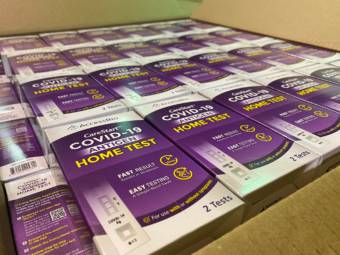
home COVID-19 tests kits
Juneau received 26,000 of these home test kits for COVID-19 on Jan. 19, 2022. Local families pick up two kits for free. (Photo courtesy of City and Borough of Juneau)

State health officials say there’s a lot of COVID-19 circulating in Alaska, and like the rest of the country, that’s predominantly the coronavirus’s omicron BA.5 subvariant.

Hospitalizations in Alaska have been on a mostly upward trajectory since April, as have case counts. That’s even with more people using at-home tests, the results of which aren’t reported to the state.

Still, state epidemiologist Dr. Joe McLaughlin says vaccinations and boosters — including a second booster available to anyone immunocompromised, and those 50 and up — are helping stave off infections or minimizing serious illness.

And McLaughlin says, even with COVID-19 on the upswing again, people are better protected and there are better treatments than when the pandemic started more than two years ago.

Listen:

The following transcript has been lightly edited for clarity.

Joe McLaughlin: It’s best to get started on those medications as soon as possible after you test positive. So if you woke up this morning feeling sick, and you have a home antigen test, go ahead and test yourself. And if you test positive, go ahead and contact your healthcare provider. Now, if you don’t have a primary care provider, there are other options. You can go into an urgent care if you’re in an urban setting. If you’re in a more rural setting, you could go in and contact a public health nurse who might be able to help link you to a provider and link you to treatment if treatment is warranted for you. Or if you’re in a village, you can contact a health aide and try and set up either a telemedicine visit or some other sort of visit where you can, you know, talk with the health aide about your symptoms, and they can take a look at your risk factors and whether or not you’re eligible for treatment.

Casey Grove: Whether you’re looking at those test results or hospitalizations, and you see an increase here, just recently over the last few weeks, how does that compare to previous waves that we’ve seen? Or would you even call this a wave? And do you have any sense of how this might play out?

Joe McLaughlin: So if you look at the COVID-19 hospital dashboard, going back, from our first big wave that occurred in sort of November, December of 2020, the biggest wave that we had was, you know, the winter of 2021, going into, starting to go into, 2022. But then in January 2022, we had another big wave. And then now this omicron wave that we’re experiencing, is not as big in terms of the amplitude. It’s not as high in terms of number of hospital beds occupied per day. So that gives you a sense for the hospitalization burden associated with this omicron wave that we’re experiencing. It’s not as high as we’ve seen with the other variants. What does that translate to, in terms of cases? How many cases we’ve seen? That’s a little bit more difficult to answer, because, again, we just don’t have the surveillance data on cases like we used to. But right now, our biggest concern is hospitalization and deaths associated with COVID, and fortunately, the death rate is remaining very low.

Casey Grove: It strikes me that to become infected now, two-plus years into this pandemic, as you mentioned already, there are a lot of other treatments that we didn’t have a couple of years ago. And I wonder if you could tell me about that, and what impact that’s had on numbers nationally and in an Alaska.

Joe McLaughlin: So there are a number of factors that are contributing to our lower hospitalization rates and probably our lower death rates as well. Number one is just the particular variants that are circulating right now might be less virulent than previous variants like the delta variant. Remember that was very virulent and we saw very high hospitalization and death rates associated with that Delta variant. The other thing is, most Alaskans have had at least one or two doses of vaccine. And we know that prior vaccination does decrease the risk of hospitalization and death, even with the omicron strains that are circulating. And also there have been a number of Alaskans who have had prior infection. And again, prior infection like prior vaccination is protective against more severe cases.

Casey Grove: Well, Dr. Joe, when will the pandemic be over? I think maybe people want to know that.

Joe McLaughlin: I wish I had a crystal ball on that one. I don’t know. You know, what we’re doing is we’re just trying to take this one step at a time and deal with the various waves that are coming up. This is a virus that is not going to go away. We are going to continue to see the SARS-CoV-2 virus circulate in human populations for the foreseeable future, globally. And as we’ve seen with influenza, like the great pandemic of 1918-1919, when we saw the H1N1 influenza virus emerge in human populations and really cause a massive pandemic with high death tolls, that H1N1 virus is still circulating in human populations. Now, it’s much more attenuated. We have much lower hospitalization and death rates now associated with that H1N1 virus than we saw during the 1918 pandemic. But it is still circulating, and I suspect that’s what’s going to happen at some point with this SARS-CoV-2 virus, is we are going to see one or more strains that will just continue to circulate in human populations. And it may be that we will continue to see new variants emerge like we do with influenza from year to year that we’re going to have to manage. And our treatments will continue to improve and our ability to stave off more severe infection will continue to improve. And hopefully, the virus strains that circulate over time will become more attenuated and be less capable of causing severe disease, as we’ve seen with many of the influenza variants that have emerged over the years.

Doubting mainstream medicine, COVID patients find dangerous advice and pills online

blister packs of pills on a table
Ivermectin has developed an enormous following over the course of the pandemic – in part because of a small cadre of fringe doctors who promote it as an alternative to COVID vaccines, despite early studies which didn’t support it as a treatment. (Photo by Meredith Rizzo/NPR)

When Stephanie caught COVID-19 just before Thanksgiving of last year, her daughter Laurie suggested that she get help.

“She was really not feeling well, and I was like, ‘Just go to the doctor,'” Laurie recalls.

But Stephanie, who was 75 at the time, didn’t go. A few years before, she had been sucked into a world of online conspiracy theories — far-fetched ideas like one claiming John F. Kennedy Jr. is still alive. With the pandemic, it got worse. She became deeply distrustful of the medical system.

Laurie remembers what her mother used to tell her about the COVID vaccines: “Everybody who got vaccinated is going to die.” (NPR is only using family members’ first names to protect them from online harassment.)

COVID cases and hospitalizations are once again on the rise, thanks to a new omicron subvariant. Vaccines and certain proven treatments can help prevent the worst outcomes. But for Americans like Stephanie who don’t trust the medical establishment, there’s a network of fringe medical doctors, natural healers and internet personalities ready to push unproven cures for COVID. And a shady black market where you can buy them. Stephanie was plugged into that alternative medical network, and doctors say it ultimately cost her life.

Ivermectin hasn’t panned out

The array of alternative COVID treatments is vast. Some offer kosher multivitamins, others suggest more radical interventions, such as drinking your own urine.

But one drug in particular has become the center of many alternative therapies: ivermectin. Originally used to treat parasitic worms, ivermectin has developed an enormous following over the course of the pandemic — especially in politically conservative circles. That’s, in part, because of a small cadre of licensed doctors who promote it as an alternative to vaccination against COVID. Among the most prominent is Dr. Pierre Kory, whose group, the Front Line COVID-19 Critical Care Alliance, has become a major force promoting ivermectin.

“Ivermectin is effectively a ‘miracle drug’ against COVID-19,” Kory told a Senate committee in December of 2020.

But rigorous studies show ivermectin is far from miraculous. Ivermectin was studied early in the pandemic as a potential treatment for COVID, but it hasn’t panned out. Large clinical studies show that ivermectin does not lower rates of hospitalization. Meanwhile, some of the early, promising results have been retracted, including one study led by Kory himself. Today, everyone from the American Medical Association to the Food and Drug Administration tells doctors not to prescribe ivermectin to treat COVID.

""
When Laurie’s mother, Stephanie, fell sick with COVID-19 last fall, she refused to get tested. Instead, Stephanie got swept up in a world of conspiracy theories online that touted alternatives to proven treatments. “I don’t believe she was supposed to die,” Laurie says. “I blame the misinformation.” (Photo by Meredith Rizzo/NPR)

“The non-fraudulent non-messed up clinical trials are all pretty uniformly negative,” says David Gorski, a cancer surgeon and researcher at the Wayne State University School of Medicine in Michigan.

For years before COVID, Gorski tracked doctors who offered alternative cures for cancers. And he sees plenty of parallels between those physicians and doctors like Pierre Kory.

“A lot of these doctors fit the mold of what I used to call back in the day ‘the brave maverick doctor,'” he says.

Gorski says that they play up their persecution by the system, offer scant evidence for their treatments, and deride effective therapies while promoting their own cures. In Kory’s case, he offers personal consultations to sick COVID patients — for $400.

“COVID is no different than quackery going back centuries,” Gorski says.

Kory did not answer NPR’s emailed questions in time for our deadline, but he’s been everywhere on right-wing media promoting ivermectin — and his bravery for prescribing it: “People who’ve used ivermectin, their license have been threatened,” he said on a recent conservative podcast. “I have eight complaints to my medical board; I don’t know what’s going to happen to my license.”

No pharmacies, no questions

Among those influenced by Kory’s message was Stephanie. In text messages, Stephanie’s friends were passing around an ivermectin-based treatment protocol that he helped develop.

Timothy Mackey is a professor at the University of California, San Diego who studies online pharmacies. He says ivermectin promoters have spent months hyping the drug.

“They’re creating demand and this demand is being circulated in all these different online groups,” he says.

Mackey says there’s a whole range of entities trying to make a buck off the underground demand for ivermectin. It’s difficult to track how many people are seeking it out on the black market, but Mackey believes many Americans are affected.

“There’s probably thousands of people, tens of thousands of people that have looked for drugs, tried to buy something…maybe been defrauded and at worst maybe even harmed from these products,” he says.

After she fell ill with COVID, Stephanie went looking for ivermectin. A friend gave her the name of a woman in Jacksonville, Fla., who was willing to sell it to her along with some other unproven COVID drugs. Stephanie’s order totaled $390.

“She was just waiting for the pills and really did not want to do anything else,” Laurie remembers.

Her mom was getting sicker and sicker and refusing to go to the hospital. Laurie was worried that she had invested so much in the mail-order pills.

“I was like, ‘Who’d you buy it from?’ because I had read a lot of stuff about people getting it illegally, and she was like, ‘I got it from a doctor,’ and I said, ‘Are you sure it’s a doctor?’ and she was like, ‘Yeah it’s definitely a doctor.'”

Except it wasn’t a doctor. The woman’s name was Elizabeth Starr Miller. According to her LinkedIn profile, she’s a “quantum healer” who also works as a loan officer. In text messages shared with NPR by Stephanie’s family, Miller repeatedly told Stephanie to be wary of the hospital.

Meanwhile, the drugs weren’t arriving. After a few days, Stephanie worried she might be getting conned.

Stephanie became so ill she had to be rushed to the local hospital. That same day the drugs arrived, stuffed inside a plain brown envelope with Miller’s home address on the return label.

Not licensed for use in the U.S. and possibly counterfeit

When her daughter, Laurie, looked at them, she found ivermectin pills that aren’t licensed for use in the U.S. They appeared to be made by Indian pharmaceutical companies. Except, when NPR shared the photos of the packets with Mackey, the pharmaceutical researcher, he wasn’t even sure that the Indian company had made them.

“It looks highly suspect the way this pill pack is set up to begin with,” Mackey says. Mackey points to one stamp on the pack that reads “WHO GMP Certified.” It’s a real certification in one Indian state, but he’s also seen it before, on fake pills from overseas.

“Once you see this mark here, you’re pretty much going to throw out this sample,” he says.

""
The pack of pills that Stephanie received in the mail included blister packs that were labeled as hydroxychloroquine and ivermectin. (Photo by Meredith Rizzo/NPR)

When reached by phone, Elizabeth Starr Miller, the woman who sold Stephanie the suspicious drugs, initially told NPR she had nothing to do with the drugs.

“I don’t prescribe the medicine, someone else does,” she said. When pressed about text messages she sent Stephanie that, among other things, included a tracking number for the ivermectin, Miller says she and Stephanie had consulted a licensed doctor. An NPR review of the entire text thread between Stephanie and Miller did not show any evidence of such a meeting, and her family says they are unaware of any appointment taking place. Miller says the doctor has since died of cancer and she has no notes from the consultation.

Miller says she was one of well over a hundred doctors, homeopathic healers and online pharmacists offering ivermectin. She says she believed the drugs would help and that she can’t be blamed for Stephanie’s death.

“This was a grown woman who had made her choice,” she says. “I was just trying to help her, I wasn’t trying to hurt her. I would never hurt anybody.”

Stephanie’s faith in the drugs cost her valuable time. Doctors who treated her at the hospital told NPR they believe she wasted critical days waiting for them. Stephanie grew weaker and eventually succumbed to COVID just a few days after Christmas.

Stephanie’s best chance would have been to be vaccinated before she got sick, says Jai Ballani, a physician with Northwell Health who treated Stephanie at the hospital last year. But even without vaccination, had she quickly sought scientifically tested therapies, she would have fared better. “There might have been a chance that this story might have had a different outcome,” Ballani says.

Laurie and the rest of Stephanie’s family have begun to heal in the months following her death. But Laurie remains angry that both misinformers and profiteers continue to operate, promoting their treatments to the public. “It’s so abusive,” she says. “It’s so bad.”

This story was edited by Brett Neely, Meredith Rizzo and Carmel Wroth of NPR. Design and development by Connie Hanzhang Jin of NPR.

Copyright 2022 NPR. To see more, visit https://www.npr.org.

The CDC has ended its COVID-19 program for cruise ships

A cruise ship approaches Juneau
The Norwegian Bliss, the first large cruise ship of the 2022 season, arrives in Juneau on April 25, 2022. (Photo by Paige Sparks/KTOO)

The Centers for Disease Control and Prevention says that as of Monday, its COVID-19 program for cruise ships is no longer in effect. 

All of the major cruise lines had voluntarily enrolled in the program. They agreed to report to the CDC daily counts of confirmed or suspected cases aboard each of their ships operating in U.S. waters, and to follow CDC protocols for reducing the risk of transmission and managing outbreaks on board. 

On its website, the CDC says cruise lines will continue reporting case counts to the agency, but the CDC will no longer share each ship’s COVID status.

Until Monday, the CDC had been publishing a daily color-coded status indicating COVID risk aboard each ship. The system was imprecise, potentially grouping ships with a handful of cases in the same category as ships with hundreds. 

On its website, the CDC now says cruise travelers can contact their cruise lines directly about outbreaks during their trips. Earlier this summer, travelers said cruise lines kept them in the dark during their cruises as COVID outbreaks spread on board.
Cruise lines participating in the CDC program also had to sign agreements with the port communities they visit. The agreements lay out more protocols for reducing risk and managing outbreaks, with an eye on the impact that outbreaks could have on those communities. For example, the port agreements in Southeast Alaska say cruise passengers or crew members requiring hospitalization from COVID are supposed to go to Seattle for treatment. 

In Juneau, Deputy City Manager Robert Barr learned about the CDC’s change after a KTOO reporter called seeking comment. Barr wasn’t certain but says he thinks the port agreements will remain in effect. 

The website Cruise Critic reports that the reaction on its message boards was mostly positive, and that Cruise Line International Association welcomed the development. 

A new dominant omicron strain in the U.S. is driving up cases — and reinfections

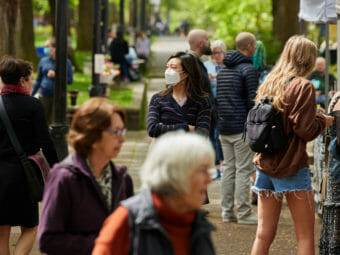
Shoppers in an outdoor market, one of them wearing a mask
Shoppers walk through a Portland, Ore., farmers market in May. With the BA.5 variant driving case counts, public health experts are encouraging people to take precautions. (Photo by Leah Nash /The Washington Post via Getty Images)

For much of the pandemic, the only silver lining to coming down with a case of COVID-19 was that you likely wouldn’t catch it again for a while (though there isn’t exactly a definitive answer on how long that period immunity typically lasts).

Increasingly, however, more people appear to be contracting the virus multiple times in relatively quick succession, as another omicron subvariant sweeps through the U.S.

The BA.5 variant is now the most dominant strain of COVID-19 in the country, according to the Centers for Disease Control and Prevention. And while it’s hard to get an exact count — given how many people are taking rapid tests at home — there are indications that both reinfections and hospitalizations are increasing.

For example: Some 31,000 people across the U.S. are currently hospitalized with the virus, with admissions up 4.5% compared to a week ago. And data from New York state shows that reinfections started trending upwards again in late June.

Dr. Bob Wachter, the chair of the Department of Medicine at the University of California, San Francisco, says BA.5 is highly transmissible and manages to at least partially sidestep some of the immunity people may have from prior infections and vaccinations.

“Not only is it more infectious, but your prior immunity doesn’t count for as much as it used to,” he explains. “And that means that the old saw that, ‘I just had COVID a month ago, and so I have COVID immunity superpowers, I’m not going to get it again’ — that no longer holds.”

So just how worried should you be, especially if you’re vaccinated and taking precautions like wearing masks in crowds? Here’s what some public health experts make of the latest surge.

Is BA.5 more dangerous?

So far there is no evidence that this variant causes more serious illness. And infectious disease experts say that even though new infections are on the rise, the impact of BA.5 is unlikely to be on the scale of the surge we saw last winter — in part because the country is better equipped to manage it.

The U.S. is averaging about 300 deaths a day, compared to 3,000 last winter. Dr. Anna Durbin, a professor at the Johns Hopkins University School of Medicine, says the combination of prior infections and vaccinations is still protective, and COVID-19 treatments are better.

“Most people have some underlying immunity that is helpful in fighting the virus,” she explains. “We have antivirals … And I think that because of that … we’re not seeing a rise in deaths. And that’s very reassuring. It tells me that even this virus, even BA.5, is not so divergent that it is escaping all arms of the immune system.”

She adds that new booster shots specifically targeting omicron — which could roll out as soon as this fall — should also be helpful in preventing serious illness and deaths.

Are there long-term consequences for people who get COVID-19 multiple times?

Findings of a pre-print study published in June suggest that people who get sick multiple times may have a higher risk of long-COVID symptoms.

Dr. Ziyad Al-Aly, a clinical epidemiologist at Washington University in St. Louis, looked at thousands of cases of reinfection and saw a wide range of problems in the months that followed: certain respiratory conditions, cough, shortness of breath, fatigue, brain fog and other conditions including metabolic disease, cardiac disease, kidney disease and diabetes.

“Altogether, we concluded that reinfection contributes to additional risk,” Al-Aly says. “So even if you’re vaccinated … it’s absolutely best to avoid reinfection.”

And a study published last week in the journal Cell concludes that repeat infections are likely.

Researchers studied blood samples from people who had been vaccinated and boosted, and they found they had a reduced ability to neutralize the BA.5 virus, compared to prior sub-variants, BA.1 and BA.2.

In addition, blood from people who had breakthrough infections from BA.1 also showed reduced neutralization, “suggesting that repeat Omicron infections are likely in the population,” the authors conclude.

What can people do to protect themselves?

There are steps you can take to reduce your exposure to the virus, like masking up in crowded indoor spaces. Here’s how to step up your mask game.

Plus, children under the age of 5 are finally eligible to get vaccinated (and while many parents are hesitant, public health experts are encouraging them not to wait any longer). And adults ages 50 and older, as well as those over 12 with certain underlying conditions, can get a second booster shot.

And, if you already have plans to travel or attend gatherings this summer, check out these tips for protecting yourself outdoors, improving indoor airflow and what to do if you get sick while on vacation.

Copyright 2022 NPR. To see more, visit https://www.npr.org.

Health officials see high demand for youth COVID vaccine in Juneau

A 9-year-old gets a flu shot after getting her COVID-19 vaccine on Thursday, Nov. 11, 2021, at Riverbend Elementary School in Juneau, Alaska. (Photo by Rashah McChesney/KTOO)

Juneau Public Health began administering vaccines to young children under 5 years old last week. So far, 24 of Juneau’s youngest eligible population have gotten the shot.

“We’ve been booked! They filled up really quickly,” said Public Health Nurse Alison Gottschlich. She says the clinic usually only does vaccines on Friday, but they added Wednesdays because of the response.

The clinic has 200 vaccine doses — 100 Pfizer and 100 Moderna — for children aged 6 months to 5 years.

The first Friday of July is fully booked, but there are a few walk-in appointments available if you’re willing to wait.

“We are getting full. I think there’s still a handful of appointments available for next Friday, but we do have Wednesday appointments available. Beyond next Friday there’s still plenty of availability,” Gottschlich said.

Juneau Public Health has Wednesday and Friday appointments available through the end of July. The vaccine is also available at SEARHC and Juneau Urgent Care.

At a state public health presentation earlier this week, doctors stressed the important of vaccinating young children against COVID-19 to protect against the possibility of a severe case.

As state COVID emergency ends, tens of thousands of Alaskans will see reduced food stamp benefits

""
Shelves at a small Anchorage-area grocery store on Wednesday, Jan. 5, 2022. (Photo by Emily Mesner/ADN)

Tens of thousands of Alaskans will lose access to expanded food stamp benefits in September after the state ends its public health emergency in July.

The end of certain additional benefits under the federal Supplemental Nutrition Assistance Program comes as food aid groups say need is reaching previous pandemic highs while prices are soaring. Plus, other pandemic-era benefits, like the child tax credit and rental assistance, are expiring too, said Cara Durr, director of public engagement at the Food Bank of Alaska.

“We know families are struggling and they are turning to services,” Durr said. “So this is really coming in the middle of what is kind of a perfect storm.”

The SNAP Emergency Allotment program, which has been in place throughout the pandemic, is set to end in Alaska after August. It will mean the loss of at least $95 in benefits per month for the 56,000 households in Alaska that receive food stamps. But some families could be losing hundreds of dollars more each month, at a time when roughly 13% of Alaskans are receiving benefits from SNAP.

The additional benefits will cease because the state of Alaska opted to end its public health emergency in July. For the money to be sent, both a federal and state-level order need to be in place.

A state spokesman said the emergency declaration was specific to COVID-19, and was not related to today’s economic challenges. The order was initially a way to respond to the pandemic, but is no longer needed since the private sector is providing much of that response now, he said.

The emergency allotment program gives people already receiving SNAP benefits the maximum amount for their household each month, Durr said. Benefits are calculated based on someone’s income and expenses, which means someone with more income would usually get lower benefits.

But under the emergency allotments, a single person in Anchorage who might normally receive the minimum of $26 per month could receive the maximum amount of benefits for their household, which is $322 per month, she said.

People who were already receiving their maximum benefit were able to receive an additional $95 each month beginning in July 2021 under the emergency allotment, Durr said.

“It’s been a really important boost for households,” she said.

SNAP benefits are available to some low-income families and come on debit cards issued to recipients so they can purchase food. While the benefits may not fully cover a month’s worth of food for families, they’re still an important resource, Durr said.

All told, some 97,000 Alaskans, among 56,000 households, were receiving SNAP benefits in April and are set to lose some amount of benefits come September.

That’s around 17,000 more people who received the benefit compared to January 2020, and is a number that’s been steadily rising since January 2021, according to data from the state’s health department.

At a press conference earlier this month, Shawnda O’Brien, director of the Division of Public Assistance, told reporters that the department will give notice to people receiving the additional money that the benefit will end.

According to a spokesperson for the U.S. Department of Agriculture, 16 states around the country have ended their emergency or disaster declarations while another four have said they will end theirs. States can extend the emergency SNAP benefits by a month after their emergency declarations end — which Alaska opted to do in order to send the benefits out through August once the order ends in July. The benefits will also extend a month after the federal emergency ends, according to the USDA.

For the states continuing their public health emergencies, the federal Department of Health and Human Services has said it will give a 60-day notice of when it plans to end the federal public health emergency, which by late June, it had not yet done — meaning the earliest the emergency could end would be late August, and the benefits for those states would continue through September.

The end of the emergency allotments will be “devastating” for people who rely on SNAP, predicted Heather Parker. She is a supervising attorney in Southeast Alaska with Alaska Legal Services, a nonprofit that provides free civil legal services to low-income Alaskans.

Parker said local food banks can be a stopgap measure for those who need food. She’s also told clients that to qualify for the maximum amount of food stamp benefits, they should make sure the Division of Public Assistance is aware of all expenses. But all in all, she said, there’s not a great safety net for people.

Leigh Dickey, advocacy director for Alaska Legal Services, noted that the federal dollars to pay the benefit still exist.

“By DHSS ending the state emergency, they’re basically just ending Alaskans’ access to the federal money earlier than they need to, which does seem cruel right now,” Dickey said.

An earlier disaster declaration that had been in place since March 2020 expired in February 2021, after Gov. Mike Dunleavy said the Legislature was the body that should renew it and it failed to do so. The current public health emergency set to end in July has been in place since May 2021.

In an emailed response, health department spokesman Clinton Bennett said that the emergency order was only possible under limited authorities given to the state’s health commissioner by the Legislature to help with the pandemic response.

The state public health emergency “is specific to COVID-19 and has nothing to do with the current economic situation,” Bennett wrote. “The tools provided for the COVID-19 response are no longer required, so it is appropriate to end the State Public Health Emergency Order.”

This story was originally published by the Anchorage Daily News and is republished here with permission.

Site notifications
Update notification options
Subscribe to notifications