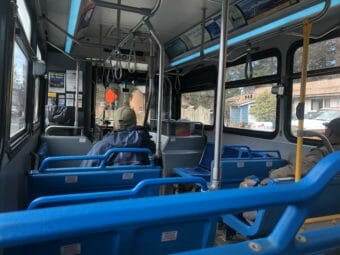
A Capital Transit bus on Thursday morning, April 21 in Juneau. (Photo by Yvonne Krumrey/KTOO)
On Tuesday morning, the City and Borough of Juneau announced that masks will no longer be required on public transportation like city buses or at Juneau International Airport.
The decision happened fast. On Monday, a federal judge struck down the mask mandate for public transportation. On social media, people posted videos of passengers taking off their masks mid-flight when pilots announced the change.
The next day, the City and Borough of Juneau announced that it wouldn’t require masks on city buses anymore. That mask mandate had been in place since March of 2020.
At the downtown transit center a few hours after the announcement, there weren’t any signs on the buses or in the transit center about the change. Many riders were still wearing masks — some by choice and some because they hadn’t heard about the rule change.
The city had a choice whether or not to keep its mask mandate for bus service after the federal mandate went away. Denise Koch is with the city’s public works department and has been the second in command for the Emergency Operations Center, making decisions for the city during the pandemic.
“I’d say the country and Juneau are moving from a more emergency posture, surrounding COVID to a posture of living with COVID,” Koch said.
She says that the city’s COVID-19 leadership has been anticipating the end of the public transportation mask mandate, but a federal judge striking it down suddenly wasn’t expected, Koch said.
Still, the plan has always been to follow federal guidelines, based on Juneau’s level of risk.
“So given that the community is low risk, it just seemed to make sense,” Koch said.
Anchorage mayor Dave Bronson announced the end of mandatory mask wearing for his city’s bus service.
Some cities, like Seattle and Portland, have chosen to keep their mask mandate.
Correction: A previous version of this story had the wrong date on the photo caption. The photo was taken on April 21 in Juneau, not April 10.
Royal Caribbean’s Serenade of the Seas docked at Ketchikan’s Berth 4 in 2021. (Eric Stone/KRBD)
Federal COVID-19 protocols that were mandatory for last year’s cruise season are now optional, but cruise lines visiting Alaska are still expected to follow the voluntary guidelines for the coming season.
Ketchikan’s acting city manager, Lacey Simpson, says in a memo that all cruise lines scheduled to visit Ketchikan’s city-run downtown port have indicated they plan to follow the Centers for Disease Control and Prevention’s COVID-19 protocols. Norwegian Cruise Line, which is scheduled to tie its ships up at a privately run port north of town in Ward Cove, has also said publicly that it’s opting in to the program.
As part of the voluntary program, cruise lines are encouraged to sign agreements with the ports they plan to visit outlining their COVID-19 protocols. One agreement between Royal Caribbean and a wide range of Alaska ports is up for Ketchikan City Council approval Thursday.
Under the proposal, 95% of crew and all eligible passengers 12 and older are required to be vaccinated against COVID-19. Passengers would be required to present a negative COVID-19 test before boarding. Shoreside workers who interact with cruise passengers and crew are also “highly encouraged” to be vaccinated.
With the start of the cruise season fast approaching, Ketchikan city officials are asking the council for the authority to sign similar agreements with other cruise lines.
Cruise Lines International Association executive Brian Salerno told KHNS last week that the cruise industry expects some 600 voyages to bring roughly 1.5 million passengers to the state this summer.
Large foreign-flagged cruise ships, which bring most passengers to Alaska, are also required to stop in Canada by federal law. Canadian authorities require all passengers 12 and older to be vaccinated and present a negative test.
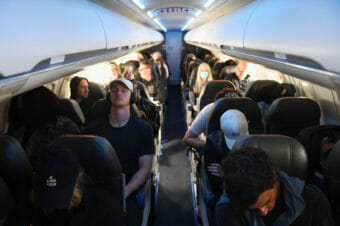
Airline passengers, some not wearing face masks following the end of the federal mask mandate, sit during a American Airlines flight operated by SkyWest Airlines from Los Angeles International Airport to Denver, on Tuesday. (Photo by Patrick T. Fallon/AFP via Getty Images)
When U.S. District Judge Kathryn Kimball Mizelle tossed out the federal government’s transportation mask mandate on Monday, she relied in part on her interpretation of the term “sanitation.”

The 10-letter word can be found in the Public Health Service Act, a sprawling 1944 law that gave the federal government certain powers to respond to public health emergencies.
The Biden administration relied on a piece of the Public Health Service Act to defend its COVID-19 mask mandate on airplanes and other forms of mass transit.
Specifically, the law says that if the government is trying to prevent the spread of communicable diseases, it can “provide for such inspection, fumigation, disinfection, sanitation, pest extermination, destruction of animals or articles found to be so infected or contaminated as to be sources of dangerous infection to human beings, and other measures, as in his judgment may be necessary.”
The administration argued that masks qualified as “sanitation” under the law, but Mizelle disagreed, opting for a much narrower definition of the term that would exclude measures like face coverings. Legal experts say her interpretation missed the mark.
“If one of my students turned in this opinion as their final exam, I don’t know if I would agree that they had gotten the analysis correct,” said Erin Fuse Brown, a law professor at Georgia State University.
“It reads like someone who had decided the case and then tried to dress it up as legal reasoning without actually doing the legal reasoning,” she added.
What counts as ‘sanitation’?
In her opinion, Mizelle says that a common way judges decide the meaning of words in laws is to look up dictionary definitions that were contemporaneous with the passage of the law. In this instance, that’s 1944.
Mizelle says “sanitation” could have been taken to mean either actively cleaning something or measures to keep something clean, but ultimately settles on the former definition.
“Wearing a mask cleans nothing. At most, it traps virus droplets,” Mizelle wrote. “But it neither ‘sanitizes’ the person wearing the mask nor ‘sanitizes’ the conveyances.”
Mizelle says her reading is bolstered by the fact that other words listed alongside “sanitation” in the 1944 law — such as “fumigation” or “pest extermination” — refer specifically to cleaning something or trying to wipe out a disease.
But Fuse Brown says that while this understanding of “sanitation” may be true for lay people, it’s not how the term is used in the public health field or understood by the U.S. Centers for Disease Control and Prevention, which issued the mandate.
“Sanitation was just the old way in public health parlance of taking traditional public health steps to prevent the spread of disease,” she said.
Fuse Brown points to the widespread mask-wearing during the 1918 influenza outbreak, which came roughly two and a half decades before the passage of the Public Health Service Act.
She suggested the opinion will make it harder for the Biden administration to control the spread of COVID-19.
“The reasoning is poor, but it also has really drastic and dire consequences for public health, which is the part that makes it not just a joke, but it actually makes it really frightening,” she said.
The opinion could have lasting effects on the CDC’s authority
Mizelle’s opinion also restricts the CDC’s ability to respond to public health emergencies in ways it deems appropriate, and if the opinion is upheld by a federal appeals court or the U.S. Supreme Court, legal experts warn it could hobble the government’s ability to control future outbreaks.
“If this particular type of opinion took on greater precedential value as it rises up through the court system, if that happens, it’s big trouble for CDC down the road,” said James Hodge, a law professor at Arizona State University.
Mizelle substituted her own definition of “sanitation,” Hodge said, brushing aside a legal norm known as “agency deference” that compels judges to yield to the interpretation of federal agencies when a law’s language is unclear.
Mizelle also criticized the agency for not following standard rulemaking procedures before instituting the mandate. Hodge said she misunderstood how the federal government operates during a national public health emergency.
“This is really a serious deviation from not just what we’re trying to do to protect the public’s health, but a misstatement of federal authority in emergencies to a great degree,” Hodge said.
Fuse Brown agreed, suggesting the opinion amounted to a “breathtaking amount of political judicial activism” that “should chill us all.”
“Even if we’re skeptical about agencies or even about Congress’s ability to make good judgments in this … time, we certainly do not want these decisions to be in the hands of a single unelected judge,” she said.
NPR’s Pien Huang contributed reporting to this story.
Copyright 2022 NPR. To see more, visit https://www.npr.org.
Many businesses closed or reduced operations early on during the COVID-19 pandemic. (Photo by Abbey Collins/Alaska Public Media)
Alaska businesses impacted by the pandemic have a little more time to tap into tens of millions in unspent federal relief funds.
That’s according to state Department of Commerce, which announced Monday that there will be two more weeks to apply for the state business relief program, which will disburse funds from the American Rescue Plan Act.
Businesses that already received ARPA funds won’t be eligible. The threshold to qualify for the relief has also changed — applicants now have to show they lost at least 30% of their gross revenue between 2019 and 2020 because of the pandemic. Business owners previously had to show a 50% loss.
A federal judge in Florida ruled on Monday that the Centers for Disease Control and Prevention can no longer require masks for all forms of public transportation — planes, trains, buses, subways. Even Uber and Lyft dropped mask requirements for passengers and drivers in response to the judge’s ruling.
In addition, many cities have lifted mask mandates for public spaces as COVID case counts have declined in recent weeks.
Yet omicron variants have been causing COVID cases to rise in some places — a special concern for those more vulnerable to COVID because of age or medical conditions as well as people who just don’t want to come down with the virus.
So a number of people are “one-way maskers” — the terms used for those who mask up even if others around them do not.
Is one-way masking — wearing a mask — helpful in any way?
It can be lonely out there as the solo masker in a sea of exposed chins and noses.
And there’s no getting around the fact that having everyone wear a mask cuts down the risk of spreading the coronavirus in a public space much more effectively than a scattershot approach.
“One-way masking isn’t doing that,” says Kristen Coleman, an assistant research professor at the University of Maryland School of Public Health. “We’re not maximizing the benefits of masks [if] only a proportion of the population” wears them.
But if you plan to continue wearing a mask, you can still get substantial protection as the sole mask-wearer if you do it right.
Pick the best mask
If it’s pouring outside, would you throw on a cotton hoodie and expect to stay dry?
The same principle applies to masks and pathogens.
Unlike a cloth or surgical mask, an N95 respirator (as well as similar products, like a KN95 or KF94) is specifically designed to filter out the tiny viral particles that stay suspended in the air when exhaled by someone who’s infected — and not just the larger respiratory droplets that spray out like cannonballs and fall to the ground at close range.
(These models are often referred to as masks but are technically known as respirators.)
“The only thing I recommend is something like an N95 respirator,” says Lisa Brosseau, a bioaerosol scientist and industrial hygienist who’s a consultant for the University of Minnesota’s Center for Infectious Disease Research and Policy.
Lots of studies dating well before the coronavirus pandemic, in the laboratory and in workplaces, demonstrate that fit-tested respirators protect the wearer from hazardous airborne contaminants, she says.
“From Day 1, we have collectively done a poor job at communicating the strong efficacy of N95 respirators,” adds Coleman.
Of course, any kind of protection is better than nothing at all. If you have no other options, surgical masks are better than cloth masks because the material has electrostatic charge to trap incoming particles, says Abraar Karan, an infectious disease physician at Stanford University — but if you’re serious, don’t count on them to keep you safe when most people nearby are unmasked.
Karan has taken care of hundreds of COVID-19 patients over the past two years and knows how well N95s work, even if you’re face-to-face with a contagious unmasked person.
“I’ve been very close to them while they were coughing and weren’t able to wear masks and never got COVID from a patient,” he says.
The only real downside of wearing an N95 is that some models can compress your face, pinch your nose and make it hard to breathe. The key is to find one that you can tolerate wearing, while making sure there aren’t big gaps around your nose or chin (if your nostrils are showing, forget about it!).
“They all feel slightly differently,” says Karan, who personally prefers a model made by 3M called the VFlex.
But keep in mind that an N95 on its own isn’t foolproof.
Health care workers go through fit tests to ensure the ones they’re wearing are sealed properly. Even so, Brosseau says research shows that about 10% of particles will leak through during the normal wear and tear of the day.
Of course, most of the N95-wearing public will not undergo a rigorous fit test. Brosseau had studied this scenario — people who had no prior experience or assistance putting on a respirator. She found that the majority of them could get a fit that would result in about 20% leakage.
This drop in effectiveness should not deter you, she stresses.
“It just means that it doesn’t offer that 95% protection that’s been advertised, but it’s still going to be providing more protection than a surgical mask or a cloth mask,” says Coleman.
Figure out how risky a situation could be
Even with a solid choice like an N95, you need to calculate the risks you’ll face as a one-way masker.
“Just wearing a mask — it helps, but it is not going to turn being indoors into something that has no risk,” says Jose-Luis Jimenez, a professor at the University of Colorado Boulder and an aerosols scientist.
Many of the considerations should feel familiar at this point, if not hard-wired into our pandemic-weary brains.
Poorly ventilated indoor spaces, especially where people are talking loudly, singing or exercising, carry the highest risk. If you do go inside, the safest situation is an uncrowded venue. And the longer you spend indoors, the more you open yourself up to infection.

The final big risk consideration comes down to how many people are contagious in your community. Dr. Lisa Maragakis says you can look at the number of new cases per capita in your community over the past week.
“That number needs to be in the single digits — somewhere between one to five cases per 100,000 — before we’ve reached that low level where the probability is such that you’re less likely to encounter someone with the virus,” says Maragakis, who’s senior director of infection prevention at the Johns Hopkins Health System.
And remember: There are no hard-and-fast rules.
For example, you can spend the same amount of time in similar indoor spaces, but the chance of infection can go up enormously depending on what people are doing.
“We’ve seen tons of outbreaks in choirs, none in libraries and movie theaters that I know of,” says Jimenez, who has developed a tool that estimates risk in different scenarios.
Some researchers have tried to specifically quantify the risk of being infected when one person is wearing a mask and the other isn’t — i.e., one-way masking. But many factors come into play.
One recent modeling study found a 90% risk of being infected after 30 minutes when a person wears a surgical mask and is about 5 feet away from an infected unmasked person. Switching to a respirator drops that risk to 20% over the course of an hour. And if both people are wearing a respirator, it’s under 1% in an hour.
Brosseau has also analyzed this kind of scenario, although with a different approach that looks at how long it would take to get a big enough “dose” of the virus that you’d likely be infected. She found it would be about an hour and 15 minutes for someone wearing an N95 (not fit tested) to get infected when in close contact with a contagious person.
Of course, all these estimates are based on certain assumptions and can’t be taken as a strict guide. Brosseau’s relies on the idea that there’s a high risk of infection for two unmasked people in close proximity for 15 minutes — but that time span comes from contact-tracing guidance used by the Centers for Disease Control and Prevention, not data about the virus.
“These are not bright lines between safe and unsafe,” she says.
What would they do?
Even among experts, there’s considerable variation in how much they’re going to rely on one-way masking when infection rates are high in their community.
Karan feels comfortable going into places that would be considered riskier if he’s wearing the N95 he likes: “I use that to work out in the gym. I wear it everywhere. I wear it in the hospital or just out and about.”
Others play it much safer. Jimenez says he isn’t going back to the grocery store yet, even with a high-quality respirator.
Brosseau is back to shopping for groceries but avoids busy times — and still rules out certain destinations. “I haven’t gone back to church since the beginning of the pandemic,” she says.
What to do about that awkward feeling
The decision to be a one-way masker can also add to your pandemic stress. It can be awkward to be the only person in a public place who’s wearing one. And given the way that masks have been politicized, you may feel that your decision to be a one-way masker could be taken as a confrontational action.
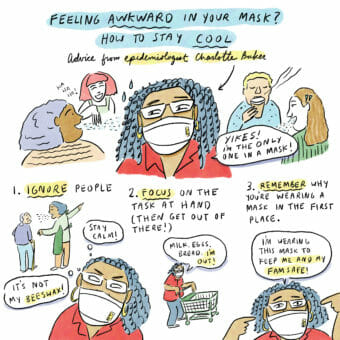
As a one-way masker, epidemiology professor Charlotte Baker at Virginia Tech often finds herself one of the few people wearing a mask. And she recognizes that it can be a lonely road.
She suggests giving yourself a little pep talk to strengthen your resolve: “I’m doing this so I can see my parents,” or “I’m doing this so I can keep my kids safe.” In her case, she is immunocompromised and reminds herself, “I don’t want to die” — but notes “that might be a bit too on the nose for many people.”
And don’t obsess about the non-maskers around you, she says: “I suggest ignoring people, focusing on the task at hand and getting out of there.”
Copyright 2022 NPR. To see more, visit https://www.npr.org.
Masked travelers head into the terminal of Juneau International Airport on May 15, 2020. Alaska Airlines previously required passengers wear masks in response to the COVID-19 pandemic and CDC recommendations. (Photo by Jeremy Hsieh/KTOO)
Last week, the federal transportation mask mandate was extended through May 3rd so that health officials could further study the new omicron variant of COVID-19. Monday’s decision makes that extension irrelevant.
In March, the CEOs of the country’s major airlines had signed a request to President Joe Biden to drop the mandate. And the governors of 21 states, including Alaska Gov. Mike Dunleavy, sued the federal government over the mandate.
Alaska Airlines had a mask requirement for passengers for two years. The company’s press release specifically addresses passengers who had been banned from flying on the airline for refusing to wear a mask, like Alaska Sen. Lora Reinbold. It said that some guests whose “behavior was particularly egregious” would remain banned even after the mask policy ended.
This story has been updated with additional information.
Close
Update notification options
Subscribe to notifications
Subscribe
Get notifications about news related to the topics you care about. You can unsubscribe anytime.