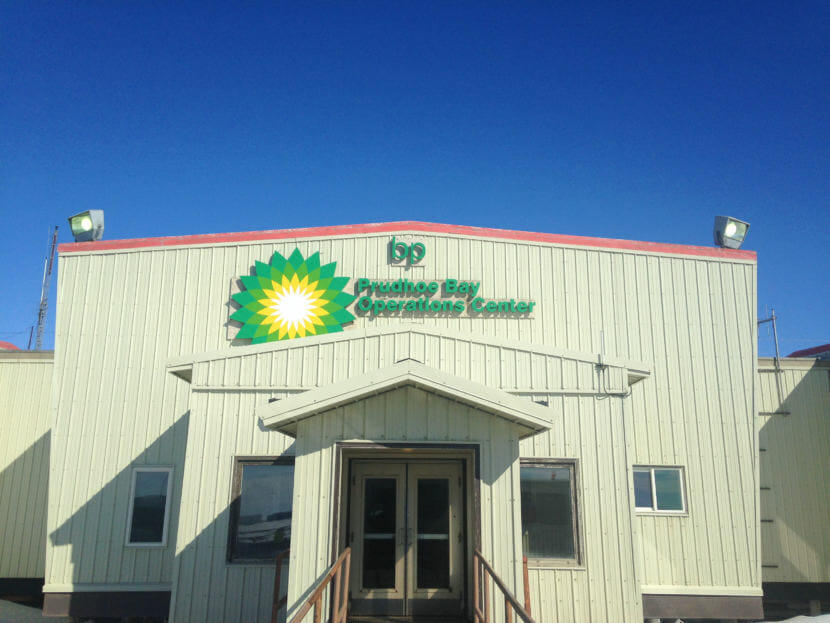
BP’s operations center at Prudhoe Bay. (Photo by Elizabeth Harball/Alaska’s Energy Desk)
Oil and gas company BP confirmed Tuesday that a worker at Prudhoe Bay has tested positive for COVID-19, the disease caused by the coronavirus. It’s the first confirmed case of the illness at the massive oil field in northern Alaska, where many workers live in close quarters.
BP is the operator of the field.
“BP is following procedures and protocols to minimize the risk of COVID19 and ensure the safety of our people. We are eliminating all non-essential activity on the slope,” said a statement from the company. “The safety and wellbeing of staff and contractors and respect for the communities in which we operate is our highest priority.”
A BP spokesperson did not immediately respond to additional questions. It’s unclear where the employee is from, what condition the employee is in and whether they have exposed others.
The company also did not provide specifics about which work activities qualify as essential.
BP previously said it has deployed new measures to prevent the spread of the coronavirus on the Slope. Those include checking employees for fevers, extending many workers’ shifts to at least three weeks and increasing cleaning. It also said its out-of-state workers will self-quarantine for two weeks in Alaska before flying to the Slope.
Ketchikan’s downtown cruise ship docks. (Photo by Leila Kheiry/KRBD)
While concerns over the coronavirus have knocked out Alaska’s cruise industry for the time being, a question remains about where the huge ships will wait out the pandemic.
Local officials in Ketchikan are weighing whether to allow idled cruise ships to tie up at the city-owned downtown docks.
More than 50 cruise lines have suspended sailings globally after federal health officials warned people not to get on cruises. The coronavirus pandemic — and the ensuing cruise industry shutdown — have created a unique problem: where can the ships go?
“At any given time, a lot of them are are underway normally,” said Ketchikan Port and Harbors Director Steve Corporon at a Ketchikan City Council meeting earlier this month. He compared it to 9/11, when federal officials suddenly grounded every plane in the sky after news of the hijackings broke.
JetBlue landed at a tiny airport in upstate New York. The population of Gander, Newfoundland, nearly doubled as 38 planes landed at the town’s airport.
“The infrastructure wasn’t there to land all the planes at once,” Corporon said. “Similar here — the infrastructure really isn’t in place to have all the cruise ships in port in a place that can accept them all at once.”
But this disaster has unfolded much more slowly.
Coroporon said he’s fielding inquiries from cruise lines looking for somewhere to park their ships while sailings are on hold. Usually, it’s his job to decide who gets to tie up at the city’s berths.
“But on a decision like this,” he said, “I would look to the manager and to the city council for guidance, because it’s a huge decision if we want to consider something like this.”
He laid out a set of possible conditions that the city could put on any cruise ships tying up. The ships would have to arrive fully provisioned with plenty of food and water for the crew, for example, and they wouldn’t be allowed to offload garbage.
And, importantly, “currently it appears that the [Centers for Disease Control and Prevention] and the Coast Guard would not direct or allow a vessel to moor in Ketchikan if there were any known cases of COVID-19 onboard,” Corporon said.
Beyond that, he said, the crews aboard the ships wouldn’t be allowed to disembark.
But Corporon says there’s one very important caveat.
“Legally, there would have to be some exceptions in order to comply with the seafarer exit regulations,” he said. “And that usually has to do with medical issues if they need to get somebody on or off.”
So what’s in it for Ketchikan? Not money, necessarily — Coroporon says that after paying for Coast Guard-mandated security, the city would more or less break even. And even if the cruise line paid for security, it wouldn’t be a bonanza for city finances.
But council member Sam Bergeron says it’s not necessarily about the money.
“We talked about what Ketchikan’s going to do going into the future and the cruise line business and having people cruise ships come here,” he said. “Well, I don’t think that they would forget that we weren’t good neighbors to them, you know, when times were hard.”
He said he’d support allowing the ships to dock in Ketchikan, assuming the cruise line could guarantee that the ship was free of coronavirus.
But council member Janalee Gage pushed back.
“I’m sorry, I’m not going to support this because I’m not going to assume anything,” she said. “I’m going to assume that we’re all infected as we’re sitting around this table.”
She pointed to the fact that relatively few people can be tested for COVID-19 — especially people without symptoms.
“It’s not about [being a] good steward. It’s not about being a good neighbor,” she said. “It’s about making sure that we’re not infecting more people in our community.”
Ultimately, the council decided to postpone any action to give the public a chance to weigh in — the discussion was a last-minute addition to the meeting’s agenda.
The council will discuss the idea of letting idled cruise ships dock in Ketchikan again at its next meeting.
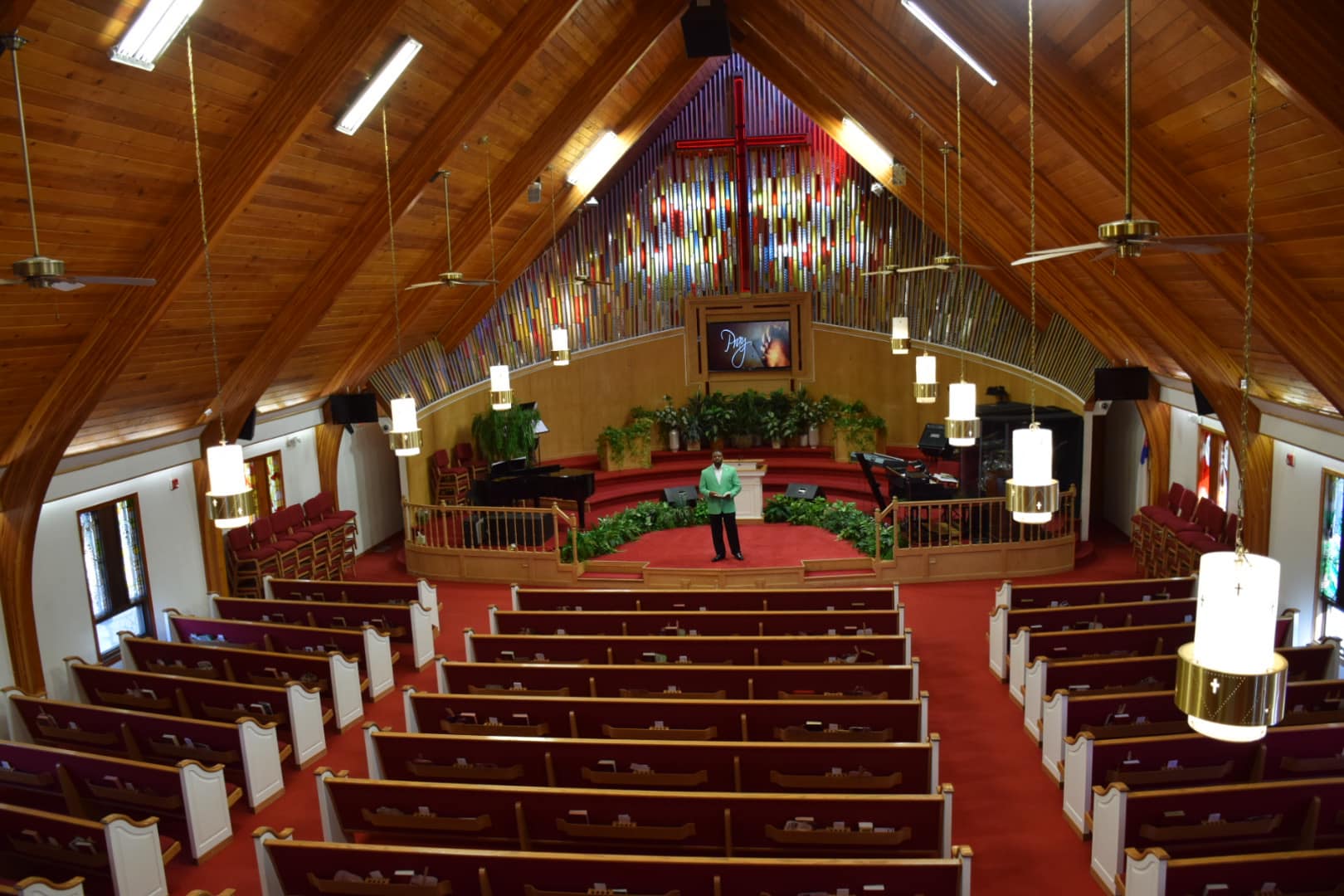
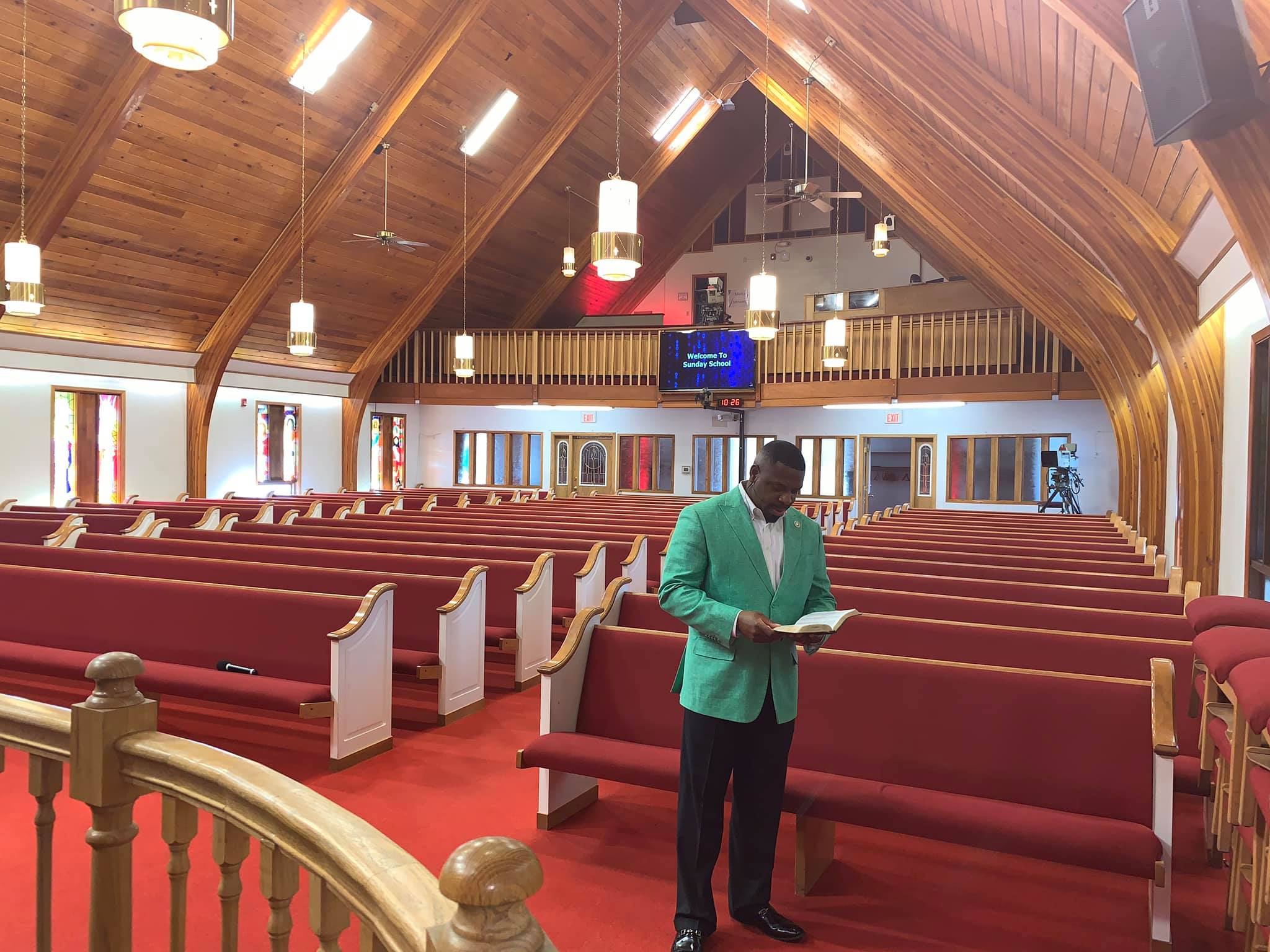
Pastor Undra Parker delivers a sermon to an empty church on Sunday, March 29. The sermon was recorded and shared on a variety of streaming services. (Photo courtesy of Shiloh Missionary Baptist Church)
When Undra Parker, the pastor at Shiloh Missionary Baptist Church in Anchorage, made the switch to online services, he said it felt different. Normally, in black churches, there’s a lot of interaction with the sermon.
“There’s a lot of ‘amens,’ ‘save us,’ ‘do it,’ ‘preach,’ — that talk-back you get,” Parker said. “And it’s a little different when you don’t have that.”
Now, Parker is preaching to a mostly empty church, save for the few staff members needed to produce the online service, which is streamed through Facebook Live and other platforms.
It’s hard not being able to see the reactions of congregants, not being able to hear the voice of the choir and not shaking hands at the end of service, he said.
Matt Schultz, at the First Presbyterian Church of Anchorage, also said he’s struggling to adapt to the new online sermons.
“It’s strange, man, because I like to make a lot of jokes, and you pause for laughter and there’s no laughter. Even on the good jokes, there’s no laughter — and that’s kind of funny,” he said.
But Parker, Schultz and others have also been adapting quickly to the changed worship landscape. They’re even learning to appreciate it.
“You know, it’s not bad,” said Schultz. “It’s just new, and you learn in the comments what people like. People are very, very free to criticize your work via email. You can get a lot of feedback that way.”
Rev. Undra Parker at an empty Shiloh Missionary Baptist Church on Sunday, March 29. He says he’s struggled with not being able to connect, but that it’s important to convey the right message. “(It’s) a great time for the church to be the lead and be the light. We need to be the forefront of hunkering down, particularly in the state of Alaska,” he said. (Photo courtesy of Shiloh Missionary Baptist Church)
Part of the trick has been learning new ways to engage with congregants digitally.
Rabbi Abram Goodstein of Congregation Beth Sholom said he realized that, in some ways, digital interaction can be more intimate than in-person sermons. For example, in the Mi Shebeirach prayer of healing or in the Mourner’s Kaddish, instead of asking people to say the names of their loved ones aloud, Goodstein said he has them post in the live comments.
“I see names pop up on the comments. People want to say the names they’re thinking of, and everyone can see it. So, it’s an exciting format to show a person who you are thinking of who needs healing, or a loved one who you knew who’s passed away,” he said.
The new format is also helping Goodstein fine-tune his own sermons using the digital analytics.
“In Facebook Live, people can react with buttons,” he said. “When it’s over, I can see when the most reactions happen, giving me an idea of what’s most popular about my worship service in a really incredible way.”
The technology is used in other ways as well. Churches around the state are seeing check-ins from places they didn’t even expect — and from people who might be turning to faith now with a particular intensity.
The ChangePoint Alaska church has seen its web viewership roughly double — from 2,000 to 4,000 — even though they’ve had an active webcasting service for years. They’ve seen viewers tune in from states across the country, and from as far away as Central America and Europe. They’ve been communicating with missionary partners in Italy and hearing dire news about the virus, as well as with former members who just pop into livestreams and chat rooms.
While these streams have existed for years, the church is also experimenting with new adaptations. One of the ideas is a daily prayer streamed over Facebook. The church is calling the 7 p.m. meetings “The COVID-1900.”
“We’re getting together for prayer, and we’re trying to pray in response to the things we’re learning about daily and that people are experiencing daily,” says Michael Warren, ChangePoint’s community and care pastor.
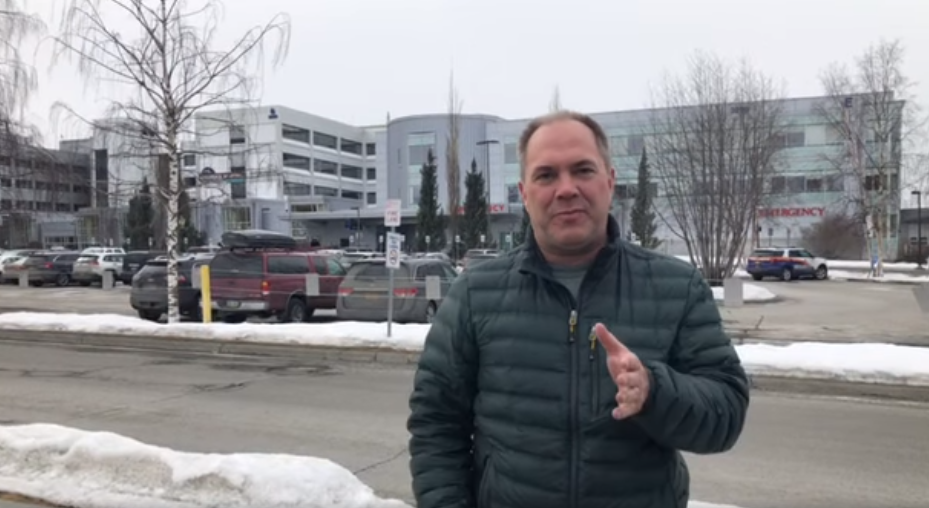
Pastor Scott Merriner delivers a “COVID-1900” prayer in front of Providence Hospital, a location he says he chose because it is on the “front lines” of the crisis (Photo courtesy of ChangePoint Alaska)
It’s especially important — and challenging — to keep elderly members of the congregation involved. Not only are people over 65 at higher risk of the effects of COVID-19, but they also tend to be less proficient technologically.
Tony Schultz at the Anchorage Lutheran Church said his staff identified the need to keep elderly members involved early on — and quickly found a solution.
“One of our members who provides the camera work for anything that we do is able to make DVDs. We have some people close by that we drop (them) off into their mailbox, and let them know it’s there,” he said. “Others, we’re mailing.”
There are plenty of ways to connect the global pandemic to scriptural lessons. Religious leaders said they’re tying sermons to themes of trials of faith, the unity of the community and keeping hope in hard times.
They’re also trying to be leaders in conveying practical messages from public health officials. While some churches in other parts of the country made headlines by defying public health mandates against large gatherings, most faith institutions around Alaska said they’re in lockstep with the recommendations.
“We are a faith community, so we do honor and still trust in God. But we use wisdom and we heed the mandates, the recommendations, the advisories, all of the things that will come down from our local, state and national officials to hunker down and to heed the six-foot distance,” said Parker, of Shiloh Missionary Baptist.
Religious institutions are getting as creative as they can in conveying those messages to their audiences.
In Fairbanks, the Unitarian Universalist Fellowship of Fairbanks produced a video with lyrics like: “There’s lots of stuff to watch online while keeping safe from sinus ills/ In this case it is better to enjoy Netflix minus chills.” The two performers hold a six-foot-long rod to make sure they’re keeping proper social distance.
But the humor underlies what, in many cases, are serious emotional and spiritual questions brought to light in a time of crisis. While many church leaders said they’ve seen more resilience than hope, and more offers to help neighbors than requests for assistance, they know that faith institutions play a special role in addressing deep spiritual concerns.
“I think when people are facing trouble, it’s a time when people are particularly open to spiritual kinds of things, because it makes them ask those kinds of questions,” said Warren, of ChangePoint, “As a church, we want to be ready to answer those questions in a clear and a winsome way, so that people have hope and they’ve got a vision that they can hang onto as we go through this.”
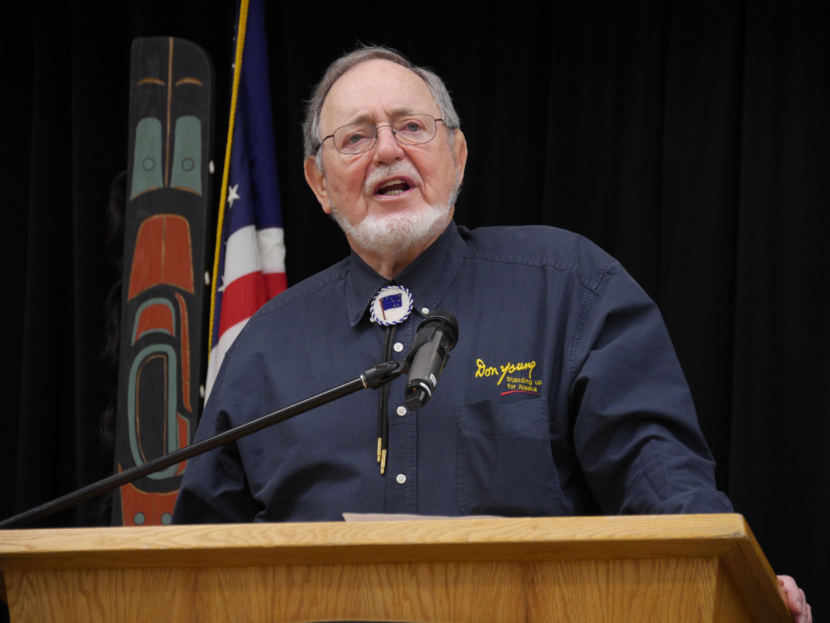
U.S. Rep. Don Young, R-Alaska, speaks at a Native Issues Forum in Juneau, April 5, 2016. (Photo by Skip Gray/KTOO)
Alaska Congressman Don Young has only praise for the CARES Act, a massive coronavirus stimulus bill Congress passed last week and President Donald Trump signed into law.
“Financial assistance — a lot of people have heard about that, when every person will get $1,200 … (and) $500 per child,” he said.
Just two and a half weeks ago in a speech in Palmer, Young derided a much smaller coronavirus stimulus proposal called the Families First Coronavirus Response Act. He complained then that the House bill intended to help families and workers cope with the economic hardship was stuffed with “socialist” ideas.
At the March 13 event at a senior center, Young encouraged people to remain calm in the face of the “beer virus.” He said the nation should continue its normal activities. He blamed the media for stoking an overreaction and cautioned against spending money the country doesn’t have.
“We’re going to borrow that money from the future generations to solve a problem right now that’s been created primarily by hysteria,” Young said, as recorded by reporter Tim Rockey of the Mat-Su Valley Frontiersman. “We have to think about that. That’s not a healthy thing to do.”
A few hours after that speech, the House of Representatives approved the $105 billion Families First bill. The bill requires some employers to provide paid sick leave in exchange for tax credits, expands unemployment benefits and provides free coronavirus testing.
Young skipped the vote. In Palmer, Young called it a “dumb bill” filled with “every little socialist idea in the world.”
But on Monday, Young offered a different perspective when asked what he’d do if he were given a second chance to vote on the Families First bill.
“I probably would have voted for it, but that was the very beginning of this pandemic, and there was a lot of questions about it then,” he said.
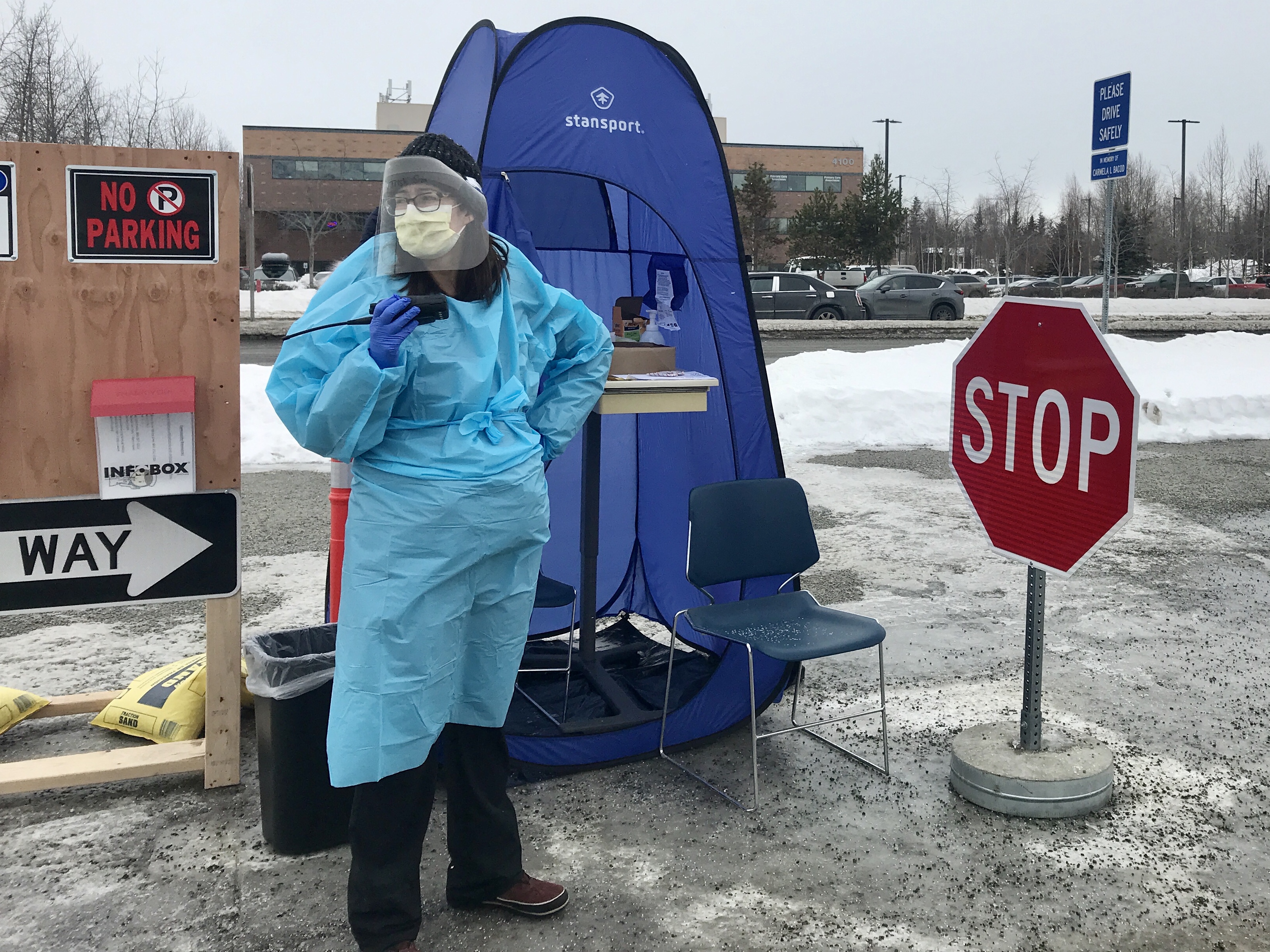
Trish Siza was the first health care provider to greet people in Anchorage seeking COVID-19 testing earlier this month at a drive-thru testing location. (Photo by Casey Grove/Alaska Public Media)
Anchorage officials are again asking people, businesses and medical providers to donate protective equipment “immediately,” including homemade masks, because of a shortage amid the coronavirus pandemic.
“Despite generous community donations so far, Anchorage continues to face a shortage of personal protective equipment and medical supplies,” the Anchorage Office of Emergency Management said in a plea to residents Saturday morning.
The city issued a similar message a week ago. Since then, its needs have grown to include “non-contact thermometers” — ones that can take people’s temperature without touching them, like with infrared technology. It’s also looking for “universal transport media,” which are the tubes used to stabilize test samples.
The city is also looking for gloves, masks, gowns and face shields. Open and expired equipment are acceptable, as long as it’s not used.
The city also said the Anchorage Fire Department needs homemade masks, as long as they’re made of a “single layer of tightly-woven material,” like dish towels, bed sheets or anti-microbial pillowcases.
Those masks will be used for patients that the department’s first responders are picking up — not for the responders themselves, who are still using traditional medical equipment, said Audrey Gray, a spokesperson for the city’s emergency operations center.
“Right now, they’re using medical-grade surgical masks, and they’re running low. So they just want to make sure they’re conserving those for actual medical use, instead of using them on patients,” Gray said. “It’s not ideal, but it’s what times are calling for at this moment.”
Homemade masks must be able to be washed and dried on high heat, and people should wash their hands and keep things clean when making them — don’t make them if you have any symptoms of respiratory illness, the city said. Packs of 25 or less can be placed in a clear zip-close bag.
All donations can be dropped off at CrossFit Alaska, 9191 Old Seward Highway, between 9 a.m. and 5 p.m., seven days a week.
Update (5:59 p.m.) — Liz Ruskin, Alaska Public Media
Alaska’s three-person congressional delegation was on the line at the governor’s Monday evening news briefing. They praised the features of the $2.2 trillion bill Congress passed last week, known as the CARES Act. That’s the bill that provides $1,200 for individuals, as well as at least $1.25 billion for the state of Alaska.
“It’s a good package for Alaska,” Congressman Don Young said.
Young talked about financial assistance — not for all Alaskans, he said, but “those who paid their taxes at a certain time.” He said there will be $1,200 for individuals, $500 per child, or $2,400 per family. He also talked about strengthened unemployment benefits and benefits for gig workers.
Sen. Dan Sullivan discussed a program meant to provide rapid relief to small businesses, called the “paycheck protection program.”
“The idea is that you keep the employer connected to … his or her worker,” he said.
It’s $350 billion set aside to provide government loans through community banks to small businesses, he said. If they use the money to cover qualified expenses, like payroll, rent or mortgage, after eight weeks the loan will turn into a grant. Small businesses are defined as having 500 or fewer employees and can be as small as independent contractors, sole proprietors or commercial fishers. Some companies, like those in oil and gas, can be up to 1,000 employees.
Sen. Lisa Murkowski said that the federal funds would help to “keep the wheels on the bus,” she said.
“Every day we see more and more the impact to people of all areas of the state,” she said.
Alaska will benefit from $1.25 billion in stabilization funds used directly for coronavirus impacts, to be shared with municipalities or school districts, she said. Additionally there will be an education fund, funds to tribes, the Indian Health Service, first responders and small farmers, she said. There will also be additional funding for domestic violence shelters.
Update (5:33 p.m.) — Liz Ruskin, Alaska Public Media
Alaska reported five new cases of COVID-19 Monday, bringing the total number of cases to 119, Gov. Mike Dunleavy said at an evening news briefing.
All the new cases were between the ages of 30 and 59, according to Chief Medical Officer Dr. Anne Zink. There were two new patients in Anchorage, two from Fairbanks and one from Palmer, she said.
Seven people who have tested positive have been hospitalized. There have been 3,713 tests given in the state.
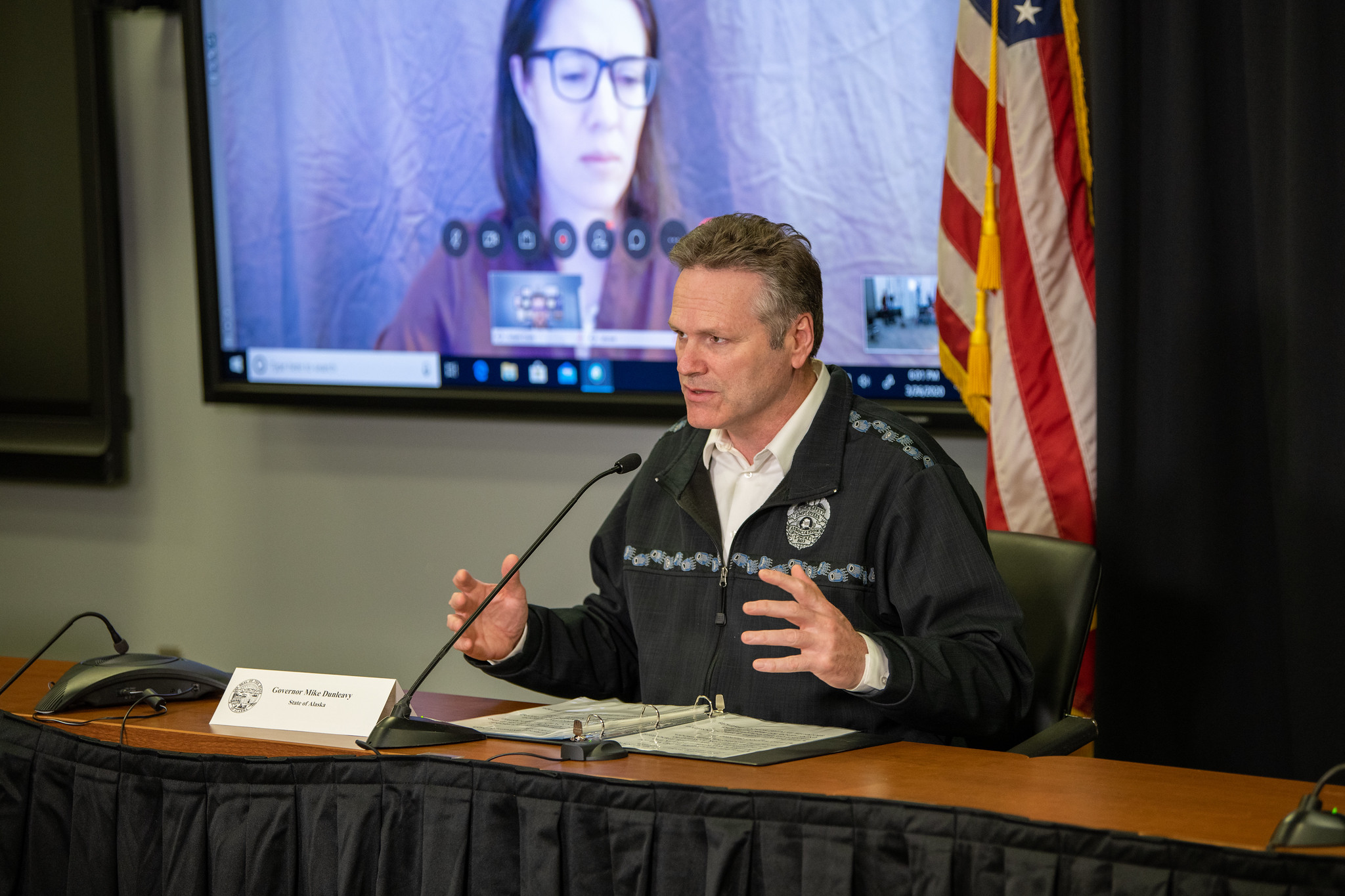
Alaska Gov. Mike Dunleavy speaks at a news conference on COVID-19 in Anchorage on March 26. Chief Medical Officer Dr. Anne Zink spoke remotely and appeared on a TV screen to the governor’s right. (Creative Commons photo by Office of Gov. Mike Dunleavy)
Original story — Ryan Cunningham and Rashah McChesney, KTOO
At 5 p.m., Alaska Gov. Mike Dunleavy will be joined by Congressman Don Young, Sen. Lisa Murkowski and Sen. Dan Sullivan to discuss efforts to address the economic impact of the coronavirus.
Alaska’s Chief Medical Officer Dr. Anne Zink will also provide an update.
The governor, Health and Social Services Commissioner Adam Crum and Chief Medical Officer Dr. Anne Zink have been holding briefings almost daily since March 10.
They’ve shared updates on the number of people in the state with confirmed cases, announced public health mandates and explained the administration’s strategy and rationale.