Arctic

What causes the northern lights? Scientists finally know for sure

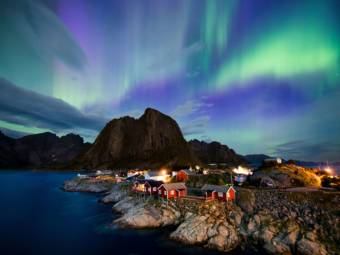
Northern lights (aurora borealis) illuminate the sky over Reinfjorden in Reine, on Lofoten Islands, Arctic Circle, on September 8, 2017. (Jonathan Nackstrand/AFP via Getty Images)

Nothing can ruin our joy in the aurora borealis, or northern lights, those ribbons of blue, green and violet light that cascade from the sky. Not even knowing for sure what causes them.

Physicists have long speculated about what gives rise to this very specific light phenomenon that occurs in the Earth’s polar regions.
Now they’re certain.

An article published in the journal Nature Communications this week suggests that the natural light show starts when disturbances on the sun pull on Earth’s magnetic field. That creates cosmic undulations known as Alfvén waves that launch electrons at high speeds into Earth’s atmosphere where they create the aurora.

“It was sort of theorized that that’s where the energy exchange is occurring,” said Gregory Howes, associate professor of physics and astronomy at the University of Iowa. “But no one had ever come up with a definitive demonstration that the Alfvén waves actually accelerate these electrons under the appropriate conditions that you have in space above the aurora.”

How the aurora form

The sun is volatile, and violent events there such as geomagnetic storms can echo out into the universe.

In some cases, the sun’s disturbances are so strong that they yank on the Earth’s magnetic field like a rubber band, pulling it away from our planet.

But, like a taut rubber band when it’s released, the magnetic field snaps back, and the force of that recoil creates powerful ripples known as Alfvén waves about 80,000 miles from the ground. As those waves get closer to Earth, they move even faster thanks to the planet’s magnetic pull.

On the same space highway are electrons also traveling toward Earth but not as fast as the Alfvén waves.

Sometimes electrons hitch a ride on these superfast Alfvén waves, reaching speeds as high as 45 million miles per hour as they hurtle downward.

“Think about surfing,” said Jim Schroeder, an assistant physics professor at Wheaton College and the article’s lead author. “In order to surf, you need to paddle up to the right speed for an ocean wave to pick you up and accelerate you, and we found that electrons were surfing. If they were moving with the right speed relative to the wave, they would get picked up and accelerated.”

When the electrons reach Earth’s thin upper atmosphere, they collide with nitrogen and oxygen molecules, sending them into an excited state. The excited electrons eventually calm down and release light, which is what we see as the aurora.

An illustration shows how electrons “surf” on passing Alfvén waves, which launch electrons at high speeds into Earth’s atmosphere where they create the aurora. (Austin Montelius/College of Liberal Arts and Sciences, University of Iowa)

What the experiment showed

While scientists had assumed for decades that Alfvén waves were responsible for speeding up the electrons, this laboratory experiment has produced the only definitive proof.

“Nobody had actually ever measured this before between electrons and Alfvén waves,” Schroeder told NPR.

The researchers used what’s known as the Large Plasma Device at the Basic Plasma Science Facility at the University of California, Los Angeles to re-create the interaction between Alfvén waves and electrons.

Such a study would have been impossible in space given that researchers cannot predict when aurora will occur and wouldn’t be able to account for other factors in the cosmos, they said.

The researchers suggested that their findings could help understand more broadly how particles are energized and also give them a clearer picture of how events on the sun affect space near Earth as well as the technological infrastructure we have there, such as satellites.

For Schroeder, there is another much simpler benefit from this kind of research.

“This appeals to our sense of awe and wonder,” he said. “We’ve been captivated by auroras for thousands of years and looking at the night sky and appreciating their beauty. And I’ve always found that understanding more about how something is created enhances my appreciation of that beauty.”

Copyright 2021 NPR. To see more, visit https://www.npr.org.

Federal appeals court rules Trump administration was wrong to reverse protections for Pacific walrus

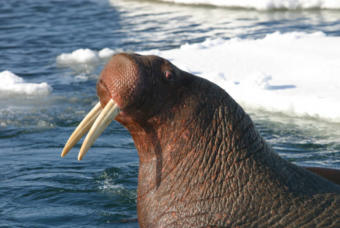
A Pacific walrus bull. Due to declining sea ice, walrus started hauling out in 2007.
A Pacific walrus bull (Public domain photo by Joel Garlich-Miller/U.S. Fish and Wildlife Service)

The U.S. Ninth Circuit Court of Appeals ruled Thursday that the Trump administration was wrong to reverse protections for the Pacific walrus. The ruling will force federal agencies to reconsider what protections are warranted for the species as their ocean habitat warms.

The ruling comes more than a decade after the Center for Biological Diversity, a conservation group, first petitioned the U.S. Fish and Wildlife Service to list the walrus as endangered or threatened. In 2008, attorneys for the Center said that oil and gas development threatened the species, as did the melting of sea ice that walruses use for habitat.
Emily Jeffers, an attorney for the Center, says that in 2011, during the Obama administration, the federal agency initially agreed with the petition, but was too busy to take action on it.

“And then six years later in 2017, the Trump administration found that the species did not warrant listing under the Endangered Species Act,” Jeffers said.

One of the factors in measuring threats to the walrus is what constitutes a problem in the immediate future.

In the Obama administration’s original 2011 ruling, scientific models predicted substantial sea ice loss by the year 2100, causing walrus population declines.

In its reversal, the Trump administration said 2060 was a better timeline to measure the immediate future of walrus sea ice habitat. And while Fish and Wildlife acknowledged that the species was in danger of losing that habitat, the agency said it didn’t believe the risk was at a level warranting federal protections.

In their lawsuit, Jeffers and the Center for Biological Diversity said the Trump administration didn’t fully explain its justification for changing the timeline from 2100 to 2060. And in a 20-page ruling Thursday, the court agreed.

“The court said, ‘Fish and Wildlife Service, you did one thing in 2011, you did another thing in 2017,’” Jeffers said. “‘That’s the hallmark of agency decision-making, that you have to explain the reasons why you’re doing something. And here you just didn’t explain what you were doing.’”

The Pacific walrus remains a subsistence staple in Arctic Alaska Native communities, which harvest an estimated 5,300 walruses annually. Endangered Species Act protections for the species, if adopted, would not affect subsistence hunting for Alaska Natives. Jeffers says that while subsistence hunts have the potential to threaten the Pacific walrus, that risk is small.

“Climate change and sea ice loss is overwhelmingly the main threat to the species, not subsistence harvests,” Jeffers said.

With the new ruling, Jeffers says the Biden administration will have to reassess whether the Pacific walrus should be listed as threatened or endangered. She says the Center for Biological Diversity is confident that the agency will boost protections.

“I think that when they do have to go back and reexamine their decision, we’re very confident that they’ll find that the walrus warrants protection under the Endangered Species Act because the science overwhelmingly supports that,” Jeffers said.

If listed, the federal government would also have to designate critical habitat deemed essential to the species.

US, Russian researchers track polar bears and ice seals across the Arctic

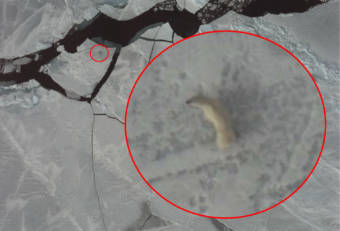
Polar bear image captured during aerial survey of the Chukchi Sea. (Photo courtesy of NOAA Fisheries)

Sea ice in the Arctic serves as a habitat for polar bears and their prey, ice seals. The ice doesn’t follow international boundaries, and monitoring the migration of these species requires access to both American and Russian waters.

collaboration between scientists from both countries is providing a clearer picture of the species, which remain subsistence staples to Arctic communities.

Irina Trukhanova is a wildlife biologist with North Pacific Wildlife Consulting. The group contracts with the National Oceanic and Atmospheric Administration and U.S. Fish and Wildlife Service.

She says that polar bears and ice seals are loosely spread out across the vast Arctic, and it can be difficult to keep track of their movements and populations.

“The only time that you can actually look at those species in their natural habitat is springtime,” Trukhanova said.

That’s when the species travel on the sea ice in the Chukchi Sea.

However, U.S. researchers are normally restricted to U.S. boundaries. Researcher Paul Conn with NOAA says that the process can be limiting since the polar bears travel between sea ice in both Russia and the United States.

“The only ones that they collar are the ones that end up over near Kotzebue, so that is a knowledge gap,” Conn said.

Bearded and other ice-associated seals are the primary prey of Chukchi Sea polar bears. (Photo courtesy of NOAA Fisheries)

In order to survey polar bears and ice seals across the entire Chukchi Sea, U.S. researchers with NOAA and Fish and Wildlife partnered with Russian scientists. The result was a 2016 aerial survey that observed the species populations and movements.

Using a combination of infrared technology with photography and visual observations, the researchers were able to track the distribution and abundance of the seals and polar bears. Conn says the results from the research give a more complete view of the mammals in the wider Arctic.

“It does give us a sense for where bears are in the spring in April, and having done surveys for seals at the same, we can see how important the distribution of prey is for the distribution of bears,” Conn said.

Moving forward, Trukhanova says that global warming will necessitate continuous research, as the Arctic warms faster than any other part of the world. That has led to diminishing sea ice for polar bears, and the ice seals they prey on.

“If it melts earlier, if the ice cover isn’t stable enough, then the survival rates for the pups, specifically for the ringed seal pups, become lower,” Trukhanova said.

The Alaska Nannut Co-Management Council, an organization of tribes that subsist on polar bears, praised the collaboration.  In a statement, Nannut Executive Director Katya Gray said  “… this effort is significant for its use of non-invasive methods to study polar bears, the importance of which our tribes and hunters are consistently raising.”

Trukhanova, who grew up in Russia and attended the University of St. Petersburg, said the data could not have been collected without collaboration.

“We were working together,” Trukhanova said. “We were planning the survey together, trying to make the methods compatible and make the results compatible so we could join forces and bring all the data to the table and get the robust joint results that we could use on both sides of the border.”

While the governments of both countries have had a sometimes tense relationship in recent years, Conn says he was impressed with the scientific community’s good-natured approach.

“You hear about Russia and us, and this antagonistic relationship, but when you actually get to the people it’s just amazing the amount of love they have for their science,” Conn said.

Results from the joint survey on polar bears and ice seals were published in the scientific journal PLOS One, part of the open-access Public Library on Science.

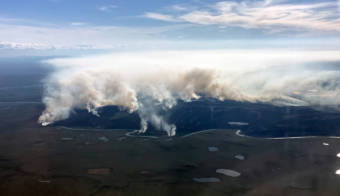
‘Zombie wildfires’ that can smolder underground all winter appear to be increasing in the Arctic

The Swan Lake Fire on Wednesday, June 12, 2019. (Photo by Kale Casey/Alaska Division of Forestry)

A recently published study examines the phenomenon of holdover or “Zombie wildfires” in Alaska and Canada. The fires, which smolder underground through the winter and flare up the following spring, appear to be increasing, due to climate change.

The study published in the journal Nature was led by researchers at a university in Amsterdam, aided by University of Alaska Fairbanks scientists. Randi Jandt is a UAF fire ecologist and co-author of the paper. She says holdover wildfires weren’t historically tracked until the last 20 years, but appear to be increasing.

“Everyone I’ve talked to — all these long-time field people in the fire business up there — kind of think it is increasing in frequency and now we’re starting to expect these things after some of our bigger fire seasons,” she said.

The study points to more than 40 overwintering wildfires reported in Alaska since 2005, and Jandt says climate change is suspected to be a key factor.

She says when Alaska’s peat rich soils dry out, they can provide an environment where fire can smolder through the winter.

“It penetrates down into the lower parts of that duff,” she said. “Or, if it can get under the roots of some trees and be protected from moisture, it can hold that fire.”

Overwintering fires pose challenges for firefighters.

“That smoldering overwinter can leave a bit pit of ash or maybe even a finger of fire that creeps out from an area that looks green on top,” she said. “But it’s kind of underground, so they have to root these things out and it takes a lot of water.”

Jandt says holdover fires typically crop up in the spring, and that requires firefighting agencies to be ready to respond earlier in the season.

Warming Pacific waters likely adding to Arctic sea ice loss, study finds

Sea ice floats in the Bering Strait off Cape Prince of Wales. (UAF photo by Gay Sheffield)

For the past decade, scientists have observed several years of abnormally low sea ice extent. While most of the cause has been attributed to a warming Arctic climate, a new study from the University of Alaska Fairbanks has found evidence that warming waters outside of the Arctic are impacting sea ice as well.

In the summer, there is a warm water mass that flows up from the Pacific Ocean through the Bering Strait across the Chukchi Sea. UAF marine science professor Harper Simmons says this transfer of warm water up into colder seas is normal.

“That flow is a natural state of the system,” Simmons said. “Unless things were really rearranged in the distant past.”

The water ends up resting in a layer just below the surface of the Arctic Ocean. Simmons says it stays there until the fall when colder water starts to form ice on the surface.

“That warm water makes its way slowly out of that layer and affects the ultimate amount of sea ice that forms in the Arctic,” Simmons said.

While that flow is normal, Simmons says there is emerging evidence that the warm water coming up from the Pacific is getting even warmer.

“Since the 90s, the temperature of that water has been observed to have a pretty significant warming trend,” Simmons said.

That trend translates to about half a degree Fahrenheit per decade. While that may not seem like a lot, Simmons says because it’s such a sudden change from years of stable sea ice conditions, it can be jarring to the system.

“If there was, in the past, kind of an expected sea ice formation of two meters of sea ice over the Beaufort,” Simmons said. “And this heat becomes part of that, then you would expect that instead of getting two meters of sea ice, you would only get a meter and a half of sea ice.”

R/V Sikuliaq docks in Nome (File photo by Emily Russell/KNOM).
The UAF-University of California San Diego study on warming Pacific waters was conducted on the R/V Sikuliaq, seen here docked in Nome. (Emily Russell/KNOM)

These observations were made as part of a study conducted by the University of Alaska Fairbanks and the University of California San Diego’s Scripps Institute of Oceanography. Simmons says the major change between this study and studies in the past was the introduction of new CTD, or conductivity, temperature and depth, technology.

The process works the same as how scientists had done it in the past. Basically, researchers lower a package into the ocean to monitor conditions in the water.

However, Simmons says the new custom-made CTD technology from the Scripps Institute exponentially increases the amount of data that researchers can gather.

“In a traditional cruise, you could make hundreds of profiles, and with a package like this, you could make thousands,” Simmons said.

Satellite imagery (upper figure) shows a warm jet of salty water flowing past Point Barrow then disappearing. Ship-based measurements (lower figures) show that the warm water subducts and continues below the surface. Lines A and B in the upper figure correlate with the ship-based data in the lower left and right figures, respectively. (Harper Simmons/UAF)

As scientists continue to monitor changes in sea ice, the impacts to the region continue to grow.

Diminishing ice has the potential to disrupt everything from marine mammal migration to the travel patterns of people who use the sea ice. Additionally, it could make travel across the Northwest Passage easier for shipping companies. Simmons says the diminishing sea ice could also impact the rate of coastal erosion.

“The more open water that you have for longer periods of time gives you more opportunities for storms to create large waves that increase coastal erosion.”

In the end, Simmons says that the findings of the study show that it isn’t just a warming Arctic that is leading to less sea ice.

“It’s not warmer temperatures locally,” Simmons said. “There’s this kind of global connection where warm water in the Pacific makes a difference.”

The study was published last month in the outlet Nature Communications.

Arctic research conference to highlight how rural Alaska communities approach energy, climate issues

The view from Point Hope, early winter 2015. (Photo by Ellen Chenoweth/University of Alaska Fairbanks)
The view from Point Hope early winter 2015. (Photo by Ellen Chenoweth/University of Alaska Fairbanks)

Several Alaska energy researchers will be featured in a national conference this week of the U.S. Arctic Research Commission.

One of the big topics of discussion will be how rural Arctic communities deal with energy and climate issues. Bruno Grunau is the director of the Cold Climate Housing Research Center in Fairbanks. He’s slated to introduce the climate, energy and equity keynote speeches on the first day of the conference.

“You know, we’re operating and looking in a place of the earth where people have been for 10,000 years and living sustainably for that long,” Grunau said. “So what we’re looking at here is what does the future look like, what does sustainable future look like in this part of the earth.”

Tim Leach is a contractor with the Arctic Research Commission. Leach said a lot of these issues related to renewable energy overlap with other chronic problems in rural Alaska communities like water and sewer problems, as well as issues dealing with infrastructure.

“Really with regard to both the provision of electricity and for heat,” Leach said. “Those are two focus areas within this energy sphere that we’re looking at in the conference.”

Deputy Director Cheryl Rosa with the U.S. Arctic Research Commission said that they are eager to hear from Arctic residents on the individual energy challenges their communities are facing.

“We’ve got remote communities, they’re all very different from one another,” Rosa said. “So there’s very rarely a one-size-fits-all solution for approaches to almost any technology or things that you’re trying to install in remote areas. And it’s very important to work with folks, learn what their needs are and figure out how to best address them, with them as part of the equation.”

The conference is free and will be held virtually from 8:30 a.m. to noon Tuesday through Thursday. Those interested in attending can register online. It will also be broadcasted live on Facebook.

Site notifications
Update notification options
Subscribe to notifications