Arctic

Bering Sea ice ‘resilient’ against winter storms this year, though extent is below average

This satellite shot is from March 25th after a winter storm. The most prominent leads can be seen near St. Lawrence Island and in parts of the Norton Sound. (courtesy Alaska Center for Climate Assessment and Policy)

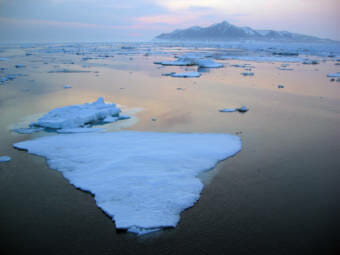
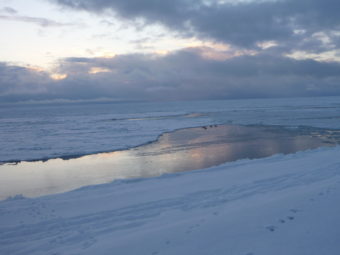
Blizzards and winter storms battered the Seward Peninsula and surrounding region throughout the month of March, but the sea ice has proved more resilient than in recent years.
Rick Thoman is a climatologist with the Alaska Center for Climate Assessment and Policy. He said these March storms have been known for tearing the ice apart.

“We have not seen the dramatic collapse of sea ice like we saw in several previous years, including last year, when the ice extended significantly farther south than it does this year,” Thoman said. “During the stormy spell last March, the ice retreated quite a bit. We have seen some decrease this season, but it’s been much less.”

Thoman thinks the sea ice held better this year because the most southern part of the ice edge down near St. Matthew Island has been much thicker and more stationary than in recent years. That ice can hold up better against the recent batch of storms.

The most recent sea ice model from the National Weather Service. Image from the NWS, 2021.

Some of the worst ice retreat was off Savoonga, but that’s unsurprising for Delbert Pungowiyi, a lifelong resident of Savoonga and former tribal president. He said that for about ten years now, the island has only had sikuliaq — that’s the word in St. Lawrence Island Yup’ik for young and brittle shorefast ice.

“Before the storms hit us you see on a satellite [that] it looks like a good winter,” Pungowiyi said. The north side of our island is all locked up [with ice] and the south side of our island. [But] any given storm from the east or south, it just breaks it up and opens it up.”

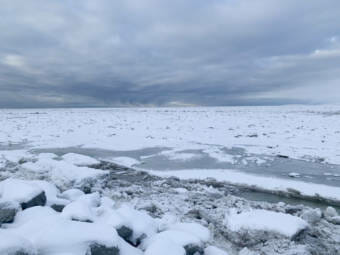
Recent storms have continued to push the ice off the northern parts of St. Lawrence Island.

Even when the sikuliaq is there, it is difficult to use for hunting. Pungowiyi recounted that recently a group of hunters fell through the young ice attempting to get to walrus. The hunters were fine, but the hunt was unsuccessful and Pungowiyi estimates that Native food from the ocean makes up as much as 90% of the community’s food security.

Wind speeds in the Nome-census area averaged around 43 mph with easterly winds on Sunday, based off data recorded from regional airports collected by mesowest.edu, with wind in Golovin reaching as high as 56 mph.

Thoman says that historically, these storms haven’t been typical for March.

“Typically this time of year, we’re not seeing storms track through the northwestern Bering Sea, across Chukotka and into the Chukchi Sea. That’s very common in the fall. But this time of year, quite unusual. But it’s been an unusual run of marches,” he said.

Weather patterns suggest that rather than having a storm season, the climate is just becoming stormier and less predictable. Thoman said that 2021 is also the seventh year in a row that the maximum ice extent is less than the 1981-2010 average.

“When we get these storms with less ice cover, that means, of course, that there’s more water exposed south of the ice edge, which means that water is available to evaporate and be incorporated into these storms,” Thoman said. “So when these storms come along, they have the potential to hold more moisture than they would have if say the ice extended all the way to St. Paul. And that certainly is directly attributable to the low sea ice, which is part and parcel with our changing environment.”

Graphic courtesy of the Alaska Center for Climate Assessment and Policy

And that likely means more snow and rain for Western Alaska.

At this point, Thoman predicts that melt-out for most of the Western Bering Sea and Gulf of Anadyr will likely occur in early to mid-May for parts of the Norton Sound. But these abnormally late winter storms may not be over yet. The National Weather Service is predicting heavy snowfall for Friday evening and the weekend in many parts of Western Alaska, including 5-10 inches for areas near Unalakleet and across the Eastern Norton Sound.

At federal forum, Alaskans weigh in on future of oil and gas

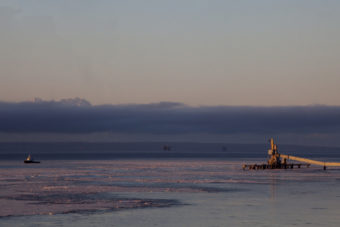
Cook Inlet oil platforms are visible from shore near Kenai, Alaska. (Photo by Rashah McChesney/Alaska’s Energy Desk)

Oil and gas leasing on federal lands and waters is on pause. That includes a sale in Alaska’s Cook Inlet that was originally slated for later this year and is now suspended indefinitely.

At the same time, the federal government is reviewing its energy program and gathering input from industry experts, environmental advocates and tribal leaders across the country. Several representatives from those groups, including two from Alaska, weighed in on the program at an Interior Department forum Thursday.

Nicole Borromeo, executive vice president and general counsel of the Alaska Federation of Natives, said that while Alaska Native communities are on the front lines of climate change, the federation also acknowledges the oil and gas industry is a boon for the Alaska Native workers it employs.

“Alaska natives do not operate in an either/or space when it comes to the nation’s energy policy,” Borromeo said. “We favor both traditional and emerging forms because a combination of both best serves our state and our people.”

In Alaska, the National Petroleum Reserve and a large swath of Cook Inlet are both part of the federal oil and gas program.

Earlier this year, the federal government halted an upcoming lease sale in the inlet in response to an executive order from the Biden administration, geared toward addressing climate change. Alaska and 12 other states are suing the Biden administration for that decision, while some environmental advocates are petitioning the government to block offshore leasing for five years.

Interior Secretary Deb Haaland said the government needs to take a long view at its management of public lands and waters.

“The pause on new oil and gas lease sales give us space to look at the federal fossil fuel programs that haven’t been meaningfully examined or modernized in decades,” she said.

Michael LeVine is a Juneau-based Arctic fellow with Ocean Conservancy, an environmental advocacy nonprofit. He said the pause was a good first step but further reforms and legislation are needed.

“If we could make one change in the legislation about offshore oil and gas, it would be to prioritize the health and viability of ocean ecosystems, rather than the way it’s stated now, a priority for extraction,” LeVine said.

He said offshore leasing in Alaska jeopardizes ocean ecosystems and the people who rely on them, including coastal communities and members of the fishing industry.

Representatives from trade unions and oil and gas industry associations said cutting federal oil and gas production would be bad for jobs.

Borromeo said AFN is also concerned about maintaining energy jobs for Alaska Native people. She said the department should actively consult Native communities in its decision-making on energy policy.

“Let us show you our lands,” she said. “Don’t necessarily just rely on what private industry or environmental groups are saying. We want to be the ones to take you and to show you.”

She encouraged Interior Department officials to visit Alaska to see it for themselves.

“That means you’re going to have to stay probably a week or so,” she said. “Because it’s going to take you a day to get here, a day to adjust up in Anchorage, and then we’ve gotta get out to the bush. We need to travel.”

The Interior Department said it will complete an interim report on its federal conventional energy programs this summer. It’s soliciting additional feedback until April 15.

The country’s biggest icebreaker will take trip through Northwest Passage this summer, US Coast Guard says

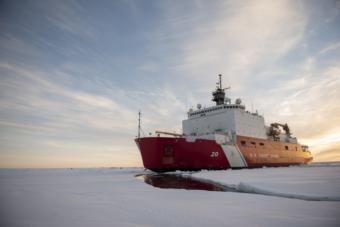
The U.S. Coast Guard Cutter Healy in the ice Wednesday, Oct. 3, 2018, about 715 miles north of Utqiaġvik, Alaska, in the Arctic.
The U.S. Coast Guard Cutter Healy in the ice Wednesday, Oct. 3, 2018, about 715 miles north of Utqiaġvik, Alaska, in the Arctic. (Public domain photo by NyxoLyno Cangemi/U.S. Coast Guard)

Last year, the United States’ largest icebreaker needed repairs after an engine fire. This summer, the U.S. Coast Guard Cutter Healy will take a trip through the Northwest Passage, in conjunction with Canada.

Experts said the Coast Guard cutter Healy’s trip through the Northwest Passage signifies a willingness to cooperate between Canada and the U.S. The announcement came from Coast Guard Commandant Adm. Karl Schultz during his State of the Coast Guard Address on March 11.

Professor Troy Bouffard studies Arctic security at the University of Alaska Fairbanks. He said the two countries disagree about the status of the Northwest Passage. The United States said it’s an international strait that ships should be able to transit without Canada’s consent, but Canada said those are internal waters that fall within its sovereignty and they should be notified of any transit.

“I think it sends a clear message or agreement to disagree. The official status of the Northwest Passage is somewhat less important than being able to collaborate and operate with expectations and confidence with our partners,” Bouffard said.

The countries have a treaty, signed in 1988, basically agreeing that the United States will get Canada’s consent to sail icebreakers through waters Canada claims. That treaty came about after controversy in 1985 when the U.S. icebreaker Polar Sea transited the passage without telling Canada.

The upcoming 2021 trip honors that treaty. But in recent years, the U.S. has considered moves that would have violated that.

In response to a 2019 Russian announcement that the country would restrict traffic in the Northern Sea Route, the U.S. said it likely would conduct an exercise in the Northwest Passage. That exercise could have inflamed tensions with Russia and Canada, but it never happened.

Bouffard said that the Biden administration and Canada jointly planning this summer’s 2021 trip is a strategic move — and that it sends a message to Russia and U.S. adversaries.

“I tend to think that this was also a clear message to, as quick as possible, strengthen the friendship in partnership with Canada in light of recent years of tensions and mixed messages about freedom of navigation and get back to the way things normally were,” Bouffard said.

“The Arctic continues to be a region of growing geostrategic importance, where the maxim ‘presence equals influence’ rings true,” Schultz said in his address to the Coast Guard earlier in March.

Statements like that aren’t lost on Kawerak’s Marine Advocate Austin Ahmasuk. He pays close attention to those international tensions as he studies shipping traffic and activity in the region.

“I think what’s perhaps playing out, is a little bit of rhetoric between countries that are kind of escalating hot political topics, such as, security interests, national defense, that kind of thing. I don’t think that we in the Arctic want to be in the middle of an arms race or political stage playing that puts us in jeopardy. Of course, we have to work internationally, as much as possible to ensure that peace occurs in the Arctic,” Ahmasuk said.

Ahmasuk said the Coast Guard and U.S. military have been destructive toward Alaska Native people many times. As one example, he points to the military’s history of leaving toxic waste in the Arctic.

Even the Healy’s namesake, Capt. Michael Healy was partially responsible for the destruction of the Tlingit village of Angoon in 1882. While U.S. Naval Cmdr. Edgar C. Merriman is often cited as the primary officer who gave the order for the bombardment, historical documents do show that Healy, as captain of the Thomas Corwin, did participate in the bombardment.

But as temperatures rise, Ahmasuk recognizes the undeniable increase in traffic in the Arctic waterways. And he’s hopeful that trips like the Healy’s upcoming Northwest Passage journey could be a chance for communication between federal agencies and Indigenous people.

“I hope that the Coast Guard can learn from our communities, and compare how our communities contrast [and] how our communities might be involved in this new era — this relatively new era that we’re trying to figure out now,” he said.

Bouffard explained that this trip is meant to be primarily for research and learning.

“I hope this does become a pattern for research and for other means and collaborations and learning about the environment and working together because the U.S. Coast Guard and the Canadian Coast Guard have completely different statutory requirements,” he said. “For example, the U.S. Coast Guard has a law enforcement function, especially with regard to international law, whereas Canada doesn’t. There’s a lot to learn from each other in that way.”

And he said there is still much to be studied and surveyed in the Northwest Passage.

According to Coast Guard documents, the trip will be primarily observational. And pending approval from Canadian officials, it will allow for some onboard scientists to do some “passive research”.

The Coast Guard does plan to do some undefined operational exercises in Baffin Bay after embarking from Nuuk, Greenland.

Right now, Nome’s Harbormaster Lucas Stotts doesn’t have any official word on whether the U.S. Cutter Healy will dock in Nome.

But according to the Coast Guard, the voyage plans to begin in mid-August from Dutch Harbor and finish by mid-September in Nuuk. Plans have not yet been decided for the timing or route of the USCG Healy’s return voyage to its homeport in Seattle, Washington.

Army wants to find snow-loving soldiers as it commits to ‘Arctic dominance’

Soldiers participate in a skijoring exercise at Joint Base Elmendorf Richardson in January. (Alejandro Pena/USAF)

The Army says it will boost its ability to operate in the Arctic, in part by recruiting soldiers who want to be in Alaska.

The Army’s new plan for the region is called “Regaining Arctic Dominance.” The name implies both a commitment and an admission of neglect.

Gen. Peter Andrysiak said the Army excelled in the far North during the Cold War. Then, he said, its Arctic skills “atrophied” as the focus shifted to warmer climates and the global war on terror.

The new plan outlines a need for Arctic-capable equipment and also focuses on what Andrysiak calls “talent.”

“When you go into a recruiting station, you’re going to be able to sign up there and say, ‘I want to go to Alaska, because I grew up in Colorado. I like to ski and I like to snowboard. I know that’s a key component of being able to operate in and through the Arctic,’” he said, describing a proposal that’s gaining support. “So what we want to do is make that opportunity available.”

Andrysiak also said the Army wants to revive relationships with Alaska Native communities to teach soldiers Indigenous survival skills.

The Army is the latest of at least seven military services or agencies to announce an Arctic plan in the past two years.

Heather Conley, an Arctic expert at the Center for Strategic and International Studies, said the multitude of Arctic plans is a sign the U.S. government lacks a unified approach.

“Now that we have so many strategies, now it’s time to make painful budgetary decisions and, you know, really prioritize this,” she said.

In lieu of U.S. commitments, some of the Arctic plans instead highlight what America’s allies bring to the table, Conley said.

“The Navy isn’t going to build new ice-strengthened surface vessels for use in the Arctic. They said very clearly in their strategy: They’ll think about it for the future,” Conley recalled.

The Army plan mentions climate change as a threat to infrastructure. Victoria Herrmann, managing director of the Arctic Institute, said she wishes it had gone farther.

“There wasn’t a forward-looking assessment of the rapid increase of how climate change will become a threat multiplier,” Herrmann said.

Like other recent Arctic plans, the Army document notes a potential increase in ship traffic and acknowledges the region is becoming a place of competition for the U.S., Russia and China.

Federal government extends public comment period for Arctic seal critical habitat

A bearded seal rests on ice in 2011 off the coast of Alaska. (Photo by John Jansen/NOAA’s Alaska Fisheries Science Center)

The federal government is extending the public comment period for proposed critical habitat for ringed and bearded seals. Both species had been listed as “threatened” under the Endangered Species Act during the Obama administration in 2012.

Designating an area as critical habitat means it contains features deemed essential to threatened species. Taking up a large swath of Arctic waters, the chosen area for the seals contains sea ice that they rely on for hunting and nursing their young.

A critical habitat designation does not mean that it’s off limits to human activity. However, if the government makes a decision about the area, they must consult with local biologists to ensure the species and habitat aren’t negatively impacted.

The National Oceanic and Atmospheric Administration proposed critical habitat for the two species of Arctic seals in January.

By law, the critical habitat should have been designated shortly after the seals had been listed as threatened. But the process was delayed by almost a decade, in part due to numerous lawsuits from the state of Alaska, the oil industry and others.

The original deadline for the public to weigh in on the habitat was March 9. It has now been extended to April 8.

Comments can be submitted online or by mail.

Kaktovik tribe says Biden didn’t reach out before agreement with Canada over caribou in Arctic refuge

The building that houses the Native Village of Kaktovik
The Native Village of Kaktovik building in June 2018. (Photo by Jennifer Pemberton / Alaska’s Energy Desk)

The Native Village of Kaktovik is speaking out against the Biden administration, claiming their tribe wasn’t consulted about an agreement President Biden made with Canadian Prime Minister Justin Trudeau regarding protections of the Porcupine caribou herd in the Arctic National Wildlife Refuge.

Last week, in a joint statement with Prime Minister Justin Trudeau, President Joe Biden pledged to “help safeguard the Porcupine caribou herd calving grounds that are invaluable to the Gwich’in and Inuvialuit peoples’ culture and subsistence.”

The herd’s migration takes them through both Canada and the United States.

It’s the latest in a series of moves from the Biden administration to stop oil drilling in the Arctic National Wildlife Refuge. Shortly after taking office, Biden placed a halt on lease sales in the refuge.

Eddie Rexford Sr. is the president for the Native Village of Kaktovik, an Iñupiat tribe and the only one located within the refuge. He says they weren’t consulted by the Biden administration before the announcement. Despite their opposition, Rexford says the tribe is committed to protecting subsistence resources.

“We certainly like to protect our homelands also, but we want to utilize the natural resources that our creator provided to us,” Rexford said. “Oil and gas, so we can get use the natural gas to get away from using diesel.”

Rexford went on to say that Biden’s actions run counter to his recent memorandum to respect tribal sovereignty and self-governance.

“He promises to work with the tribes and the Native groups in Alaska, and it’s not coming to fruition to our community and tribe,” Rexford said.

The Porcupine Caribou Herd in the Arctic National Wildlife Refuge on July 3, 2019. The Gwich’in live outside of the refuge but harvest caribou from the Porcupine Herd, which breeds in the refuge. (Danielle Brigida via Creative Commons)

Rexford says the tribe had successes with the Trump administration and former Interior Secretary David Bernhardt. He’s hopeful that, if confirmed, Biden’s Interior nominee Deb Haaland, of the Laguna Pueblo people, will make more efforts to work with the tribe.

“Have her come to our community to meet with our folks,” Rexford said, “to let her know that we live here and there’s no Gwich’in homelands here in the refuge, like it’s being purported in the news nationally, internationally and statewide.”

The Gwich’in are an Alaska Native people who reside primarily in the Yukon-Koyukuk region in Interior Alaska. The Inuvialuit are a First Nations people from Northwest Canada. Both oppose opening the refuge to drilling.

Beyond the agreement with Canada last week, the Biden administration has not made any concrete plans to address how they will safeguard the caribou herd.

This is the second scuffle Kaktovik has had with the Biden administration in recent weeks. Last month, the local Alaska Native corporation Kaktovik Iñupiat Corporation was informed by the Interior department that they missed a deadline to do oil exploration in ANWR. The corporation says the federal Fish and Wildlife Service held up the process, resulting in the deadline passing.

Site notifications
Update notification options
Subscribe to notifications