Arctic

Kaktovik Iñupiat Corp. blames feds for missed ANWR deadline, demands apology

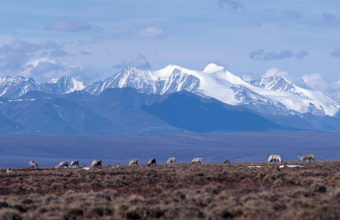
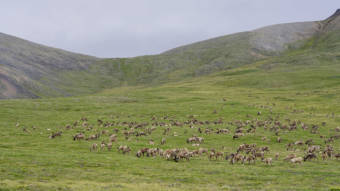
Caribou graze on the coastal plain of the Arctic National Wildlife Refuge, with the Brooks Range as a backdrop. (Creative Commons photo by USFWS)

Last weekend, officials from the U.S. Interior Department said there would be no searching for oil in the Arctic National Wildlife Refuge this winter.

The reason: The Alaska Native corporation proposing to do it failed to meet a key deadline to identify polar bear dens in the area, which could be threatened by the trucks used to detect underground oil formations.

Now, Kaktovik Iñupiat Corp. is firing back.

In a strongly-worded statement Thursday, KIC said the Interior provided a “blatant mischaracterization” of what happened.
“It was the agency that ran the time out, not KIC,” said Nathan Gordon Sr., the corporation’s chairman.

KIC said it was blocked from making the flights to search for polar bear dens by a Feb. 13 deadline because it never got approval from the U.S. Fish and Wildlife Service, an Interior Department agency.

It blamed Fish and Wildlife’s “negligence, irresponsibility and failure to do its job” for thwarting its plans to search for oil this winter, which were largely targeting corporate-owned lands within the Arctic refuge’s boundaries.

“They held all the cards,” said Matthew Rexford, president of KIC, “and then we saw a lot of delays and excuses from them.”

Rexford, in a news release and six-page letter to Fish and Wildlife, is demanding an apology and correction from federal officials, saying they harmed KIC’s reputation and caused significant economic loss to the corporation and the village of Kaktovik — the only community within the Arctic refuge’s boundaries.

An Interior Department official said the agency had no comment on KIC’s statement.

What KIC wanted to do this winter was bring the big trucks and dozens of workers onto a piece of the Arctic refuge’s coastal plain to search for pockets of oil using seismic technology.

Much of the surface area it wanted to assess is owned by the corporation, with an affiliated regional Native corporation, Arctic Slope Regional Corp., holding rights to any oil under the ground.

But for the seismic testing to move forward, KIC needed approvals from the federal government, including an authorization for “incidental harassment” of polar bears in case the work disturbed any dens.

KIC originally applied to do the work under the Trump administration, which pushed for oil development in the Arctic refuge. But the administration didn’t take action on the request before Trump left office — leaving decisions to the anti-drilling administration of Joe Biden.

Federal officials’ correspondence with KIC suggests that one reason the review took as long as it did was a campaign opposing the seismic exploration that popped up on the popular video-sharing app TikTok.

Video creators called on people to submit comments opposing KIC’s proposal to explore for oil this winter — their messages often playing over montages of polar bears and caribou. One activist even created an “influencer kit” to help other social media users promote the campaign.

@alex.harausLink in bio for some footage you can use! Hit those buttons to spread the word! #anwr #activism #outdoorsy #climatecrisis #cuteanimalsoftiktok #arctic

♬ Intro – The xx

In a letter Sunday to KIC, a Fish and Wildlife official pointed out that the agency received more than six million public comments. He said the agency could not review and consider all of the comments tied to the corporation’s request by the Feb. 13 flight deadline, despite taking “extraordinary measures.”

“These efforts included hiring a contractor to process and sort the comments, assembling a team of approximately 40 service staff members to review unique comments and working nights, weekends and holidays to ensure that all substantive comments were appropriately addressed,” the letter said.

KIC says that’s no excuse.

In a response letter, Rexford, with KIC, said the corporation expected approval by late January, which would have left more than enough time for the aerial surveys.

When that deadline seemed no longer possible, Rexford said, the corporation asked if it could do the flights without the harassment authorization and was told no.

“In other words, the service put KIC in an untenable situation where it could not perform a task without the service’s authorization, and then turned around and blamed KIC for the service’s failure to provide said authorization,” Rexford wrote.

KIC’s thwarted efforts to search for oil this winter are a major blow for proponents of drilling in the Arctic refuge. Any future proposals will likely face steeper hurdles under Biden’s administration.

Kaktovik Iñupiat Corporation misses deadline for seismic work in Arctic refuge this winter

The Porcupine Caribou Herd in the Arctic National Wildlife Refuge on July 3, 2019. (Danielle Brigida via Creative Commons)

An Alaska Native corporation has missed a key deadline to search for oil in the Arctic National Wildlife Refuge, according to the Department of the Interior.

Before it could get approval for what’s known as a seismic survey, the Kaktovik Iñupiat Corporation had to make three flights to search for polar bear dens in part of the refuge.

But the corporation did not do the work before the Feb. 13 deadline, said a brief statement Saturday from Interior spokeswoman Melissa Schwartz.

It’s unclear what exactly happened. An official with KIC did not return requests for comment Monday.

The missed deadline effectively kills the corporation’s proposal to use seismic exploration to search for oil in part of the Arctic refuge’s coastal plain this winter.
It’s the latest setback for drilling proponents who have long wanted to see oil pumped out of the refuge in northeast Alaska.

Another came last month when the first-ever oil and gas lease sale in the refuge, held under then-President Donald Trump, attracted very little interest.

KIC was proposing to bring big trucks and dozens of workers onto the coastal plain to search for pockets of oil on part of the land.

But, to move forward, the corporation needed what the federal government calls an “Incidental Harassment Authorization” of polar bears.

In October, KIC submitted a request to the U.S. Fish and Wildlife Service for the authorization. The agency got inundated with more than 6 million public comments tied to the controversial request.

It had until Sunday to decide whether to give KIC the authorization.

Because the aerial work was not done, the agency told the corporation that its request “is no longer actionable,” according to Schwartz, with the Interior.

Environmental groups celebrated the news that KIC’s plan hit a major roadblock. They had raised concerns about it damaging the tundra and harming wildlife.

“The previous administration attempted to fast-track exploration on an unreasonably short timeline, so the fact that KIC was unable to do the work necessary to ensure the safety of threatened polar bears was completely foreseeable, and Interior responding by voiding the harassment request is the right move at this time,” said a written statement from Adam Kolton, executive director of the Alaska Wilderness League.

Any future proposals for seismic work will likely face steeper hurdles under President Joe Biden, who opposes oil development in the refuge.

On his first day in office, Biden directed the Interior Secretary to put a “temporary moratorium” on all oil and gas leasing activities in the refuge.

Weigh in: NOAA is accepting public comments on protecting sea ice habitat of Arctic seals

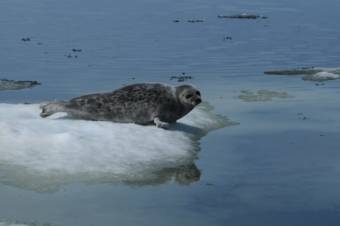
Ringed seal in Kotzebue Sound, Alaska
Ringed seal in Kotzebue Sound, Alaska. (Photo courtesy of NOAA)

The federal government is moving ahead with a proposal to protect the habitat of two Arctic seals. Public hearings start next week and will be hosted by the National Oceanic and Atmospheric Administration.

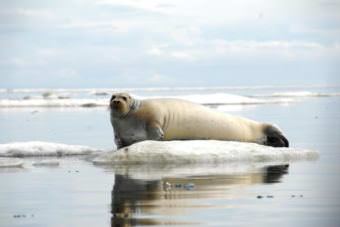
After being delayed for almost a decade, the federal agency proposed what’s called critical habitat designation last month in the Bering, Chukchi and Beaufort Seas. Bearded and ringed seals were listed as threatened under the Endangered Species Act in 2012 by the Obama administration. Though the species is still in relative abundance compared to other threatened species, long-term climate projections for the region forecast diminished sea ice, which the seals live off.

The hearings are scheduled for Tuesday through Thursday, Feb. 24-26 at 4 p.m. Anyone can submit their comments on the topic either by calling in during the hearings or submitting a written comment through the website.

Those who wish to make public comments can call 800-201-3962, and enter the conference code 651174.

The public comment period on the critical habitat ends on March 9.

Study connects physical decline of Alaska seals to warming Arctic

Spotted seal mother and pup in the Bering Sea. (NOAA Fisheries photo)

As global temperatures rise and warm the coldest parts of the world, scientists are watching for changes to species that live there. A new study has found evidence connecting the rapid warming of the region with a physical decline in three species of Alaska seals.

For 12 years, researcher Peter Boveng with the National Oceanic and Atmospheric Administration led a team that monitored ribbon and spotted seals in the Bering Sea. They were specifically monitoring body condition, or how fat the seals were. Boveng says what they found was the youngest seals were getting smaller.

“The fatness of the pups, the young of the year, declined on average over that time period,” Boveng said.

Boveng says this is one of the first major studies that shows evidence of a noticeable change in the seals’ body condition related to global warming.

“There hadn’t been, up until now, really much of any documentation of impacts that we think are climate related,” Boveng said.

Both of these species of seal tend to gather on the edge of the sea ice to hunt for food and raise their young. However, sea ice extent has drastically diminished over the past decade, with an average loss of just over 18,000 square miles a year. Boveng says that could impact how much seal mothers are able to forage.

“The mothers, maybe, were not finding as much food in the period prior to the birth of their pups, when they were pregnant,” Boveng said. “And also maybe not having as much fat or finding as much food during the nursing period.”

NOAA Fisheries scientists approach a ribbon seal. (NOAA Fisheries photo)

Between 2007 and 2018, the time period of the study, Boveng says that the two species of seals experienced two unusual mortality events, or an unexpected rapid decline in population. During the first event, the seals acted more lazy, with many showing sores on their bodies and loss of hair. Boveng says there was no evidence linking those things to a loss of food or a warming climate. He says the second however, saw more evidence that the decline was food-related.

“So this second UME which occurred right in the years of record low ice extent in the Bering Sea, really seemed to line up with the things we were seeing,” Boveng said.

A related study of harbor seals in the Aleutians found a similar decline over a three-year period, with an average decrease of 13 pounds per year — that’s about 10% of their weight. Boveng says that decrease is tied to a heat wave in Southwest Alaska between 2014 and 2016. He says it’s clear the dramatic decline in weight hadn’t been going on for long.

“The decline in harbor seal body condition over that period was pretty rapid,” Boveng said. “Something like that wouldn’t be something that had been going on for a long time, because they would’ve just wasted away.”

Looking to the future, Boveng says that scientists forecast warmer Arctic conditions will become more normal, and he anticipates that changes to seal bodies will be much clearer as time goes on.

US and Russia update plan to address marine pollution in Bering, Chukchi seas

The U.S. Coast Guard Cutter Healy, a 420 ft. icebreaker homeported in Seattle, Wash., breaks ice in support of scientific research in the Arctic Ocean.
The U.S. Coast Guard Cutter Healy, a 420-foot icebreaker homeported in Seattle, Washington, breaks ice in support of scientific research in the Arctic Ocean. (Public domain photo by Petty Officer Prentice Danner/U.S. Coast Guard)

The United States and Russia have updated their plan for addressing pollutants across national boundaries in the Bering and Chukchi seas.

The agreement between the United States and Russia, known as the Joint Contingency Plan, has been in effect since 1989. The U.S. Coast Guard is the federal agency that does most of this work, working with counterparts at Russia’s Marine Rescue Service.

Coast Guard incident management official Mark Everett said the plan lays out protocols for pollution that spreads from one nation’s waters to the other’s.

“This agreement says, essentially, we will agree to notify you. We will agree to request assistance in the response if needed,” Everett said.

Everett said to date, there have been no joint responses to pollution like oil or marine debris along that boundary with Russia. However, he said the two entities regularly conduct exercises and share information on pollution within their boundaries.

“There was one recently in Kamchatka, on the Russian side, that the Russian Federation government shared information with the United States,” Everett said. “We offered assistance. They didn’t accept the offer of assistance, but that is part of the bilateral agreement — to share information about other incidents, even though they may not affect the other party.”

Everett said one of the major new features of the latest Joint Contingency Plan is the addition of what’s called an international coordination officer.

“Someone potentially from the U.S. Coast Guard, in the event of a joint response, could go over to the Russian side,” Everett said. “A Russian representative could come over to the U.S. side, and then we have embedded liaison officers.”

Everett said he’s hopeful that having the new positions will make it easier and more efficient for either nation to share information. He said U.S. and Russia officials plan to meet in the fall to discuss their next exercises related to marine pollution response across national boundaries.

Researchers ask for more Indigenous input in national Arctic science initiative

Snow piles on sea ice in the Kotzebue Sound. (Wesley Early/KOTZ)

One of the National Science Foundation’s flagship initiatives for the past few years is called Navigating the New Arctic. It looks at the effects of a warming climate on Arctic communities. However, some in the field believe NSF isn’t doing enough to involve Indigenous people who live there.

More than 200 researchers from around the country signed an open letter to the foundation last month, requesting more Indigenous input within the initiative.

Margaret Anamaq Rudolf is a doctoral candidate at the University of Alaska Fairbanks. An Inupiaq woman originally from Fairbanks, her area of study is cross-cultural science education — which she says involves trying to answer the question, “How do we improve working relationships between researchers and Indigenous communities?”

Rudolf is one of the people who authored the letter to the National Science Foundation. While she welcomes the foundation’s initiative, she says it falls short of its potential to include the people who live in the Arctic.

“NSF is still centering researchers in Navigating the New Arctic, instead of centering Indigenous people in what they want and they need,” Rudolf said.

The letter from researchers was formed in solidarity with another letter sent last year from four Native organizations — Kawerak Inc., the Association of Village Council Presidents, the Bering Sea Elders Group and the Aleut Community of St. Paul Island.

The letter from Native groups outlines several issues that would have been studied more comprehensively if traditional knowledge was included from the start. Those include food security and community infrastructure. The letter also highlighted problems with requests for proposals.

Henry Huntington is an Eagle River-based independent researcher who’s worked with the initiative. He’s also one of the main authors of the open letter. He says that requests for research proposals from the National Science Foundation are geared to traditional academic knowledge.

“The forms that you fill out work pretty well if you have a bunch of university degrees and you have some scientific publications and all the standard things that you’d expect of someone with academic training,” Huntington said.

Comparatively, Huntington says it’s harder to list the traditional knowledge of Alaska Natives, who often are much more informed about their communities and will contribute as much if not more to the research.

“They confirm what we already know, instead of investigating what we want to know,” said Cana Uluak Itchuaqiyaq, one of the more than 200 scientists who signed the letter.

Itchuaqiyaq is a PhD candidate in technical communication and rhetoric at the University of Utah. An Inupiaq woman from Kotzebue and Noorvik, she says growing up, researchers coming into her community often would form questions that Alaska Native people already knew the answers to.

“And so, it’s taken tons of time for academia and the sciences to catch up to us,” Itchuaqiyaq said. “They’re just catching up.”

Kawerak social science program director Dr. Julie Raymond-Yakoubian helped write last year’s letter. She says oftentimes when Arctic researchers are making research proposals, one of their last steps is to ask for collaboration with tribal organizations, instead of including them from the start.

“When tribes and tribal organizations and Alaska Native organizations are brought into the process so late in the game, there’s really no way to effectively collaborate on a truly equitable level,” Raymond-Yakoubian said.

NSF Arctic sciences program director Colleen Strawhacker says a major initial issue with Navigating the New Arctic was that many researchers were eager to compete for grants and proposals, making tribal outreach a lower priority.

“Given the feedback from communities, that’s clearly … quite frankly a disrespectful approach to including Indigenous communities in NNA-type science,” Strawhacker said.

While NSF officials are still working on a formal response to the letter from the Arctic researchers, Strawhacker says she values the feedback. She says building and strengthening tribal relationships is key moving forward with Navigating the New Arctic.

“I think it’s critical if we want to fund the best science in the Arctic, we need those perspectives,” Strawhacker said. “We need perspectives from multiple scientific disciplines, but we need perspectives from Indigenous elders and the knowledge that they’ve acquired. I think if we don’t do that, we are doing a disservice to the science and understanding the changes in the Arctic.”

At the beginning of February, NSF announced that the Navigating the New Arctic community offices would be hosted at three universities, including the University of Alaska Fairbanks and Alaska Pacific University, a tribal college in Anchorage.

APU president Valerie Nurr’araaluk Davidson, a Yu’pik woman, described the office as a “hub for Indigenous engagement.”

Raymond-Yakoubian from Kawerak says she’s hopeful that outreach like this, the solidarity between Native groups and researchers shown by both letters, and a push for more Indigenous researchers will produce better outcomes in Arctic research.

Site notifications
Update notification options
Subscribe to notifications