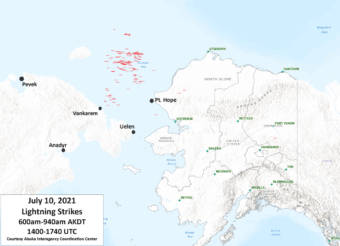
A map of lightning strikes in the Chukchi Sea on July 10,2021. (courtesy of Alaska Interagency Coordination Center)
As our climate changes around us, the unusual is becoming more frequent — whether it’s shorter snow seasons, intense wildfires or more recently, storms and lightning across the Chukchi and Beaufort seas.
Alaska climate specialist Rick Thoman says thunderstorms need a few different ingredients.
“One, they need moisture, and they need a fairly steep decrease in temperature aloft,” he said.
Storms over the oceans aren’t particularly rare, but Thoman says these storms form differently.
“We have very warm, moist air, moving off of Siberia and across the Chukchi and Beaufort seas. And that’s intersecting in this case, in the last few days, a slow moving weather front thats then providing the mechanism to cause that warm, moist air well above the ocean surface,” he said.
As the storms rage on, they bring smoke to parts of northern and western Alaska as well.
“The same winds aloft that have brought this warm, moist air, the smoke is coming with it — and that is all Siberian fires in the interior right now. Everything across the North Slope and out over western Alaska, that is all Siberian smoke, where they have had a lot of wildfire activity this season.”
Thoman says that the likelihood of these storms becoming more frequent in the next couple decades is high and will continue to rise as our climate changes at a rapid pace.
Special thanks to Rashah McChesney & Tripp Crouse for edits
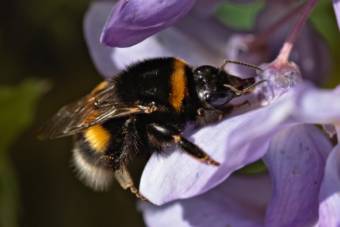
A bumblebee. (Creative commons photo by Miroslav Fikar)
Some of Alaska’s most valuable pollinators are bumblebees and, it turns out, we have a lot of them.
As bumblebees have declined in parts of the Lower 48, they’re apparently thriving in Alaska, even in the high Arctic.
But entomologists want to know more.
A project to compile an Alaska bee atlas is aiming to give us a better understanding of how many bees there really are in Alaska, including the bumbles, which belong to the genus Bombus.
Gemma Tarlach is a senior editor and writer at Atlas Obscura. She wrote about Alaska’s bumblebees in a recent article, describing the bumblebees’ method of generating body heat by vibrating their muscles as “twerking.”
Tarlach is also a beekeeper, and she says that while honeybees are also valuable pollinators, the native bumblebees are particularly important to the ecosystem.
She recently spoke with Alaska Public Media’s Casey Grove about Alaska bees and the atlas project.
Listen:
The following transcript was lightly edited for length and clarity.
Gemma Tarlach: Bumblebees have evolved to pollinate specific plants. So without bumblebees around or without other kinds of bee specialists around, those plants will not reproduce. So even though we think of honeybees as useful, they’re useful to us as humans in addition to the plants they pollinate. But bumblebees and other bee species are extremely important for healthy ecosystems.
Casey Grove: And bumble bees do pretty well in Alaska still, how is that? Why do bumble bees do well in such a northern latitude?
Tarlach: They really evolved to handle the cold better than most insects. One of the folks I talked to said, “Bumblebees are really pushing the envelope of what insects can do.” And the reason they’re doing really well in Alaska is down to a few different things. Number one: Bumblebees cold-adapted. Their life cycle includes a queen that will hibernate alone underground for eight to nine, maybe even 10 months out of the year. Bumblebees are also larger so that they have more mass and can keep themselves warm. And they are really good at twerking. I know that sounds crazy. But bees in general can detach their flight muscles from their wings and then just vibrate their flight muscles. So it’s basically, you know, just doing this really intense vibrating wiggle that generates warmth. And bumblebees are super good at this. They can actually raise their temperature by 30 degrees and about five minutes, just by vibrating these flight muscles.
Grove: Wow, that’s amazing. So are they kind of like warm-blooded in a way or like pseudo warm-blooded? How would you describe that?
Tarlach: You know, it’s funny. I was talking to Derek Sikes from the University of Alaska Museum. He’s the curator of the insect collection there. And he very casually mentioned that bumblebees are warm-blooded. And I said, “Wait, stop, hold the phone! What?” And he said, “Yeah, they do not generate heat constantly the way mammals do, but they do generate heat internally.” So technically, bumblebees are warm-blooded. And there’s some evidence, as well, that some species will just sit on specific flowers, for example, bombus polaris, which is the Arctic bumblebee, it likes to sit on poppies. It’s not collecting nectar or pollen. It’s just sitting on the poppy because the poppy’s shape reflects sunlight really well. So it actually helps the bee warm itself better than other flowers.
Grove: So tell me about bombus polaris, in particular, where does that species of bee live? And then they have this enemy that’s nicknamed the usurper, right? Tell me about that.
Tarlach: Sure, well, above the Arctic Circle, you have a few different species of bumblebee. You’ve got bombus polaris, which is commonly known as the Arctic bumblebee. And it’s hanging out collecting pollen and nectar from the various flowers available to it. Then you’ve got the usurper. That’s Bombus hyperboreus, or the High Arctic bumblebee. It’s actually a parasite. So what happens is bombus hyperboreus will go into the nests of the Arctic bumblebee, it will kill the queen and take her place and force all the workers of that colony to raise its own brood. And one description of it in a journal that I read that I loved is that it’s a bully, a thief and a murderer. So this may sound pretty dramatic to have a parasitic bee species, but there are a lot of parasitic bee species. And they’re really important.
In fact, for ecologists and biologists, when they’re doing surveys, they love to find parasitic bees because that means there are enough of the host species to support the parasites. So it’s actually a sign of a healthy ecosystem to have these parasitic species.
Grove: That’s interesting. It really does seem like there’s a lot of drama going on there with that whole thing. There’s this bee atlas project, right? What is that?
Tarlach: Researchers and land managers are finally going to be able to get a sense of just how many bees, specifically bumblebees too, are in Alaska. And that’s really important for a number of reasons. I mean, it’s a signal of good ecosystems, ecosystem health. It’s important to understand if the bees are doing well in the face of climate change and other changes to their habitat. And it’s also just really cool because there are so many areas that haven’t been surveyed. There were probably even more Bumble species in Alaska that no one has found yet.
Grove: And our current thinking right now is that bumblebees are doing pretty well in Alaska, right?
Tarlach: Yeah, bumblebees are doing really well in Alaska by all the information that folks have so far. And, unfortunately, that is not the case in the Lower 48 in a lot of areas, specifically, some species like bombus franklini or bombus occidentalis, the western bumblebee, they have disappeared from huge portions of their natural ranges. Climate change is a big factor. There are other factors as well including the way we use the land, especially with monoculture agriculture, growing one crop and not allowing any room for wild flowers or other plants that the bumble bees may forage on. But climate change is a big factor because there’s already a lot of evidence showing bumblebees are moving north and they are moving up in elevation to cooler areas because they just can’t handle the heat.
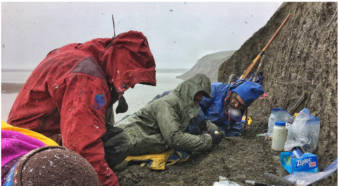
Researchers dig for dinosaur bones on a bluff on the Colville River (Photo courtesy of UAF)
The discovery of baby dinosaur bones on Alaska’s North Slope has paleontologists rethinking the animals’ lives and physiology.
University of Alaska Museum of the North director Pat Druckenmiller and colleagues from the University of Alaska Fairbanks and Florida State University made the discovery along the Colville River.
Druckenmiller said the area of eroding bluffs has yielded many dinosaur fossils over the last couple of decades. But these bones are different.
“Tiny little baby bones and teeth, not of adults and juveniles, but of actual very, very young animals that died either in the egg or just after they hatched,” he said.
The baby dino bones were found in sediments collected by University of Alaska Fairbanks and Florida State University scientists. They ranged from those of small bird like animals to giant Tyrannosaurus. Druckenmiller said the discovery of the baby dinosaur bones so far north indicates year-round residency.
“Dinosaurs likely had incubation periods upwards of five to six months for some species. And if that’s the case, a dinosaur laying its eggs in the spring would have been hatching them late in the summer,” he said.
If dinosaurs were migrating, they would have had very little time to move to lower latitudes with newborns, which suggests that the animals did not, in fact migrate.
“We think it’s more likely they actually managed and adapted to living in the Arctic conditions, year-round,” he said.
Given that the site where the bones were found was closer to the North Pole 70 million years ago, Druckenmiller said even in that era’s warmer climate, the dinosaurs endured pretty extreme conditions.
“Yes, it was cold. Yes, it was freezing conditions and probably snow. But at 80 to 85 degrees north you have to deal with three to four months of continual winter darkness. That’s the kind of world we don’t generally envision dinosaurs living in,” he said.
Druckenmiller said living in such relative cold is also telling about the dinosaurs’ physiology.
“If you lived up there year-round, you almost certainly had to have made your own body heat and probably maintain some elevated internal body temperatures,” he said. “And that, in a nutshell, is warm-bloodedness.”
Druckenmiller said that adds to evidence from other studies pointing to warm-blooded dinosaurs. Findings from the study are published in the journal Current Biology.
An Utqiagvik resident reported a tar-like substance spill on Tuesday morning near Simmons Field Beach. (Photo courtesy of North Slope Borough)
Coast Guard officials are en route to a beach in Utqiagvik in response to a tar-like substance spill.
The spill was reported just past midnight Tuesday morning when a local resident posted photos to Facebook, said Kimberly Maher, a spokeswoman for the Alaska Department of Environmental Conservation.
“A private citizen in Utqiagvik was on the beach and noticed this tank that was on a line of tanks that is on the beach for coastal erosion,” Maher said. “And they noticed some black tar-looking substance oozing out of one of the tanks.”
Maher said officials are still examining the substance in a lab to determine what it is, but DEC suspects it’s black tar or asphalt. In the 1960s, local officials placed 38 2,500-gallon tanks on the Simmons Field Beach in response to coastal erosion from a storm.
“These tanks, all chained together in a long line, were repurposed and brought down to the beach and placed for erosion control, to help reduce additional erosion in the future,” Maher said.
Maher said DEC believes that this is a one-time occurrence, where large metal drums were used to protect against erosion. However, she said, similar makeshift coastal protection methods were common.
“In the past people have tried to recycle different types of things in order to do either streambank revetment or coastal erosion type things,” Maher said. “If you’re in the Fairbanks area and you’re floating down the Chena River you’ll definitely see some old vehicles that have been used for bank stabilization. So it was not an uncommon practice in the past.”
So far, one of the tanks has been confirmed to be leaking, but there’s evidence that another four tanks could have leaks as well. Responders observed evidence of corrosion and weathering damage on the tanks.
The day the spill was reported, North Slope Borough officials began shoveling the spilled substance into a 55-gallon drum and placed sorbent boom around the tanks to try to absorb some of the contaminant.
Maher said the tanks haven’t been removed from the site, but the area is blocked off as responders continue their investigation. The spill does not appear to be impacting local wildlife.
The Noatak River Fire is an estimated 11,000 acres and burning in the Noatak National Preserve about 120 miles northeast of Kotzebue. Smoke from it and the nearby Tutak Creek Fire are impacting numerous communities to the southwest. (Courtesy of Ryan McPherson, BLM AFS)
On Tuesday night, the state of Alaska saw thousands of lightning strikes.
“Most of the 3,800 lightning strikes were concentrated in the Northwest Arctic,” said BLM Alaska Fire Service spokeswoman Beth Ipsen.
Those lightning strikes sparked more than a dozen new fires in the region.
Ipsen says there are several communities in close proximity to new fires. A fire popped up about 27 miles northeast of Kivalina, where Ipsen says it might run into a local Native allotment.
“There’s some smokejumpers that are prepping that Native allotment in case that fire does threaten it,” Ipsen said.
Two other villages near fires are Selawik and Buckland. Ipsen says a team of smokejumpers deployed to the Canyon Creek Fire about six miles southeast of Buckland. The fire near Selawik is burning at Niglaktak Lake, about two miles away from the village. But Ipsen says the fire is burning on a peninsula.
“We don’t believe that it’s going to do anything, impact the neighboring community because it is surrounded by water,” Ipsen said.
Map of fires burning in the area include new fires (numbers 250-263) that started on June 22, 20121 after lightning rolled through part of Western Alaska from Galena north to the Kobuk River Valley. (Graphic courtesy of BLM Alaska Fire Service)
Another five wildfires started near the mouth of the Noatak River, with a dozen smokejumpers deployed to the Mulik Hills and Hugo Creek Fires. The two are about a mile apart.
Ipsen says the biggest fire in the state has been burning in the Noatak National Preserve, about 120 miles northeast of Kotzebue.
“An estimated 11,000 acres,” Ipsen said. “And that estimation is from satellite imagery.”
She says right now, the fire isn’t threatening any buildings or allotments, and the fire service is letting it burn out naturally while keeping an eye on it.
Ipsen says temperatures have been warm, but the forecast should shift by Thursday.
“We do have rains forecasted starting Thursday and Friday — there’s I believe a 70% chance in some areas,” Ipsen said. “So that’ll definitely help with the fires.”
Any wildfires can be reported to BLM Alaska Fire Services by calling 1-800-237-3633 or to your local authorities by calling 911.
An image of 2018 Arctic sea ice minimum extent, with red line representing the 30-year average. (NASA Scientific Visualization Studio)
Defense Secretary Lloyd Austin this week announced the establishment of the Ted Stevens Center for Arctic Security Studies. But the center doesn’t physically exist yet. It doesn’t have any staff. And it might be located far from the Arctic.
A Defense Department spokesman said three cities are under consideration for housing the Ted Stevens Center: Anchorage, Colorado Springs and Washington, D.C.
Sen. Lisa Murkowski said she’s made it very clear to Secretary Austin that she expects the center to be located in Alaska.
“He acknowledged that he was fully aware of that,” she said.
The Defense Department has five other regional defense study centers. They are academic forums and hubs for building international alliances. One in Hawaii is named for the late Sen. Daniel Inouye. He and Sen. Stevens were close friends.
The Pentagon didn’t originate the idea of an Arctic center. It’s a congressional mandate, added by the Alaska delegation. Murkowski inserted $10 million for it in an appropriations bill.
The Pentagon spokesman said the department will “immediately” begin the work of hiring a director. The Alaska delegation has already submitted its list of preferred candidates, Murkowski said.
Close
Update notification options
Subscribe to notifications
Subscribe
Get notifications about news related to the topics you care about. You can unsubscribe anytime.