Arctic

Scientists have documented an increase in harmful algal blooms in northern waters

A bloom of algae discolors a swath of Gastineau Channel just north of the Douglas Bridge on Monday, July 30, 2018.
A bloom of algae discolors a swath of Gastineau Channel just north of the Douglas Bridge in Juneau on Monday, July 30, 2018. Scientists have documented an increase in harmful algal blooms in the northern Bering and Chukchi Seas. (Jeremy Hsieh/KTOO)

Scientists have documented an increase in harmful algal blooms in the northern Bering and Chukchi Seas. The blooms carry toxins, but scientists aren’t sure what effect they will have on marine mammals.

“We don’t know yet if toxin levels in Arctic food webs are reaching high enough concentrations to cause health impacts in marine mammals in that (the Arctic) region,” Don Anderson said.

Anderson, a senior scientist with Woods Hole Oceanographic Institute, or WHOI, has been studying algal cysts in the Bering and Chukchi Seas for several years. He presented his data and the work of other researchers in the region during a Strait Science virtual event hosted by the University of Alaska Fairbanks Northwest Campus on Oct. 14.

Map of harmful algal blooms in the Northern Bering and Chukchi Seas. (courtesy of Don Anderson/WHOI)

Not all types of algal blooms are harmful, Anderson pointed out. In fact, there are thousands of them spread across the world’s oceans. But in the Northern Bering and Chukchi Seas, there is a growing presence of Alexandrium cysts, an algal bloom that creates harmful saxitoxin.
The previously accepted explanation for how they got this far north is called the “trail of death” hypothesis, Anderson said.

“That (says) it’s being carried from the south in these relatively warm surface waters, and that it would form cysts in the Chukchi region that fall to bottom sediments where the temperatures would be too cold to support significant germination,” Anderson said. “I call that cyst seed bed a sleeping giant.”

Since bottom water temperatures have been warming drastically across the Northern Bering and Chukchi Seas over the last few years, cysts are now growing locally in Arctic waters. In other words, the sleeping giant has awoken.

“So what you’ve got then is a dramatic increase in the potential for what we would say is local initiation of blooms. In other words, not just transport, but blooms that are starting, inoculated from that region, from those two Ledyard Bay and Barrow cysts’ seed beds,” Anderson stated.

Ocean currents shown on a map in the Northern Bering and Chukchi Seas. (courtesy of Don Anderson/WHOI)

Recently, the United States Geological Survey concluded that the recurring seabird die-offs seen in the Bering Strait region are not related to harmful algal blooms. USGS scientists did however find low levels of toxins in many species of birds they sampled.

Since 2016, low levels of biotoxins have been documented in all different types of marine mammals, seabirds and various fish species in the Bering Sea, Anderson pointed out.

Even so, Anderson said eating various forage fish or salmon in the region still poses low risk to human health.

“Based on current understanding of these toxins in many other parts of the world, we think that muscle and blubber are not likely to accumulate saxitoxin in levels that pose a human health hazard. These tissues haven’t been fully tested, but there are reasons to believe they’re not going to accumulate toxin,” Anderson said.

This baseline is based on the only metric that exists from the FDA regarding safe food consumption of shellfish. It determines the level at which clams or other shellfish become too toxic to eat and then could cause paralytic shellfish poisoning. However it is not the best way to gauge how high algal toxins can be in marine mammals before causing harm to humans who eat them, Anderson said.

Alaska Marine mammals map showing toxin levels found in various species, from Kathi Lefebvre’s 2016 report on algal toxins in Alaskan waters, used with permission. (courtesy of Kathi Lefebvre)

While Anderson believes the health risk for Bering Strait subsistence users is quite low, he still emphasized using caution and safe practices as usual when eating shellfish or marine mammals. He also highlighted the fact that other parts of the world are living with the same conditions.

“Many regions of the world face similar risks and yet are able to maintain healthy communities and ecosystems. But it’s done through good management, good communication, and through understanding what the threats are,” Anderson said.

Overall, as cysts spread and cause more harmful algal blooms, there is an increasing potential for them to impact human health and ecosystem health in Northern Alaskan waters.

One observation from Edgar Ningeulook cited in 2013 pointed to an algal bloom near a historical place called Ipnauraq.

“This was the location of a red tide that at one time caused many deaths. And it doesn’t say how, what were they eating? I note that this is a place where there is a lot of fishing going on, especially for herring, one of those forage fish that I was talking about. So was it herring that was eaten, was it clams, who knows. But notice its location, it’s in that pathway of the transported blooms from the south. So long ago there was that threat and it got to the point where many people died,” Anderson said.

Research in the Chukchi Sea is ongoing. Anderson’s team will be partnering with scientists on the Russian side of the Strait in 2022 to get the full scope of what other changes are happening in the Bering Sea ecosystem.

House version of Biden’s $1.75 trillion bill would cancel drilling leases in Arctic Refuge

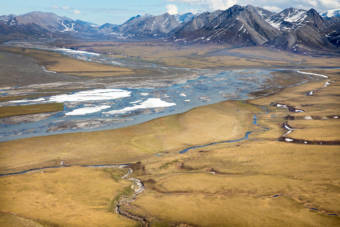
The Canning River forms the northwestern border of Arctic National Wildlife Refuge. (Lisa Hupp/USFWS)

Democrats in Congress are still arguing over what should be in President Biden’s Build Back Better bill, but a version that emerged Thursday includes a provision that would close the Arctic National Wildlife Refuge to oil drilling and cancel existing leases.

The measure would repeal a section of the 2017 tax-cut law authored by U.S. Sen. Lisa Murkowski. It requires two oil lease sales in the Arctic Refuge by the end of 2024.

The ANWR reversal provision was not included in a bare-bones outline of the bill that the White House released Thursday. That framework doesn’t mention the refuge.

But the drilling repeal is included in a 1,684-page bill debated Thursday evening in the House Rules Committee. The bill is likely to change. Speaker Nancy Pelosi said it may be replaced entirely.

If the House passes it, the bill would go to the Senate. It’s a type of bill that can’t be filibustered, so it could pass with only Democratic votes. But it’s not clear that all Democrats would approve the drilling repeal. Sen. Joe Manchin, D-W.Va., who has had an outsized role in trimming the bill, has previously voted in favor of opening the Arctic Refuge to oil drilling.

In January, the Trump administration, following the requirement of the 2017 law, held the first lease sale in the refuge, resulting in leases that cover half a million acres. Seven of the nine tracts went to the state-owned Alaska Industrial Development and Export Authority.

If the repeal goes through, the leases would be canceled immediately with payments returned to the companies that won the leases.
Biden administration lets stand a judgment thwarting Willow, a ConocoPhillips drilling project in Arctic

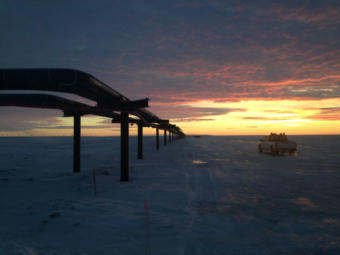
Pipelines stretch toward the horizon in the National Petroleum Reserve-Alaska. (Elizabeth Harball/Alaska’s Energy Desk)

Conservation groups are cheering the Biden administration’s decision not to appeal a judgment that reversed approval for Willow, the ConocoPhillips’ plan to develop five drilling sites in the National Petroleum Reserve-Alaska.

U.S. District Court Judge Sharon Gleason ruled in August that the Trump administration didn’t adequately consider greenhouse gas emissions or the impact on polar bears when it approved the plan.

The Biden administration initially defended the Willow approval, but Tuesday was the deadline for an appeal and the government didn’t file one. Nor did ConocoPhillips.

Jeremy Lieb, an attorney in the Anchorage office of Earthjustice, said Willow doesn’t fit with the Biden administration’s climate goals.

“We’re pleased to see that the administration has recognized that at this point and is not continuing to defend the plan in court on appeal,” he said.

Willow is a big priority for U.S. Sen. Lisa Murkowski. The Biden administration’s initial defense of the project was seen as an overture to her, as she is one of the few Senate Republicans who might vote for some of Biden’s priorities.

Interior Department spokeswoman Melissa Schwartz didn’t say why the government didn’t file an appeal.

“The matter has now been remanded to the BLM,” she said in an email. “In light of the court’s decision, we are reviewing to determine next steps.”

If the Bureau of Land Management decides to do another environmental review to comply with the judge’s order, environmental groups hope the agency scraps the project or imposes more restrictions.

A ConocoPhillips spokeswoman says the company remains committed to the project.

“ConocoPhillips is not appealing the court’s earlier decision because we believe the best path forward is to engage directly with the relevant agencies to address the matters described in the decision,” she said by email Thursday.

Threatened by melting sea ice, polar bears’ status up for review under Endangered Species Act

A polar bear on Barter Island, near Kaktovik. (Lisa Hupp/U.S. Fish and Wildlife Service)

The U.S. Fish and Wildlife Service is beginning its next review of polar bears’ status under the Endangered Species Act.

The review, which the Fish and Wildlife Service conducts every five years, could result in polar bears being “uplisted” to endangered, with further protections, or de-listed altogether. And of course, they might just stay right where they are, listed as threatened and still protected under the Endangered Species Act and other laws.

Erin Knoll is the threatened and endangered species coordinator for the Fish and Wildlife Service’s Alaska region. While polar bears’ status as a threatened species often draws a lot of attention, Knoll says it’s too early to say what recommendations might come out of the review or what implications they might have.

Listen here:

The following transcript has been lightly edited for clarity.

Erin Knoll: So every five years, we review the status of listed species. So we are looking for information, any new information since the last review, which was done in 2017. And that information includes information about the species, its habitat and any threats that it might face, or it does face, since the last review. And we’re looking for information from the public, you know, any researchers that are out there. We have already coordinated with partners and reached out to them, including the state of Alaska, tribal governments, corporations, researchers at universities and other countries, to see if they have any new information.

Casey Grove: Gotcha. So it’s kind of an open call to people, but there’s also coordination and sort of some outreach involved there?

Erin Knoll: Yes, we send out letters to our existing partners, but then we want to keep it open, and we don’t want to limit ourselves. So we reached out. It goes out to the general public too.

Casey Grove: So, understanding that this is kind of a long-term process, what, in the future, are the possible implications of polar bears being uplisted to endangered, if that were to happen?

Erin Knoll: So right now, we’re working on this five-year status review. And it’s important to understand that a status review only results in a recommendation. And that recommendation could be a recommendation to uplist to endangered or to downlist, or in this case, delist. If the recommendation is to uplist, we would go through the rulemaking process. So we would write a proposed rule, which would then get published in the Federal Register. So now we’re talking like a couple years out, and then that proposed rule would result in a 60-day comment period for the public, at a minimum. And once that comment period closes, we would review and consider all public comments prior to finalizing a rule. So when polar bears were first listed as threatened, we also published a special rule called a 4D rule. And that provides them protections very similar to what they would have if they were to be uplisted as endangered. If they were to be uplisted as endangered, we would review our conservation management plan and see if there were any additional measures that would be needed to continue to conserve polar bears. But as they’re currently listed as threatened, they receive almost the same protections as they would if they were to be uplifted to endangered.

Casey Grove: It’s probably important to point out that the Endangered Species Act isn’t the only thing that affords protections to polar bears, right? There are other laws, and what are those? And how do those compare to the Endangered Species Act?

Erin Knoll: Yeah, so polar bears are also protected by the Marine Mammal Protection Act, and CITES, which is the Convention on International Trade of Endangered Species of Wild Fauna and Flora. And it’s really the Marine Mammals Protection Act that provides the polar bears with a lot of protections. But the Endangered Species Act does give us additional flexibility to work with states and provide funding for listed species. It also directs us to work with federal agencies that authorize, fund, permit and carry out projects to ensure that those projects minimize impacts to listed species, like the polar bear. And then we can also work with private landowners to help with any listed species conservation.

Casey Grove: Okay. I have to ask, because I think there’s been a lot of attention on polar bears as a victim of climate change, in that, it’s pretty well established that fossil fuel emissions have caused global warming, which has melted sea ice and affected polar bears pretty negatively. Is there any way, at this point, of saying even hypothetically that an endangered listing for polar bears might have an impact on fossil fuels — either the fossil fuel industry or regulations on the use of fossil fuels?

Erin Knoll: So in the 2008 listing decision that we published, listing polar bears as threatened, we did recognize that loss of sea ice habitat due to human-induced climate change is the primary threat. However, under the Endangered Species Act, we don’t have the authority to regulate those greenhouse gas emissions. And similarly, in the listing rule, we noted that there wasn’t a regulation at the national or international level that directly and effectively addressed the primary threat to polar bears, which is range-wide loss of sea ice habitat. And this still holds true today. So really, we would just continue with what we’re currently doing, which is continue to work with partners and federal agencies that permit, fund and carry out projects in Alaska to minimize any impacts to polar bears in their habitat.

Casey Grove: Is it fair to say that polar bears get a lot of attention as a threatened species?

Erin Knoll: Yes. Polar bears are what we call a “charismatic megafauna.”

New Inupiaq and Yup’ik glossary is ‘one small step’ toward Indigenization of knowledge

The language experts gather together for a group photograph. (Photo courtesy of Kawerak Social Science Program)

Bering Strait regional nonprofit Kawerak has published a language glossary that provides research, science, policy and resource management terms in English, Inupiaq, St. Lawrence Island Yupik and Yup’ik.

The glossary is part of Kawerak’s “Knowledge Sovereignty and the Indigenization of Knowledge” effort.

It’s “one small step” in the work of the Indigenization of knowledge, said Kawerak Social Science Program Director Julie Raymond-Yakoubian. With a glossary available, she said, researchers can better collaborate with Indigenous knowledge and culture.

“Indigenous knowledge, traditional knowledge, Indigenous languages are often not forefronted,” she said. “So Kawerak staff wanted to take an opportunity that we had to bring language experts together to put down on paper a lot of the terms and phrases that are relevant for the work that Kawerak staff and others are doing.”

Raymond-Yakoubian emphasized the relevance of Indigenous knowledge today and said she wants to ensure Indigenous voices are heard.

“What knowledge sovereignty and the Indigenization of knowledge means is really bringing to the forefront tribal knowledge,” she said. “It’s important, it’s value. And ensuring it is used in all the appropriate contexts where it can be used — which is basically everywhere. And making sure that Indigenous voices are being heard and taking a lead in matters that impact Indigenous people.”

There are many ways to continue the process of the Indigenization of knowledge, said Raymond-Yakoubian. Expanding the glossary to include more dialects and terms is one step. Kawerak is also working on a toolkit to help provide communities with guidance so they can engage more with researchers.

Raymond-Yakoubian thanked the contributors for making the publication of the glossary possible. Especially, she said, she thanks the language experts.

“They are the ones who contributed their time and their knowledge and their language expertise to this work,” she said.

Kawerak hopes its work with the Indigenization of knowledge will be something other organizations partake in and keep in mind when completing other projects.

Biden administration to review protections for polar bears

A polar bear walks along the beach in Kaktovik, Alaska on Sept. 10, 2012. (Loren Holmes/ADN archive)

With climate change expected to continue melting the sea ice polar bears use for hunting seals and bearing cubs, a new review by the U.S. Fish and Wildlife Service will consider whether its status as a threatened animal under federal law is sufficient.

The federal agency listed polar bears as threatened under the Endangered Species Act in 2008.

The agency on Monday announced it will accept scientific and commercial information for 60 days in a new review of the animals’ status.

The reviews are conducted every five years for animals listed under the act. The review will determine if the polar bear should receive an endangered status with stronger protections, be delisted or if its threatened status should continue, the agency said in a statement.

The assessment could lead to a recommendation for a new status, but with an opportunity for public comment before any final decision is made, said Andrea Medeiros, a spokeswoman with Fish and Wildlife.

The Alaska Oil and Gas Association is reviewing the notice from the U.S. Fish and Wildlife Service and will determine whether to provide comments, said Kara Moriarty, president of the group. The group represents oil companies with operations on the North Slope where polar bears live.

The review is critical, said Nicole Whittington-Evans, with Defenders of Wildlife’s in Alaska. “Climate change is already jeopardizing the future of the polar bear,” she said in a statement.

This story was originally published by the Anchorage Daily News and is republished here with permission.

Site notifications
Update notification options
Subscribe to notifications