Arctic

Sullivan still seeking a ‘bridge’ ship to fill the icebreaker gap

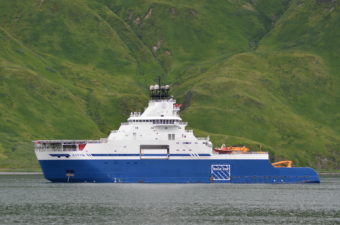
The Aiviq in Unalaska in August 2016.( Photo by Sarah Hansen/KUCB)

The Coast Guard’s first heavy icebreaker in nearly 50 years is due in 2025. U.S. Sen. Dan Sullivan says the country can’t wait that long.
Sullivan is among those advocating for leasing or buying a medium-weight icebreaker in the meantime, to bridge the gap until the new billion-dollar icebreaker is ready. At a hearing in October, he prodded the head of the Coast Guard, asking if “we’ve made progress” on a short-term icebreaker lease.

The Coast Guard commandant said he’s considering acquiring an icebreaker to serve in the gap years. That’s a shift that began to surface last year. Before that, the Coast Guard adamantly rejected using the only icebreaking ship on the market.

Eventually, the Coast Guard will have a fleet of new heavy icebreakers, built to its specifications. Congress has authorized three and fully funded the first two, but complications from the COVID-19 pandemic have delayed the start of construction by a year. After delivery, the Coast Guard needs to test and ready its new ship for service, pushing the icebreaker’s first mission to 2027.

At stake in the icebreaker lease debate is the nation’s ability to assert its presence in the Arctic during the gap. Also on the line: millions of dollars and the fortunes of a politically influential company that owns an underemployed icebreaker.

Sullivan has said it’s the mission that he cares about. The Coast Guard’s only heavy icebreaker in service is nearly 50 years old and needs constant maintenance.

“We’re one catastrophic maintenance failure away from having no heavy icebreaking capacity at all,” said a Sullivan spokesman.

Discussions about leasing a ready-made icebreaker get specific in a hurry. The country has just two major icebreakers in private hands, according to the Congressional Research Service. One ship is leased to the National Science Foundation. The other is the Aiviq, a $200 million vessel that’s been wearing a metaphorical “lease me” sign for years.

The Aiviq’s owner, Louisiana-based company Edison Chouest, built it to support Royal Dutch Shell’s plan to drill in Arctic waters. But Shell gave up that plan in 2015, and Edison Chouest has been trying to find work for its icebreaker ever since.

Alaska Congressman Don Young tried pressing the Coast Guard to accept the Aiviq back in 2016.

“I know you’ve got the proposal on your desk, by the way,” a frustrated Young told the Coast Guard’s second in command, at a 2016 hearing. “It’s already been laid on your desk and it’s an automatic no. Why?”

The vice commandant of the Coast Guard at the time, Adm. Charles Michel, insisted the ship wasn’t suitable for the Coast Guard’s many missions, including military service.

“Military service,” Young scoffed. “I’m talking about moving ice!”

In the 2020 election, the owners and executives of Edison Chouest were among Young’s top campaign donors.

In 2016, the shipbuilders made political contributions totaling more than $2 million, mostly to Republicans, including the campaigns of both Alaska senators.

Edison Chouest also spends $300,000 a year to lobby Congress, partly on federal ship acquisition. The company did not respond to a phone message seeking information for this story.

At the October hearing, Sen. Sullivan didn’t mention the Aiviq or any specific icebreaker that might be for lease. While the Aiviq is the only domestic icebreaker available, the Trump White House was considering leasing Finnish icebreakers, Sullivan said last December. But no contract was signed and after the Biden administration began the next month, the whole leasing idea seemed to stall.

The merits of leasing a polar icebreaker did not get high marks in an extensive study a few years ago.

“We looked at all the leasing issues,” said retired Navy Adm. Richard West, who chaired a National Academies of Sciences committee that explored icebreaker acquisition, at the request of Congress. “We said leasing should be limited strictly to a one-time look at a specific mission, for a short period of time.”

West said the peer-reviewed 2017 report found buying would be cheaper than leasing.

His committee instead recommended “enhanced maintenance,” to keep the old Polar Star in service for another 10 years, until the new ice breakers are ready. That’s what the Coast Guard is doing, but in 2021, with the new heavy icebreakers still years away, the idea of leasing an ice breaker for the gap years is still on the table.

Meanwhile, the Aiviq has a new summer gig in Antarctica. Six years after it lost the job it was built for, the ship is now chartered by the Australian Antarctic Division to support its current research season.

https://www.facebook.com/259670439520404/posts/277963587691089

The Arctic has a new record high temperature, according to the U.N.

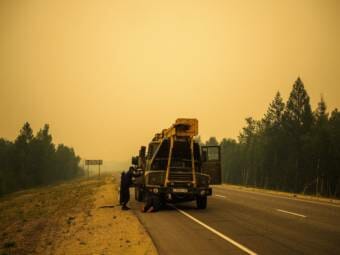
Two men working on a truck by the side of a road through a forest. The sky is yellow with wildfire smoke.
Men repair their truck in smoke from a forest fire on a road near Magaras, in the republic of Sakha, Siberia, in July. (Dimitar Dilkoff/AFP via Getty Images)

The United Nations’ weather agency has officially recognized a new record high temperature for the Arctic, confirming a reading of 38 degrees Celsius (100.4 Fahrenheit) taken in June 2020.

The World Meteorological Organization issued a statement on Tuesday calling the temperature reading “more befitting the Mediterranean than the Arctic.”
The high reading, taken on June 20, 2020, in the Russian town of Verkhoyansk, came amid a prolonged Siberian heatwave in which the region reached as much as 10 degrees C above normal.

However, the reading in Verkhoyansk inaugurates a new WMO category for high temperatures in the region, so it doesn’t supplant a previous record. The agency says temperatures have been recorded in the Russian town since 1885. The lowest temperature ever recorded above the Arctic Circle was -69.6 C (-93.9 F) in Greenland in December 1991, according to the agency.

“This new Arctic record is one of a series of observations reported to the WMO Archive of Weather and Climate Extremes that sound the alarm bells about our changing climate,” WMO Secretary-General Petteri Taalas said in a statement.

“In 2020, there was also a new temperature record (18.3°C) for the Antarctic continent,” he added.

The WMO said the Arctic “is among the fastest-warming regions in the world” and that the unprecedented temperatures caused it to add a new climate category for “highest recorded temperature at or north of 66.5⁰, the Arctic Circle” to its archives.

The high temperatures were “fueling devastating fires [and] driving massive sea ice loss” that played “a major role in 2020 being one of the three warmest years on record,” it said.

As NPR’s Rebecca Hersher reported in June of last year, 20,000 tons of diesel spilled in northern Siberia when storage tanks collapsed, likely because of melting permafrost.

The WMO said the new Arctic record high was just one of many record high temperatures in 2020 and 2021 that it was working to verify — including a reading of 54.4 C (129.9 F) in Death Valley, Calif., the world’s hottest place, and a record in Europe of 48.8 C (119.8 F) on the island of Sicily.

“The WMO Archive of Weather and Climate Extremes has never had so many ongoing simultaneous investigations,” Taalas said.

Copyright 2021 NPR. To see more, visit https://www.npr.org.

A historic settlement turns 50, but questions linger over whether it was fair

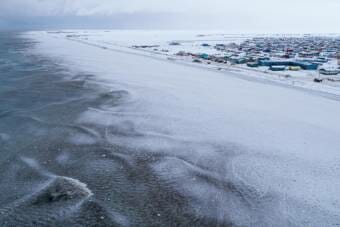
An aerial shot of Utqiagvik in the snow, taken from just off the coast
Waves churn newly-forming ice next to the shoreline in Utqiagvik on Nov. 1, 2021. (Loren Holmes/ADN)

The portfolio of Alaska’s largest corporation includes two oil refineries, a construction business and one of the North Slope’s few hotels.

At Arctic Slope Regional Corp.’s headquarters in Alaska’s northernmost community, Utqiaġvik, the richly decorated boardroom features a skin boat used for whaling that rests on the floor, encircled by the conference table.

Since its inception, ASRC has paid out more than $1 billion in dividends, with recent per-shareholder payments as high as $7,000 a year. Only people with Alaska Native heritage can own shares, with a few exceptions. And the shares cannot be sold, only issued directly by the corporation or passed from existing shareholders to their loved ones.

""
In Arctic Slope Regional Corporation chairman Crawford Patkotak’s office, whaling memorabilia sit alongside a bumper sticker for U.S. Congressman Don Young in a windowsill overlooking Utqiagvik on Nov. 2, 2021. (Loren Holmes/ADN)

This unique ownership structure was created by the U.S. Congress in a landmark land claims deal with Alaska Native leaders that turns 50 years old this month.

But while the deal helped create monetary wealth for ASRC’s 13,000 shareholders and those of dozens of other Alaska Native-owned corporations, it also came at a huge cost.

A map showing land ownership on Alaska's North SlopeFor all of ASRC’s assets, its shareholders still cannot claim title to their ancestral Iñupiat lands 25 miles from the corporation’s Utqiaġvik headquarters — or to any oil that might lie beneath them. That property now belongs to the U.S. government, which established the area as a naval oil reserve in the 1920s before later designating it the National Petroleum Reserve in Alaska.

To the east, Prudhoe Bay, one of North America’s largest oil fields, belongs to the state of Alaska, which receives royalty and tax revenue from the $35 million in crude piped off the North Slope every day. And nearly all of the Arctic National Wildlife Refuge is in federal hands, frustrating ASRC’s efforts to open it to oil development and provoking routine clashes over access and management with the Iñupiat residents of Kaktovik, the only village that lies within the refuge’s boundaries.

An aerial photo looking down along the Arctic Ocean coastline
The Arctic Ocean meets the shore just east of Nuvuk, the northernmost point in the USA, on Nov. 1, 2021. Nuvuk is 9 miles northeast of Utqiaġvik, Alaska. Archaeological evidence indicates that the site was occupied about 1,500 years before the arrival of the first Europeans. (Loren Holmes/ADN)

That tension between monetary wealth and lost land is at the heart of the Alaska Native Claims Settlement Act, which President Richard Nixon signed into law in December 1971.

The legislation was, in effect, an experiment by a mostly white Congress pulled between two conflicting approaches to Indigenous people: self-determination, and assimilation and termination — the concept of ending the government’s obligations to Natives.

By creating more than 200 Native-owned corporations like ASRC and seeding them with 44 million acres of land and $1 billion, the legislation was one of the most progressive land deals ever struck between the U.S. government and Indigenous people.

A black-and-white photo of a group of 14 men posing together inside a hotel
As a result of the passage of the Alaska Native Claims Settlement Act, monetary awards were made to Native regional corporations created by the Act on July 1, 1972 at the Anchorage Westward Hotel. Pictured L-R: Alaska Lt. Gov. Red Boucher, Mike Swetzof (Aleut League), Jack Wick (Koniag, Kodiak), Martin Olson (Bering Straits), George Miller (Cook Inlet Region), Joe Upicksoun (Arctic Slope), John Sackett (Doyon, Tanana Chiefs), Robert Marshall (Ahtna), Cecil Barnes (Chugach), Robert Newlin (NANA), Bob Willard (Sealaska), Morris Thompson (BIA area director), Sen. Ted Stevens and Don Wright (AFN president). (Dept. of Interior/Ted Stevens Foundation photo)

But by establishing for-profit corporations, Congress also pulled Alaska Natives into a Western, capitalist system and cut off access to lands that, for generations, sustained them through subsistence harvests of fish and game. The vast majority of Alaska lands — some 90% — were taken away from the state’s Native people.

“This capitalist system was imposed on us in a colonistic way: ‘Either you’re going to do it this way or you’re not going to do it at all. And you’re going to conform to this or you’re not going to do it at all,’” said Qaiyaan Harcharek, an avid subsistence harvester in Utqiaġvik. “It got us where we are today. But it’s a drop in the bucket for the Indigenous people of Alaska.”

The face of a man seen in the rear-view mirror of the car he's driving on snowy roads
Qaiyaan Harcharek gives a driving tour of Utqiagvik on Nov. 2, 2021. “ANCSA got us what we have today,” he said. “It’s a drop in the bucket.” (Loren Holmes/ADN)

Hindsight

Today, with 50 years of hindsight, discussions about the settlement with Alaska Natives inside and outside the corporate world provoke complicated emotions — a reflection of the legislation’s wide-ranging impacts on Native and non-Native people in Alaska.

The North Slope, with its rich oil and gas resources, is a useful test case to examine the legislation’s huge cultural and economic stakes.

Utqiaġvik, the 5,000-person North Slope hub town, is almost unrecognizable from what it was in the 1960s, when a previous generation of Iñupiaq leaders first organized to stake their claim to their ancestral lands.

Elders still remember emptying honey buckets full of sewage and melting ice on Coleman stoves to wash up each morning.

In the years following ANCSA’s passage, oil money began pouring into the community and its surrounding villages, allowing them to invest in infrastructure envied by other regions of rural Alaska.

Now, a 3-mile underground “utilidor” moves water, wastewater and utility lines around town, and gas fields not far away supply heating fuel to local homes.

Pineapples and mangoes on display in a grocery store produce section
Fresh pineapples are $13.49 each at the Stuaqpak grocery store on Oct. 31, 2021 in Utqiagvik. (Loren Holmes/ADN)

Grocery stores sell hot food and fresh fruit and vegetables. And students, who once flew hundreds of miles even to reach middle school, can now attend Barrow High School and take classes from a tribal college, Ilisagvik. Iñupiaq is now taught at school — a stark change from a few decades ago, when government-run schools punished North Slope residents for speaking it.

“I got my hands whipped,” said Harry Brower, 63, the borough mayor.

The region’s modernization grew out of ANCSA’s passage in 1971 and the establishment of the  North Slope Borough the following year. But the Iñupiat had to fight for both.

Statehood

The push toward a settlement lasted years, and it began as the state government started selecting pieces of its land entitlement granted by Congress under the 1958 Statehood Act. The state got to select 100 million acres, about one-fourth of the land in Alaska.

Some of the areas it chose caused conflicts with Native communities, whose members were encountering newly built cabins on their ancestral lands and greater competition from non-Native residents for fish and game.

Unlike in the Lower 48, Alaska tribes hadn’t been conquered in wars and they hadn’t signed treaties ceding their lands. So Alaska Native groups began filing land claims.

A man sitting in an office, gesturing with both hands as he speaks.
North Slope Borough mayor Harry Brower sits in his office on Nov. 3, 2021. Behind him is a painting of the first North Slope Borough mayor, Eben Hopson, Sr., as well as a walrus skull and Yankee whaling ships fashioned out of baleen. (Loren Holmes/ADN)

While the Native leaders largely enjoyed support from the state’s representatives in Congress during the land claims era, including Rep. Nick Begich and Sens. Ted Stevens and Mike Gravel, they also faced disinterest, opposition and blatant racism.

Oliver Leavitt, an ASRC board member and Iñupiaq elder who spent time working with Congress in the 1970s, described attitudes there in blunt terms: “To them, you were a f–king savage.”

“They just didn’t give a damn about you,” Leavitt, 78, said in an interview in ASRC’s Utqiaġvik offices. “They’d tell you to get the f–k out of their office.”

A man standing in front of a large wall map of the North Slope
Arctic Slope Regional Corporation board member Oliver Leavitt stands in front of a map of the North Slope in the ASRC board room on Nov. 2, 2021 in Utqiagvik. Leavitt spent time working on Native claims issues with Congress in the 1970s. (Loren Holmes/ADN)

Oil

An event on the North Slope dramatically changed those political dynamics: The 1968 discovery of the Prudhoe Bay oil field.

The field contained billions of barrels of oil. But the Native land claims stalled construction of the trans-Alaska pipeline, which got congressional leaders’ attention.

“People really could care less about the Alaska Natives,” Ron Birch, who worked as chief of staff to Stevens during the land claims era, said in a recent interview. “But senators and congressmen out of Texas and Oklahoma and Louisiana cared a lot about big oil.”

A black-and-white photo of three men studying a map
L-R, Oliver Leavitt and Mayor Jake Adams of Barrow visit Senator Ted Stevens in Washington D.C. on September 6, 1972, regarding ANCSA land selections for the Arctic Slope Region. (U.S. Senate/Ted Stevens Foundation photo)

Other dynamics converged to help overcome institutional opposition to the settlement.

One was a homegrown movement of Alaska Native leaders — activists and regional Native organizations from around the state who coalesced into the Alaska Federation of Natives.

The group, led by figures like Emil Notti, Don Wright, John Borbridge and Willie Hensley, included representatives from the North Slope to Western and Southeast Alaska. And it fought, said co-founder Hensley, with “two hands tied behind our back.”

At one point, AFN had $9 in the bank, and one man mortgaged his house to fund his participation in the movement, Hensley and other early AFN leaders recalled during October retrospectives hosted by the Alaska Historical Society. AFN ultimately secured loans from a tiny Alaska Native village that had made money from an oil and gas lease sale, and from a Washington tribal government.

“We didn’t have any lawyers, initially,” said Hensley, who wrote a key research paper on Natives’ legal standing for a 1966 university graduate course. “We didn’t have any money. We didn’t have any time.”

An audience, all standing, filling the floor of an arena
Alaska Federation of Natives delegates applaud during a presentation of the Shirley Demientieff award Thursday, Oct. 17, 2019 during the AFN convention at the Carlson Center in Fairbanks. (Loren Holmes/ADN)

Some in Alaska’s business and political establishments opposed transferring land to Native people, and AFN’s leaders said they faced death threats and hostile newspaper editorials. But Stevens, Gravel and Begich all helped push the legislation across the finish line in Washington, D.C.

Stevens, the Republican senator, was convinced that any Alaska lands that could be shifted out of federal ownership would end up benefiting the state, said Birch, his chief of staff at the time.

“Ted would explain tirelessly, ‘No, I’m taking the land away from the federal government and giving it to Alaskans,’” he said.

Gravel, Alaska’s other U.S. senator, was a Democrat who owed his election to the Alaska Native community, and he supported the legislation. Nixon’s White House and some of his top aides were also key allies and early supporters of a 40-million acre settlement, which gave political cover to Republican lawmakers who had previously opposed a deal with that much land.

“‘Tricky Dick,’ they called him. But as far as I’m concerned, he’s a hero,” Hensley said. “He’s the fellow who created self-determination.”

A natural gas stack with a flame at the top, with the sky in the background
Natural gas flares at a processing facility just outside Utqiagvik on Nov. 2, 2021. The gas heats homes and is burned to provide electricity for the community. (Loren Holmes/ADN)

Settlement

The drawn-out political process that led to the settlement tested the bonds between the Native groups that came together to form AFN, and they forced the North Slope’s leaders, along with others, to make concessions.

A particularly difficult set of questions arose around how to divide up the money and land that Congress would set aside on a statewide basis. In the end, the lands were split up based on the North Slope’s preferred formula, which tied each region’s share to the size of their original land claim.

But other parts of the settlement were divided on a per capita basis, which the thinly settled North Slope vehemently opposed, saying the method benefited more populous Alaska Native groups at their expense. Another provision opposed by the North Slope that was included in the legislation required corporations to share 70% of their resource revenue — including from oil.

A man gesturing while giving a speech
Arctic Slope Regional Corporation chairman Crawford Patkotak speaks in support of an amendment preserving access to natural resources during discussion of a resolution reinstating a climate action leadership task force and declaring a state of emergency on climate change, on Saturday, Oct. 19, 2019 during the Alaska Federation of Natives convention at the Carlson Center in Fairbanks. In December 2019, the ASRC board voted unanimously to leave AFN in order to focus on local concerns on the North Slope. (Loren Holmes/ADN)

North Slope leaders were some of the most strident in their arguments for the settlement, even withdrawing from AFN at one point, and their contemporaries said their positions helped move the negotiations’ center of gravity.

Among those early leaders was Charles “Etok” Edwardsen, who protested outside a 1969 Prudhoe Bay lease sale held by the state with signs that read: “2,000,000,000 Native land robbery” and “Eskimos own North Slope.”

Protestors handed out leaflets that said the lease sale was “perpetrating of economic genocide on a native minority,” and Edwardsen told reporters it represented “the rape of Alaska Natives.”

After the settlement’s passage through Congress, North Slope leaders wrote to Nixon asking him to veto the legislation. And when AFN convened to consider whether to recommend to Nixon that he sign the bill, the North Slope delegation voted no.

Its leader, Joe Upicksoun, delivered a scorching indictment in a speech.

“You can obviously see that I am hurt and frightened and perhaps bitter,” he said. “This hurt and fright and bitterness have been caused by the other Natives demanding more than their just share; by the state being dishonorable in grabbing whatever she could; by the Congress’ incompetence in not really understanding the problems and not trying to; by the oil companies stepping on us as if we were not people; by Western society moving in on us and brushing us aside.”

Hensley said other Native leaders felt similarly to Upicksoun, even as they voted to recommend that Nixon approve the settlement.

“You’d think there would have been celebration. But there wasn’t — we knew what we were giving up,” he said at the historical society’s recent retrospective. “The remarkable story is that people just didn’t sit back and cry about it all. They said, ‘What the heck, let’s get this thing together and let’s see what we can do with it.’”

A black-and-white photo of a man with a pipe, standing, speaking to three seated men in
L to R: Eben Hopson of Barrow and Flore Lekanof of the Pribilof Islands listen as attorney Lester Miller, representing the Aleut League, and Sen. Ted Stevens confer during an ANCSA hearing in the Committee on Interior and Insular Affairs in Washington, D.C. on August 7, 1969. (U.S. Senate / Ted Stevens Foundation photo)

No ‘trail of tears’

The ink on the settlement wasn’t even dry before the Iñupiat began work to improve on the deal Congress made with them.

Eight months before Nixon signed ANCSA, the region’s leaders had submitted their petition to form the North Slope Borough, which at 89,000 square miles is roughly the size of Minnesota. After voters in the region approved it, the new government entity began levying taxes on infrastructure built by oil companies.

The borough now raises $400 million a year in property taxes — levying more than $100 million on ConocoPhillips alone.

A man walking down a snow-covered street
A person walks down a street in the Browerville neighborhood of Utqiagvik on Nov. 1, 2021. (Loren Holmes/ADN)

The money is invested in water and sewer lines, communications infrastructure and schools. It also pays for police and fire departments, a wildlife department that does bowhead whale research, and a search and rescue department with four aircraft, including a massive Sikorsky helicopter.

Major oil companies sued to block the borough’s formation, but they were unsuccessful.

“There’s always, for the longest time, been those sentiments of the old guard: Don’t give any land to the borough. Don’t give any lands to the Natives. Fighting tooth and nail because oil is at stake up here,” said Gordon Brower, the borough’s current planning director.

A man sitting at his desk, gesturing as he speaks
Gordon Brower, director of the North Slope Borough Planning & Community Services Department, talks with a reporter in his office on Nov. 2, 2021 in Utqiagvik. (Loren Holmes/ADN)

ASRC, meanwhile, got to work creating an array of subsidiaries, including a construction company and fuel distribution and tourism businesses.

It also began signing leases with oil companies for the land ANCSA granted it — and for a tract inside the Arctic National Wildlife Refuge that it obtained through a federal land exchange orchestrated during the Reagan administration. So far, ASRC’s leasing revenue from that area, which doesn’t have to be shared with other Native corporations, is likely at least $50 million, according to public documents.

ASRC has now been listed as Alaska’s top revenue-generating business for the past 27 years. It says it has 13,500 employees across the country and ranks among the top regional corporations in its yearly cash dividends, though the impact of the COVID-19 pandemic did force reductions.

Original ASRC shareholders received $7,000 in 2018 and 2019, and the company employed some 500 shareholders during that time. At least one regional Native corporation has paid out less in dividends over its entire, five-decade existence than ASRC has paid in a single year.

North Slope leaders say they’re keenly aware of their relative fortune, particularly when they compare themselves to Native people outside Alaska.

“Ain’t no trail of tears in Alaska,” said Josiah Patkotak, who represents the North Slope in the state House. “We got the best deal that a Native people has got. Ever.”

Patkotak’s father, Crawford, is board chair and executive vice president of stakeholder engagement at ASRC, which paid him $2 million last year. In an interview at the corporation’s Utqiaġvik office, Crawford used a poker analogy to describe how the Inupiat have fared since the settlement: starting with two deuces — a very tough hand.

“Look at the challenges we had to face. Look at what mountains we had to climb. Look at the valleys we’ve had to endure. And we’re still here,” he said. “We ain’t going anywhere.”

""
The sun sets behind Utqiagvik on Nov. 1, 2021. (Loren Holmes/ADN)

This story is part of a reporting collaboration between Alaska Public Media, Indian Country Today and the Anchorage Daily News on the 50th anniversary of the Alaska Native Claims Settlement Act. Funding for the ANCSA project was provided by the Alaska Center for Excellence in Journalism. Read more from the ANCSA project.

Alaska author’s new book follows life among Arctic caribou herds

Courtesy of Seth Kantner

Seth Kantner sees his life today as a continuation of the subsistence life he grew up with in northwest Alaska, with some new additions: commercial fishing in the summer, writing in the winter and photography in the spring and fall.

In the last several years, he’s gathered images and stories from the caribou herds that live near his home on the south side of the Brooks Range. His latest book, “A Thousand Trails Home,” recounts those tales, his own story and how they all intersect in a part of the country that’s experiencing climate change at a staggeringly rapid pace.

Kantner capped off a three-week tour through Alaska, Washington and Montana with a visit to Homer this week.

Listen here:

The following transcript was lightly edited for length and clarity.

Sabine Poux: Seth, thanks for being here. Your new book, “A Thousand Trails Home,” came out last month. Can you talk about how long this book has been in the works? When did you start writing?

Seth Kantner: Probably about nine years ago. And the photographs, probably 30 years ago, without the idea of a caribou book. More just wanting to get photos of the land, and the caribou were hard to resist — big herds of caribou — when you got a camera. The book was supposed to be out Sept. 1, after all these years, and then was held up for a couple extra months in a shipping container on the barges. And so it was a little bit of a rocky start.

Sabine Poux: Affected by the supply chain problems that we’re hearing a lot about.

Seth Kantner: Yep. Yeah.

Sabine Poux: I know that you’re a big photographer. And you have managed to capture these really vivid descriptions of the things you’re doing and seeing while also taking photos and writing. How do you balance all of that at once? Do you have a process when you’re out and how you think about writing?

Seth Kantner: I don’t have a process at all. I don’t think I was born with organizational skills. But they’re along the south side of the Brooks Range, where I was born and raised. Our life was so focused on the land, I think I carried on with that, a searching-for-food type of life. But then I just added searching for stories and searching for photographs to that. So, in my mind, it feels like a subsistence way of life with some new additions. And then the seasons kind of decide — maybe winter would be more writing, and fall and spring would be more photographing and then summer would be trying to make a living.

Sabine Poux: Do you see the photos and writing as complementing each other? Do you think that when a reader takes it in, they have to take in all of that to get the full picture of what you’re trying to communicate?

Seth Kantner: I think it helps with this book. Obviously, if I wrote a novel, I would feel like photographs would take away from that experience you have, or you fall into another world and you’re surrounded by that world. And so my first book was “Ordinary Wolves” in 2004 and, similarly, there were things I really wanted to say. I just chose fiction as the way to say it. And so with this, yeah, I feel like kind of to say enough about caribou, I really wanted photographs mixed with words. Which definitely makes a much more complicated project.

Sabine Poux: Your first book is a novel, and this book of course is more autobiographical. Do you feel like there are things that you were able to freely write about and say in a novel that maybe you aren’t when you’re writing in such a first-hand way? The things that character deals with in “Ordinary Wolves,” I imagine, are paralleling your experience. But of course, you’re writing through another character.

Seth Kantner: Yeah, you hit it dead on there. That book is autobiographical, and I was urged to write it as nonfiction. Apparently it would have sold better, et cetera. But I was adamant that if I wanted to describe a situation that may or may not be admirable for the for the person portrayed by my words, then writing a fictional person, I could say “so-and-so did this.” And if you had a real person’s name tied to that, well, good luck with feeling free with what you say.

Sabine Poux: A lot of the people reading your work will have never been to this part of the state. And, at the same time, you’re writing about issues of identity and issues about race that are very real to the people who live there. How do you balance explaining a place to people who have no frame of reference, and doing a place justice for the people who are actually from this part of the country?

Seth Kantner: That, I would find, wasn’t a balance. It’s more like all at one end of the teeter-totter. I just spend endless amounts of time weeding through my words and being suspect of each one. Does this do its job, is this fair? But also, is it as descriptive as possible? And so this book, I joke — but it’s not too much of a joke — that it took an extra five years because of the politics of talking about some issues that a lot of people disagree on, like the difference between sport hunting and subsistence and user rights, and then ways of hunting caribou now versus 50 years ago. So each one of those felt like a dangerous swamp I was heading into as far as trying to say the truth and and be fair at the same time. And then not always good things to be said.

Sabine Poux: Right. And your educational background is in journalism. So I imagine fairness and considering things from a lot of sides is very front of mind for you.

Seth Kantner: Yeah. I think my upbringing is stronger than my journalism training. But the journalism training in Missoula, Mont., they were adamant about if you’re using a quote, it has to be the real thing, you can’t just sort of make one up. And adamant about, you know, if something’s 95% true, it’s fiction still. It’s not nonfiction. So yeah, I hadn’t thought of it until you said it, but I think that those journalism ethics from that school have kept me on the desire to stay as true as possible.

Sabine Poux: Then, of course, you mentioned controversial topics. A big part of life in northern Alaska is dealing with the effects of climate change. Do you see communicating messages about how climate change is impacting that part of the state as a major reason that you’re writing these stories? Is that something you think about a lot in your writing?

Seth Kantner: Absolutely. Yeah. I think it would be different if I made a living off of writing, that I might be writing for money. In this case I’m not, so I write about what I care about. And that’s the land and the caribou and being able to hunt in the future and have wild lands. And I don’t mean wild lands to look at, I mean wild lands to live on.

But yeah, climate change has really affected that part of Alaska. I guess it’s sort of the ground zero for the most warming and the most effects of climate change on the planet. And so the permafrost is melting and the ice is not freezing as consistently as it did, and then we’re getting rain in the winter which would coat the land with ice and make so animals perish and or have a hard time getting their food.

And so all those effects are sort of exaggerated in my mind because of the fact that I’m so tied to the land and I expect the caribou at this time of year, as do other people there.

Twenty five years ago, I was sort of nervous about talking about climate change, which I did, but people were very quick to call you a “greenie” or a “bunny hugger” or something. And that’s interesting because the amount of change up in northwest Alaska is so intense that now, 25 years later, I’m not a bunny hugger and everybody’s a believer. You can’t help up there being that, because of the change.

One simple thing is we travel on ice, we don’t have roads. So those are our roads, and if it doesn’t get cold like it used to and we don’t have those trails and traveling routes, then you can’t kind of pretend that there’s no climate change. So, anyway, the long and the short of that is that it’s kind of a relief not to be accused of being some animal lover, making up this weird stuff — that climate change is finally not such a big discussion.

Sabine Poux: Well, it sounds like you recognize, too, that you’re in this position where you see these effects so prominently in a way that most people — even in this part of Alaska — just wouldn’t really see.

Seth Kantner: Yeah. I think that getting your food from the land makes you notice. And if I shop totally at Costco — which, I love Costco — and traveled in cars on roads, I think it would be so much harder to see, even if it was around you. And so traveling on ice and eating from the land just makes those changes obvious.

Sabine Poux: You also have written a children’s book. What was it like writing for a younger audience?

Seth Kantner: The children’s book — I guess that the whole publishing effort was so dismaying that I’ve kind of lost memory of what it was like before that, just the actual writing of the story. At that point, my daughter was pretty young when I was writing that. So I considered her and I more like siblings because we played together a lot, and mentally I’m sort of on that level. So yeah, I was always making up stories every day and night for her and it was fun to write one down. It was surprising to me how complicated the next steps were with publishing and illustration and stuff. And otherwise, I think I would love to write children’s stories. Just because I like that age. I like kids and I like that age.

Sabine Poux: Speaking of kids, do you have a first memory of caribou? Is there a memory you can think back to?

Seth Kantner: Yeah. The funny thing is that the caribou were so ubiquitous in my life that they just sort of flowed through everything, in spring and fall. We didn’t see them in the middle of summer. But yeah, I do have that first memory of waking up in the old igloo and scared because there was nobody there and stumbling outside, probably no shirt, and who knows what else, probably four years old. And calling for my parents, and they were just sort of around the front of the hill there, gutting a caribou.

So in that time of year, the caribou swim across the Kobuk toward our place. Caribou are constantly flowing by the house and constantly — not constantly, but every day — so some would come ashore. And apparently they needed a caribou, needed meat, and they were working on it. So I remember the caribou in the melting-out grass and my parents bending over it and me sort of really grateful to see them. I don’t know about the caribou. I was just a little kid looking for parents.

November sea ice extent in the northern Bering is the best since 2012

An aerial view of Unalakleet, with open water along the coast in 2019. (Zachariah Hughes, Alaska Public Media)

Through the weekend of Nov. 13, sea ice extent in the Chukchi Sea was well above the average from the last thirty years.

“So far, Chukchi Sea ice is developing much quicker this year than it has in all recent years,” climatologist Rick Thoman explained.

Thoman, with the Alaska Center for Climate Assessment and Policy, or ACCAP, has Chukchi Sea ice data going back to 1979. Current sea ice extent in Northern Alaska waters is the highest it’s been since November 2001, according to the National Snow and Ice Data Center’s sea ice index.

https://twitter.com/AlaskaWx/status/1459928137077182466

As of Nov. 13, the main ice pack had already reached the northern coast of the Seward Peninsula, Thoman said.

“What we have right now is fairly typical in the sense that ice tends to start to grow out from the Alaska and the Chukotka coast. This year it’s actually kind of met down towards the Bering Strait, so there’s really no open water now just north of the Bering Strait, between Chukotka and the Alaska side,” Thoman said.

Thoman suspects the rest of open water in the Chukchi Sea could be ice covered by the end of November.

As of Nov. 17, sea ice in the Bering Sea has covered much of the Eastern Norton Sound along the coastline of the Seward Peninsula except for an area in front of Nome. Sea ice had also started forming on the southern edge of St. Lawrence Island.

This is much more favorable for Western Alaska compared to the sea ice conditions the region experienced last year. The last couple winters in the Bering and Chukchi Seas have featured record low sea ice extents.

Thoman says all the pieces for sea ice growth, like colder surface temperatures and sustained northern winds, came together this year in the Bering Strait region.

“Really since early October, we’ve been in a persistently cold pattern,” he said. “Not quite every day was below normal, but most days below normal (temperatures). And so we didn’t have our thumbs on the scales with very warm waters that had to be extracted out, and we’ve had a weather pattern that has been conducive for ice formation.”

Based on current forecast models, the entire Norton Sound could be covered in ice by the end of November. There’s also a good chance of sea ice extending all the way south to the Pribilof Islands this winter, which hasn’t happened in recent years, according to Thoman.

A beluga from the Beaufort Sea has traveled unusually far south, to Washington State

A beluga whale from the Beaufort Sea photographed in Puget Sound earlier in October, 2021. (Photo from NOAA Fisheries, World Vets under MMHSRP 18786-05)

A beluga whale found unusually far south in Puget Sound earlier this month is believed to have come from a pod in the Beaufort Sea. NOAA Fisheries made the announcement this week based on genetic material they were able to analyze from the beluga.

In the first week of October, the Seattle Times reported a single beluga whale had been sighted in multiple places across Puget Sound — something that hasn’t been seen in the area since the 1940s.

NOAA Fisheries says the whale appears to have swum thousands of miles south from Arctic waters in the Beaufort Sea. Scientists do not believe the beluga came from the smaller Cook Inlet population.

NOAA Fisheries did not say what might have caused the beluga to wander so far south on its own. However, beluga whales are known to sometimes roam beyond their normal area in Arctic waters.

Dr. Kim Parsons, a research scientist with NOAA Fisheries, said they used genetic analysis of DNA taken from a water sample in the Puget Sound near where the beluga was located. This material is referred to as environmental DNA.

“The information that we can obtain from eDNA is more limited than what we can generate from a tissue sample, but can provide insight about where the whale is likely from,” Parsons said.

Scientists determined that the DNA sequence from the beluga matches other beluga whales found in the Beaufort Sea and Arctic waters. This population usually migrates between Alaska, Canada and Russia.

The far-flung beluga was last sighted on Oct. 20 near Tacoma, Washington, according to NOAA Fisheries. The West Coast Marine Mammal Stranding Network will respond if this whale is identified as stranded.

Site notifications
Update notification options
Subscribe to notifications