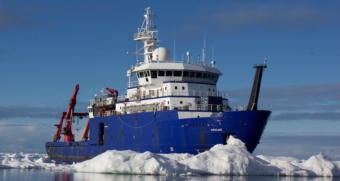
The R/V Sikuliaq, owned by the National Science Foundation and operated by the University of Alaska Fairbanks. (courtesy of Mark Teckenbrock/University of Alaska)
The research ship Sikuliaq is wrapping up a marine geology expedition this week. The nearly 2-month long journey took the ice capable ship — which is owned by the National Science Foundation and operated bu the University of Alaska Fairbanks — over 500 miles north of Utqiagvik.
That’s the farthest north the Sikuliaq ever been.
“Where we were up in the northern Chukchi, we were breaking new ground,” said UAF Geophysical Institute professor Bernard Coakley, speaking from the Sikuliaq by satellite phone.
Coakley and colleagues have used an array of technology to survey the ocean floor of the Canada Basin and adjacent Chukchi Borderlands. Coakley says the features they observed included channels in the sea bottom.
“Where the gouges are parallel, we call them mega-scale glacial lineations,” he said. “They’re evidence that a continental glacier once scraped across the top.”
Coakley says other features, like random plow marks made by icebergs and piles of sediment created by now inactive faults, can help us better understand the ocean area’s formation.
“I like to say we’ve been working backwards in the Arctic, where we stand on the edges and make our observations, and then we say ‘well, therefore, the ocean is this,’” Coakley said. “But I think the real answer to the question of how the ocean formed is to be found by looking at the features.”
Coakley says surveying the seafloor has practical implications for things like mineral exploration and defining the extent of U.S. territory in the Arctic, but there’s also the pure intellectual pursuit.
“We want to know, we want to understand. That’s what drives me,” he said.
Coakley and fellow UAF researchers are scheduled to disembark from the Sikuliaq in Nome and be back in Fairbanks this week.
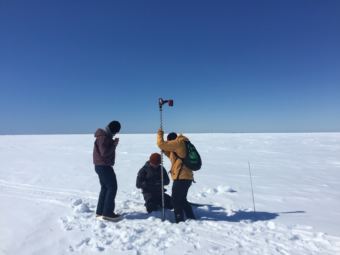
Arctic Field School students taking measurements on Elson lagoon in 2018. (Ravenna Koeniq/Alaska’s Energy Desk)
The White House on Friday announced six new appointees to the U.S. Arctic Research Commission, and they reflect an emphasis on Alaska and Alaska Native representation.
The USARC is an eight-member board that advises on Arctic policy and research priorities.
One of the new appointees is Liz Qualluk Cravalho of Kotzebue, vice president of lands for Nana Regional Corporation. She wants to advocate for science that can be put into practice in Arctic life.
“As things are changing right now in our communities, for commercial activities, and for all the maritime activity in the Arctic, there’s a strong need to see research done that can be used practically and move our understanding of how we can adapt forward,” she said.
Other appointees are:
•Former Alaska Commissioner of Natural Resources Mark Myers.
•Rasmuson Foundation Program Director Deborah Vo, who is originally from St. Mary’s and worked as an advisor to Sen. Lisa Murkowski.
•David Michael Kennedy, who worked for the National Oceanographic and Atmospheric Administration for 30 years, ending as the senior policy advisor for the Arctic.
•Jackie Richter-Menge, who worked at the U.S. Army Corps of Engineers Cold Regions Research and Engineering Laboratory and now a research afffiliate at UAF.
•Fairbanksan Michael Sfraga, founding director of the Polar Institute at the Wilson Center Washington D.C.
The Biden administration named Sfraga as chair of the Commission.
The White House says two-thirds of the appointed commissioners are now Alaskan. Half are women and one-third are Indigenous.
Arctic Today reported this month that the White House forced four Trump appointees to resign for lack of required Arctic experience. Three of them listed little or no prior experience in Alaska or the Arctic on their professional biographies.
The White House also announced that it is reviving the Arctic Executive Steering Committee to coordinate federal action in the Arctic. Its director is David Balton, a former ambassador for oceans and fisheries and a senior Arctic official during the Obama administration.
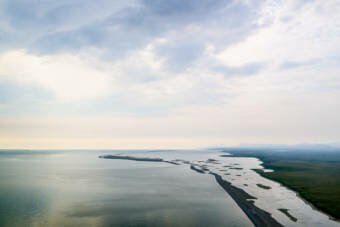
The coast of the Seward Peninsula near the community of Wales. (Laura Kraegel/KNOM)
Next year, Alaska’s international border with Russia will open for the Bering Strait Festival.
The seven-day festival is an effort to bring together residents of the high north from both sides of the strait, some of whom are relatives, and to honor their shared culture. It will include a cultural summit, an Indigenous peoples’ forum, traditional sports competitions and then a 43-mile boat crossing from Uelen in Russia’s Chukotsky District to Wales, on Alaska’s Seward Peninsula.
The festival’s head U.S. coordinator in Alaska, Mille Porsild, who is also an Iditarod veteran, says the hope is that the border will open every year for these seven days.
For the first crossing, set for the first week of August 2022, Porsild says people and boats of all kinds are welcome, but there’ll be an important frontrunner.
LISTEN HERE:
The following transcript has been lightly edited for clarity.
Mille Porsild: The first boat that will go across will be a skin boat. And that skin boat will be built by the hunters (in Chukotka) and supported by hunters from St. Lawrence Island, from Savoonga. And that is a very strong statement to the meaning of the Bering Strait and the crossing of this piece of water. Because the people that first came to North America, they actually came via this route, but before there was water. They walked across the steppe — the Beringia steppe. And then eventually water came and then they started traveling by skin boats. And still today, skin boats are a very important part of life in Chukotka, and it’s also a very important part of their sport. They have skin boat races. We’ll start out this whole historic event by having them go across first — that’s absolutely of tremendous importance. Then, following, will be literally anything or any way that people want to try and cross the Bering Strait. It’ll be open for all.
Casey Grove: I’m curious, as somebody who grew up in the ‘80s and had kind of this vague idea of what the Soviet Union was. How different is this now? I mean to even have the borders opened up for this limited amount of time, it seems so different from the past, of the Cold War.
Mille Porsild: I mean this is a really, really significant event and initiative to do this. I really can’t emphasize that enough. If you had asked me two years ago if this was going to happen or be possible, I would have looked at you with a smile and said, “I wish it was different, but I don’t think that’s going to be happening.” It’s really a result of the Arctic Council and the fact that the Russians now have the chairmanship, and they hold it until 2023. And so there has been this opening and this push that they should really look at: How can this forum — the council — support the need for collaboration across countries and the opening up of borders? How can it support and facilitate events that really support that? We can’t talk about an opening Arctic and not also look at the need to make sure that it’s open for people to travel and meet.
Casey Grove: In some ways, it’s almost like it’s going to be a family reunion for some of those folks that have relatives just on the other side of the border, right?
Mille Porsild: It is, it absolutely is a family reunion. Traditionally, there were people living on Big Diomede and Little Diomede, and they will be in the path of this 43 miles. Today, there’s a Russian military base on Big Diomede, and there’s a community of Alaskan Siberian Yupik on Little Diomede, and their families will live on the land and along the coastline there in Chukotka, and they will now be able to go back and forth by boat.
A bearded seal sits on the ice edge in Kotzebue Sound. (Photo by Jessie Lindsay, NMFS MMPA Permit No. 19309.)
Seal meat makes up a good portion of what’s in subsistence hunters’ freezers in Kotzebue. However, the sea ice the seals haul out on is diminishing, and new research has shown the window to hunt seals is getting shorter as a result.
Iñupiaq hunter Cyrus Harris has harvested ugruk, or bearded seal, his whole life. For many people in Kotzebue and the surrounding region, the rotund mammal is a dietary staple.
“Ugruk, once we process it into a seal oil form and using it as a preservative for the meats, the product itself is very nutritious,” Harris said. “We may be processing this stuff in the month of June, but we’re thinking ahead to fill our Siglauq, or storage, with product that’s going to run us through the winter.”
Harris says the hunting season starts in the spring, as the sea ice breaks up in the Kotzebue Sound. But he’s noticed a change in the season length.
“Once the ice flows break loose and are drifting north, we’d have about a two-week timeframe to do that on a regular hunting season,” Harris said. “But the shortest I’d seen it happen was about three days.”
The sharp decline in the season length can be directly linked to the decline in sea ice due to a warming climate. That’s the finding of a new collaborative study conducted by the Native Village of Kotzebue and the International Arctic Research Center at the University of Alaska Fairbanks.
Alex Whiting is the environmental program director for the Native Village of Kotzebue. He’s a co-lead author on the study and has been documenting the change in the ugruk hunting season for almost 20 years. He says it’s become more relevant as the tribe has studied the change in sea ice extent.
“Notes that I had been taking since 2002 did show a pattern of shorter ugruk hunting seasons because the ice would disappear a little bit earlier and earlier over time,” Whiting said.
That change has translated to an average loss of a day per year for the hunting season since 2002. The study found that the season is ending an average of 26 days earlier than normal. Whiting says the sea ice extent fluctuates.
“Some years it resembles a little bit like it used to in the 20th century,” Whiting said. “But other years, like 2018 and 2019 in particular, by the time the ugruk hunting season began, the ice in the Kotzebue Sound, which was 70 to 80 percent gone already, looked like it would at the end of June or the beginning of July.”
Roswell Schaffer, an Iñupiaq elder and hunter from Kotzebue, Alaska, who helped co-author the study. (Photo from Sarah Betcher, Farthest North Films)
With these changes, Whiting says hunters are having to plan their hunts earlier in the year.
“If they wait, all you need is a week of strong west winds, and you could lose out on your opportunity for that year,” Whiting said. “Because the ugruk hunting season only occurs during that short window of May, June.”
To date, researchers haven’t seen any drastic decline in hunters’ ability to land ugruk, but it’s largely due to hunters adapting to the shifting ice.
Donna Hauser is a marine ecology researcher with the International Arctic Research Center and the other co-lead author on the study. She says normally hunters would have a lot more sea ice to travel out on to harvest ugruk, often meaning packing more gear and gas for their boats. That is changing as the sea ice extent becomes smaller.
“Some sea ice had grounded close to Kotzebue, within 10 miles,” Hauser said. “And so people could make more frequent, shorter trips, use more gear, less gas, and actually be really successful still. So hunters have had to adapt to these changing conditions. That has allowed them to still be successful, despite the sea ice loss.”
In researching the impacts of sea ice extent on ugruk hunting, Hauser says the process was collaborative from the start. That meant input from more Western academics at the university level, but also the inclusion of village officials as well as an Indigenous Elder Advisory Council, something Whiting from the tribal office says is a first. Hunters like Harris were added as co-authors of the study.
Hauser says the co-production of knowledge was valuable, and the research wouldn’t have been as robust without the inclusion of Indigenous knowledge from the study’s inception.
“This is really responding to Indigenous sovereignty over the entire research process,” Hauser said. “It creates a more inclusive and sustainable research process, which hopefully will lead to more equitable outcomes in terms of incorporating those Indigenous perspectives in climate change planning and adaption.”
As Hauser and others look forward to further collaboration, hunters like Harris say they’re looking ahead to this upcoming winter, to see what sea ice it’ll bring for spring.
A researcher looks at a canyon created by a meltwater stream on the glacial ice sheet in Greenland in 2013. (Joe Raedle/Getty Images)
Greenland saw rain at the highest point of its ice sheet for the first time since scientists have been making observations there, the latest signal of how climate change is affecting every part of the planet.
According to the U.S. National Snow & Ice Data Center, rain fell for several hours on an area 10,551 feet in elevation on Aug. 14, an unprecedented occurrence for a location that rarely sees temperatures above freezing.
It was also the latest date in the year scientists had ever recorded above-freezing temperatures at the National Science Foundation’s Summit Station.
The rainfall coincided with the ice sheet’s most recent “melt event,” in which temperatures get high enough that the thick ice begins to melt.
Rising global temperatures driven by climate change have made extreme weather events more common. The Greenland Ice Sheet is no exception.
There were two major melt events there in July. Scientists also recorded melt events on the ice sheet in 2019, 2012, and 1995. Before then, “melting is inferred from ice cores to have been absent since an event in the late 1800s,” the center said.
The melting event that occurred during the August rain mirrored those that took place in July, which came about after “a strong low pressure center over Baffin Island and high air pressure southeast of Greenland” pushed warm air and moisture north, the scientists said.
Greenland’s ice sheet — one of just two on Earth, the other in Antarctica — is about 656,000 square miles of glacial land ice, blanketing the majority of the country.
The Arctic region is warming twice as quickly as the rest of the planet under climate change. Global average temperatures have risen about 1 degree Celsius, or almost 2 degrees Fahrenheit, since the growth of industrialization and fossil fuel use in the mid-19th century. The Arctic region has warmed by almost 2 degrees Celsius so far.
Arctic National Wildlife Refuge (U.S. Fish & Wildlife Service-Alaska)
The Biden administration announced Tuesday that it will formally reconsider the decision allowing oil lease sales across the northern coastal plain of the Arctic National Wildlife Refuge.
The announcement will likely further delay or limit oil development in the refuge. It calls for a new study that will be a “supplement” to the 2019 environmental impact statement conducted by the Trump administration. It is expected to take about a year and a half.
Following the study, the Bureau of Land Management will issue a new decision on leasing in the refuge, according to a notice to be published in Thursday’s Federal Register.
Among the new alternatives to be considered are “those that would: designate certain areas of the Coastal Plain as open or closed to leasing; permit less than 2,000 acres of surface development throughout the Coastal Plain; prohibit surface infrastructure in sensitive areas; and otherwise avoid or mitigate impacts from oil and gas activities,” the notice says.