Arctic

Pollutants from far distances found in Bering Sea animals hunted by Indigenous people

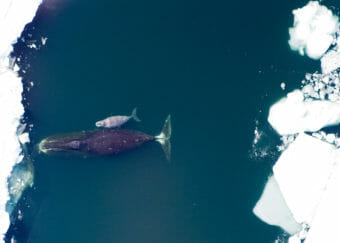
An adult whale and calf swimming among ice floes
A bowhead whale and calf are seen swimming in an open-water lead the Arctic Ocean in this undated photo. A new study appears to be the first to document the presence of PFAS compounds, known as “forever chemicals,” in body tissues of bowhead whales. (Photo provided by the National Oceanic and Atmospheric Administration)

Chemicals from fire retardants and other materials have accumulated in the bodies of seals, whales and other animals of the northern Bering Sea, showing that pollutants emitted thousands of miles away continue to contaminate animals on which Indigenous people depend for food, according to a newly published study.

The study, published in the journal Environmental Science and Pollution Research, focuses on marine mammals and reindeer harvested by the Yup’ik residents of St. Lawrence Island, at the southern end of the Bering Strait.

Through samples donated by hunters, researchers – who included island residents themselves – found varying levels of polybrominated diphenyl ethers (PBDEs) and per- and polyfuoroalkyl substances (PFAS) in marine mammals and reindeer on or around the island.

PBDEs are a class of compounds used as flame retardants. PFAS compounds are also used for that purpose but are found in a wide variety of consumer products such as cosmetics, clothing and cookware; they are known as “forever chemicals” because they do not break down in the environment. PBDEs have been phased out in the United States since 2004, but there is no national PFAS ban.

The study of subsistence foods at St. Lawrence Island shows how contaminants carried to the far north by atmospheric and ocean currents persist for years and sometimes decades, burdening the region’s Indigenous people.
Two women, standing outside, hold a large photo of another woman
Pam Miller, executive director of Alaska Community Action on Toxics, and Vi Waghiyi, the organization’s environmental health and justice program director, hold up a photo of the late Annie Alowi, a health aide from the St. Lawrence Island community of Savoonga who spurred studies of contaminants from local and long-range pollutants. Miller and Waghiyi are co-authors of a study that examined contaminants found in marine mammals and reindeer that the Yup’ik people of St. Lawrence Island hunt for traditional foods. Waghiyi is also from Savoonga. (Photo by Yereth Rosen/Alaska Beacon)

“We are being contaminated against our will,” said study co-author Vi Waghiyi, who is from Savoonga, one of the two villages on the island.

Still, the findings should not deter people from conducting their harvests of negepik, or traditional foods, said Waghiyi, the environmental health and justice program director at Alaska Community Action on Toxics, a nonprofit environmental health organization based in Anchorage.

“Our people still feel the benefits outweigh the risks. It is our identity,” she said. “We’re intricately tied to our lands and waters and wildlife that have sustained our people since time immemorial.”

The St. Lawrence Island findings are, in some ways, similar to those of other studies of contaminants in animals around the Arctic.

There were some new discoveries, however. The study appears to be the first to document PFAS compounds in bowhead whales, with traces showing up in mangtak – the name for skin-attached blubber – and blubber alone and muscle.

It also found that of all tested species, seals generally had the highest levels of PBDEs. That shows how persistent those chemicals are in the environment, said Pam Miller, ACAT’s executive director.

“Even though they’ve been subject to some global regulation and regulation in the U.S., they’re still very ubiquitous in the Arctic and still prevalent in people and wildlife that people depend on for traditional foods,” said Miller, another co-author.

The study, which used tissue samples provided by local hunters, is the latest in a series in a research program conducted by ACAT and its partners. The program traces back to the advocacy of Annie Alowa, a former health aide in Savoonga, who pushed for cleanup of military pollution on the island after watching so many villagers get cancer and other health problems. Much of the inspiration for ACAT’s founding and its continued work; she died of cancer herself in 1999.

Strips of meat drying on horizontal poles
Walrus meat dries on a rack in Gambell, one of the two communities on St. Lawrence Island, in 2005. Walruses were among the animals tested in a study that traced persistent pollutants in the Bering Sea environment. (Photo provided by the Alaska Division of Community and Regional Affairs)

The research program is notable for its community focus and reliance on local leadership and knowledge, said Waghiyi, who was named last year to a White House advisory council on environmental justice. “It’s one of the few where we’re not just research subjects,” she said.

While this newly published study focuses on pollutants that are carried long distances in the air and in the ocean, other work in the program is continuing to examine the effects of pollution from Northeast Cape, a military site closed in the 1970s, and other on-island sites.

St. Lawrence Island gets pollution from both faraway and local sources, and it is possible to distinguish between the two, said study lead author Sam Byrne, an assistant professor of biological and global health at Middlebury College.

Proximity to military sites and places like landfills is one distinguishing factor, he said. The types of chemicals discovered is another factor, as lighter compounds are more volatile and can be more easily carried by the winds, while heavier compounds such as some of the PCBs found near Northeast Cape, tend to not travel far.

The face of a white seal, in profile
A Bering Sea bearded seal displays its distinctive whiskers. A study of animals hunted by St. Lawrence Island’s Indigenous people found that the highest levels of flame-retardant chemicals were generally in seals. (Photo provided by NOAA)

The problems go beyond emissions of dangerous chemicals, Waghiyi and Miller said. Melt of sea ice and glacier ice, thaw of permafrost and the proliferation of microplastics in the ocean is also spreading contamination, some of what had previously been sequestered in frozen states, they said.

“The convergence of climate, chemicals and plastics has not been fully appreciated by the scientific community or climate-justice activists,” Miller said.

The eight-nation Arctic Council is one organization that has made the connection between climate change and persistent organic pollutants, known as POPs.

report issued at a meeting last year of high-level officials from council nations showed how climate change has eroded some of the progress made since the mid-1990s by international bans and phaseouts of dangerous chemicals. In some places of the Arctic, the report said, POPs are even increasing in concentration after earlier declines.

Amid Alaska’s permafrost areas, more soil is staying thawed year-round, UAF scientists find

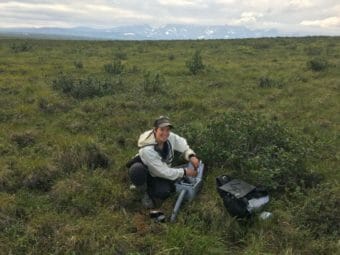
A woman sits on the tundra with miscellaneous scientific equipment
Louise Farquharson, a University of Alaska Fairbanks permafrost expert, checks conditions off the Seward Peninsula’s Kougarok Road on July 23, 2019. The Seward Peninsula, in northwestern Alaska, had nine sites of new talik formation that emerged in 2018, according to research by Farquharson and her UAF colleagues. (Photo by Vladimir Romanovksy/UAF)

Beneath the surface of Alaska’s partially frozen landscape, permafrost is being replaced by what might be considered its opposite: soil that stays unfrozen, even in winter.

Taliks are sections of year-round thawed soil that are wedged in areas with permafrost, generally between the lower layers that remain in freeze and the active surface layers that freeze and thaw with the seasons.

Now talik formation is speeding up, thanks to warmer winters, increased snowfall and the combination of those factors, according to research by permafrost experts at the University of Alaska Fairbanks.

The findings are detailed in a study published this week in the journal Nature Geoscience.

The study uses the temperature readings from long-established permafrost monitoring sites that have been sending data nearly continuously since as early as 1999. The 54 sites chosen for the investigation into talik formation ranged from the Canadian border area in the east to the Seward Peninsula in the west. The sites were both below and above the Arctic Circle and are places where permafrost is classified as discontinuous and where the state of freeze might be considered marginal. None of the sites had any unusual surface disturbance, such as wildfire scarring, that might have hastened thaw.

The state of thaw took a big jump in the winter of 2017-18, when new taliks were found at 24 of the sites, the study found. That coincided with exceptionally snowy and warm conditions that winter.

White, wooden crosses at a cemetery, many of them leaning
Permafrost thaw is causing grave markers to tilt at the cemetery in the Seward Peninsula village of Teller, seen here on Sept. 2, 2021. (Photo by Yereth Rosen/Alaska Beacon)

Warmer winter air temperatures are tied to talik formation, as is thick snow cover, which insulates the ground from the winter cold, said lead author Louise Farquharson, a research assistant professor at UAF’s Geophysical Institute.

The talik expansion is ominous, Farquharson said.

Since the presence of talik enables further thaw, talik expansion has implications for release into the air of carbon long sequestered in permafrost, she said. “This is going to really accelerate the amount of carbon mobilization that happens,” she said.

More talik also likely means more problems for structures and facilities on the ground surface, where thaw is already creating numerous maintenance and repair challenges in Alaska, Farquharson said. And there are yet-to-be determined effects on the flow of water over the landscape, including the possible new movement of contaminants and mercury through groundwater, she said.

Farquharson and her colleague calculated that a decade from now, if carbon emissions and warming continue at present rates, talik formation will be happening in up to 70% of the zone considered to be discontinuous permafrost — and by 2090, talik layers in some parts of the black spruce forest and other ecosystems will be nearly 40 feet thick.

Unlike the abrupt permafrost collapses found at eroding coastal bluffs, at areas of intense wildfire or at sinkholes in ice-rich areas of tundra landscapes, talik development is not obvious to the casual observer.

But it affects a lot more territory, Farquharson said.

“If we look at talik development, it’s a slower process but it’s much more widespread,” she said. “The taliks are going to form across the whole landscape.”

A muddy coastal bluff that is falling apart
Thawing permafrost is hastening erosion of a coastal bluff in the Seward Peninsula village of Teller, as seen on Sept. 2, 2021. Unlike such surface disruption, the development of talik — year-round thawed soil — is not obvious to casual observers. (Photo by Yereth Rosen/Alaska Beacon)

In time, that will include higher-latitude areas where the permafrost layers are, for now, unbroken. “This is going to expand northward into continuous permafrost,” she said.

Taliks can sometimes refreeze, if air temperatures are cold enough and snow is sparse enough. Farquharson and her colleagues actually found two examples of refreeze in their study, at Healy near Denali National Park and near Tanacross in the eastern part of Interior Alaska.

But do not expect any such refreezing after about 2030, according to the study. By then, if warming trends continue as expected, conditions will no longer allow refreezing, no matter how little snow falls.

“We’re kind of in a flickering-light phase right now,” Farquharson said.

The pattern of snow-linked talik formation persisted last winter, which featured record or near-record early winter snowfall in Interior Alaska. In Fairbanks, winter rain that created a durable coating of ice was followed by heavy snow, all creating havoc for drivers and for utilities. At Denali National Park, it was the snowiest December on record, according to the National Weather Service. Heavy snow collapsed the roof of the only grocery store in Delta Junction, about 90 miles southeast of Fairbanks.

Soil temperatures over the past winter were “significantly warmer” than the previous winter, Farquharson said. “That snowfall wasn’t good for permafrost,” she said.

Nome seen in the distance across an expanse of open ground
Nome, seen from the Kougarok Road on Sept. 2, 2021, is built on tundra landscape underlain by discontinuous permafrost. The formation of talik — ground that does not freeze in the winter — poses thaw threats to structures in Nome and similar Alaska communities. (Photo by Yereth Rosen/Alaska Beacon)

For Fairbanks and the area around it, patterns of snow and winter precipitation have changed in the past decades, but in somewhat complicated ways, said Rick Thoman, a scientist with the Alaska Center for Climate Assessment and Policy at UAF.

Total winter snowfall in the region hasn’t increased or decreased, but the snow season has become compressed, Thoman said. “We’re getting more snow in a shorter period of time,” he said. Meanwhile, winter rain events, such as the one that drenched Fairbanks last winter, have become more frequent, he said.

There is a climate-change link to that precipitation pattern. The Bering Sea has become, over time, less icy, allowing more evaporation from open water later in the year, he said. “In Interior Alaska, that’s the primary source of moisture in the wintertime,” he said.

A new Iron Curtain is eroding Norway’s hard-won ties with Russia on Arctic issues

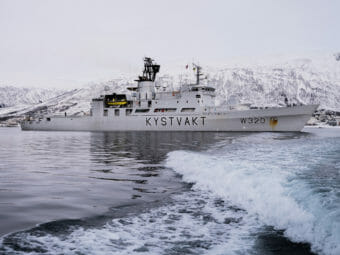
A Coast Guard cutter with snowy mountains in the background
Norwegian coast guard cutters are used for rescue, fishery inspection, research purposes and general patrols in Norwegian waters. (Photo by Nora Lorek for NPR)

Capt. Pal Bratbak has patrolled the Barents Sea for decades. His Norwegian coast guard search-and-rescue cutter mostly chases after distress calls from fishermen. The fishermen are chasing the cod — and the cod sometimes lead them astray.

“The codfish, they don’t see the border, so we help every boat in our area,” he says, and that means as many Russian boats as Norwegian. A treaty allows both nations to catch a quota, and that management of the Barents Sea Arctic cod fleet is considered a success worldwide, both economically and environmentally.

“That’s important for Norway and the European Union and NATO and the whole world. And it’s important for the Russians,” he says.

Cooperation like that has been a given on the Russian-Norwegian frontier for decades, if not centuries. The Norwegians call it “high north, low tension.”

Since Russia’s invasion of Ukraine, though, that tension isn’t so low, and Bratbak is worried. The coast guard also enforces the fishing laws in the Barents Sea.

Years ago, in a rare case, a Russian trawler fled from a coast guard ship, into Russian waters — with Norwegian inspectors on board. Back then, Russian authorities promptly arrested the captain and returned the inspectors. Bratbak hopes the same cooperation would happen today, but his confidence is a bit shaken by recent events.

“In these days, Russia can use other methods to negotiate. Like in the Ukraine conflict, they are willing to use power (more) than talking,” he says.

Critical climate work is on hold

As a founding member of NATO, Norway’s government has joined the rest of Europe in isolating Russia. But as a country bordering Russia, it’s feeling the effects more immediately than some others — in everything from Arctic climate action and nuclear waste control to cross-border trade and regional sports leagues.

The protection of the pristine waters of the Arctic, as well as that cod fleet Capt. Bratbak mentioned, falls under an international group called the Arctic Council. The rotating chair of that group is currently Russia, and as such the council has suspended all activities, including crucial research on climate change.

“It’s not something you can point out that failed today, but it’s ongoing,” says Kim Holmen with the Norwegian Polar Institute in Tromso, where the Arctic Council would normally be coordinating research.

Russia has about half of the world’s Arctic landmass, including permafrost that, if it melts, could release megatons of trapped carbon and greenhouse gases.

Scientists like Holmen count on collaboration with their Russian colleagues.

“We have common publications. We have collected data together. We’ve been on each other’s cruises. I’ve been to people’s homes in Saint Petersburg, good friends,” he says.

Holmen isn’t in contact with those friends right now. He’s been working on the Arctic for more than 30 years, and he says the lesson from back in the Soviet days is that communication will only get them into trouble, which would delay getting back to work.

“Polar scientists are used to the cold,” says Holmen. “We hope and wish to pick up when it thaws.”

‘We are seeing the Iron Curtain come back’

For residents of the border city of Kirkenes, their world changed overnight.

Guro Brandshaug is CEO of the Kirkenes Conference, an annual businesses summit between Russia and Norway. This was the 14th year the event was held, and, on a weeknight in February, it all started out relatively normally.

“On Wednesday the 23rd I welcomed our foreign minister and the Russian ambassador,” says Brandshaug.

With Russian troops massed on the Ukrainian border, she says, it was tense. But Kirkenes is a city built on friendly relations with Russia, and Brandshaug says no one she knew thought Russian President Vladimir Putin would really invade.

“And then we woke up on the morning on the 24th,” she says. “The Russians had started bombing Ukraine. It was a huge shock. People were actually crying.”

A nuclear waste dump poses a constant threat

“Everything that has been built up over the last 30 years, was just washed out in a few days. We are seeing the Iron Curtain coming back,” says Thomas Nilsen with the Barents Observer newspaper in Kirkenes.

The new Iron Curtain severed personal ties, economic links and even scuttled issues of mutual survival, Nilsen says. For years, Norway had been helping Russia safely dispose of spent fuel rods from its aging nuclear submarines, which were stationed in the Arctic.

At a park station in Svanvik, scientist Bredo Moller collects air samples for the Norwegian radiation safety authority.

“We are some, some kind of a nuclear watchdog on the border to Russia,” he says. “That’s more or less why we’re here — to monitor what’s on the other side of the border, just a few kilometers from here.”

He’s referring to one of the world’s biggest nuclear waste dumps, across the border, where tons of waste from Russian power plants and aging submarines pose a constant threat, either as a contaminant to the Arctic sea life or as material in a terrorist dirty bomb.

Moller says that just last November, Norway marked 25 years of cooperation on nuclear cleanup, and he went to Murmansk in Russia for a celebration with his colleagues.

“I have many friends in Murmansk, shaking their heads like me, waiting for this to end,” he says.

Moller is counting on those colleagues to keep up the work of saving the Arctic from nuclear contamination. And he’s certain his friends oppose the war in Ukraine just as he does — they just can’t speak right now. But it’s chilling that many local officials across the border, as well as 700 rectors and university presidents in Russia, have issued strong statements supporting Putin. And that makes Moller worry that even this vital work might not resume soon.

“It will take many, many years I’m afraid, to get back to that trust that we have gained through these 25 years of cooperation. So, yeah, it is frightening times,” he says.

Copyright 2022 NPR. To see more, visit https://www.npr.org.

At Anchorage conference, ambassadors say they see a more militarized future for the Arctic

Joe Manchin leans over to speak in another man's ear
Joe Manchin and U.S. coordinator for the Arctic region at the State Department James DeHart at the 2022 Arctic Encounters symposium in Anchorage. (Photo by Lex Treinen/Alaska Public Media)

Arctic nations are boosting military spending in response to Russia’s invasion of Ukraine.

That was the message from Arctic nations’ top ambassadors and U.S. senators on Friday at the Arctic Encounters conference in Anchorage.

“What is happening is that instead of dividing us, Putin is unifying us in Europe,” said Tiina Jortikka-Laitinen, Finland’s ambassador.

She said for the first time in the country’s history, the majority of its citizens support membership in NATO, which would guarantee a military response from other members if Finland is attacked.

The Norwegian ambassador speaks into a microphone while Sen. Lisa Murkowski stands behind her.
Norwegian Ambassador Anniken Krutnes told reporters at the Arctic Encounters symposium in Anchorage that she foresees a more militarized Arctic following the Russian invasion of Ukraine in February. “We’re only five and a half million people. Fifty-two F-35 – that’s a big thing for us,” she said. “We are buying a marine surveillance aircraft, P-8s, we’re buying new submarines.” (Photo by Lex Treinen/Alaska Public Media)

The Finland ambassador spoke alongside eight other leaders, including U.S. Sen. Lisa Murkowski, at a 40-minute news conference. Both Jortikka-Laitinen and Norway’s ambassador said their countries are buying more than 50 F-35 fighter jets each in response to Russia’s invasion, and they say they foresee a more militarized future in the Arctic.

“We’re only five and a half million people. Fifty-two F-35 — that’s a big thing for us,” said Norwegian Ambassador Anniken Krutnes. “We are buying a marine surveillance aircraft, P-8s, we’re buying new submarines.”

The two-day Arctic Encounters symposium was held at the Dena’ina Center and featured talks from researchers, government officials and Indigenous leaders from Arctic nations, plus countries with interest in the Arctic like Japan and the United Kingdom. They spoke on topics including Arctic health, resource development and the environment. It’s the first time the annual event was held in Anchorage.

Protestors hold large signs shaped like caribou
Demonstrators opposing oil development in the Arctic Refuge outside of the Dena’ina Center where political, industry and some indigenous leaders met for the 2022 Arctic Encounters symposium. Demonstration leaders decried what they saw as overrepresentation of industry and development interests at the symposium. (Photo by Lex Treinen/Alaska Public Media)

Officials from Russia did not attend. They informed organizers a few days before Russia invaded Ukraine in February that they would not come, according to Arctic Encounters director Rachel Kallander.

“We did learn that there was still interest at a later point, but it was not appropriate at that time,” said Kallander. “And we had a cordial exchange to that regard.”

While Russia has been diplomatically cut off from many other forums and scientific projects around the world, Murkowski said that there is still a cooperative Coast Guard agreement to respond to emergencies in the Bering Sea.

“We certainly hope we don’t have environmental issues that we may have to deal with, but I do think that that speaks to some of what has been put in place, historically, where we don’t have a lot of resources in the Arctic, we need to rely on one another,” she said.

The Arctic Encounters symposium wrapped up Friday evening.

When death arrives in Utqiaġvik, volunteer gravediggers answer the call

Two men stand at the bottom of a freshly dug grave
Herman Ahsoak and Marvik Kanayurak dig a grave dusted in snow in winter 2021. (Photo courtesy of Herman Ahsoak)

When Betty Ann Bodfish died from COVID-19 complications, her family wanted to follow her wishes and bury her in Utqiaġvik, next to her mom and grandparents. Relatives gathered from Wainwright, Chugiak, Unalakleet and Colorado, hoping to have the funeral as soon as they could — but the weather was bad and volunteers were already busy digging another grave.

Still, the five men who always volunteer to dig graves in Utqiaġvik were up to the task, even on a long and stormy day.

“When my mom, Dorothy Edwardsen, asked if they could double up, dig two graves in one day, they didn’t hesitate. They never hesitate,” Bodfish’s cousin Iñuuraq Moss said about the volunteers. “They always show up, grave after grave, snow or shine. They honor our loved ones that way, and we couldn’t do what we do without them.”

When people pass away in Utqiaġvik, the family reaches out to a team of volunteer gravediggers, and they take time off from their jobs, bring their tools and get to work, asking for nothing in return. About 20 people in the community sometimes help dig graves, but about five of them come every time.

“We’re here for the people that love those who passed the most, that are hurting the most,” said one of the volunteers, Marvin Kanayurak. “I can’t imagine them having to dig a grave for a person they loved so much. So we’re here for them. We dig graves so that they don’t have to worry about it.”

In a tight-knit community like Utqiaġvik, volunteers do end up digging graves for people they know — or even people who harmed their families. A few years ago, Kanayurak helped bury a person who died in jail after murdering his aunt.

“They buried him in Barrow, and we went there and helped dig that grave,” he said. “There’s always the same five, six guys that are always there. And I mean always.”

Kanayurak has been volunteering for several decades, and he noticed that in the past few years, the number of deaths in Utqiaġvik — the biggest village on the North Slope and the northernmost community in the state — has grown.

“We used to only get two or three deaths a year, and now we’re getting way too many,” he said. “I don’t count them, I just know that the gravesite that we have, when we started it, was empty.”

This winter was a bad season for Utqiaġvik, a city of fewer than 5,000 people. Residents needed eight new graves in December and another 11 since January, said another longtime volunteer, Herman Ahsoak, who digs graves “working from the heart” for his community.

“It’s almost 20 graves in a two-month time frame,” Ahsoak said.

Bodfish’s death a few weeks ago was another addition to the graves volunteers needed to make.

To thank the Utqiaġvik gravediggers “for their continuous tireless hard work,” Bodfish’s family — Dorothy Edwardsen and her daughters, Tracy Benson, Qiñuģan Roddy and Moss — made five hats for the volunteers. The women got together last week to cut out the patterns and sew hats using seal and sea otter skins, a fleece lining and yarn for tassels.

“Our mom said, ‘They’re digging another grave on Monday. I’d like to give them to the guys then.’ And that was our deadline,” Moss said. “It was definitely a labor of love.”

The hats turned out to be quite warm, which was welcome news for the Utqiaġvik gravediggers who were working at temperatures of 20 below zero last month.

Five men stand at the edge of a snowy graveyard, with a wheelbarrow filled with shovels beside them
(From left to right) Volunteer gravediggers Simon Ahluk Toovak, Herman Ahsoak, Marvin Kanayurak Sr., Will Ahlook Stevens and Tony Kaleak received hats as gifts for digging graves for the community of Utqiagvik. (Photo by Clifford Benson)

Kanayurak explained that gravediggers work even if it’s windy or cold because they try to make the graves the day before the burial, following the tradition of not letting anyone “sit above ground.” The team goes out to dig during blizzards, even if the gusts are blowing 45 to 50 miles an hour and the visibility is limited to 150 feet.

“The other day, we’re just facing the wind,” Kanayurak said, “and the guy standing next to me, I looked at his face and said, ‘Hey, your cheeks are turning white!’ And he looks at me and says, ‘Yours too!’ ”

At 59, Kanayurak has been on the volunteer crew the longest. When Kanayurak was a 10-year-old boy in the 1960s, he said, his mother asked him — “a strong young man” — to go help gravediggers. Back then, volunteers only used buckets, sledgehammers and a big ice pick, and it would take them up to three days to dig one grave.

“My job was to hold that pick while they hit that sledgehammer at it, and they would say, ‘Don’t lose!’ Oh, that was the scariest thing I’ve done in my life. But I got good at it,” he said.

Once gravediggers started using a drill, it cut down the digging time to about 10 hours. Nowadays, using different equipment and after years of working side by side, they can dig a grave in solid permafrost in about four or four and a half hours, Kanayurak said.

They drill eight holes close to each other, drill out the middle pieces of mud and use an excavator to dig a grave 6 to 7 feet deep. The ground has changed in the past years too: When Kanayurak first started, the permafrost was about 10 inches to a foot deep. Now the permafrost is only down to 3.5 inches, and the soil is muddier.

Kanayurak observes the passage of time with a smile: “I used to be the youngest gravedigger, and now I’m the oldest.”

Today, the youngest volunteer is 15-year-old Donald Adams, known to everyone as Button. Adams was 8 when he helped dig his first grave — the one for his auntie.

“At first, I didn’t know what I was doing,” Adams said. “At first, I was a little emotional.”

He said that as he has volunteered more and more, he’s gotten better and better at managing his emotions and understanding the importance of the help he is providing.

“We dig other people’s graves to show appreciation to the people that passed on,” Adams said. “We help them because we might have known them. They might have been part of our families, part of our life in some way.”

Ahsoak and Kanayurak both have helped bury their family members as well, but for Kanayurak, there was one grave he couldn’t bring himself to dig: his mother’s.

“I didn’t even dig when my mom passed away. I tried to, but it just made me cry so much,” he said. “I sat there all the way through, and it was the first time I did absolutely nothing on a grave.”

For Ahsoak, the hardest graves to dig are for really young people.

“When it comes to the elderly, I look at it as, we’re going to celebrate their life,” Ahsoak said. “But when there are young people, those are the harder ones to dig. … There’s been moments in the past where I’ve actually started crying while shoveling because it’s hard to witness young people passing away.”

Overall, digging graves becomes easier for the volunteers with time.

“At first it was kind of hard. Now, it hardly fazes me anymore. Death. I’m just so used to it now. But I’ve been doing it for a very long time,” Kanayurak said.

Kanayurak used to get complaints from his wife, asking him to volunteer less and focus on work more, but he would always respond that nothing was more important than honoring people who passed.

“I know we need money, but this is the last time we’re going to help them. So I’m just going to go and help them,” he said. “I just really love my community that much, and I’ll give anything to my people. I hate digging graves, but I love helping my people.”

While working on a grave, the team tries to keep the mood positive, among themselves and with the family, Kanayurak said. They share a meal with the relatives of a person who passed. They start their work with a prayer and finish it with a prayer after they cover the grave with plywood.

“The most memorable part of digging is when you taste the mud, and you smell the mud,” Ahsoak said. “The Heavenly Father says, ‘From dust you were made and to dust you shall return.’ … Every time I dig, I remind myself that one day, they’re going to have to dig a grave for me, you know. So it reminds me to stay humble.”

This story was originally published by the Anchorage Daily News and is republished here with permission.

A Coast Guard cutter has reached the planet’s southernmost navigable waters, setting a new record

An ice shelf seen from the deck of a ship
Shown is the edge of the ice shelf in the southernmost navigable water from the crows nest of U.S. Coast Guard Cutter Polar Star on Feb. 17, 2022. (Photo by Petty Officer 3rd Class Diolanda Caballero/U.S. Coast Guard)

The nation’s only heavy icebreaker reached the southernmost navigable waters on the planet last month, setting a new world record.

Melting of the Ross Ice Shelf meant the Polar Star could sail into newly navigable waters. The shelf is a huge frozen block about the size of France. In some areas, it can be nearly 2,500 ft. thick.

The nearly 400-foot U.S. Coast Guard icebreaker reached a position of 78 degrees, 44 minutes, 1.32 seconds south latitude off the coast of Antarctica. That’s about 500 yards from the edge of the Ross Ice Shelf, beating out the current Guinness world record holder for the southernmost point reached by a ship, according to a Coast Guard statement.

Almost 25 years ago to the day, the Polar Star’s sister ship, the Polar Sea, set the previous record.

The deployment marks the Polar Star’s 25th journey to the earth’s southernmost continent, supporting Operation Deep Freeze — an annual mission to resupply American scientists doing research near the South Pole.

During Polar Star’s transit, it surveyed nearly 400 nautical miles of the ice shelf, providing information that can be used by other ships in the future.

“The crew of Polar Star is proud to follow in the footsteps of legendary Antarctic explorers,” said Capt. Bill Woityra, commanding officer of Polar Star, in a statement. “We carry on that legacy of exploration, reaching new places, and expanding human understanding of our planet.”

This mission marks the Polar Star’s first return to Antarctica since the start of the COVID-19 pandemic.

Last winter, instead of going south, the 46-year-old icebreaker sailed in the Arctic. During that deployment, it stopped in the Port of Dutch Harbor for the first time since 2013. 

Site notifications
Update notification options
Subscribe to notifications