Arctic

Dead bowheads in Beaufort and Chukchi point to increased killer whale presence in Arctic

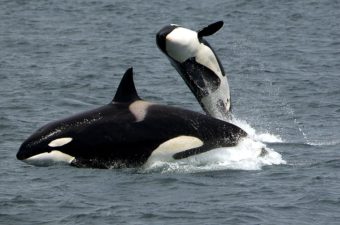
Two killer whales breaching
Killer whales are seen swimming in Alaska waters in 2005. As sea ice diminishes, killer whales are increasing their presence in farther north waters. Studies confirm they are preying on bowheads in the eastern Chukchi Sea and western Beaufort Sea. (Photo by David Ellifrit/National Oceanic and Atmospheric Administration)

There are new signs that killer whales, which are swimming farther north and staying for longer periods of the year in Arctic waters, are increasingly preying on Alaska’s bowhead whales.

A newly published study found that 2019, an especially warm year in the region, also seems to have been an especially dangerous year for bowheads targeted by killer whales.

That year, 11 dead bowheads were found in the eastern Chukchi and western Beaufort seas, with seven of them identified as killer whale victims and the others with causes undetermined. That compares to the 33 dead bowheads found floating or beached in the region in the previous decade, from 2009 to 2018. Eighteen of them were identified as killer whale victims, according to a previous study by the same authors.

Along with the sheer numbers, the new study had another interesting finding about 2019, a year known for its warm Arctic Alaska waters and associated effects like seabird die-offs: a “drastic shift” from the eastern Chukchi to the western Beaufort as a place where bowhead carcasses were found, said lead author Amy Willoughby of the University of Washington and the National Oceanic and Atmospheric Administration’s Marine Mammal Laboratory in Seattle.

The new study detailing 2019 numbers and the previous 2020 study detailing 2009-2018 numbers comprise the first project to systematically examine causes of death for Alaska bowheads killed outside of the traditional Inupiat subsistence hunts. The project uses information gathered in the Aerial Surveys of Arctic Marine Mammals program that is funded by multiple federal agencies.

The authors, along with Willoughby, are other University of Washington and NOAA scientists, as well as colleagues from the North Slope Borough and University of Alaska Fairbanks.

A dead bowhead whale floating on its side
A dead bowhead calf, spotted floating in the Chukchi Sea in 2015, was found upon close analysis to have the tell-tale signs of killer whale predation. This calf was among several dead bowheads in the Chukchi and Beaufort seas that were determined to have been killed by killer whales. (Photo by Lisa Barry/National Oceanic and Atmospheric Administration)

Willoughby and her colleagues were also the first to assemble direct proof of killer whale predation on Alaska bowheads – a dead bowhead calf photographed in 2015 with bite marks on its flipper, mouth and jaw.

On its own, the new study holds too little information to show a trend. “Unfortunately, we do not have comparable data before 2009 in this portion of bowhead whale range, so we cannot determine what is normal or establish patterns without future data,” Willoughby said by email. Also unknown, she said, is how many dead bowheads went undetected – and how many of those were killer whale victims.

Still, the findings fit into a larger pattern, emerging in Alaska and elsewhere, of killer whales spending more time in Arctic waters and preying on marine mammals there. “This is likely because summer sea ice is moving farther north, sea water temperatures are rising, and sea ice is breaking up earlier in the spring and forming later in the fall,” Willoughby said.

Numerous studies and Indigenous whalers’ reports are documenting more killer whales spending more time and making more predation attempts in far-north waters.

2017 study led by Craig George, a longtime North Slope Borough biologist, found an increased frequency over time of killer whale-inflicted scars on subsistence-harvested bowheads. That study examined the body conditions of 514 bowheads harvested from 1990 to 2012.

A study published in 2018 tracked an increasing frequency of killer whale calls in the Chukchi in the fall months. The acoustic monitoring showed that they have substantially increased their post-summer presence, said the study, by Kate Stafford of the University of Washington.

On the Atlantic side of the Arctic, killer whales have been increasingly seen preying on narwhals. One recent study estimated that killer whales could kill more than 1,000 narwhals a year.

This story originally appeared in the Alaska Beacon and is republished here with permission.

Numerals invented by Kaktovik students can now be used digitally

 A set of dark blue cards with symbols printed on them arranged in an arc
The cards with Kaktovik numerals are displayed on a table Oct. 5, 2022. The cards are used in a game called Tallimakipiaġutaiḷaq, which means “99.” In the game, you add the cards as they are played, with the goal to avoid being the person that brings the pile above 99. (Photo by Chrisann Justice)

Almost 30 years ago, a group of Kaktovik students invented a numbering system that reflected the way they counted in Iñupiaq and made math more intuitive for them. Soon, anyone in the world will be able to type Kaktovik numerals on a computer.
“It’s not just a number system. It’s not just math. It was created and developed by a teacher of our district and our Iñupiaq students,” said Tennessee Qaġġuna Judkins, director of Iñupiaq Education at the North Slope Borough School District. “When you use it in a classroom, it’s most relatable to those students, to that population. When it comes to Indigenous methods and understanding, it just clicks. It makes a lot more sense.”

Today, the interest in culturally responsive education — and studying Kaktovik numerals in Iñupiaq schools — is growing, and so is the need for an easy way to use the numbers digitally. Starting this September, an international encoding standard, Unicode, included Kaktovik numerals in its latest version, which means that the numbers will be now universally accepted by computers.

“That means that anybody anywhere in the world on a computer can have access to producing stuff using the numerals,” said former Harold Kaveolook School math teacher William Clark Bartley, whose students invented the system in the ‘90s.

Creating the numerals

When Bartley was a math teacher in Kaktovik in 1994, his middle school students came up with the numbers to represent the Iñupiaq oral counting system.

“Before we made these numerals, we used the Arabic numbers, and, visually, it didn’t connect to our language,” said Alicia Solomon, who was an eighth grader at the time. “And we started asking our teacher, ‘What about our own numbers? Our own system?’”

Most countries use the Hindu-Arabic base-10 numbering system where numbers range from 0 to 9. But in Iñupiaq — as well as other Inuit and Yup’ik languages — the numbers go from 0 to 19, which makes it a base-20 system.

“The Iñupiaq word for the number 20 is iñuiññaq, which represents a whole person,” Judkins said. “You have all 20 appendages — your 10 fingers and your 10 toes. A lot of the classroom activities that we use now with this numbering system is in relation to those body parts and those appendages.”

Kaktovik students came up with digits from zero through 19, composed of straight strokes joined at sharp angles that you can write without lifting a pen.

“We didn’t want them to look like any other numbers,” Solomon said. “It was our whole math class that did it together.”

A table showing the Iñupiaq counting system from 1 to 59
Kaktovik numerals from 1 to 59, as they are seen in Edna MacLean’s Inupiaq dictionary. The lower numbers, 1 to 59. The Kaktovik numbers in the tens’ and fifteens’ rows are graphically simpler than those immediately above and below them, and the corresponding Iñupiaq numbers are lexically simpler than those above and below them.

The Iñupiaq counting system did not have zero, so the school district suggested a couple of names for the digit. A student who had a disability came up with zero’s visual representation.

“She just raised her hands above her head crossing them,” Bartley said.

The numerals are built following the structure of numbers in Iñupiaq: for example, 16 is akimiaq atausiq in Iñupiaq, which translates as 15 and 1. The Kaktovik numeral 16 is also composed of 15 and 1.

“The kids really did come up with a brilliant system,” Bartley said. “The numerals, you just have to look at them, and you can see what the numeral means.”

Because Kaktovik numbers visually reflect the composition of the number, using them in math problems was easier than Arabic numbers, Solomon said. Just by looking at the Kaktovik numerals, students could see how to add, subtract and even divide. For example, for long division, students used colored pencils to match the strokes of the divisor in the dividend.

“The numbers almost gave themselves away,” Bartley said.

After students started working with Kaktovik numerals, Bartley said their interest in math grew. They would rush to get through the regular math book to save time for working with Kaktovik numerals.

“It’s their culture that got all the kids far more involved in it,” he said.

Digitalizing the numerals

The effort to make Kaktovik numerals available on computers began in 2021, when several linguists and language enthusiasts wrote a proposal describing the relevance of the numbering system.

NowUnicode has a spot reserved specifically for Kaktovik numerals starting with Version 15.0 released on Sept. 13. Because the update is so recent, today’s computers, smartphones and other devices don’t come with a font that can display Kaktovik numerals, according to Deborah Anderson, research linguist at the University of California Berkeley who also helps preview new Unicode proposals before they are submitted.

“To access the numerals, users need a font with glyphs and an input mechanism, such as a keyboard,” Anderson said.

In the past, Google has developed free fonts for new Unicode characters that are in modern use. If this is done for the Kaktovik numerals, a font may become available in the next few months, said Craig Cornelius, a software engineer at Google who contributes to Unicode. Eventually, a font will also be available on mobile devices such as Android, but the process will take at least a year, Cornelius said.

“The next step, to make this really usable, is to build a keyboard that can be used on a laptop or desktop directly,” Cornelius said. “If people can type the characters, then someone will be able to see them if the font is installed on their device.”

For now, Cornelius built a digital keyboard for those who want to start using numerals today. The developers are working on training the Iñupiaq Education staff on how to access and use the numerals before the fonts are publicly available.

“The people who did the hard work of getting the Kaktovik characters into the Unicode standard have started the process,” Cornelius said, “but like with any product, it takes time for it to roll out to all the stores.”

Teaching the numerals

Teachers across the North Slope used Kaktovik numerals in math classes for a period after their invention. Their use has since been scaled back, with the influx of out-of-state teachers and the growth of standardized testing in the late ‘90s, but more and more teachers in Iñupiaq schools are now considering bringing the system back.

Adults and children sit around tables looking at numeral system cards
From left: Teachers Kayutak Julie Itta, Anausuk Timmothy Ferreira, Tukak Vernon Elavgak and Atuqtuaq Chrisann Justice play a number game using Kaktovik numerals during Immersion gathering in May 2022. (Photo courtesy of Tenna Judkins)

Next fall, the North Slope Borough School District hopes to roll out several pilot immersion classrooms that will include teaching students math concepts and math activities, using Kaktovik numerals. Moreover, this immersion program will be built on a place-based culturally relevant curriculum that will offer students classes in the Iñupiaq history and local governance.

“There’s this huge wave of Indigenous education and culturally responsive teaching,” Judkins said.

Kaktovik numerals are part of the Iñupiaq language curriculum in the district, and students learn to count and describe dates and ages using them, said Chrisann Justice, the Iñupiaq Education Department Specialist.

But creating educational materials with Kaktovik numerals right now means drawing them by hand or, in Justice’s case, copying and pasting screenshots of each numeral, which often leads to a pixilated image.

“It would be so handy to be able to just type them in!” Justice said.

Digitalizing Kaktovik numerals can also help preserve the use of numbers in Iñupiaq.

“Our words are long, and it’s just easier to see the numbers instead of saying the numbers,” Solomon said. “I think it would be awesome to have the kids try to learn the numbers, sort of get a feel for them and learn our numeral system. Just to stay in touch with our culture.”

This story originally appeared in the Anchorage Daily News and is republished here with permission.

Western Arctic Caribou Herd decline continues, bringing population to a third of peak size

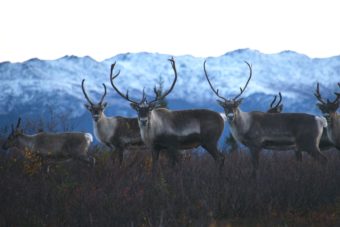
Five caribou seen up close, with snowy mountains behind them. Three of the caribou are looking straight at the camera.
A group of Western Arctic Herd caribou pause in front of mountains in Kobuk Valley National Park during fall migration in 2016. The Western Arctic herd, one of the largest in the world, has been in decline for the past two decades. The 2022 census shows that the decline is continuing. (Photo by Kyle Joly/National Park Service)

One of the world’s biggest caribou herds is continuing a long-term population slide, according to new numbers released this week by the Alaska Department of Fish and Game.

The Western Arctic Caribou Herd is down to 164,000, a decline of 24,000 from the population count made last year and roughly a third of the peak herd populations last reached in the early 2000s, according to the numbers.

There is no obvious reason for the past year’s decline, but it is not surprising, said Alex Hansen, a Kotzebue-based Alaska Department of Fish and Game biologist who is part of the team monitoring the herd. “We’ve seen, for the last number of years, reduced cow survival,” Hansen said.

The Western Arctic Caribou Herd is, in most years, the largest of Alaska’s 32 herds. Its range covers a nearly California-sized swath across Northwest Alaska that stretches from the North Slope in the summer to the eastern Seward Peninsula in the winter.

The annual census is the product of radio tracking, on-site North Slope observations and high-resolution aerial photography that allows biologists to count and categorize individual animals. The work is meticulous, Hansen said. “If we report a number, it’s a good estimate,” he said, noting that the population figures reported include a range known as a confidence interval.

Caribou herds are known to fluctuate widely in size, and the Western Arctic herd’s record since 1970 shows it is no exception. Since then, the herd has veered between a low of about 75,000 in the late 1970s to a high of nearly 500,000 in 2003.

The herd is important to Indigenous villagers in northern Alaska who depend on the animals for food and for cultural traditions. That potentially makes the herd’s decline a problem.

“I can’t say that it isn’t concerning. It depends on what your needs and purposes in life are,” Hansen said. There has been local concern expressed about the caribou’s present population, he said, “because folks rely on them.”

The herd has been at the center of a debate over the proposed Ambler Mining District Industrial Road, a 211-miles project that would cut through the Brooks Range foothills – and a large swatch of the caribou’s range – to connect an isolated copper-mining district with Alaska’s existing road system.

The road, proposed by the Alaska Industrial Development and Export Authority, is needed to make mining commercially viable, argue proponents. But tribal governments and other organizations have consistently opposed the road, citing threats to the Western Arctic herd. In the past, members of the Western Arctic Caribou Herd Working Group, which comprises community residents, hunting guides, environmentalists and other interested parties, have expressed opposition.

The working group makes recommendations about hunting regulation and other management issues. It is scheduled to hold its annual meeting in December.

Caribou and reindeer populations have been declining around the circumpolar north.

The 2018 Arctic Report Card issued by the National Oceanic and Atmospheric Administration noted that the migrating populations of caribou and reindeer have declined 56% over the prior two decades. . Only two of the cited 22 regularly monitored herds had populations at or near historic highs, and some once-large herds in Canada have collapsed almost entirely, that report said.

Arctic climate change is considered to be a likely culprit. Threats from climate change include vegetation changes and a shift in both summer and winter conditions. Through “shrubification,” plants covering tundra are transitioning from the lichen and mosses that are ideal caribou food to woody shrubs that are not, scientists have said. Warmer winters increase the frequency of dangerous rain-on-snow events, and warmer summers increase risks of disease spread, scientists say. Other threats to caribou populations come from development that has fragmented habitat, they say.

The decline of the Western Arctic herd may leave the Porcupine Caribou Herd, which has a range that straddles northeastern Alaska and northwestern Canada, as the state’s largest. The most recent census, conducted in 2017, put that herd population at between 202,000 and 235,000. The Porcupine herd has long been at the center of another development controversy: long-proposed oil drilling in the coastal plain of the Arctic National Wildlife Refuge. That coastal plain is the heart of the herd’s calving grounds.

This story originally appeared in the Alaska Beacon and is republished here with permission.

New federal Arctic strategy lacks focus on issues local to Alaska

""
The Coast Guard icebreaker Healy breaks ice in the Nome Harbor on Jan. 13, 2012. (U.S. Coast Guard photo)

The federal government rolled out a new Arctic strategy this month, a move welcomed by the Alaska congressional delegation. But it’s unclear what it means for residents back in Alaska.

“It’s much more a list of goals,” said Amy Lovecraft, the director of the Center for Arctic Policy at the University of Alaska Fairbanks. She said that the strategy isn’t necessarily new as much as a revival by the Biden administration of Obama-era policies discarded by the Trump administration.

“So, it’s got a lot of buzzwords: conserve and protect, you know, Arctic ecosystems, Indigenous co-production, co-management. Right. What do all those things mean? And so it seems like it’s pretty specific, and so in that sense there are initiatives mentioned,” Lovecraft said.

Lovecraft said that the document falls short of providing clarity on how the goals outlined might be met.

“So these are strategic objectives,” she said. “What I want next are the action items.”

It’s action items that Sen. Lyman Hoffman also wants to see. He’s been a state legislator representing the Bethel region as a Democrat for more than three decades.

“How do you make people that are living in the Arctic, their lives affordable to live up here?” he wondered. “The food is high. The transportation costs are high. The heating costs are high. Everything is too exorbitant.”

Hoffman said that he’d like to see a strategy that addresses on-the-ground realities for Alaskans.

“A large portion of it needs to be focused on global warming and the effects that it’s having on places like Newtok, and places that are eroding; the permafrost melting away. What effect does it have on our food supply for salmon?” Hoffman said.

He said that these are some of the realities people in Western Alaska live with every day.

U.S. Secretary of State Antony Blinken announced the new strategy for the government’s future Arctic in a video posted to Twitter. In it, Blinken outlined four pillars that will guide White House policy in the Arctic in coming years.

The last time the U.S. government released an Arctic strategy was in 2013. That version was heavy on military presence in the region. The new strategy also calls for improved military capabilities in Alaska, but includes three other objectives that focus on economic development, climate change and international relations and diplomacy.

Lovecraft said that the timing of the new strategy’s release is not coincidental. Federal midterm elections are less than a month away. The announcement also comes as Arctic leaders and policy experts gather for an annual meeting in Iceland to discuss science innovation and international policy in the Arctic.

White House Arctic strategy puts new emphasis on national defense and threats posed by Russia

U.S. Air Force Tech. Sgt. Anthony Downs and Staff Sgt. Derek Bolton, staff weather officers assigned to one of the AIr Force’s combat weather squadrons, walk toward an Alaska National Guard helicopter during training on Aug. 25 at Joint Base Elmendorf-Richardson in Anchorage. The new White House Arctic strategy released on Friday emphasizes national defense and the threats posed by Russian aggression. (Photo by Senior Airman Patrick Sullivan/U.S. AIr Force)

A new Arctic strategy released on Friday by the White House acknowledges some big changes in the region over the past decade — the rise of military threats posed by Russia, the largest Arctic nation.

A heavier emphasis on national defense is the biggest difference between the new Biden administration strategy and its predecessor, released in 2013 by the Obama administration.

The 15-page document says the strategy “acknowledges increasing strategic competition in the Arctic since 2013, exacerbated by Russia’s unprovoked war in Ukraine, and seeks to position the United States to both effectively compete and manage tensions.”

Security is identified as the first of four strategic pillars guiding White House policies on Arctic affairs. The others are climate change and environmental protection, sustainable economic development and international cooperation and governance.

While the 2013 strategy also identified security as one of the policy pillars, that document did not mention Russia as a security threat. The new strategy, in contrast, makes multiple specific references to Russia.

“Russia’s war of aggression against Ukraine has rendered government-to government cooperation with Russia in the Arctic virtually impossible at present,” the new strategy says in one of those references.

To achieve national strategic goals, the new White House document lists several concrete policies.

To help Alaska Native communities threatened by climate change, for example, the administration plans to make it easier to get access to federal resources to build resilience. That includes more coordination work with tribal governments, Native corporations, the Alaska state government and other entities, the document says.

To promote economic development, the White House “will support development of much-needed infrastructure in Alaska that serves responsible development, food security, stable housing, climate resilience, and national defense needs as driven by requirements,” the document says. It lists telecommunications and the planned deep-draft port in Nome as key infrastructure investments.

To boost security and protect the national interest, “the United States will enhance and exercise both our military and civilian capabilities in the Arctic as required to deter threats and to anticipate, prevent, and respond to both natural and human-made incidents,” the new strategy says.

Alaska’s two U.S. senators gave the new strategy mixed reviews.

In statements, Sen. Lisa Murkowski and Sen. Dan Sullivan, both Republicans, said they welcomed the new emphasis on national defense.

Sen. Lisa Murkowski said the strategy contains many “positive elements.”

“For example, I’m pleased with the administration’s emphasis on security, infrastructure, climate adaptation and resilience, greater consultation with the State of Alaska and Alaska Native Tribes and Corporations, and its elevation of Arctic diplomacy through the creation of the Arctic Ambassador position — all of which I have called for,” she said in a statement. The heavier emphasis on military security is appropriate, as has been demonstrated by the recent incident in which two Russians sailed over the Bering to Alaska’s St. Lawrence Island to request asylum, she said.

However, she criticized it for what she characterized as too little discussion of resource development and an omission of oil and gas development.

Sullivan, in his statement, said he appreciated the “full-throated support for increasing America’s operational capabilities, infrastructure, and Coast Guard and naval vessels in the Arctic, and for elevating the voices and interests of the people who actually live in the Arctic—Alaskans who’ve inhabited these lands for millennia.”

However, he faulted the document for its emphasis on climate change, which he said shows the Biden administration “will continue to focus on shutting down responsible resource development, like oil, natural gas, and critical minerals in Alaska.”

Sullivan, in his statement, dismissed the 2013 strategy as being “filled with mostly pictures,” though that Obama administration document did not include a single image other than the presidential seal. However, a Department of Defense Arctic strategy released in November of 2013 did contain illustrations.

This story originally appeared in the Alaska Beacon and is republished here with permission.

Alaska’s next big storm forecast to hit farther north, as some communities still recover from September flooding

A forecast map shows the storm expected to hit Alaska on Wednesday. (National Weather Service)

A storm is forecast to hit Alaska’s northwest coast with high winds and coastal flooding, starting Wednesday night and continuing into Friday.

That’s as many Western Alaska communities are still trying to recover from last month’s major storm, the remnants of Typhoon Merbok, which impacted nearly 1,000 miles of coastline.

While the current storm’s track appears to be farther north, National Weather Service meteorologist Ryan Metzger said the communities impacted by the previous storm are now more vulnerable than they were a month ago.

“You know, the worst impacts with this storm will be north of the Bering Strait,” Metzger said. “But areas south of the Bering Strait that were impacted by the previous storm, they have more susceptibility to smaller events, so that’s why we’re kind of keeping an eye out for those areas.”

The most serious impacts are expected from Shishmaref to Kotzebue and up the coast to Utqiagvik.

The Weather Service has issued warnings for high winds, flooding or both for those areas, as well as the community of Gambell on St. Lawrence Island in the Bering Sea.

Wind gusts are expected as high as 70 mph in some locations by Thursday.

To the south, in places like Nome, Unalakleet and down to Hooper Bay, there are less serious weather advisories in effect.

State officials say assessment resources and local contractors are already on hand in communities that might be affected by the coming storm.

The Alaska National Guard’s adjutant general, Maj. Gen. Torrence Saxe, said guardsmen and helicopters are pre-positioned at armories in Nome, Kotzebue and Utqiagvik.

“This could be a different storm, as we’ve heard, so we’re getting people ready now,” Saxe said. “What we call the ‘warning order’ has already gone out to my forces, and we will be ready to go.”

Gov. Mike Dunleavy urged residents in the region to prepare. He emphasized the importance of protecting human life, after no deaths or serious injuries were reported from last month’s storm.

Most locations within the National Weather Service’s warning zone are expected to see the high wind tapering off by Friday.

Alaska Public Media’s Chris Klint contributed reporting to this story.

Site notifications
Update notification options
Subscribe to notifications