North Slope

Exxon transfers Point Thomson operations on Alaska’s North Slope to Hilcorp

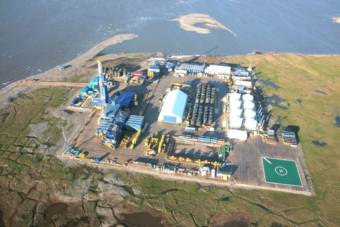
An aerial view of an oil field on Alaska's North Slope
Point Thomson is on state land 60 miles east of Prudhoe Bay. (ExxonMobil photo)

ExxonMobil has agreed to transfer operating responsibility for the Point Thomson field on the North Slope to Hilcorp.

Point Thomson, on state land east of Prudhoe Bay, is a large reservoir of natural gas and gas condensate.

Exxon will maintain its 60% ownership stake in the field, said Hans Neidig, the company’s Alaska public affairs manager.

“ExxonMobil remains committed to Point Thomson and will continue to have a leadership role in exploring all options to monetize its gas resources,” he said.

Exxon will also maintain its ownership stake in Prudhoe Bay and the trans-Alaska pipeline, Neidig said.

Some 38 employees are affected by the transfer. They might be hired by Hilcorp, Neidig said, while others could be reassigned to other positions at Exxon.

Exxon has been active in Alaska’s oil and gas industry for decades. Despite its large working interest in the North Slope, Point Thomson was the first and only Alaska field that Exxon decided to operate itself, Neidig said.

Hilcorp is a newer player but has a much larger profile in Alaska operations. It became the main oilfield operator in the state after it bought BP’s Alaska assets last year.
Production of condensate from Point Thomson began in 2016. It travels through the trans-Alaska pipeline. Commercial production of Point Thomson gas will depend on a large liquified natural gas system.

Alaska’s North Slope grapples with soaring COVID-19 infection rate, low vaccinations

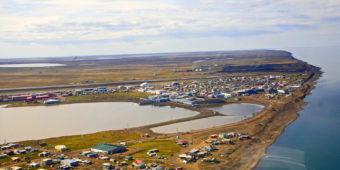
Utqiagvik, the city formally know as Barrow, in 2014. ( Creative Commons photo)
Utqiaġvik, Alaska (Creative Commons photo)

Alaska’s North Slope has seen the highest coronavirus infection rates of any region in the state recently.

And while the North Slope Borough’s rate of vaccination for COVID-19 is on par with Anchorage, it’s far behind that of other comparable, rural areas off the road system.

Anchorage Daily News reporter Zachariah Hughes recently wrote about COVID on the North Slope.

Hughes says some communities there have seen their first infections of the pandemic during the surge driven by the delta variant.

Read a transcript of the conversation with minor edits for clarity

Zachariah Hughes: This is a region that had gotten by relatively unscathed from previous waves of the pandemic. There were communities on the North Slope that saw no cases last summer or even last winter when the virus was surging in other parts of the state. And all of a sudden, you’re having dozens of people in communities of just a few hundred folks that are returning positive tests. So that’s where a lot of the alarm is, is there’s just so many positive tests coming back. And I think there’s some degree of uncertainty about whether or not another shoe would drop in that.

Casey Grove: Another thing that you got into with your story was the rate of vaccination in the North Slope Borough. What are they seeing with that?

Zachariah Hughes: Well, it’s a really low vaccination rate relative, not just to the state’s overall rate, but to most of the hub communities in rural Alaska. A lot of the Western Alaska regions have really high vaccination rates and they have had them since the vaccine first came out. A lot of the regional health corporations in the Bethel area, the Northwest Arctic Borough, the Bering Strait region, were really aggressive and frankly, really capable about delivering vaccination to a lot of the residents in hubs and in the outlying smaller communities.

And that’s not the case in Utqiaġvik and for the North Slope. The North Slope actually has the second lowest vaccination rate in the entire states at about 41%. That’s 20, 30, 40 points lower than some of the comparable communities in Western and kind of Arctic Alaska.

Casey Grove: Did any of the folks that you talk to have ideas about why that’s the case?

Zachariah Hughes: One of the people I spoke with in the North Slope Borough’s health department said that this summer, the bureau sent out teams to basically canvass every single household in the communities on the North Slope to find out “OK, why aren’t people getting the vaccine?”

And what this fellow told me was that he’d knocked on about 200 doors in some of the outlying communities, and he heard a lot of misinformation. He heard a lot of people’s mistrust for the vaccine, they had some conspiratorial assumptions about the vaccine. And so for him, that was the biggest factor that they were running into.

I think it’s also important to point out that if you’re living in a place that has not had a single positive case, it can be hard to see the urgency and the imperative. An assembly member from the North Slope Borough who represents Point Lay and Atqasuk told me was “we had no cases in town until very recently and maybe we let our guard down because now it’s spreading out all over the place.”

Then just historically, the Arctic North Slope region has not always had a great relationship with federal agencies and federal initiatives that have come in, purportedly in the name of scientific progress and health.

Biden administration will review Trump’s plan that opened most of the NPR-A to oil development

The National Petroleum Reserve Alaska is the size of Indiana. It includes important habitat for migratory birds. It also shows promise for oil development. (Elizabeth Harball/Alaska’s Energy Desk.)

The Biden administration will reexamine the land use plan for the National Petroleum Reserve-Alaska, with the likely effect of putting more areas off-limits to Arctic drilling.

The announcement came in a lawsuit challenging the Trump administration’s plan, which called for opening 80% of the NPR-A to possible oil development. That plan reversed an Obama administration decision that shielded about half of the reserve from drilling.

Last week, Laura Daniel-Davis, an assistant secretary with the Interior Department, directed the Bureau of Land Management to review the NPR-A management plan for compliance with President Biden’s climate goals.

The NPR-A sits to the west of Prudhoe Bay and is a bit larger than the Arctic National Wildlife Refuge.

Both tracts of federal land have seen a similar back-and-forth on policy: Democratic administrations erect barriers to drilling. Republicans take them down and clear a path for development, followed by another Democratic administration blocking that path.

Athan Manual, the Sierra Club’s public lands program director, said the zig-zag should stop with NPR-A on its current course.

“I think what’s different about this decision now is that the Biden administration cited climate change as the reason to block or to re-examine the drilling and leasing in the National Petroleum Reserve,” he said. “And so we hope that changes the dynamic here.”

The next president, no matter the party, should recognize the reality of climate change and the need to keep more petroleum in the ground to fight it, Manual said.

Alaska Oil and Gas Association President Kara Moriarty said the Trump plan for the NPR-A was thorough and it was finalized months ago. She said she understands Biden has other priorities.

“But those priorities shouldn’t allow an administration to go back and review a legal document,” she said, “because what kind of certainty does that send?”

She said the industry is always looking for the best technology to have the least amount of impact on the environment.

While the government’s review of the NPR-A is underway, the Bureau of Land Management won’t offer oil and gas leases in the areas recently opened for possible development.

Gov. Dunleavy replaces Transportation Commissioner John MacKinnon

Ryan Anderson has been named by Gov. Mike Dunleavy as the new commissioner of the Alaska Department of Transportation and Public Facilities, replacing John MacKinnon, on Sept. 3, 2021. (Photo provided by the Department of Transportation and Public Facilities)

Gov. Mike Dunleavy appointed Ryan Anderson as the new commissioner of the Department of Transportation and Public Facilities. He replaces John MacKinnon.

Anderson has worked for the department for 20 years. His most recent position was director for the Northern Region. 

Anderson oversaw design, construction, maintenance and operations for a region that extends from the Gulf of Alaska to the Arctic Ocean. He lives in Fairbanks. 

The governor’s office did not provide the reason for MacKinnon’s departure and said that it doesn’t comment on personnel issues.

MacKinnon had been in the position since the start of the Dunleavy administration in 2018. 


Budget bill in Congress could derail ANWR drilling

Caribou graze on the coastal plain of the Arctic National Wildlife Refuge, with the Brooks Range as a backdrop in October 2010. (Public domain photo by U.S. Fish and Wildlife Service)
Caribou graze on the coastal plain of the Arctic National Wildlife Refuge, with the Brooks Range as a backdrop in October 2010. (U.S. Fish and Wildlife Service photo)

Democrats in the U.S. House want to use the budget process to reverse the 2017 law requiring oil lease sales in the Arctic National Wildlife Refuge.

The ANWR reversal is part of the budget reconciliation bill debated in the House Resources Committee Thursday.

Budget reconciliation is a type of bill that can’t be filibustered in the Senate, so in theory it could pass there without any Republican votes. Rep. Jared Huffman, D-Calif., said it’s a fitting way to repeal the refuge leasing mandate.

“This is something congressional Republicans enacted as part of their 2017 tax cut legislation,” Huffman said. “It happened through budget reconciliation.”

Alaska Congressman Don Young sponsored an amendment to strike the anti-drilling section. He didn’t participate in the committee’s video proceeding. His spokesman said Young is in Alaska and had a prior commitment.

The House Resources Committee is scheduled to vote on the amendment next week. Meanwhile, Senate committees will work on their own versions of the budget bill, and it’s not clear Democrats there will go along with their House counterparts.

Sen. Joe Manchin, D-W.Va., chairs the Senate Energy Committee. He has previously voted in favor of drilling in the Arctic Refuge. He recently called on fellow Democrats to hit “pause” on reconciliation, which includes $3.5 trillion in spending.

Federal judge reverses Trump environmental approval for major Alaska oil project

An aerial view of one of the exploration pads and wells that ConocoPhillips drilled during the 2018 exploration season at its Willow prospect. (Judy Patrick Photography / ConocoPhillips Alaska)

A federal judge has reversed the Trump administration’s environmental approval for ConocoPhillips’ multibillion-dollar proposed Willow development on Alaska’s North Slope, throwing a significant roadblock in front of a project seen by analysts as a needed boost to the state’s flagging oil industry and tax revenue.

U.S. District Court Judge Sharon Gleason, in a 110-page ruling on two related lawsuits Wednesday, said the Trump administration’s approval of the project under the National Environmental Policy Act was flawed because it failed to thoroughly analyze potential greenhouse gas pollution and didn’t sufficiently consider legal protections for Teshekpuk Lake, an important subsistence area on the North Slope.

The ruling by Gleason, an appointee of former President Barack Obama, sets aside the project’s approval by the Bureau of Land Management. It also vacates a formal opinion by the U.S. Fish and Wildlife Service that said the project was unlikely to jeopardize polar bears’ continued existence and was unlikely to harm their critical habitat.

The decision, released Wednesday afternoon, quickly reverberated around Alaska’s political and oil industry circles. In a reflection of Willow’s broad significance, ConocoPhillips, Gov. Mike Dunleavy’s administration and the North Slope Borough had all intervened in the litigation in defense of the federal agencies being sued by nine separate environmental groups.

Other major potential Alaska oil developments have endured recent political and financial setbacks: The Biden administration has halted development in the Arctic National Wildlife Refuge, a state government-sponsored LNG pipeline has stalled and another major project on the North Slope, Pikka, is in limbo amid the acquisition of its owner.

Willow, located in the National Petroleum Reserve-Alaska, was the “one bright spot in what was otherwise a gloomy world,” said Brad Keithley, a retired Alaska oil and gas attorney and state budget watchdog who tweeted a news story about Gleason’s ruling alongside a “scream” emoji.

The project, Keithley noted, has the potential to employ many Alaskans, and federal projections indicate that it could generate as much as $13 billion in taxes and royalties for state government.

“How do you say anything other than, ‘uh oh’?” Keithley said in a phone interview Wednesday. “It’s not only a big deal in the ConocoPhillips boardroom, it’s a big deal not only to the Alaska oil industry, it’s a big deal to the Alaska fiscal situation. It just hits all those buttons.”

Keithley said he was especially concerned about Gleason’s rejection of the Trump administration’s analysis of greenhouse gas pollution that could be caused by Willow.

The judge rejected several other claims brought by the environmental groups, but concluded that the greenhouse gas projections were inadequate because they failed to account for foreign emissions.

Her opinion relied on a recent precedent set by a higher court in litigation over another Alaska oil project, Hilcorp-owned Liberty, that faulted another federal analysis of foreign emissions.

In its Willow analysis, the Trump administration made similar errors, Gleason wrote. Those errors included asserting, without sufficient evidence or research, that an individual project has a negligible impact on global emissions and that the government lacks reliable data on foreign oil consumption, she said.

The action by Gleason leaves Willow’s future uncertain. Either the Biden administration, which was defending the Trump administration’s approvals of the project, or ConocoPhillips could appeal the decision.

A spokesperson for the Department of the Interior, the BLM’s parent agency, said Gleason’s decision was being analyzed. Conoco responded to Gleason’s ruling with a brief statement: “We will review the decision and evaluate the options available regarding this project.”

The ConocoPhillips building in downtown Anchorage. (Joey Mendolia/Alaska Public Media)

Alaska elected officials were quick to criticize Gleason. In a prepared statement, Dunleavy, a Republican, called her ruling a “horrible decision” and said it outsources oil production to “dictatorships and terrorist organizations.”

Anchorage Republican state Sen. Josh Revak, in a prepared statement, said the decision “should be deeply concerning to every Alaskan.”

“Alaska resource development pays the bills for public safety, education and the health and well-being of all Alaskans,” said Revak, the chair of the state Senate committee with jurisdiction over oil and gas. “This ruling is heartbreaking for the hard-working men and women in the industry.”

Willow, if built, could produce 160,000 barrels of oil a day, or roughly a third of the state’s current total production, and a total of 600 million barrels over three decades. It would include five drill sites, an oil processing center, 37 miles of gravel roads, seven bridges, 100 miles of new pipelines and a freshwater reservoir.

Conoco has already invested $500 million in the project, according to court documents, and its full cost could be as high as $6 billion.

Earlier this year, Biden’s administration faced criticism by environmental groups when it decided to continue defending the Trump administration’s environmental approvals in the court cases.

Observers interpreted the decision as an effort to appease Republican U.S. Sen. Lisa Murkowski, a moderate who has occasionally been a key vote in favor of some of Biden’s congressional priorities.

By that point, though, a panel of higher-level of judges had already signaled that Willow was in significant legal jeopardy. In February, the panel had agreed to a request by the environmental groups to temporarily bar work at the project site, citing a strong likelihood that they could win their underlying lawsuit before Gleason.

If Gleason’s decision stands, the Biden administration would likely have to redo the Trump administration’s environmental reviews, according to Bridget Psarianos, an Anchorage-based attorney who worked with the groups that filed the lawsuits. That would give the Biden administration an opportunity to more rigorously analyze the project’s impacts, she added.

“This is definitely a chance for them to do the right thing,” Psarianos said. “I hope they take it.”

Environmental groups have pointed to the potential greenhouse gas pollution generated by Willow as a key reason to fight it. But they have also opposed it because it represents a major westward expansion of Alaska’s oil industry into the National Petroleum Reserve — which, in spite of its name, contains valuable fish and wildlife habitat. Some of those areas, like Teshekpuk Lake, are important subsistence resources for the North Slope’s Indigenous residents.

Wednesday’s victory, oil development opponents said, buys them time, given the financial industry’s increasing wariness about investing in fossil fuels — particularly in the Arctic. Psarianos said she’s conscious that that’s causing real impacts on Alaskans’ lives and jobs, but added that the transition away from the industry is necessary.

“The longer we can hold off Willow, the better,” Psarianos said. “Because the oil industry is suffering, and there is an exodus going on.”

This story has been updated.

Site notifications
Update notification options
Subscribe to notifications