North Slope

Hilcorp tops list for methane emissions, report says

Permafrost-derived methane bubbles are trapped in the ice on a pond near Fairbanks, Alaska. (Katey Walter Anthony/University of Alaska Fairbanks)

A new report says Hilcorp Energy emits far more methane into the atmosphere than any other oil and gas producer in the United States.

Texas-based Hilcorp is Alaska’s second-largest oil producer. Nationally, it produces far less energy than Exxon Mobil, but Hilcorp emits nearly 50% more methane pollution, according to a report produced by consulting firm M.J. Bradley & Associates for two non-profits.

Methane is the primary ingredient in natural gas. It is emitted from cracked equipment, bad seals and when liquids are transferred, among other ways.

Methane is also a powerful contributor to global warming. It’s 25 times more potent than carbon dioxide at trapping heat in the atmosphere.

The report shows little methane escaping from Arctic Alaska, where most of the state’s oil production is located. Gas there is re-injected into wells.

A leaking Cook Inlet pipeline contributed to Hilcorp’s high methane escapement, but Hilcorp’s larger methane problems are in the Lower 48, according to the public data sources M.J. Bradley relied on.

A Hilcorp spokesman said by email that the report’s conclusions are meant to advance the agenda of the groups that sponsored it, the Clean Air Task Force and another climate advocacy organization called Ceres.

The spokesman said Hilcorp buys aging assets and improves them but he said the emissions data does not give the company full credit for the improvements. He also said that “nearly all (of) Hilcorp Alaska’s facilities have decreased emissions since coming under our ownership.”

Biden administration puts Arctic refuge leases on ice as it asks for new environmental reviews

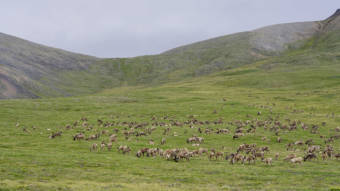
The Porcupine Caribou Herd in the Arctic National Wildlife Refuge on July 3, 2019. (Danielle Brigida via Creative Commons)

The Biden administration Tuesday took its first steps toward reversing the opening of the Arctic National Wildlife Refuge’s coastal plain to oil drilling, by suspending leases issued in the final days of the Trump administration.
The suspension comes as no surprise: Biden, on the campaign trail, vowed to adopt permanent protections for the refuge. And on his first day in office, on Jan. 20, he directed the Interior Department to put a “temporary mortarium” on all oil and gas leasing activities in the refuge and to review the environmental impacts of the Trump administration’s oil and gas program for the area.

Now his Interior Department says it’s doing just that. It announced in a written statement Tuesday that it’s conducting a new environmental review of the Trump administration’s oil and gas leasing program for the refuge’s coastal plain while addressing what it called “legal deficiencies.”

All activities related to the program — including the current leases — are suspended until the review is complete. The department will then decide whether the leases should be “reaffirmed, voided, or subject to additional mitigation measures,” the statement said.

The refuge’s coastal plain — the area Congress opened to drilling in 2017 — is the northernmost slice of the Arctic refuge.

It’s home to migrating caribou, polar bears, birds and other wildlife. It also potentially sits atop billions of barrels of oil, according to federal estimates. Some Indigenous Iñupiat leaders in the village of Kaktovik, which sits within the coastal plain, support oil exploration, while the Gwich’in, who live to the south and subsist on caribou, are opposed.

The Arctic National Wildlife Refuge’s coastal plain is shown in orange. The area covers about 1.6 million area, roughly the size of Delaware, and makes up about 8% of the refuge. (USGS map)

After a decades-long fight over whether to drill for oil in the coastal plain, the Trump administration held the refuge’s first-ever lease sale Jan. 6.

It was a controversial sale, snarled in lawsuits and opposition.

Critics said it was rushed, sloppy and a threat to animals and the environment. But supporters said drilling in the refuge is good for jobs and the country’s energy independence.

The sale ended up drawing little interest; no major oil companies bid on the leases. Instead, two smaller ones each picked up a single lease, and the state-owned Alaska Industrial Development and Export Authority picked up seven. The leases last for 10 years.

An Alaska-based spokesperson with the Bureau of Land Management said she had not been given any information on a suspension by late Tuesday morning.

An AIDEA spokesperson did not immediately respond to a request for comment.

Meanwhile, environmental groups and a Gwich’in organization cheered the news of suspended leases.

“The Gwich’in Nation is grateful and heartened by the news that the Biden administration has acted again on its commitment to protecting sacred lands and the Gwich’in way of life,” said a statement from Bernadette Demientieff, executive director of the Gwich’in Steering Committee.

Demientieff said she hopes the Biden administration goes a step farther soon and cancels the existing oil and gas leases and bans drilling in the refuge’s coastal plain.

This is a developing story. Check back for updates.

US Sen. Sullivan tells lawmakers that Biden decisions harm Alaska economy, asks for help with large oil project

Alaska Republican U.S. Sen. Dan Sullivan, center, speaks to a joint session of the Alaska Legislature on Monday, May 3, 2021, in Juneau, Alaska. Pictured behind Sullivan are, from left, Senate President Peter Micciche and House Speaker Louise Stutes. (AP Photo/Becky Bohrer, Pool)

U.S. Sen. Dan Sullivan told Alaska’s legislators on Monday that President Biden’s administration is at war with Alaska over developing resources. 

In an address to a joint session in the Legislature, Sullivan said Alaska’s economy benefited from a series of decisions by former President Trump’s administration. These decisions included on oil development for the Willow Project in the National Petroleum Reserve-Alaska and the development of a road between King Cove and Cold Bay that will run through a national wildlife refuge. He says those decisions are under attack.

“This is not surprising,” Sullivan said. “We knew this anti-Alaska agenda was coming if the national Democratic Party took control of the White House, the Senate and the House. Alaska is always the gift that national Democratic administrations give their extreme, radical environmental supporters.”

This year is the first time Sullivan, a Republican, has been in the minority caucus in the U.S. Senate. And with Democrats controlling both Congress and the White House, he said he will be strategic.

“We need to look for ways to gain ground when we can, even if we feel that we’re in retreat right now,” he said.

He said support in Alaska for developing projects like the oil discovery at Willow hasn’t been partisan. 

“But we need all of your help, especially our Democratic friends in the Legislature,” he said. “You all have powerful voices. Please, underscore the importance of Willow in any and all conversations you have with any Biden administration officials. We need to turn Willow into a victory for Alaska and America.”

He said the Biden administration’s proposals are part of a long-term battle facing the country.  

“They’re tempting America with cradle-to-grave, European-style socialism,” he said. “They’re cutting the ties between work and income, and in so doing, undermining the notion of earned success and the dignity and importance of work.”

But he did say there were some early successes for the state with the new administration, including the decision to build a dock, pier and office in Ketchikan, to serve as the home port for a National Oceanic and Atmospheric Administration research vessel.

It was the Legislature’s first joint session in the House chamber since the pandemic arrived in Alaska. The Legislature has been easing some of its COVID-19 safety rules, including no longer requiring fully vaccinated people who work in the Capitol to frequently be tested for the coronavirus. 


Kaktovik Iñupiat Corporation misses deadline for seismic work in Arctic refuge this winter

The Porcupine Caribou Herd in the Arctic National Wildlife Refuge on July 3, 2019. (Danielle Brigida via Creative Commons)

An Alaska Native corporation has missed a key deadline to search for oil in the Arctic National Wildlife Refuge, according to the Department of the Interior.

Before it could get approval for what’s known as a seismic survey, the Kaktovik Iñupiat Corporation had to make three flights to search for polar bear dens in part of the refuge.

But the corporation did not do the work before the Feb. 13 deadline, said a brief statement Saturday from Interior spokeswoman Melissa Schwartz.

It’s unclear what exactly happened. An official with KIC did not return requests for comment Monday.

The missed deadline effectively kills the corporation’s proposal to use seismic exploration to search for oil in part of the Arctic refuge’s coastal plain this winter.

It’s the latest setback for drilling proponents who have long wanted to see oil pumped out of the refuge in northeast Alaska.

Another came last month when the first-ever oil and gas lease sale in the refuge, held under then-President Donald Trump, attracted very little interest.

KIC was proposing to bring big trucks and dozens of workers onto the coastal plain to search for pockets of oil on part of the land.

But, to move forward, the corporation needed what the federal government calls an “Incidental Harassment Authorization” of polar bears.

In October, KIC submitted a request to the U.S. Fish and Wildlife Service for the authorization. The agency got inundated with more than 6 million public comments tied to the controversial request.

It had until Sunday to decide whether to give KIC the authorization.

Because the aerial work was not done, the agency told the corporation that its request “is no longer actionable,” according to Schwartz, with the Interior.

Environmental groups celebrated the news that KIC’s plan hit a major roadblock. They had raised concerns about it damaging the tundra and harming wildlife.

“The previous administration attempted to fast-track exploration on an unreasonably short timeline, so the fact that KIC was unable to do the work necessary to ensure the safety of threatened polar bears was completely foreseeable, and Interior responding by voiding the harassment request is the right move at this time,” said a written statement from Adam Kolton, executive director of the Alaska Wilderness League.

Any future proposals for seismic work will likely face steeper hurdles under President Joe Biden, who opposes oil development in the refuge.

On his first day in office, Biden directed the Interior Secretary to put a “temporary moratorium” on all oil and gas leasing activities in the refuge.

Judges block work at ConocoPhillips’ huge Alaska project, casting cloud over ‘North Slope renaissance’

An aerial view of one of the exploration pads and wells that ConocoPhillips drilled during the 2018 exploration season at its Willow prospect. (Judy Patrick Photography / ConocoPhillips Alaska)

A federal appeals panel has halted work at one of Alaska’s biggest proposed North Slope oil fields, putting dozens of contractors out of work and costing ConocoPhillips, the project’s developer, millions of dollars.

The two-judge panel, from the Ninth Circuit Court of Appeals, issued its emergency order late Saturday.

It comes a week after a pair of Alaska Native-owned corporations hired by Conoco started building ice roads over frozen tundra to access the site of a proposed gravel mine to support construction of the oil company’s massive Willow project, according to court documents. And given the short length of the North Slope’s winter construction season, project opponents say the ruling appears to thwart Conoco’s development plans until next January.

The Willow development is one of the largest proposed projects in years on the North Slope, where total oil production has leveled off around 500,000 barrels a day after decades of decline.

At its peak, Willow, located in the National Petroleum Reserve in Alaska, could add another 150,000 barrels a day to that figure — if Conoco ultimately decides to invest the $2 billion or more needed to build it. But the court’s ruling Saturday is an indication of the new legal and political obstacles standing in the project’s way.

Just two years ago, industry boosters — including Conoco’s top Alaska executive — were hailing Willow as one of multiple promising projects in what they called a “North Slope renaissance,” buoyed by the Trump administration’s “energy dominance” agenda.

Today, Alaska’s oil industry is contending with a new presidential administration that’s pledging decisive action on carbon emissions and has already issued a temporary moratorium on all activity around leasing in the Arctic National Wildlife Refuge. And a pressure campaign by opponents of oil development in the refuge has convinced an array of banks and other financial institutions to rule out financing of drilling projects anywhere in the Arctic.

ConocoPhillips’ CD5 drill site in January 2017 (Photo by Elizabeth Harball/Alaska’s Energy Desk)

Now, Conoco’s Willow project faces new headwinds. In issuing its Saturday injunction temporarily halting work on the gravel mine and a related three-mile road extension, the Ninth Circuit judges noted that the project’s opponents, who requested the order, also have a good chance of winning their underlying lawsuit challenging the Trump administration’s environmental review of the full Willow project.

Project opponents hope that the judges’ decision Saturday will prompt the Biden administration to re-evaluate the costs and benefits of development in the petroleum reserve, according to Bridget Psarianos, an attorney with the environmental law firm Trustees for Alaska.

“It does come at a moment where it seems like we might have an administration that might question that business as usual approach,” said Psarianos, who’s working on the case. “I’m hoping that this gives us a lot of time to think clearly about the future of this case and the future of this project.”

A Conoco spokeswoman, Natalie Lowman, said the company is reviewing its options and will have more to add in the next few days.

Reserve’s future in question

The legal dispute over Willow marks an escalation in the fight over the future of the Indiana-sized petroleum reserve, which is still mostly undeveloped except its easternmost corner.

Environmental organizations, tourism interests and certain Indigenous groups are opposed to expanded development, citing impacts on the neighboring village of Nuiqsut, risks to fish and wildlife and the global push to reduce fossil fuel consumption.

They also note that while the reserve is named for its oil potential, it contains critically important habitat for caribou and birds, and the legislation that governs its management directs the Interior Department to keep environmental and scenic values in mind.

Oil companies, meanwhile, have pushed to advance development further west. And those efforts got a boost from the Trump administration, which approved major projects and also rewrote the overarching land use plan for the entire reserve to open more areas to drilling.

While Iñupiat-led corporations and political leaders have supported continued oil development balanced with mitigation measures, Conoco’s original plans for Willow provoked opposition among Nuiqsut residents and North Slope elected officials. And the company ultimately made major changes to its proposal in response to the initial backlash.

After the Trump administration approved the project in October, opponents sued in federal court. They claimed the decision violated several bedrock environmental laws, from the National Environmental Policy Act to the Clean Water Act.

A month later, the opponents asked U.S. District Court Judge Sharon Gleason to block Conoco’s work at Willow while the lawsuit played out.

Gleason initially rejected the request, saying the opponents had failed to file their lawsuit within a required 60-day window after the Trump administration’s approval of the project. But she then granted the request for two weeks to allow opponents to appeal to the Ninth Circuit.

The Ninth Circuit’s emergency ruling could ultimately be lifted. But opponents say the court’s briefing schedule will push a decision too late into April to allow construction to resume this year.

Conoco’s project manager, James Brodie, said in a sworn statement that any construction left unfinished by mid-April will have to wait at least until January 2022.

The company already had roughly 60 workers involved in Willow-related ice road construction and support, and it planned to employ double that number at the project’s peak this winter, Brodie said.

Conoco also had already started moving culverts from Fairbanks to the North Slope, and will have “wasted” nearly $4 million on contracts if its winter work is canceled, Brodie said.

Brodie downplayed the impacts of this winter’s plans at Willow, saying that the work was a “small portion” of construction in the petroleum reserve and noting that more than 500 people are working at a separate Conoco project nearby called GMT2.

“This GMT2 work will continue and maintain an industrial presence in the area regardless of whether the Willow gravel construction is allowed to proceed this winter,” Brodie said.

Conoco still has not made a final decision to build the Willow project, and this winter’s plans amounted to preliminary work, the company said.

But the project’s opponents argued that Conoco’s planned gravel mining and road extension would still cause “irreparable harm” to the reserve’s fish and wildlife, and to their members’ interests in subsistence hunting and fishing, tourism and research.

In a sworn statement, Nuiqsut resident and environmental advocate Rosemary Ahtuangaruak said she was concerned about the new infrastructure blocking subsistence wildlife, like caribou, from getting to the village’s hunting grounds.

“We won’t have the migration come to us,” Ahtuangaruak said. “There may be [a] smattering of animals that get through the infrastructure, but they will be unhealthy and highly stressed.”

Nuiqsut in June 2018. The village is near a growing number of oil developments in the western Arctic.
Nuiqsut in June 2018. The village is near a growing number of oil developments in the western Arctic. (Photo by Elizabeth Harball/Alaska’s Energy Desk)

Irreparable harm is one of several legal standards that must be met in order for courts to issue an injunction. In its ruling, the Ninth Circuit judges said they agreed with Willow’s opponents on that point — and also with their argument that they were likely to win their underlying case challenging the whole project, which is another requirement for an injunction.

The two judges cited a point made by Gleason, the lower court judge who initially rejected opponents’ request to block Conoco’s work at Willow based on the two-month time limit.

The project’s opponents argue that Gleason was wrong about the time limit. And if that’s the case, Gleason wrote in one of her orders, the opponents “could well be likely to succeed” in one of their underlying claims challenging the Trump administration’s environmental review of Willow.

Specifically, Gleason cited opponents’ argument that the Trump administration review violated the National Environmental Policy Act by inaccurately estimating Willow’s potential greenhouse gas emissions.

The Ninth Circuit’s ruling, handed down late Saturday, made a big splash on both sides; Psarianos, the attorney for Willow’s opponents, called it a “really big deal.”

But she also noted the broader context of many other legal disputes still playing out on the North Slope.

In addition to the lawsuit challenging Willow, drilling opponents have sued over the Trump administration’s new, less-restrictive management plan for the petroleum reserve, and over the Congressionally-created oil leasing program in the Arctic National Wildlife Refuge.

“We’re looking forward to continuing to work on this case, and just keep fighting it,” Psarianos said. “This is one battle in a long war.”

Judge says Conoco can’t start gravel construction or mining at Willow oil project for up to 2 weeks

ConocoPhillips’ undeveloped Willow prospect. (Photo courtesy ConocoPhillips)

A federal judge said Saturday that ConocoPhillips can’t start opening a gravel mine or building gravel roads at its Willow oil project for up to two weeks.

U.S. District Court Judge Sharon Gleason’s order comes after conservation groups appealed her decision last week to allow the work at Willow.

Willow is the name of Conoco’s massive oil project in the National Petroleum Reserve-Alaska, on the western North Slope.

Supporters say the project will lead to hundreds of jobs and help keep oil flowing down the trans-Alaska pipeline for decades. But conservation groups say it will cause too much harm — adversely impacting wildlife, the land and those who live in the nearby village of Nuiqsut.

Conoco has said it could start producing oil at Willow in about five years.

Conoco’s Willow oil and gas prospect is located in the northeastern corner of the National Petroleum Reserve-Alaska. (Image credit Bureau of Land Management)

This winter, it wants to build ice and gravel roads in the area, plus a mine site, about seven miles from Nuiqsut.

But conservation groups are suing, and want the project stopped.

Sovereign Iñupiat for a Living Arctic, the Center for Biological Diversity and about a half-dozen other conservation groups sued the Trump administration in late 2020, arguing the government violated environmental laws when it OK’d the Willow project.

The groups want work halted on the project until the lawsuits are resolved.

They’ve recently taken their requests to the U.S. Ninth Circuit Court of Appeals.

Gleason ruled Saturday that Conoco can continue construction on its seasonal ice roads, but it must not blast the gravel mine or build gravel roads until Feb. 20 or until the Ninth Circuit rules on the groups’ requests — whichever happens first.

Conoco had planned to break ground at the mine site on Feb. 12, according to Gleason’s 11-page order.

She described the mandatory pause as a “brief and limited injunction.”

She said while she remains confident in last week’s decision to allow the work at Willow, the Ninth Circuit may disagree with her. There’s a “strong likelihood of irreparable environmental consequences” once the blasting operations at the mine site start, she said.

The conservation groups behind the lawsuits celebrated Gleason’s decision.

“We must protect the Arctic, not exploit it,” said a statement Sunday from Kristen Monsell, senior attorney with the Center for Biological Diversity.

Asked how Gleason’s order impacted Conoco’s plans for Willow, a company spokesperson Rebecca Boys said in an emailed response that it does not prevent the ongoing construction of ice roads. She said she could not comment further on the active litigation.

Editor’s note: This story has been updated with a response from ConocoPhillips spokesperson Rebecca Boys.

Site notifications
Update notification options
Subscribe to notifications