North Slope

Biden administration goes back to drawing board on oil leasing in Arctic Refuge

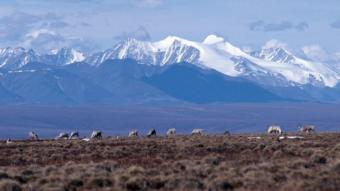
Arctic National Wildlife Refuge (U.S. Fish & Wildlife Service-Alaska)

The Biden administration announced Tuesday that it will formally reconsider the decision allowing oil lease sales across the northern coastal plain of the Arctic National Wildlife Refuge.

The announcement will likely further delay or limit oil development in the refuge. It calls for a new study that will be a “supplement” to the 2019 environmental impact statement conducted by the Trump administration. It is expected to take about a year and a half.
Following the study, the Bureau of Land Management will issue a new decision on leasing in the refuge, according to a notice to be published in Thursday’s Federal Register.

Among the new alternatives to be considered are “those that would: designate certain areas of the Coastal Plain as open or closed to leasing; permit less than 2,000 acres of surface development throughout the Coastal Plain; prohibit surface infrastructure in sensitive areas; and otherwise avoid or mitigate impacts from oil and gas activities,” the notice says.

Complicating the the legal picture is that, in the final days of the Trump administration, the government issued leases in the refuge. The Jan. 6 lease sale produced $14.4 million in bids, most from the state-owned Alaska Industrial Development and Export Authority.

LISTEN: Alaska research shows melting permafrost is affecting infrastructure faster than expected

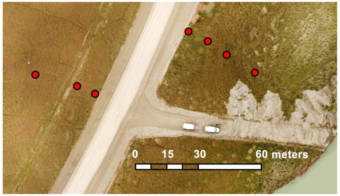
Drone photo of temperature logging sites on the Dalton Highway. (Soraya Kaiser)

New research from Alaska on how climate change affects things built on or in permafrost — like highways, buildings and underground pipes — shows this type of infrastructure will deteriorate faster than expected.

The study, published in May in the scientific journal the Cryosphere, involved a detailed analysis and computer modeling of data from a section of the Dalton Highway, the supply haul road to Alaska’s oil-rich North Slope.

The study’s authors included University of Alaska Fairbanks Geophysical Institute permafrost researcher Vladimir Romanovsky, who says the work will better inform engineers and planners in the future.

LISTEN:

Vladimir Romanovsky: You can apply this model for larger areas, for example, for the entire North Slope of Alaska, and describe the impact of roads, on permafrost, both the impact of roads, and also impact of changing climate. So that’s kind of a new thing that make this paper very different from typical engineering calculations for modeling for specific infrastructure.

Casey Grove: If there’s more warming or more effects from the warming than expected, should people be alarmed about things like the pipeline or other highways that might be degrading because of that?

Vladimir Romanovsky: Well, definitely they do. For a long time, it was the accepted opinion that permafrost on the North Slope of Alaska is cold and stable, and you shouldn’t worry about anything. So this paper shows that it’s not exactly true, even in our present climate, which is, of course, much warmer than it was 20 or 30 years ago when most of this engineering opinion was formed about the North Slope of Alaska.

This shows that even now, already, by now, the warming of climate is so substantial that even at some locations, the thawing of permafrost could start around the this highways.

Now, another example is the sewer and water pipes in the villages on the North Slope of Alaska along the coast. Again, engineers were under the impression that you can bury these pipelines in the ground, and permafrost will be still stable will be okay. But Point Lay right now — it’s a small village on the North Slope — they are experiencing huge problems. The problem is that because they followed the recommendations of engineers, and they just buried this pipes and now it’s a mess. It’s a huge problem for the village.

Casey Grove: Is one of the lessons from this, that you just can’t build that kind of infrastructure in permafrost areas, or that you just have to do it differently?

Vladimir Romanovsky: Yes, you have to do it differently. The roads — there’s still lots of research is going on right now. But there is still not kind of universal good recipe of how to build roads on permafrost without impacting it so much that you will have to spend lots of money to maintain the roads and good conditions.

For pipes it’s different. For places like Point Lay where permafrost is very, very ice-rich, it is impossible to expect that buried pipelines will continue to function properly. There is no way to do it. The solution that is used in Russia villages, and even in bigger cities on permafrost, build all pipes above the ground. Of course, it looks ugly. Of course, aesthetically it’s not great, but it is a solution.

And of course, you still have to spend some energy or some engineering measures to not to allow water to freeze. That’s another thing. So you have to do good thermal insulation. In general, there are some engineering solutions, but they may be prohibitively too expensive to use in many cases.

Dinosaurs likely lived in Arctic year-round, according to recent Alaska discovery

Researchers dig for dinosaur bones on a bluff on the Colville River (Photo courtesy of UAF)

The discovery of baby dinosaur bones on Alaska’s North Slope has paleontologists rethinking the animals’ lives and physiology.

University of Alaska Museum of the North director Pat Druckenmiller and colleagues from the University of Alaska Fairbanks and Florida State University made the discovery along the Colville River.

Druckenmiller said the area of eroding bluffs has yielded many dinosaur fossils over the last couple of decades. But these bones are different.

“Tiny little baby bones and teeth, not of adults and juveniles, but of actual very, very young animals that died either in the egg or just after they hatched,” he said.

The baby dino bones were found in sediments collected by University of Alaska Fairbanks and Florida State University scientists. They ranged from those of small bird like animals to giant Tyrannosaurus. Druckenmiller said the discovery of the baby dinosaur bones so far north indicates year-round residency.

“Dinosaurs likely had incubation periods upwards of five to six months for some species. And if that’s the case, a dinosaur laying its eggs in the spring would have been hatching them late in the summer,” he said.

If dinosaurs were migrating, they would have had very little time to move to lower latitudes with newborns, which suggests that the animals did not, in fact migrate.

“We think it’s more likely they actually managed and adapted to living in the Arctic conditions, year-round,” he said.

Given that the site where the bones were found was closer to the North Pole 70 million years ago, Druckenmiller said even in that era’s warmer climate, the dinosaurs endured pretty extreme conditions.

“Yes, it was cold. Yes, it was freezing conditions and probably snow. But at 80 to 85 degrees north you have to deal with three to four months of continual winter darkness. That’s the kind of world we don’t generally envision dinosaurs living in,” he said.

Druckenmiller said living in such relative cold is also telling about the dinosaurs’ physiology.

“If you lived up there year-round, you almost certainly had to have made your own body heat and probably maintain some elevated internal body temperatures,” he said. “And that, in a nutshell, is warm-bloodedness.”

Druckenmiller said that adds to evidence from other studies pointing to warm-blooded dinosaurs. Findings from the study are published in the journal Current Biology.

Alaska agency moves to spend $1.5 million on Arctic Refuge development, setting up clash with Biden administration

Congress opened the Arctic National Wildlife Refuge’s coastal plain to oil and gas leasing in 2017, but the fate of the area is uncertain as the Biden administration has announced a new legal analysis of the Trump administration’s environmental reviews. (Nat Herz/Alaska’s Energy Desk)

The Biden administration has suspended oil leases in the Arctic National Wildlife Refuge and aims to thwart drilling there, but an Alaska agency is still pushing ahead with its plans for development.

The state-owned Alaska Industrial Development and Export Authority, which won seven leases at a sale in the final days of the Trump administration, is proposing to spend $1.5 million on its development efforts.

The money would go toward studies, data collection and permitting needed in advance of what’s known as seismic exploration: using heavy equipment to map areas under the earth’s surface to see how much oil could be there.

AIDEA’s board will consider the staff proposal at its meeting next week.

If it’s approved, the agency aims to begin its seismic work in the refuge next year.

But the Biden administration opposes drilling in the refuge and has moved to block development there — and AIDEA’s move could put the two sides on track for a battle in court.

Earlier this month, the Interior Department suspended the oil and gas leases issued for the refuge by the Trump administration, and it placed a temporary ban on all federal activity related to a Trump-era development program. That includes acting on applications for activity like the seismic work that AIDEA wants to carry out.

The Biden administration says it’s now studying what it describes as legal errors in the Trump administration’s environmental reviews used to pave the way for leasing — and it says the leases could be reaffirmed, voided or subject to tighter environmental controls.

In a memo to board members, AIDEA’s executive director, Alan Weitzner, argued that the suspensions lacks a legal basis, adding that his agency still holds “valid and enforceable leases.”

He said AIDEA has already informed the Biden administration that it “will continue to assert our legal rights as authorized for the responsible development of the leases.”

Leaseholders generally enjoy stronger legal rights to conduct seismic work in the area under their control — so if the Biden administration were to reject an AIDEA application for such work based on the lease suspension, it could strengthen AIDEA’s case if it decides to sue the federal government.

Officials at both AIDEA and the Interior Department, which oversees the management of the refuge and the leasing program there, declined to comment.

One of the groups opposed to drilling in the refuge, the Northern Alaska Environmental Center, criticized AIDEA’s proposal to advance towards development.

“This resolution is a continuation of AIDEA’s commitment to throwing the state’s money at bad ideas — projects that will cause harm to people, our climate, and our state’s economy,” Emily Sullivan, the group’s Arctic program manager, said in a prepared statement. “By asking for approval, from themselves, to spend more money on work that is not permitted and is unlikely to ever occur is just another round of political posturing to prove an increasingly irrelevant point.”

With a haul of 11 whales this season, Point Hope gears up for Qaġruq festival

Guy Omnik stands with the baleen from Russell and Andrea Lane’s whale. (Photo courtesy of Guy Omnik for the Alaska Arctic Observatory and Knowledge Hub)

This weekend kicks off the Qaġruq Whaling Festival in Point Hope. Every year, people come from around the region for a three-day feast to celebrate the annual subsistence haul of the whaling season.

Rex Rock Sr. says he’s been whaling his whole life. The 60-year-old Point Hope captain says this year’s whaling season kicked off in early spring.

“Early April we went out,” Rock said. “The lead was further out this year.”

Rock explained the lead is the term for the crack in the sea ice that hunters follow to track the whales. He says this year’s lead was about seven miles outside town.

“We were able to get there,” Rock said. “I was happy that Russell and JJ Lane were able to land the first whale. They always say once you strike and land the first whale, everything else is going to fall into place.”

Point Hope whaling captains ended up landing 11 bowheads this year, a great year in Rock’s book.

With the hauling period over, Point Hope is preparing for the three-day Qaġruq Whaling Festival. Rock says over the first two days, captains will haul the whaling boats up and show off their crews flags before cutting up the whale for the large communal feast.

“First is what we call qalgi, the second day the avarriqirut, and then the third day we have an all-day cookout,” Rock said. “So we invite everybody to come up and sample all the food that we’ve been blessed with this spring.”

For many Inupiaq residents of Northwest Alaska, this year’s Qaġruq will be the first major community event since the COVID-19 pandemic began.

“I don’t think it feels much different,” Rock said. “Because we feel blessed when we go out to whale and provide for our community. Not only our community, but cousins in the outlying villages. Definitely we share the whale with everyone, everyone that wants a taste.”

Qaġruq begins on Sunday and will conclude Tuesday evening.


Murkowski confronts BLM nominee about ANWR

Tracy Stone-Manning at her Senate confirmation hearing. (Senate video screenshot)

President Biden’s nominee to head the Bureau of Land Management works at the National Wildlife Federation.

Sen. Lisa Murkowski was among several Republicans who took issue with that during Tracy Stone-Manning’s confirmation hearing this week. The BLM is required to make federal land available for multiple uses, including development. Murkowski questioned how that’s compatible with Stone-Manning’s career.

“You’re working for an organization that, for years, has worked to prevent the sale and transfer of national public lands to state and private owners,” Murkowski said at the hearing.

First, Murkowski confronted Stone-Manning over the reversal of a BLM land action from the final days of the Trump administration. The Trump administration issued orders freeing up BLM land in Alaska for state selection and possible mineral development. The Biden administration put those orders on pause.

Murkowski told Stone-Manning it would be up to her to end the pause and make those lands available to the state, to fulfill the land entitlement promised to Alaska at statehood.

“I look at this situation that you will have oversight of, and that causes me deep concern,” Murkowski said.

Stone-Manning was conciliatory.

“Senator, that’s fair,” the nominee said. “And if I had the honor to be confirmed, I understand that being the director of BLM is a very different job than the work I have done at the National Wildlife Federation.”

Stone-Manning said she’d follow the law. Murkowski did a quick pivot and reminded her what’s in the 2017 tax law. A section — added by Murkowski herself — requires the government to hold two auctions for drilling leases on the coast of the Arctic National Wildlife Refuge. The first was in January.

“If confirmed as BLM director, you will be the one responsible for holding the second lease sale by 2024, which is currently mandated by law,” Murkowski said.

Stone-Manning said an ongoing environmental lawsuit might influence what happens to the second lease sale, but she again committed to following the statute.

Murkowski told her of the legal mandate half a dozen more times. She read that section of the statute out loud.

“That’s the law. That’s the law,” Murkowski said. “And litigation is going on, but this is the law.”

The Bureau of Land Management manages 70 million acres in Alaska, plus the oil and mineral resources beneath other federal land.

The Senate Energy and Natural Resources Committee has not yet scheduled a vote on Stone-Manning’s confirmation.

Watch Stone-Manning’s full nomination hearing.

Site notifications
Update notification options
Subscribe to notifications