North Slope

Alaska’s US senators want to thwart Biden’s energy policies. Here’s what they’re trying.

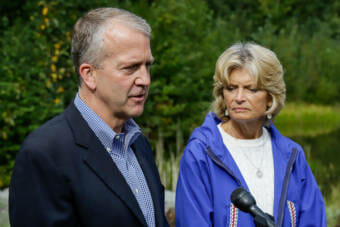
Sens. Dan Sullivan and Lisa Murkowski in August. (Jeff Chen/Alaska Public Media)

With President Biden issuing executive orders pausing oil and gas leases and permits, Alaska’s U.S. senators are seeing years of their accomplishments erased. They’re fighting back, but with Democrats in control of Congress, their tools are limited.

Here are some of the options they are using:

Option 1: Make the case in the media. Sen. Dan Sullivan argued against Biden’s low-carbon energy plan on Fox News last week, saying it kills jobs.

“We’re working hard to get the president to realize that he’s really damaging not just the economy but the American worker during a pandemic and a recession,” Sullivan said to Fox host Neil Cavuto. “Makes no sense.”

Option 2: Leverage the Senate confirmation process. Sullivan made the same case against the Biden energy plan at a confirmation hearing on Wednesday.

“Nobody has an answer!” Sullivan said while questioning Biden’s nominee for EPA administrator, Michael Regan. “It’s a strategy and a policy that makes no sense, which is why we want to go see the president.”

Regan said the policies are aimed at moving the country to carbon-free energy. In the short term, he said Alaska will benefit from Biden’s plan to invest in roads, electrical grids, and water and sewer infrastructure.

“I believe that many of the jobs and skill sets that people have in your state, and other states, can move quickly to those jobs,” Regan said.

Option 3: Aim for the Oval. Sullivan rallied 25 Republican senators, many from fossil-fuel production states, to sign a letter seeking a meeting with Biden. At Regan’s confirmation hearing, Sullivan said it hasn’t yielded results.

“The White House press secretary said, ‘Sorry, the president isn’t interested in meeting with one-quarter of the Senate on the issue of jobs and energy,’” Sullivan groused. “I hope he changes his mind, and if you get confirmed maybe you can convince (him) to talk about this really important issue.”

Option 4: Protest vote: Sullivan has so far voted against one of Biden’s cabinet nominees — Treasury Sec. Janet Yellen. He said the vote was a response to Biden energy policy.

Sen. Lisa Murkowski says she also uses the confirmation process to make her case to nominees. When a nominee makes the rounds to interview privately with each senator Murkowski says it’s a great time to educate them about Alaska’s special circumstances.

“I think what has rattled most of us is the breadth to which these executive orders and secretarial orders apply,” Murkowski said. “The first week with a secretarial order coming out that there is a pause on permits on oil and gas and federal lands. So we were hearing from every operator up in the NPR-A saying ‘what does this mean to us?’”

At least one operator was immediately affected. An Australian-based company called 88 Energy was waiting for permits to drill in the National Petroleum Reserve Alaska when the Biden Interior Department issued a 60-day pause.

Option 5: Hit the phones: Murkowski said the delegation leapt into action to get a faster permit review. She said they can’t assume the new officials know that Alaska’s North Slope drilling season ends in April.

“If you have permits that are on a 60-day pause in New Mexico or Louisiana, 60 days can come and go and you’re not going to lose your season,” she said. “In Alaska, 60 days come and go and you have lost a full season.”

Murkowski says she contacted the acting Interior secretary, among others.

The permits were issued a few days later. The senators might count that as a success, but Murkowski says she hopes they don’t have to battle the administration permit by permit.

Judge denies requests to halt work at Conoco’s Willow project

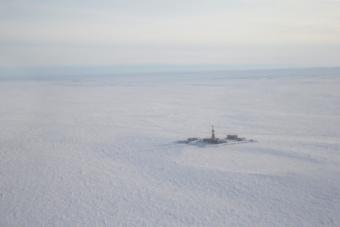
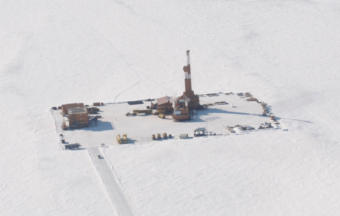
An aerial view of one of the exploration pads and wells that ConocoPhillips drilled during the 2018 exploration season at its Willow prospect. (Judy Patrick Photography / ConocoPhillips Alaska)

A federal judge has denied requests by conservation groups that she block ConocoPhillips from starting construction work this winter on its massive oil discovery, called Willow.

Sovereign Iñupiat for a Living Arctic, the Center for Biological Diversity and about a half-dozen other groups sued the Trump administration in late 2020, arguing it violated environmental laws when it approved the Willow project in the National Petroleum Reserve-Alaska on the western North Slope.

The groups also asked U.S. District Court Judge Sharon Gleason to block Conoco from starting construction on Willow this winter until the lawsuits are resolved.

Gleason denied those requests on Monday.

In a 28-page order, her reasons for the denial included that the groups, she said, didn’t demonstrate that polar bears would likely suffer “irreparable injury” if the construction work was allowed while she considered the lawsuits.

The conservation groups have appealed Gleason’s decision, and the broader lawsuits will also continue.

“We are hopeful that the court will put us back on the right path and stop the Trump administration’s last-minute effort to allow work on this environmentally reckless project to begin,” said a statement Friday from Earthjustice attorney Jeremy Lieb.

Meanwhile, Conoco said this week that it will begin laying gravel for the Willow project soon.

According to court documents, the company’s work this winter includes the construction of gravel and ice roads, as well as the opening of a gravel mine.

The company will have about 120 employees working on the projects, said Rebecca Boys, a company spokeswoman.

Conoco has said it expects oil production to start around 2026.

Willow would be the North Slope’s westernmost oil field, and Conoco said it could produce more than 100,000 barrels of oil a day at its peak.

Biden suspends new leases for oil and gas development on federal lands, including in Alaska

BLM_NPRA
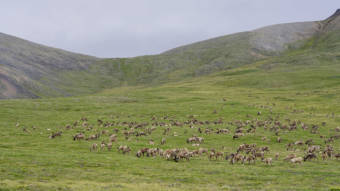
National Petroleum Reserve in Alaska. (Photo by Bob Wick, image courtesy Bureau of Land Management)

President Joe Biden hit pause Wednesday on any new leases for oil and gas development on federal lands, drawing cheers from conservation groups and criticism from the fossil fuel industry.

“We’re going to review and reset the oil and gas leasing program,” Biden said, before signing a series of executive orders aimed at combating climate change.

A piece of one order directs the Interior Department to suspend new leasing until the review is completed.

The order doesn’t prohibit work on existing oil and gas leases. Because of that, it shouldn’t have an immediate impact on oil operations in Alaska, according to Andy Mack, a former natural resources commissioner for the state.

“Alaskans should take a deep breath because there are already a tremendous number of acres under lease in the most prospective area on federal land, which is the National Petroleum Reserve,” he said.

The reserve, on the western North Slope, is home to some of the state’s biggest, planned oil projects — including ConocoPhillips’ Willow prospect. A Conoco spokeswoman said the company has the required permits for its work in the reserve this winter.

But Kara Moriarty, head of the Alaska Oil and Gas Association, said she’s concerned about the impact of Biden’s order beyond this winter.

There’s no set time limit for the Interior’s review, according to a department spokesman.

“So,” Moriarty said, “you don’t know how long that ban on leasing is going to be.”

Moriarty also expects the suspension to be the first step in sweeping changes under Biden.

“I think it’s fair to say that our leasing and permitting program on federal lands is going to change. We just don’t know how, and we just don’t know when,” she said. “So that’s just a recipe for the most extreme uncertainty that I could think of.”

While the majority of Alaska’s oil production currently comes from state lands, Moriarty said, “the future is in federal lands.”

Biden’s order to suspend leasing indefinitely follows a 60-day pause on new drilling permits and leases on federal land, unless approved by top Interior officials.

On his first day in office, the president also imposed a temporary moratorium on oil and gas leasing activities in the Arctic National Wildlife Refuge.

Conservation groups have applauded Biden’s orders, saying they’re major steps in the right direction, and a sharp shift from the policies of the Trump administration.

“We’re going to need a bunch more work in the years ahead to correct a lot of the damage that President Trump did in the past four years,” said Andy Moderow, state director for the Alaska Wilderness League.

“But I think we’re on a good strong course,” he said. “And we’re grateful for Biden’s leadership.”

Voice of the Arctic Inupiat, an advocacy group of Inupiat leadership organizations across the North Slope, doesn’t agree.

In a statement, the group said Biden’s orders halting leasing in the reserve and work in the Arctic refuge will have a significant impact on the region’s economy and jobs.

“We’re not climate change deniers. We have lived in the Arctic for thousands of years and have witnessed first-hand its effects on coastal erosion, melting sea ice and subsistence resources. We’ve worked hard to balance the health of our environment and culture with the survival of our people and communities, and we’ll continue to do so,” North Slope Borough Mayor Harry Brower said in a statement from the group.

“Shutting down the industry that supports virtually everything in our region – especially as we struggle with the effects of a global pandemic – will have very real, negative consequences for the indigenous people, and all residents, of the North Slope,” Brower said.

Lamenting Biden’s moves to ‘target’ oil and gas, Sullivan votes no on Yellen confirmation

Sen. Dan Sullivan at a Commerce Committee hearing Tuesday. (Still from U.S. Senate video)

U.S. Sen. Dan Sullivan says the Biden administration shouldn’t discriminate against oil and gas, and he’s asserted to cabinet nominees that all energy sectors matter.

Sullivan called it “shocking” that Janet Yellen, now the Treasury secretary, would not commit to an “all of the above” energy policy that includes oil and gas when the two spoke before her confirmation.

Sullivan was among only 15 senators to vote against confirming on Monday. He acknowledged the former Federal Reserve chair is more than qualified, and he said he voted against her reluctantly.

“What I’m starting to see with the new administration, unfortunately — and … hopefully they’re not going to go down this path —  is executive actions that are going to target certain sectors of the energy sector of the U.S. economy,” he said on the Senate floor, in a tone of astonishment.

President Biden has made it clear he fully intends to discriminate against oil and gas, as well as coal, because those fuels produce greenhouse gas emissions. Biden pledged during his campaign to put the country on a path to a carbon-free economy by 2050.

Sullivan did not mention the administration’s climate goals when he spoke of Yellen as weak on energy for her refusal to embrace all forms of energy.

“We’ve gotten to the point where I can’t find anyone — and I hope I’m wrong — in the Biden administration cabinet who’s going to be a proponent of a strong energy sector,” he said. “Who is it?”

Sullivan raised a similar argument when questioning Biden’s nominee for Commerce secretary, Gina Raimondo, at a hearing Tuesday. He asked if Raimondo would champion an energy policy that includes oil and gas, for the sake of jobs.

Raimondo said, as head of the department that includes the National Oceanic and Atmospheric Administration, “should I be confirmed, I will have the opportunity to help create thousands of jobs with offshore wind, in particular.”

That wasn’t the answer Sullivan wanted.

“There shouldn’t be discrimination against good paying jobs. And I’m starting to feel that there is,” he said. “And we shouldn’t have that in our country.”

Biden promised during his campaign to curtail new oil and gas development on federal lands. On his first day in office, he ordered a temporary government halt on oil leasing in the Arctic National Wildlife Refuge.

He’s expected to soon launch new efforts to reduce federal oil and gas auctions and a plan to help displaced coal workers.

Gov. Dunleavy says he’s open to working with President Biden but will oppose blocking development

Gov. Mike Dunleavy speaks about his budget proposal, which would begin next July, during a news conference on Dec. 11, 2020. (Screen capture of video stream from the governor's office)
Gov. Mike Dunleavy speaks about his budget proposal, which would begin next July, during a news conference on Dec. 11, 2020. On Wednesday, Dunleavy said in an interview that he is open to working with new President Joe Biden, but that he would use “whatever tools are necessary” to oppose the new administration if Biden consistently opposes developing Alaska’s resources.  (Screen capture of a video stream from the governor’s office)

Shortly after Joe Biden was sworn in as the nation’s 46th president, Alaska Gov. Mike Dunleavy said in an interview that he’s open to working with the new president. But he also said he’s prepared to oppose the new administration if it seeks to block developing Alaska’s natural resources. 

That was one of the first things President Biden did on Wednesday when he announced he’d put a “temporary moratorium” on all oil and gas leasing activities in the Arctic National Wildlife Refuge immediately after taking office.

“I’ll work with anyone to come up with things we can agree on, and where there are some issues that I believe are harmful to the state of Alaska, I’ll oppose the administration,” Dunleavy said. “If I think they’re going to hurt opportunities in the state of Alaska for jobs, opportunities to keep our kids and grandkids here, opportunities for wealth, I’ll oppose them.”

Dunleavy said that he plans to have a dialog with Biden administration officials, but if he sees a consistent pattern of opposition, the governor will “use whatever tools are necessary” to fight back.  

“Alaska’s viewed very differently by the rest of this country,” he said. “And they don’t necessarily see this as a sovereign state. But they see it as a vision of a larger park. In 1959, that was not the vision.”

And Dunleavy says that’s not his vision for the state, either.

Regarding the Alaska legislative session that convened this week, he said his top priorities are to:

  • settle how permanent fund dividends are set;
  • pass constitutional amendments that would limit state spending and require public approval for tax increases; and
  • pass a bond package to fund capital projects. 

Dunleavy is proposing an amendment to the Alaska Constitution that would put protect an annual draw from the Alaska Permanent Fund, and set dividends at a certain share of the draw. Both the exact amount of the draw and the share that would go to dividends would be set in state law. 

He said he only wants to make a bigger-than-planned draw from the permanent fund’s earnings reserve account one time. 

“I don’t have any intention of drawing down the ERA,” he said. “As a matter of fact, if you look at the permanent fund approach that we’re taking, it would, again, settle the question with the input of the people. And it protects the earnings reserve within the fund. So, this is a one-time event from my perspective.”

Dunleavy acknowledged that once the changes to the PFD are in place, the state would have fewer options to balance the budget. 

“Yes, it hems us in, but it gives us certainty and it gives us an opportunity if there’s going to be any changes, for example, with taxation, that the people of Alaska are part of that equation,” he said. “So … starting out with the PFD, I think allows us to have discussions on a whole host of other issues with regard to the fiscal approach.” 

He pushed back against the idea that voters would reject any new or increased taxes, in defending his proposal to require that the public vote on taxes.

“If it’s explained in the manner that the people of Alaska understand, that a certain revenue measure would help pay for this service or this program, etc., etc., I think the case can be made,” he said. “And I would be confident that the people of Alaska — again if it’s explained well, would concur with that.”

Dunleavy added that he’s “inherently suspicious,” of adding revenue, pointing to a history of the state spending money when it’s available.

Finally, Dunleavy praised Alaska’s vaccination team for leading the country in vaccinating residents so far.

He hasn’t received his first shot.

“I am going to wait my turn and that’ll be determined by our health team,” he said, adding that he wants the most vulnerable Alaskans to be vaccinated first. 

Feds arrest 2 after seizing Fentanyl headed to Utqiagvik

“M30” Fentanyl pills similar to the batch recovered by authorities in Anchorage. (Photo courtesy of Drug Enforcement Agency)

Two Utqiagvik residents are in custody after officials say they intercepted fentanyl the two intended to sell.

According to a charging document, federal postal inspectors in Anchorage flagged a package sent from Arizona to 30-year-old Roberta Sielak of Utqiagvik. Inspectors opened the package and found 2.4 ounces of blue “M30” pills that contained fentanyl, the charges say. The pills were hidden in a vacuum-sealed bag and placed inside the motor housing of an Oster blender, which was in its original packaging, according to the charges.

Inspectors removed the pills and placed a tracking device in the package and sent it on to Utqiagvik, along with several federal and state agents, the charges say.

Officials say Sielak picked up the package from the Utqiagvik post office on Friday and brought it to 41-year-old Bryon McFadden. McFadden opened the package and, upon hearing the tracking device go off, fled his residence. North Slope police apprehended McFadden and questioned him. He stated he expected the package to contain marijuana, the charges say.

Officials searched McFadden’s home and found multiple Oster fan boxes, a white powder believed to be cocaine and an AR-15 style rifle.

Both Sielak and McFadden were in custody Tuesday and charged with a federal count of attempted possession of Fentanyl with intent to distribute.

Site notifications
Update notification options
Subscribe to notifications